



Zelená brána Gate
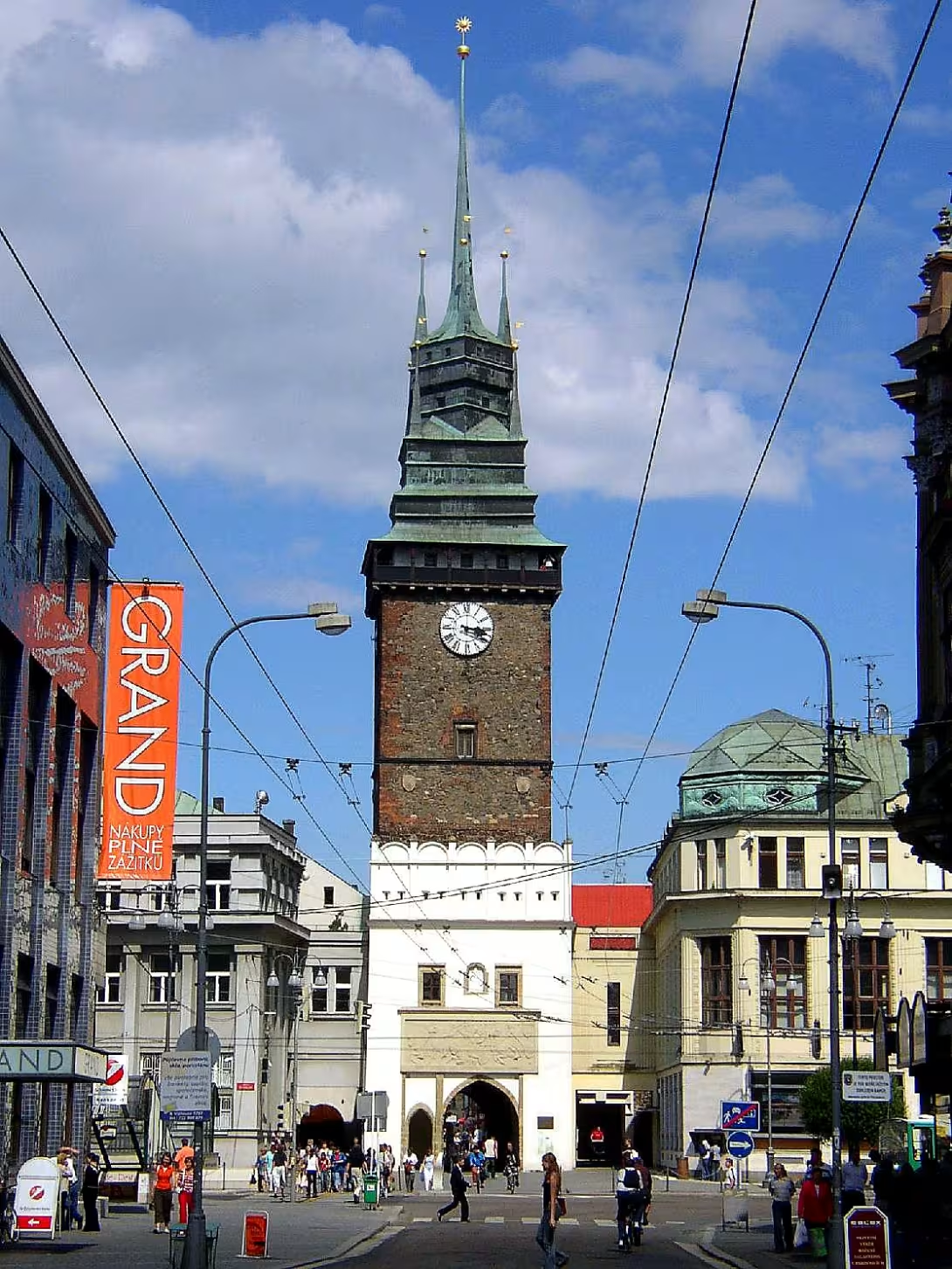
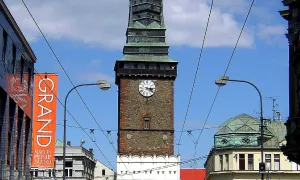
Zelená brána stands as an entrance to Pardubice City Heritage Reserve and creates the beginning and conclusion of a marked tour route called the Viléma Path from Pernštejn. Although we see it as one whole, in fact, it is two interconnected structures - Renaissance overtaking and own gate with tower.
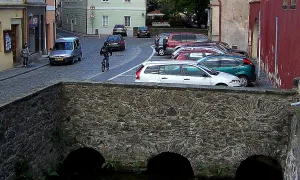
The original gate at this place was probably established in the decade 1330-1340, when Arnošt ze Staré and his son Arnošt z Pardubic founded and fortified the "new city." The gate was significantly strengthened in 1507 by Wilhelm of Pernštejn, who had the city surrounded by walls with moat. The construction was realized by mistr Paul. On the west side there was a new ground-floor foothold decorated with Gothic stucco. The lightness of the arches was 4.2 metres, the depth of the pre-grab was 11.3 metres. In front of him, there was a wall moat with two drawbridges and a footbridge. Through the City River he led a wooden bicycle bridge with a foothold. The mighty barbadian allowed a side-shot of a possible assailant. The tower was four-sided and apparently used an older wall from the 14th century. At the base, it was 9 times 7.5 meters, the passage was 3.8 meters tall and just as wide.
The decisive transformation was brought about by a cadastral event in 1538, when a major city fire broke out. Jan z Pernštejna had a large Renaissance reconstruction carried out. The builder Jiřík Olomoucký edited the opening - increased it by one floor and decorated the Renaissance shield with high atics, presses and arches. On the first floor there were two little lights where Master Jiřík himself lived. At the same time, the tower was built in its present form - 59 metres high with a gold poppy and a ten-pointed star on top. It is decorated with a late Gothic roof with three floors of roofs, prisms with eight needle towers and a high stretch of middle point. Since 1547, the tower has been named Zelená brána; formerly known as the Prague Gate.
Through centuries the construction was often repaired and changed according to the needs of the time. In 1760 clock was installed on the tower from Town Hall II, which stood on the corner of the square. In the same 18th century Loss Prussian occupation (1741, 1744), the Prussians took the copper roof and damaged the beam. In 1843, a wooden tower under the roof was brought down and the wall of the tower was plastered. The important restaurant took place only in 1912, when the wooden gallery under the roof was restored and the wall of the tower chest was exposed. At that time light dials were also installed on the clock. The copper cover was completely replaced in 1980.
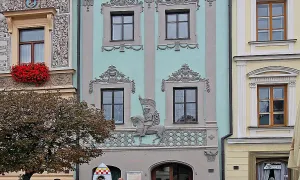
On the forefront of the forefront visitors can see the 1903 relief made by Mikolas Alš. It shows the coat of arms of the Pardubice masters whose coat of arms became a city emblem. The tower is accessible to the public and offers a view not only of the historical core of Pardubice, but also of the remote surroundings.
Then and now
Drag the slider to compare how the landmark may have looked when it was built with the view today.
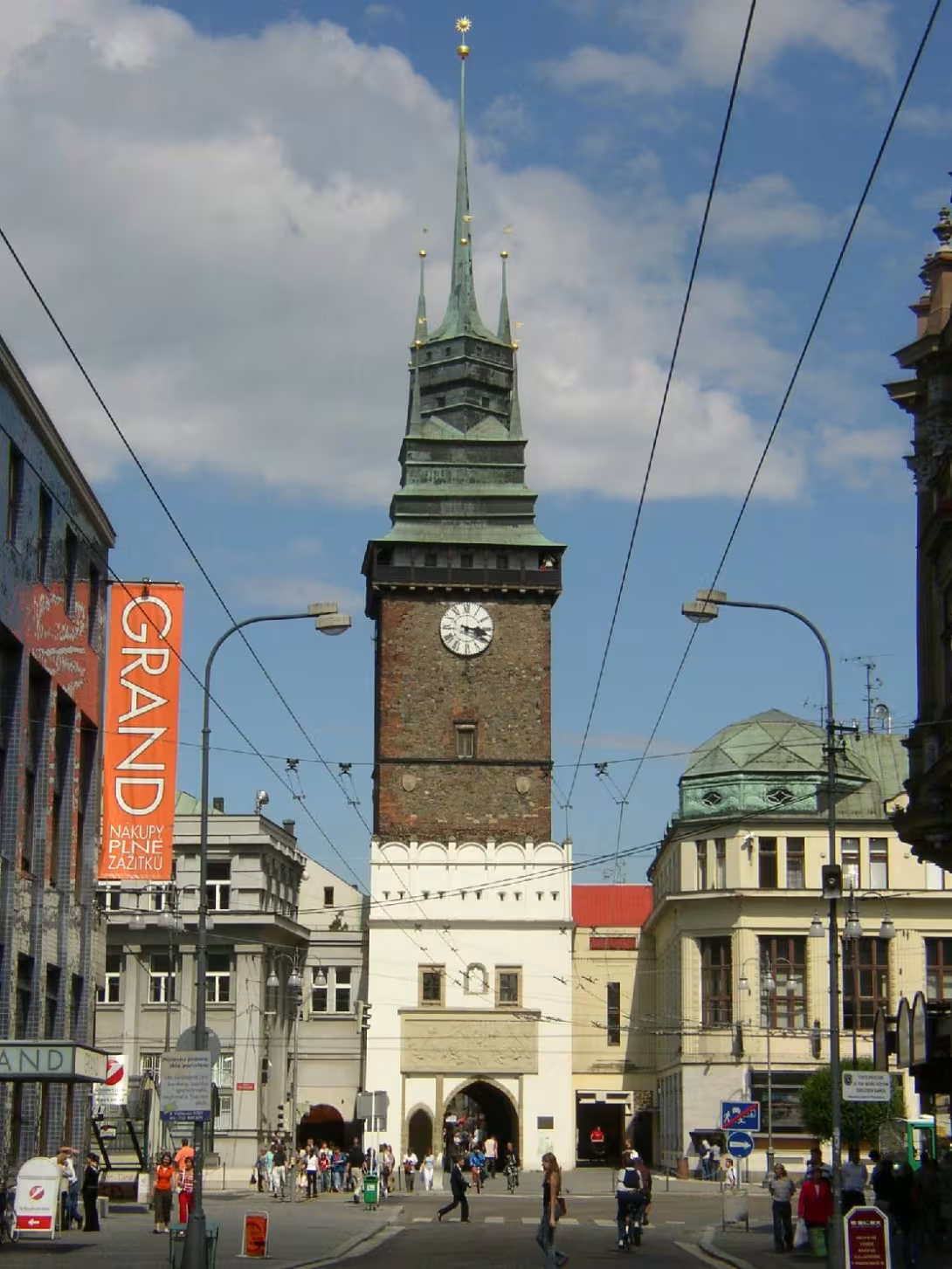

The historical appearance on the left is an AI-generated visualisation and serves as inspiration only.
Historical milestones
- 1330-1340
- The foundation and fortification of the city of Pardubice, the creation of the original gate.
- 1507
- Construction of new fortifications and fortifications of the city by Wilhelm of Pernštejn.
- 1538
- The city fire and the subsequent Renaissance rebuilding of the tower and the vanguard.
- 1547
- First mention of the name Zelená brána.
Architectural development
The original gate was created in the 14th century as part of the city fortification, and later in 1507 it was extended by a Gothic foothold with a moat and a drawbridge. After the fire of 1538, the tower was rebuilt in Renaissance style and the tower reached today's height of 59 meters. The roof of the tower is late-gothic with the headquarter towers, while the vanguard has acquired a Renaissance shield. In the 19th century the masonry was plastered and in the 20th century the original appearance was restored.
Historical events
- 1330-1340
- The foundation and fortification of the city of Pardubice by Arnoštem of Old and Arnoštem of Pardubice, the creation of the original gate.
- 1507
- Vilém z Pernštejna let the city round the walls and build a new foothold with a moat and a drawbridge.
- 1538
- A city fire, a subsequent Renaissance rebuilding of the vanguard and the Jan Tower from Pernštejn.
- 1547
- First mention of the name Zelená brána (previously Prague Gate).
Points of interest
- Zelená brána serves as an entrance to the Pardubice City Monument Reserve and is the beginning and end of the guided tour * The trail of Wilhelm from Pernštejna *.
- The original gate at this place was created probably in 1330-1340 when the "new city" was founded and fortified.
- In 1507, Vilém z Pernštejna had the city surrounded by walls with a moat and built a Renaissance foothold with a Gothic stucco that had a light arches of 4.2 meters and a depth of 11.3 meters.
- After a big fire in 1538, Jan z Pernštejna carried out a large Renaissance reconstruction, where the tower was built up to today's height of 59 meters with a poppy and ten-pointed star on top.
- On the forefront of the forefront there is a relief from 1903 according to the design of Mikolas Alš depicting the coat of arms of the masters of Pardubice, which became a city emblem.
Guide
This guide is narrated by a synthetic voice generated by artificial intelligence.
Show guide text
This text was created by artificial intelligence and has not been editorially reviewed. It may contain inaccuracies.
The Green Gate is a characteristic landmark of Pardubice. It appears as one structure, but in reality it consists of two buildings one behind the other: a Renaissance gatehouse and the actual gate with a tower that is fifty-nine meters high. It is the only remaining part of the city fortifications from the early sixteenth century and at the same time one of the entrances to the city heritage reserve. A marked tour route called the Vilém z Pernštejna Trail begins and ends here.
The gate probably stood here already in the years thirteen thirty to thirteen forty, when Arnošt ze Staré and his son Arnošt z Pardubic founded and fortified the new city. In fifteen oh seven, Vilém z Pernštejna had the city surrounded with ramparts and a moat. The construction was led by master Paul. On the western side a ground floor gatehouse was created, decorated with Gothic stucco. Two drawbridges and a pedestrian walkway led across the moat in front of it, and then a wooden bridge across the Městská River. At an angle to the gatehouse stood a massive barbican, from where an attacker could be shot at from the side. How the tower itself looked at that time, we do not know. It was four-sided and probably made use of the lower part of an older gate from the fourteenth century.
In fifteen thirty-eight the city burned down and Jan z Pernštejna had it rebuilt in the Renaissance style. His builder Jiřík Olomoucký raised the gatehouse by one story and decorated it with a Renaissance gable with a tall attic. Two small rooms were created on the first floor, where master Jiřík himself lived for some time. The tower also received its present height then. At the top it bears a golden poppy finial and a ten-pointed star and it is adorned with a late Gothic roof with three levels of small roofs, eight needle spires and a tall central spire. It has been called the Green Gate since fifteen forty-seven; previously it was known as the Prague Gate.
When the bell tower of the Church of Saint Bartholomew burned down in sixteen fifty-three, the bells were moved here. In sixteen sixty-one, however, lightning struck the tower, which people took as a bad omen, and the bells were moved back. During the Prussian occupation in seventeen forty-one and seventeen forty-four, soldiers removed the copper roof. The tower received a clock in seventeen sixty; in eighteen eighty-six these were replaced with new ones and in nineteen twelve illuminated clock faces were added. In eighteen forty-three the wooden gallery under the roof was removed and the masonry was rendered. During restoration in nineteen twelve the gallery returned and the masonry was exposed again.
On the front of the gatehouse, since nineteen oh three, there has been a relief according to a design by Mikoláš Alš. It depicts the heraldic legend of the lords of Pardubice, whose coat of arms today serves as the city symbol.
Tips for visitors
The best time to visit the Green Gate is in the morning when there are fewer tourists and you can view the tower in peace as well. If you prefer pleasant weather, a visit in spring or autumn is recommended when it is not too hot or too cold. The tower is open to the public, so schedule a visit so you can see the inside of the tower.
Parking near the Green Gate can be found in public parking lots in the centre of Pardubice. It is recommended to use public transport as the city centre is well accessible by buses and trams. The location is also easily accessible by car, but in the city centre restrictions apply to vehicles. The current connection and parking options can be found in the transport information system or on the official city website.
When visiting the Green Gate, wear comfortable shoes because the tower is high and requires several sets of stairs. The tower is not air-conditioned, so bring light clothes and possibly an umbrella if the weather forecast indicates rain rainfall. If you are planning to photograph, remember to take enough memory or external storage because the tower has a beautiful view of the whole city.
The best places for photography are from inside the tower where there is an interesting view of the historical centre of Pardubice. It is advisable to photograph in the morning or afternoon light when the light is softer and less contrast. From the outside there is also a beautiful view of the gate from Vilém Square, located in close proximity. Also remember to get a photo from the local Elbe River, which flows directly at the gate.
There are several interesting places around the Green Gate worth visiting. The city conservation Pardubice includes the historical core of the city with many other monuments, such as the Town Hall or the Church of the Assumption of the Virgin Mary. These locations are easily accessible by foot from the gate. It is also interesting for families with children to visit Vilém Square, where cultural events often take place and children can see historical statues and fountains.
For families with children, a visit to the Green Gate is very interesting because children can explore the historical tower and learn about the history of the city. The tower offers interesting information about city fortifications and what the city looked like in the past. Children can also view the view from the tower and find out how the city was developing. It is recommended to visit the gate at a time when inspections are opened so that children can actively participate in the interpretation.
Frequently asked questions
Can the monument be visited?
Yes. We verified the opening hours or admission on the official website (1. 10. 2026); you will find them in the visitor information on this page. Please double-check with the operator before you travel.
What are the opening hours and admission?
Details verified on the official website (1. 10. 2026) are listed in the visitor information on this page. Official website: https://www.zelenabrana.eu
Where is the monument?
Location: Zelenobranská 76, Pardubice-Staré Město, Pardubice, Pardubický kraj. The map on this page shows the exact spot.
Why is the monument protected?
It is listed in the Central List of Cultural Monuments of the Czech Republic as a cultural monument (register no. 30122/6-1940). It is protected as part of a larger listed ensemble.
For kids
Imagine going back to the past, until Pardubice was a royal city. The city was surrounded by a wall and a gate that was a symbol of power and defense.
How did it look here? Who lived here? What happened here? The city was full of lives, merchants, craftsmen and royal officials. People lived here in peace and harmony with nature. The gate was the gateway to the city where important events took place and where people received guests.
Businesses nearby
Do you run a restaurant, accommodation, shop, museum, rental, wellness or other visitor service near this monument? Show yourself directly to the people heading to it — this is how they will see you in the app and on the web:
Events nearby
Zdroj akcí: otevřená data měst a obcí ČR (Národní katalog otevřených dat) a kalendář akcí Národního památkového ústavu.
Nearby
- It includes the historical heart of the city with other monuments such as the Town Hall, the Church of the Assumption of the Virgin Mary or Vilem Square.
- Natural water flow flowing through the historical center of Pardubice.
- A Gothic church from the 13th century, a significant dominant city.
- Historicist square with city hall and other historical buildings.
Accommodation nearby
Themed route
Thematic cruise route: Zelená brána and historical core Pardubice
1.Zelená brána * Type: * Gothic city gate from 13th century. * Why visit? * The only preserved gate of the original Pardubice fortification, symbolizing the entrance to the historical centre. It is exactly where the City River flows, which gives the place a picturesque atmosphere.
2. City River (Elbe) * Type: * Water flow with historical significance. * Why visit? * In addition to aesthetic impression, it offers the possibility of short walks along the shore, where it is intertwined with the City Heritage Reserve. In the past, it served as a defensive moat and still affects the urban structure.
3. Church of the Assumption of the Virgin Mary * Type: * Baroque parish church from the 18th century. * Why visit? * Dominanta Vilém Square, whose interior with rich decoration and organ is one of the vertices of Pardubice's sacral architecture. Located in the heart of the monument reservation, just minutes from the Green Gate.
4. William's Square * Type: * Historical Market with Renaissance Town Hall. * Why visit? * Centre of Pardubice social life, where gothic, Renaissance and Baroque elements are mixed. Town Hall with tower and neighboring church form an iconic group that cannot be omitted during the tour of the city.
5. City Hall Pardubice * Type: * Renaissance building from the 16th century. Why visit? One of the oldest Renaissance councils in Bohemia, whose facade and interior with historical halls reflect the rich history of the city. It is located directly on Vilém Square, in the immediate vicinity of other sights of the route.
Seasonal recommendations
Spring Zelená brána in Pardubice wakes up in the spring into a new life, when its stone arches are projected into a soft light breaking through the sun of spring clouds. The surrounding area of the gate, lined with old lime and young bushes, is dressed in green and yellow shades, while the lukewarm wind brings the smell of wet earth and blooming trees. The atmosphere is quiet, almost mysterious - as if the monument was waiting for visitors to stop to enjoy the silence between historical walls and the smear of leaves. Practically, it is best to visit the gate in March or April, when the crowds are not many and the light is so pleasant that the photos fall without crowded compositions. Comfortable footwear is recommended because after rainy days the roads around the gate can be muddy. The best time is the afternoon when the sun reaches an angle that highlights the details of the stone, but before the evening cold.
Summer In the summer months, Zelená brána will turn into a live scenario where its shadows dance on the wall in the rhythm of the sun's rays and the air is saturated with the scent of dry grass and warm stone. The surrounding area is full of life - children are played on the surrounding baits, tourists stop under the shadow of the lip and sometimes the sound of footsteps after the old paving cubes is heard. The best time to visit is early in the morning, before the parking lot is emptied and the queues start forming at other sights in the centre. In the main summer season (July-August) is recommended light but covering clothing - the sun in Pardubice can be sudden, and shadows under the gate are not always sufficient. Hydration is key, so take a bottle of water. In the evening, when the sun sets behind the roofs of Old Town, the gate is dressed in golden light, an ideal moment for romantic photography.
Autumn Autumn brings to the surroundings Green gates with a rich palette of red, orange and brown shades that are reflected in stone arches and create contrast to the darkening sky. The air is fresh, but already with a hint of cold, and leaves that roll along the roads give the place the impression of temporary. The atmosphere is calm, almost nostalgic - as if a monument to the past, when this gate guarded the city in other times. The best season is September, when temperatures still allow pleasant walks, but crowds are minimal. It is recommended to warm but not too heavy clothes because the weather can change quickly. The best time is the afternoon when the sun reaches an angle that highlights the texture of the stone and the shadows extend, which gives photographs a dramatic effect. In November, in advent time, a quiet pre-Christmas mood spreads around the gate, but without disturbing markets.
Winter Winter Zelená brána acts as carved into the ice screen - its stone arches are lost in the fog or shined under thin ice, which is formed at the edges. The surrounding area is covered with a white carpet that dampens sounds and gives the place a fabulous atmosphere, while the sun, when it appears, reveals traces of snow on historical walls. In winter the gate is often abandoned, which allows you to explore its details without rush. Practically, it is best to visit it in December when the opening times of the monuments are shorter and the light is so intense that even short walks are magical. Hot, laminated clothing, waterproof shoes and gloves are recommended because temperatures can fall below freezing. The best time is the afternoon when the sun reaches an angle that creates long shadows and the gate acts as part of the winter landscape image. In the evening, when the setting sun reflects off the snow, the monument turns into a picturesque scenery worth capturing.
Visualizations and artistic views


The visualisations are generated by artificial intelligence and serve as inspiration.
Photos from the area
Real photos taken near the monument


Zdroj a licence jsou uvedeny u každého snímku.
Atmosphere of the place
This atmospheric visualisation of the place and period was generated by artificial intelligence. It is not real footage of the location.
Tips from visitors
No tips yet. Be the first!
Log in and add your tip.
Sources and literature
Photos: neuveden / CC BY-SA 3.0 — Wikimedia Commons. The author and licence also appear when you hover over the image.
Faktickým podkladem tohoto textu byl článek na Wikipedii, jehož autory jsou přispěvatelé Wikipedie. Článek je dostupný pod licencí CC BY-SA 4.0.
Location on the map

Příběhy a pověsti
Legendy, pověsti a příběhy spjaté s touto památkou

Fotografie návštěvníků
Zatím žádné fotografie. Buďte první, kdo přidá fotografii z návštěvy!
Log in a přidejte svou fotografii nebo hodnoťte.
Za ověřenou návštěvu v aplikaci získáte víc bodů — poznáme podle GPS, že jste na místě.
Reviews and comments