



železniční most Milevsko - Staňkov Railway bridge
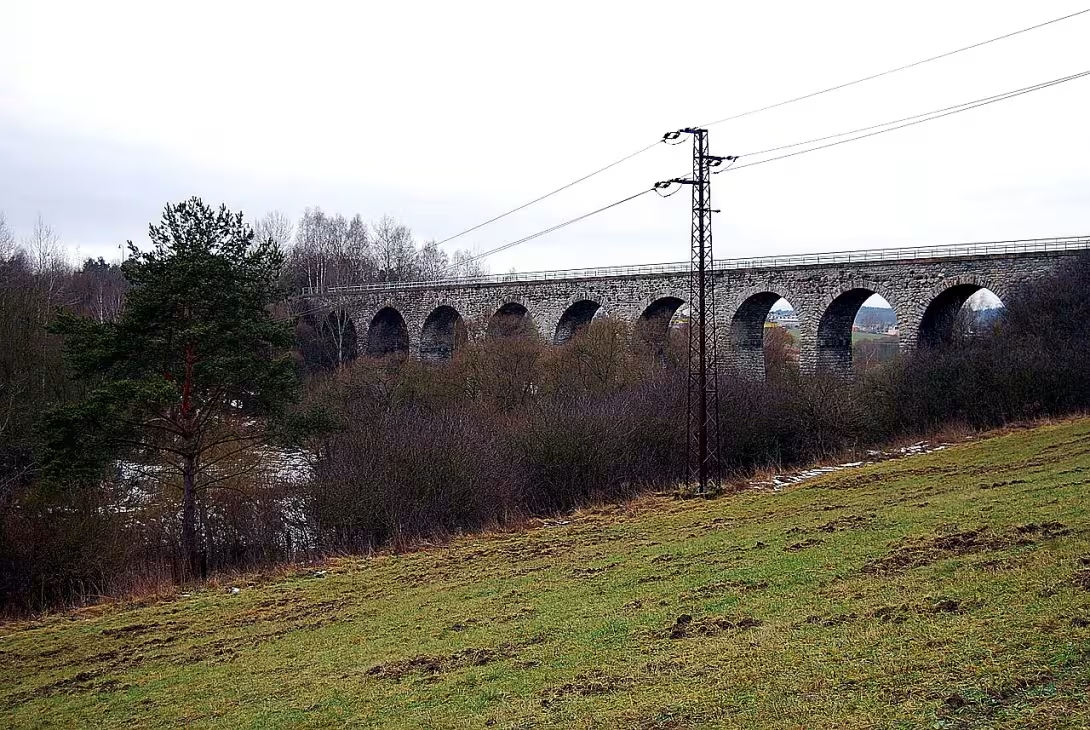
The railway viaduct through the Milevska stream between Milevska and the Staňkov Economic Court is a nine-arc stone bridge in a historic style. It is located on the cadastral territory of the municipality Sepekov and the town of Milevsko in the district of Písek. This technical monument from 1889 excels with robust construction and was registered in 1988 in the Central List of Cultural Monuments of the Czech Republic.
This bridge is located in km 26.018 of the railway line Tábor- Ražice. At the end of the nineteenth century, the turbulent development of the railway network connecting industrial centres and smaller regions took place in Czech countries. The construction of demanding technical works such as viaducts and tunnels required modern engineering techniques and often foreign labour. Specialised Italian workers were also involved in the construction of this viaduct. The railway line was launched on 21 November 1889.
The Viaduct is built of large roughly carved quarry stones on lime mortar, outside paired concrete. The whole building is unveiled. Pillars have a rectangular plan, they are narrowing upwards and there are five crackers on the inside of the vaults, which at the time of construction carried the cladding. Six arcs have a span of twelve meters and three arcs are ten meters. The Milevsky stream flows below the third arch from north to south and the slopes around the viaduct are unloaded with irregular paving. In the middle of each vault is fitted a drain pipe exceeding the face of the masonry. The crown is carried at the top of the parapet plate with a width of sixty centimeters and a height of thirty-three centimeters in which the steel rail is anchored. The extreme pillars are lower due to the relief of the terrain. The total length of the bridge is 121,80 metres, the total length of the viaduct is 140,15 metres, the crown is 4,85 metres wide and the height is 20,65 metres, according to another source is 115 metres and its height is 23 metres above the stream.
The documents retained shall not be mentioned in respect of ownership and administrative changes. There are two technically similar stone viaducts on the mentioned line Tábor- Rajice: a 10-arc stone viaduct in km 21.510 above the valley of the river Smorný and four kilometres away this 9-arc stone bridge above the valley of Milevský creek.
The key milestone in history was putting the line into operation in 1889. On 13 May 1988 the building was entered in the Central List of Cultural Monuments of the Czech Republic. In modern history, construction work focused on the maintenance of the monument took place, namely in 2006 and 2009.
Today this historical viaduct serves its original purpose as part of an active railway line. Interested in building history and technical monuments can see with their own eyes the precise work of stonemasons from the late nineteenth century.
Historical milestones
- 1889
- The introduction of the railway line Tábor- Ražice into service.
- 1988
- Registration of the viaduct into the Central List of Cultural Monuments of the Czech Republic.
- 2006
- The stone viaduct has been repaired.
- 2009
- Another monument repair took place.
Architectural development
The Viaduct is built from large on rough carved quarry stones on lime mortar, outside paired concrete. Pillars have a rectangular plan, they narrow up and contain crackers that used to carry vault formwork. The crown of the wall is equipped with parapet panels with steel railing and the whole building is unveiled. The total length of the bridge is 121,80 metres and the height is over 20 metres.
Historical events
Putting the railway line into operation in 1889, entering the viaduct into the list of cultural monuments in 1988, repairs in 2006 and 2009.
Points of interest
- It is a nine-arc stone bridge in the historic style of 1889, located on the cadastral territory of the village Sepekov and the town of Milevsko. - The construction of this viaduct was also carried out by specialized Italian workers and the entire line was put into operation on the 21st of November 1889. - The construction is built of large roughly carved quarry stones on limestone mortar, with pillars containing five crackers, which at the time of construction carried the forging of vaults. - On the 13th of May 1988, the building was entered in the Central List of Cultural Monuments of the Czech Republic and in modern history construction works aimed at the maintenance of the monument took place in 2006 and 2009.
Guide
Show guide text
This text was created by artificial intelligence and has not been editorially reviewed. It may contain inaccuracies.
Welcome to one of the most interesting technical structures in this picturesque region. Right now, you are facing a magnificent railway viaduct that proudly clings across the valley of Milevsky creek on the interface of the cadastral territory of the municipality of Sepekov and the town of Milevsko in the district of Písek. Raise your head and look around you. In front of you, there is a massive building, which at first glance will take its solid and moving form. Feel the strength and fortitude of the old builders who were able to create such a distinctive work in the landscape. When you look at the details in front of you, you will see a robust structure composed of roughly carved quarry stones that hold together and resist the tooth of time for decades. This magnificent bridge is built in a historic style and consists of a total of nine large arches which regularly divide space and carry the railway track forward.
Let us now move back more than a hundred years in time and look at how this monument originated and what preceded its present appearance. It is written at the end of the nineteenth century, and this whole area is undergoing a major transformation that is linked to the development of transport and industry. The railway line leading from Tábor to Rajice, which forms an integral part of this bridge, was put into operation on the twenty-first November of the year one thousand eighteen hundred and eighty-nine. Imagine the great labor and effort of hundreds of people who had to build such an extensive work without modern technology today. Although the names of the main architects written in chronicles have not been preserved and are unknown to us, the traces of their work speak for themselves. However, we know that specialised Italian workers were working on the construction of this stone viaduct alongside the local people, who brought their experience with demanding stonework and the construction of large arches. Together they created a work that still serves its original purpose.
Now pay attention to the architecture itself and the details that you can observe at the construction site directly from where you are standing. Note carefully folded and grossly carved quarry stones, from which the whole construcja is created. Each piece of stone passed through human hands before being placed in its place in one of the nine arches. These arches form a harmonious whole that acts very firmly and reliably. No unnecessary ornaments would be in vain, the beauty of this viaduct lies in its effectiveness, cleanliness of shapes and honest craftsmanship. It serves as a reliable route for trains passing through the countryside. If you listen, you may hear the sound of an approaching train in the distance, which will remind you that this track is still alive and doing its part.
While the great historical drama took place on the battlefield or in the monarch's settlements, the story of this bridge is written by sweat and calluses of ordinary people, workers and engineers. Although the names of particular builders or historical figures associated directly with this place have not been preserved until today, this story lives in every stone. Imagine those Italian and Czech workers working together on the construction site, communicating with their hands and feet and laying stones to stone every day in the harsh conditions of the time. Their legacy has lasted for ages, and today we can admire the result of their collective efforts.
This technical monument also has a rich newer history of care and maintenance. A long decade served its purpose until it was entered in the Central List of Cultural Monuments of the Czech Republic in nineteen hundred eighty-eight, officially recognising its enormous value for future generations. But time is eroding even the toughest stone, so it was necessary to take care of the bridge. In the year two thousand and six there was a major repair of this stone viaduct, in which experts strengthened the masonry and treated the damaged weather sites. Only three years later, in the year two thousand and nine, another significant repair of this monument took place to ensure that the viaduct could safely continue to serve.
In conclusion, we'd like to invite you to explore the area further. Take a walk along the creek, where you will find other fascinating views of this nine-arc structure from different angles. Feel the calm of this place, where the natural beauty of southern Bohemia combines with the umm of human hands. Thank you for listening to our story, we hope you enjoyed the tour, and we wish you a pleasant journey on your next tour of history.
Tips for visitors
Bring with you fixed shoes suitable for unequal terrain in nature, drinking and snacks, as there are no refreshments stands.
Frequently asked questions
Can the monument be visited?
This is a structure in a public space that can usually be seen from outside free of charge. We have not verified that this particular one is freely accessible.
Where is the monument?
Location: Sepekov, Jihočeský kraj. The map on this page shows the exact spot.
Why is the monument protected?
It is listed in the Central List of Cultural Monuments of the Czech Republic as a cultural monument (register no. 1000149417).
Businesses nearby
Do you run a restaurant, accommodation, shop, museum, rental, wellness or other visitor service near this monument? Show yourself directly to the people heading to it — this is how they will see you in the app and on the web:
Nearby
Viadukt se nachází mezi městem Milevskem a hospodářským dvorem Staňkov nad údolím Milevského potoka.
Accommodation nearby
Themed route
Railway bridge Milevsko - Staňkov This impressive viaduct is the main destination of the trip and the dominant landscape. It is located between Milevsk and the Staňkov Economic Court, where it crosses the deep valley of Milevsky creek. Its construction offers a fascinating view of the industrial history of the region and is an ideal place for photographic images.
Valley of Milevsky creek The natural environment under the bridge forms a peaceful contrast to the technical construction. Walk along the flow allows you to look at the landscape from a different angle and appreciate the beauty of the surrounding nature. This place is suitable for relaxing and observing local fauna and flora in the immediate vicinity of the monument.
City of Milevsko As an eastern point of the route, this city is located near one end of the bridge. Here you can start or end your walk and use the available facilities. The location of the city allows easy access to the viaduct itself and provides context to its location in the network structure of the region.
Staňkov Economic Court This point lies on the opposite side of the bridge and closes the route. It represents a cultural and historical footprint in a landscape that complements the image of the industrial past of the bridge. Visiting this place allows you to complete the circuit and look into life near the railway route.
The route is designed to allow a gradual examination of the monument and its immediate surroundings. The beginning of Milevsko and the end of the court of Staňkov creates a logical flow of movement along the bridge. The distances between the points are short and adequate for a walking trip. The entire circuit offers a combination of technical monuments and natural environments without the need to visit more remote locations.
Seasonal recommendations
The spring season around the village Sepekov attracts the awakening nature around the steel structure that connects the banks above the valley. The surrounding trees are just starting to green, which allows a great view of the technical details of the building without disturbing shielding with thick leaves. The sun rises relatively early and the morning rays create a fine fog over the stream, which gives pictures of the old bridge a mysterious touch. In these months, you will meet few, so you will enjoy complete peace. Get ready with a solid shoe, because the field roads can be muddy and damp after the skin. The best time to visit is in the morning, when soft light ideally finishes the waking landscape of southern Bohemia.
Summer months bring lush vegetation, which partly frames the bridge into the rich green tones of surrounding forests and meadows. The sun shines very sharply and long into the evening, with the most beautiful atmosphere in the late afternoon when the rays fall to the horizon and the steel structure casts long shadows on the landscape below. In the main tourist season there are sometimes tourists on bicycles, which is why it is better to arrive first thing in the morning so that you can have a quiet time without people. Due to the warm weather, don't forget the headgear, enough drinking water and light breathable shoes for longer walks in the surrounding terrain.
Autumn time turns the trees around into a colorful palette of shades from yellow to brown, which in combination with industrial grey paint construction creates a wonderful contrast for photography. Common morning fog and low cloud cover provide a melancholy mood that is appreciated by all lovers of calm and contemplation in nature. During this period the visitors are minimal, so you can see the memory completely undisturbed. The practical advice concerns clothing that should be layered and airproof, because the wind in the open area above the valley can be cold. Head out around noon, where there is a chance at least a partial burst of clouds and warmer sunlight.
The winter period covers the construction in a snow blanket, if it is freezing and snowing, which gives the whole place the beauty of a mountain landscape. The lighting is very short, the sun sets early in the afternoon and the rays have a cold, blue touch. The atmosphere is quiet, sometimes disturbed only by the crunch of snow beneath the feet and the distant shading of nature. Due to low temperatures and possible glaciers on the access routes, it is necessary to choose warm winter clothes, hat, gloves and shoes with anti-slip soles. The best time for a short and rapid walk is around noon when the thermometer shows the highest values of the day and the daylight is strongest.
Visualizations and artistic views


The visualisations are generated by artificial intelligence and serve as inspiration.
Photos from the area
Real photos taken near the monument

Zdroj a licence jsou uvedeny u každého snímku.
Tips from visitors
No tips yet. Be the first!
Log in and add your tip.
Sources and literature
Photos: Richenza / CC BY-SA 3.0 — Wikimedia Commons. The author and licence also appear when you hover over the image.
Faktickým podkladem tohoto textu byl článek na Wikipedii, jehož autory jsou přispěvatelé Wikipedie. Článek je dostupný pod licencí CC BY-SA 4.0.
Location on the map




Příběhy a pověsti
Legendy, pověsti a příběhy spjaté s touto památkou
Fotografie návštěvníků
Zatím žádné fotografie. Buďte první, kdo přidá fotografii z návštěvy!
Log in a přidejte svou fotografii nebo hodnoťte.
Za ověřenou návštěvu v aplikaci získáte víc bodů — poznáme podle GPS, že jste na místě.
Reviews and comments