



Zemědělská usedlost č. p. 3 v Krníně Homestead
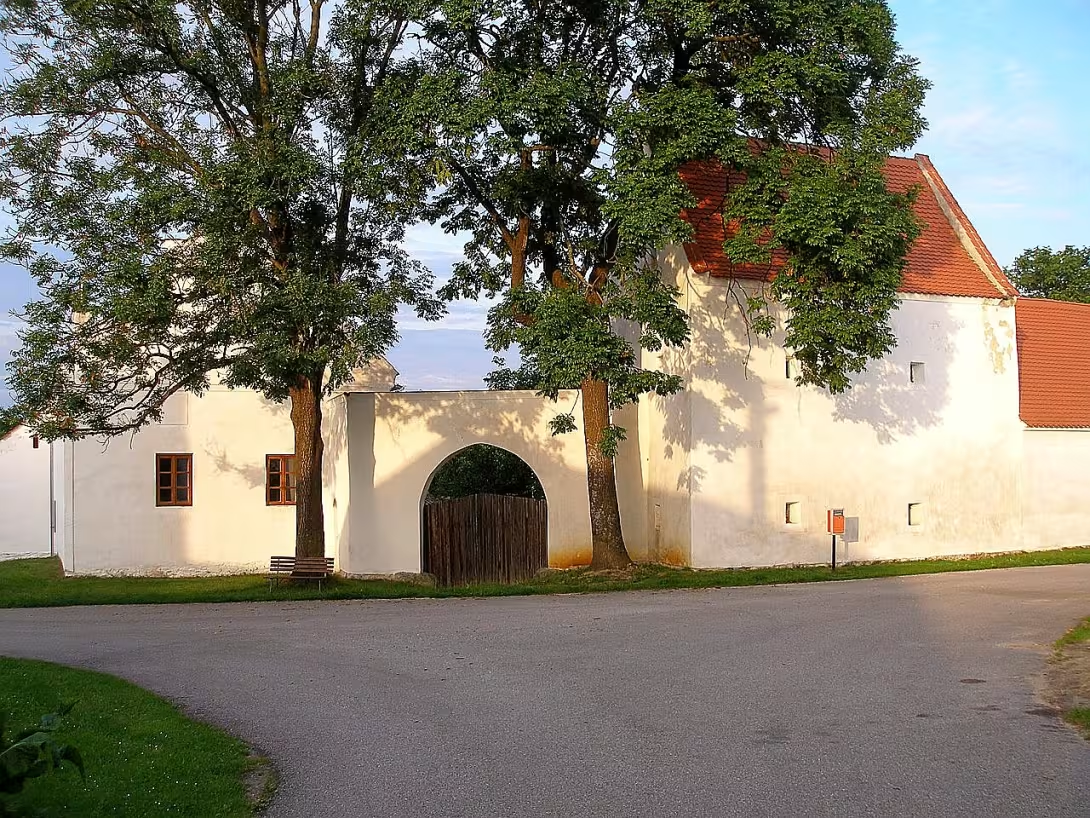
In the area of Czechoslovakia, the unique remains of the large yards of pre-white mountain age are scattered. The agricultural estate No. 3 in Krnín, the local part of Chlumce, is among the best preserved specimens of this group and represents an exceptional case where more educated rural families have built houses with elements of the temple or castle. Since the beginning of the 21st century, the status of the national cultural monument has been borne.
The estate dates back to the end of the 15th century and speaks of the wealth and status of its original family. It was owned for a long time by the Fráňov family, which ran it from around 1900 to 2001. In 1958 it was declared a cultural monument, which recognised its historical and architectural status. But the history of the 20th century did not save it - after 1950, nationalisation took place and the estate went under the management of the agricultural cooperative. The construction team did not impose the care it deserved and there was widespread devastation. It was only after 1989 that the situation changed with the return of the assets to the original owners. In the last years of the 20th century, she was inhabited by Rozena Fráňová and her daughter Rozna Dudová.
Since 2001, the estate has been owned by Miroslav Sýkora from České Budějovice and his wife. Their decision to make a complete correction returned dignity to the object. Renovation has touched all its parts - from the roof, through bags, plaster and windows to the facade. The estate was declared a national cultural monument with effect from 1 July 2010.
The size of the building contributes to her impression. The estate is 26 metres long and approximately 11,5 metres wide. More important than the dimensions is the fact that since its construction, it has been preserved in complete compactness, including its original layout. The architectural details make this building extraordinary - the lining of portals and windows are carried out by techniques known from medieval castles and larger churches. Particularly rare are profiled broken portals that seek their counterpart in higher ambitions. It is these elements that make the simple estate part of the building continuity connecting rural space with the architecture of important objects.
Today the residence in Krnín is an interesting stop for those interested in the Czech heritage of rural culture. The construction indicates the position of her original family in the local society and their ability to surround themselves with elements that were usually the prerogative of more heavily built residences.
Then and now
Drag the slider to compare how the landmark may have looked when it was built with the view today.
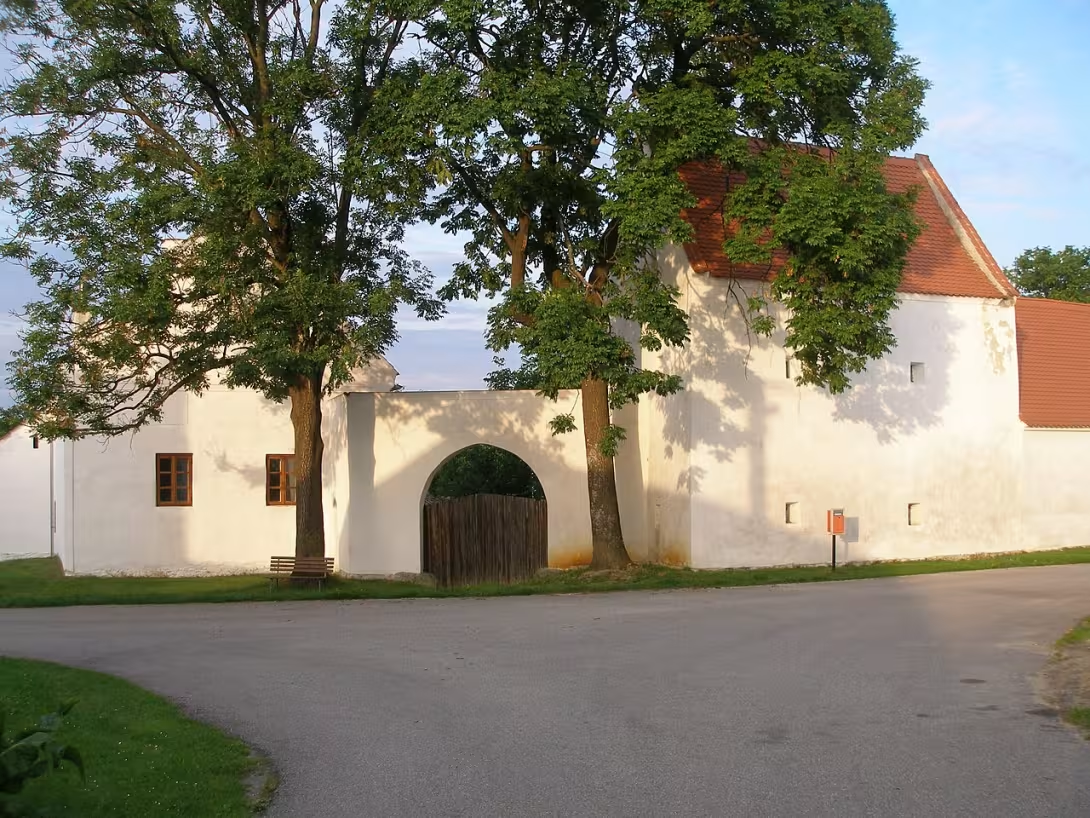
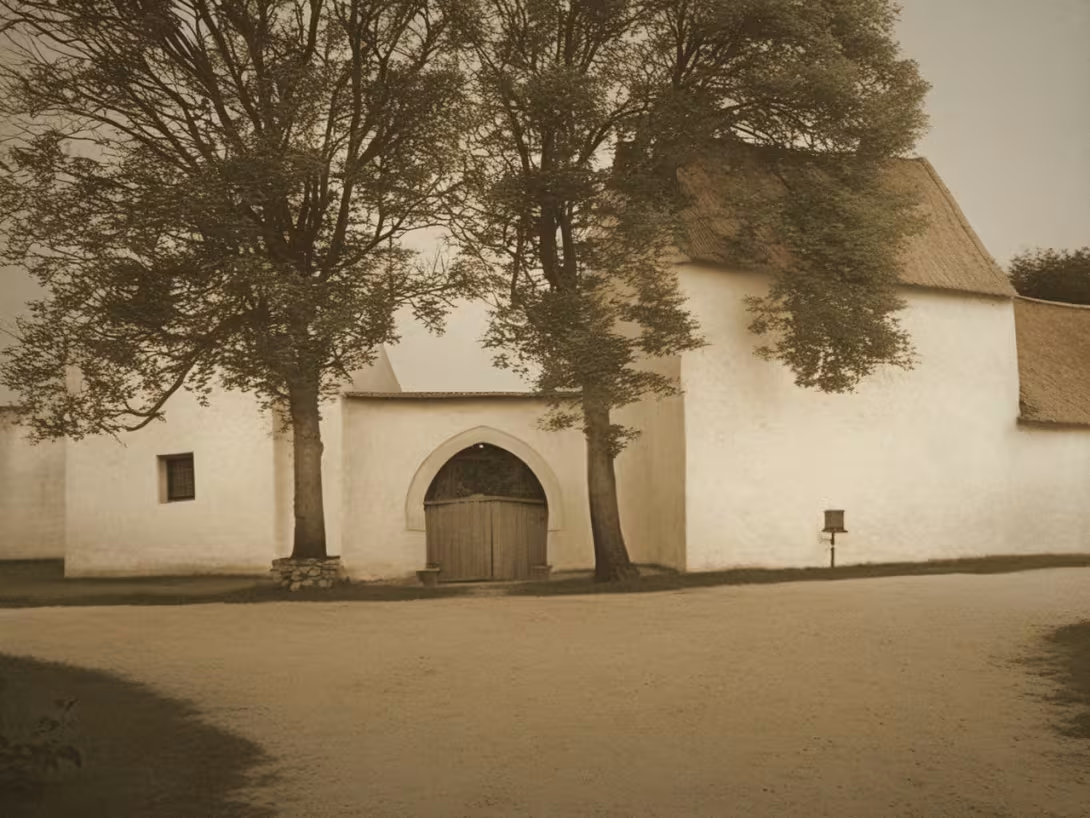
The historical appearance on the left is an AI-generated visualisation and serves as inspiration only.
Historical milestones
- End of 15th Century
- The establishment of an estate as a vast medieval court.
- 1958
- Announcement of a cultural monument.
- 2010
- Declaration for a national cultural monument.
Architectural development
The estate dates from the end of the 15th century and is completely compact preserved including the original building layout. The main building material is stone and wood, with typical medieval architectural elements such as broken portals and profiled lining. In the 20th century, a complete reconstruction was carried out in the years 2000-2010, which preserved the original character of the building.
Historical events
- 1958
- The estate was declared a cultural monument.
- 1950-1989
- Part of the complex was nationalized and belonged to the agricultural cooperative, which led to the destruction of the building.
- 2010
- The estate was declared a national cultural monument.
Points of interest
The estate dates back to the end of the 15th century and testifies to the wealth and high status of the original family.
- In 1958 it was declared a cultural monument, but after 1950 it was badly damaged by the neglect of the agricultural cooperative.
- Since 2001 it has been owned by Miroslav Sýkora and his wife, who have completed a complete repair of the entire building.
- The estate is 26 metres long and 11.5 metres wide and has been preserved in its original compactness, including the building layout.
- The lining of portals and windows is done by techniques known from medieval castles and larger churches, including rare profiled broken portals.
Guide
This guide is narrated by a synthetic voice generated by artificial intelligence.
Show guide text
This text was created by artificial intelligence and has not been editorially reviewed. It may contain inaccuracies.
The farm with the number 3 in Krnín, a part of Chlumec na Českokrumlovsku, is a national cultural monument. It is an exceptionally well-preserved ancient and extensive farmyard. Sometimes it is mistakenly considered to be a fortified manor, but in reality it has always served as a farm.
The farm belongs to a group of large pre-White Mountain farmyards. These are scattered throughout small villages in the Kouty area on the Českokrumlovsko region. Similar farms stand, apart from Krnín, also in Radostice, Čertyna, Opalice, Záluží and in Štěkř, where one of them is also called a fortified manor.
The Krnín farm dates from the end of the fifteenth century. Since its creation, it has been preserved absolutely intact, including its original architectural layout. The building is twenty-six meters long and approximately eleven and a half meters wide. Exceptional are some architectural elements, especially the stone frames of portals and windows. Such frames were used on medieval castles and larger churches, so on a village farm they are extraordinary. The profiled arched portals are also unique.
Since the beginning of the twentieth century, the farm has belonged to the Frán family, who farmed here from approximately nineteen hundred until two thousand and one. After nineteen fifty came nationalization. The family retained only the residential part of the building and the other spaces were taken over by an agricultural cooperative, under whose use the object was extensively devastated. After nineteen eighty-nine the Fráň family got their property back and in the last years before the sale, Růžena Fráňová lived there with her daughter.
In two thousand and one the farm was purchased by Miroslav Sýkora from České Budějovice with his wife. He had it completely renovated, from the roof frames and roof tiles through plaster and windows to the facade.
The farm was declared a cultural monument already in nineteen fifty-eight. By government decree, it then became a national cultural monument with effect from July first, two thousand and ten.
Tips for visitors
The best time to visit the estate is in spring or autumn when nature is blooming or coloured in autumn shades. It is often busy here in the summer, but in these times there are also the most activities for children such as outdoor tours or workshops. The sunny afternoon with mild ventilation are ideal for a comfortable walk through the whole area.
The property is available by car, but it is recommended to use public transport if possible. Parking is possible in the vicinity of the village, specific places can be found on information boards. It is recommended to bring your own vehicle if you come from a larger distance, for example from Český Krumlov. Find out the current connection and possibilities of public transport in the traffic search engine.
When visiting, wear comfortable shoes, because the estate is on a large area with different terrain. It is also appropriate to take a map or GPS to make it easier to navigate. If you are planning to take pictures, don't forget your sunglasses and hat, especially in the summer months. It is good for children to prepare something for painting or drawing, because there is enough space for creative activities in the estate.
The most beautiful photographic moments can be found at the entrance to the estate, where the original architecture is preserved, and also in the surrounding stables and cellars, where there is pleasant shading. The best light is in the morning or in the evening when the sun shines oblique and creates interesting shadows. For interior photography it is advisable to arrange a tour with the local administrator.
In the vicinity of the estate in 30 minutes you will find other interesting places. You can visit Residential No. 1 in Krnín, which is another preserved large yard in the village. For history lovers is an interesting castle Český Krumlov, located about ten kilometers from Krnína. The natural reserve of the Certová Mill is ideal for nature lovers and offers beautiful walks of nature.
For families with children, the settlement is a great choice because it offers plenty of space for games outside. Children can see the historical machines and tools used here. Local administrators often organize special tours or workshops focused on children where they can learn about rural life. It is also recommended to visit the Residence No. 1 in Krnín, where children's activities are often organised.
Frequently asked questions
Is Zemědělská usedlost č. p. 3 v Krníně open to the public?
Yes, Zemědělská usedlost č. p. 3 v Krníně is open to the public. Opening hours are 9:00 to 5:00, seven days a week.
How do I get to the place by car / public transport?
You can reach Agricultural estate No. 3 in Krnín by car on Road II / 301 from Chlumka. Parking is possible in front of the estate or on the next street. Public transport (public transport) is available in Chlumci, where it transfers to Bus 401, which stops before the settlement.
How much is the entrance fee and is it paid on the spot?
Admission to the agricultural estate No. Payment shall be made at the entrance of the estate.
Is the tour suitable for children and seniors?
Yes, Zemědělská usedlost č. p. 3 v Krníně is suitable for visits with children and seniors. The estate has accessible premises and offers interesting exhibitions about agriculture and the history of the region.
How long does the tour take?
The tour of the Agricultural estate No. 3 in Krnín takes about 1 hour.
What are the opening times and booking is required?
The opening hours of Agricultural estate No. 3 in Krnín are from 9.00 to 17.00, seven days a week. Reservation is not necessary, but it is recommended for groups over 10 people.
What's interesting in the immediate vicinity?
In the immediate vicinity of Agricultural estate No. 3 in Krnín there is a nature reserve with forests and valleys where local fauna and flora can be observed. Near the estate lies the historical center of Chlumce with the church of St. Nicholas.
For kids
Imagine going back to when Zemědělská usedlost č. p. 3 v Krníně was still young and full of life. This is the truth! The estate was built in 1500 and today it is one of the oldest buildings in the Czech Republic.
How did it look here? Who lived here? What happened here? It was a time when the village was full of life and work. Farmers tried to get as much crops as possible to feed their families. The estate was their home, where they met, where they had fun and where difficulties came.
Businesses nearby
Do you run a restaurant, accommodation, shop, museum, rental, wellness or other visitor service near this monument? Show yourself directly to the people heading to it — this is how they will see you in the app and on the web:
Events nearby
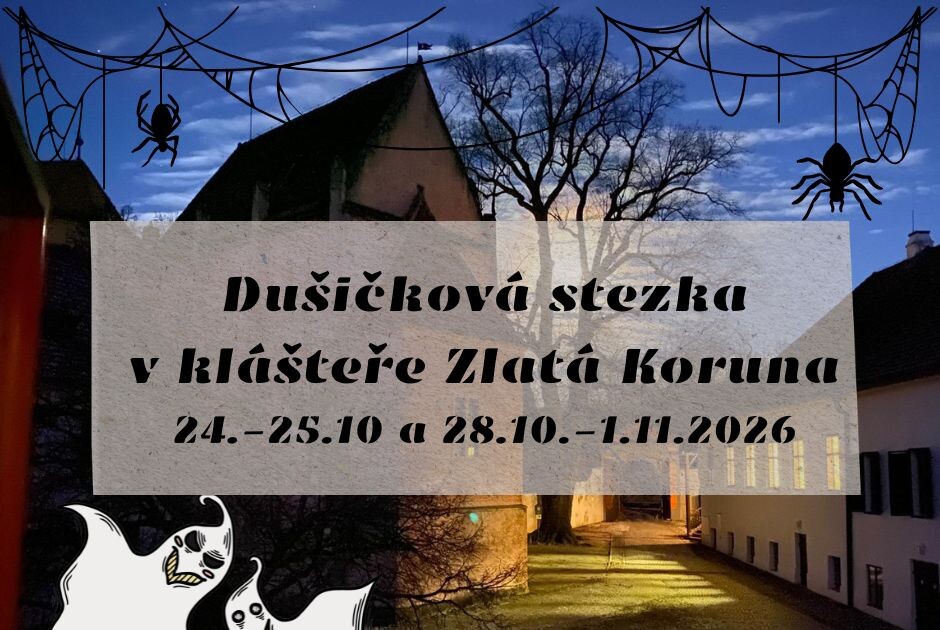
Zdroj akcí: otevřená data měst a obcí ČR (Národní katalog otevřených dat) a kalendář akcí Národního památkového ústavu.
Accommodation nearby
Trips and activities nearby
Guided tours, tickets and activities nearby from GetYourGuide
Affiliate link: if you buy from the partner, we may receive a commission. The price for you does not change.
Search tours and activities →Themed route
Zemědělská usedlost č. p. 3 v Krníně Type: Historical estate This monument is a key point of the trip, where you can see the authentic architecture of the rural building. It allows you to look into the life of farmers in this part of South Bohemia region and appreciate the preservation of traditional building style.
Residence No. 1 in KrnínÍ Type: Historical estate The visit can be supplemented logically by another preserved large yard in the village. The comparison of the two buildings provides a comprehensive picture of the development and structure of agricultural settlements in Krnín in the past.
Natural Reservation Certová mlín Type: Natural monument After visiting cultural monuments, go to this location about 5 km away. It offers the possibility of relaxing in nature and observing specific natural phenomena that contradict human activity in the village.
Castle Český Krumlov Type: Historical residence The aim of the final stage is this historic residence located at a distance of about 10 km. Inclusion of this point in the route enables linking local rural history with a significant cultural and architectural monument of the region.
This route combines a tour of local agricultural buildings with a visit to the natural reserve and a culmination point in the city. The process from smaller local monuments to larger units ensures a smooth transition between different types of experiences. The total length of the route is appropriate for a day trip with an emphasis on history and landscape.
Seasonal recommendations
In spring, the estate comes alive with the arrival of the first flowers and fresh greenery of the surrounding gardens. The morning dew and fine light underscore the purity of architecture in its excellent condition. We recommend to dress several layers of clothing because the weather in South Bohemia is usually variable during this period. Visiting is medium, which allows for a quiet tour without much haste.
The summer months bring radiant sun and golden colors of the surrounding fields, which create a strong contrast with the white walls of the building. The atmosphere is full of energy and summer heat. Due to the high season and the biggest crowds, it is best to come first thing in the morning to avoid the mass of tourists. Remember light, breathable clothing, hat and plenty of fluid.
The autumn landscape around Krnína is painted orange and morning fog brings a mysterious, melancholy touch to the memory. Soft evening light is ideal for capturing the details of the estate. Suitable are waterproof shoes and a warm sweater for colder days. There are significantly fewer people in the area during this period, which contributes to a relaxed and quiet atmosphere.
In winter, the settlement in the snowy landscape is very cozy and peaceful. The white surface of roofs and the silence of the countryside create a unique visual contrast with solid walls. It is necessary to have warm thermo-linens, gloves and solid winter shoes. Due to the shorter day, we recommend planning a visit in the morning and checking in advance the shortened opening hours.
Visualizations and artistic views


The visualisations are generated by artificial intelligence and serve as inspiration.
Photos from the area
Real photos taken near the monument

Zdroj a licence jsou uvedeny u každého snímku.
Atmosphere of the place
This atmospheric visualisation of the place and period was generated by artificial intelligence. It is not real footage of the location.
Tips from visitors
No tips yet. Be the first!
Log in and add your tip.
Sources and literature
Photos: Miloš Hlávka / CC BY-SA 3.0 — Wikimedia Commons. The author and licence also appear when you hover over the image.
Faktickým podkladem tohoto textu byl článek na Wikipedii, jehož autory jsou přispěvatelé Wikipedie. Článek je dostupný pod licencí CC BY-SA 4.0.
Location on the map

Příběhy a pověsti
Legendy, pověsti a příběhy spjaté s touto památkou
Fotografie návštěvníků
Zatím žádné fotografie. Buďte první, kdo přidá fotografii z návštěvy!
Log in a přidejte svou fotografii nebo hodnoťte.
Za ověřenou návštěvu v aplikaci získáte víc bodů — poznáme podle GPS, že jste na místě.
Reviews and comments