



Zlíchovský lihovar Other
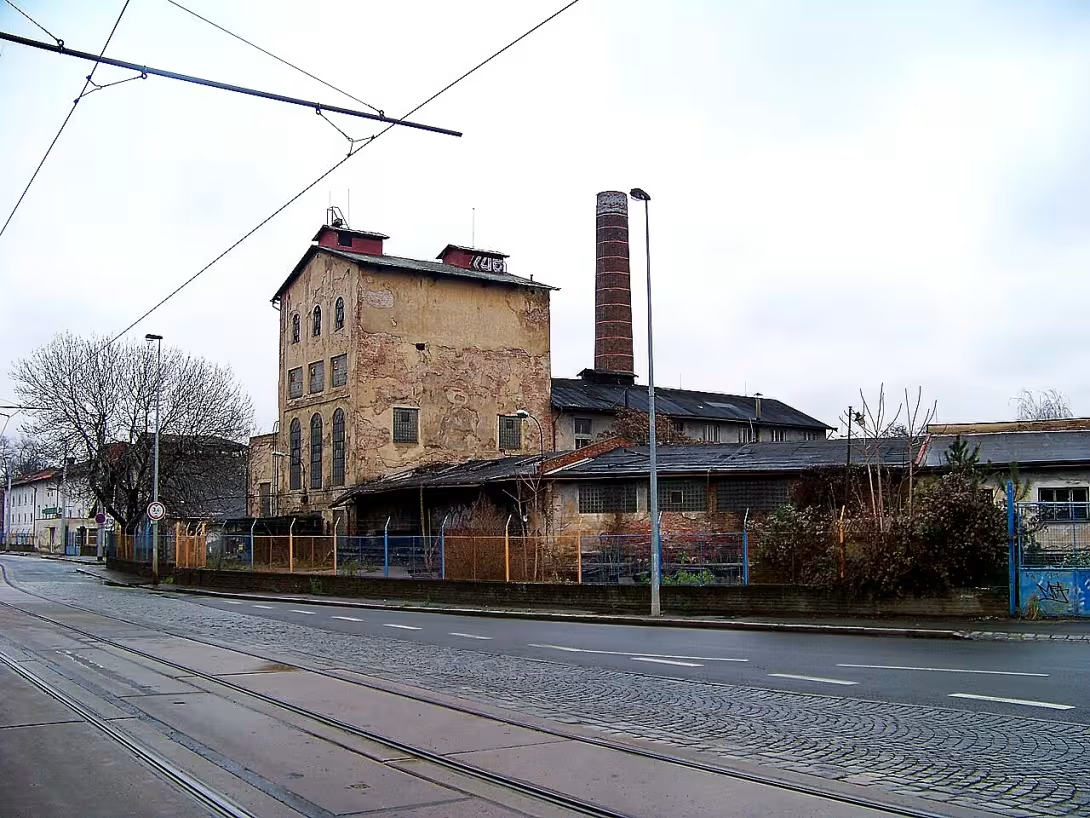
Zlíchovský lihovar is a former industrial complex in Prague in Zlíchov, a situation between the streets Railway and Strakonická. The object dates back to the late 19th and early 20th century. Since 2002 his stove and chimney have been protected as a cultural monument of the Czech Republic. They represent an authentic element of the industrial architecture of the Smichov panorama.
The Fischl family has owned a distillery at Zlích since 1836. In 1880, Samuel Fischl and Adolf Rosenbaum founded an old factory for alcohol and potash here. A significant reconstruction of the site and the completion of the alcohol refinery took place in 1907. With an average annual production of 28 070 hectolitres of alcohol, the company became the third largest of the seven industrial distilleries in Prague's commercial district. The refinery produced alcohol from molasses, from which the emerging matchsticks were subsequently processed in a potash plant for potassium salts.
The area consisted of a number of operational and administrative buildings. The dominance was a distillery with an elevated tower section. It excels in the facade facing the Railway Street with half-circled windows. In her hall there is a decorative cast iron spiral staircase which passes through the building floors. The object of the boiler room with a polygonal chimney on a high square footstool stood northeast of the distillery. The technical equipment included cylindrical tanks for molasses with a capacity of 20,000 hectolitres and a circular tank of 10,000 hectolitres.
Logistically, the factory was connected to Smíchov train station. Even in 1889 it led to a pine port and to a Schwarzenberg saw, while in 1895 it was already 310 metres long. The lift was crossed in the level with the Railway Street, on which since 1925 a tram line has been running. The dorm was originally located in a turntable which was cancelled before 1990. The tracks were officially cancelled in 1997, in 2002 sealed at the crossing point with a tram and in 2004 the crossing was carried.
The distillery was stopped on April 29, 1949. The facility was dismantled and shipped to other Czech distilleries at the end of 1950. Since 1951, the company United distilleries, a national company, has been located here. Since May 1952, there has been production of excellent alcohol for five years. In 1957, the premises of the former potash factory were converted into an acetate factory. In the 1960s, it became one of the leading European vinegar producers. In the 1960s and 1970s there was a bottle of domestic rum and Prague vodka. Both alcohol and vinegar operations were definitively terminated in 2000.
After the completion of the operation, the complex was owned by Zlatý distillery a.s., with the Goldfin Investments ltd. meeting in the Virgin Islands. The plans to build the complex with offices, apartments and shops failed and the area was intensely disintegrated. Due to the emergency situation, a production hall of 40 × 60 metres collapsed on 26 June 2013. In 2021, the development group Trigema took over the premises. The Smíchov distillery project creates an apartment complex with 500 apartments, business premises and restaurants. A gallery of Musoleum was created by David Černý.
Zlíchovský lihovar is a valuable witness to the intense industrialization of Prague and the development of Smíchov industrial suburbs. The preserved elements of industrial architecture combined with new applications offer an interesting view of the transformation of urban space. It's a place worth visiting for any interested in the technical history of the capital.
Historical milestones
- 1880
- The establishment of the alcohol and potash factory by Samuel Fischer and Adolf Rosenbaum.
- 1907
- Rebuilding the premises and rebuilding the building of the alcohol refinery.
- 1957
- Rebuilding the buildings of the former potash factory into an octarian plant.
- 2002
- Declaration of the stove and chimney for the cultural monument of the Czech Republic.
Architectural development
Buildings were built or modified in the 1990s and in the early 20th century. In 1907 there was a significant reconstruction of the premises with the construction of a alcohol refinery. The Distilovna excels with decorative cast iron spiral staircase and semi-circular windows.
Historical events
1949-1950 stopdown and equipment analysis, 1957 reconstruction of potash factory to acetate plant, 2000 closure of both alcohol and vinegar.
Owners
The Fischer family (since 1836), Samuel Fischl and Adolf Rosenbaum (since 1880), United distilleries, national enterprise (since 1951)
Points of interest
- Varna and chimney are protected as a cultural monument of the Czech Republic since 2002. - The company was the third largest of seven industrial distilleries in the Prague Chamber District. - Distilling stands out with half-circle windows and decorative cast-iron spiral staircase. - In the 1960s there was one of the leading European vinegar producers. - A gallery of Musoleum was created by David Černý.
Guide
Show guide text
This text was created by artificial intelligence and has not been editorially reviewed. It may contain inaccuracies.
Welcome to Prague, part Smíchov, where you are currently standing in front of one of the fascinating witnesses of the industrial past of our city. In front of you is the former Zlíchovský lihovar, an area which, in times of its greatest fame, formed the heart of local production. If you look at the buildings in front of you like this, you might see the atmosphere of the old workshop complex, where the administration buildings were connected to the operating ones. The dominant factor that immediately attracts your vision is a distillery with its turret part and a high chimney with many edges of the head, which stands on a square base. It is a place where the noise of machines with the smell of chemical processes once mixed and the history of the Prague industry was written.
Now let's go back a little bit in time to understand how it got to this place. It's a thousand eight hundred and eighty. In Prague, trade and production flourish at that time, and it is this year that Samuel Fischl and Adolf Rosenbaum establish their alcohol and potash factory. Imagine these two men as visionaries of their time who saw the potential in the locator conditions of Smíchova. Their aim was to create an efficient company that would process molasses, which is the thick syrup produced in the production of sugar, and then produce alcohol from it. However, this process did not end simply because the premises included a potash factory where the alcohol was further processed. It was a complex system where one product served as a basis for another.
Now that you know the beginnings, pay attention to the architecture itself. Look carefully at the distillery building. Note its specific appearance, especially the windows that end with a half circle. This detail gives the building some elegance that contrasts with its purely practical purpose. If you look even more carefully, you'll see a decorative spiral staircase from cast iron. It is one of those rare elements which we rarely see in industrial areas today and which shows that even in the factory we could think of aesthetics. The whole complex passed in the year one thousand nine hundred and seventh significant reconstruction, when the alcohol refinery building was built so that the company could grow and keep up with the period demand.
When we think about the people who worked here, we go back to the already mentioned founders, Samuel Fischer and Adolf Rosenbaum. They were people who brought a modern approach to business to Prague. Their distillery was not just a small workshop, but it became a major player in the market. Imagine that seven such large industrial distilleries existed within the Prague Chamber District and this particular company was the third largest of them. This gives us a clear idea of the scale of production and the number of people who worked here every day, kept the boilers running and oversaw the quality of the distillates.
However, the history of this place did not stop at the time of the alcohol. The times have changed and the use of buildings. Let's move on to the year one thousand nine hundred fifty-seven. At that time, there was a fundamental change in the site's function. The buildings that originally served as a potash house were converted into an acetate factory. The production of vinegar was strategically important at the time and thus the site adapted to the new needs of the time. It is fascinating to see how one and that mesma building can serve completely different purposes over the course of several decades, while retaining its basic character.
I will now lead you to something that is truly special for this place. You may have noticed the buildings look old, but they're in good shape at the same time. That's not a coincidence. Since the year two thousand and two are protected as a cultural monument of the Czech Republic. Why is it important? Because Zlíchovský lihovar represents an authentic element of industrial architecture. While many other factory sites in Prague have been levelled or completely rebuilt in modern offices in recent decades, key elements have been preserved to enable us to touch history. The chimney you see above you is not just a pile of bricks, but a symbol of years of hard work and technical progress in the late nineteenth century.
The interesting thing that may interest you is the combination of function and form. Note how the clean industry intersects in this area with details that are almost artistic, such as the cast iron staircase. It is a reminder of the time when industrial buildings were also made aware of a certain standard of beauty. It is a place that tells us a story about the transformation of Prague from the royal city to the modern industrial centre.
Now, when you look around you, see this space as a bridge between the past and the present. You're standing in a place where the tenths of a century before it was decided the fate of a big business, where people were sweating at boiling boilers, and where the air carried the smell of molasses and alcohol. Today, it is a quiet place that encourages us to think about how quickly our city changes and what remains of it.
Thank you for accompanying me on this short trip to the history of the Zlichov distillery. I hope you enjoyed seeing these unique buildings and that you felt the spirit of old Smíchov. Now I invite you to look at the facade details in peace, look again at the shape of the chimney, and perhaps imagine what this area looked like at the time of its greatest glory, when clouds of smoke came out of it, and there was constant activity in the streets. I wish you a pleasant further journey through Prague and enjoy the rest of your day. Goodbye.
Tips for visitors
The best time to visit is the late afternoon when the sun hits the tower part of the distillery and polygonal chimney, which will highlight the details of industrial architecture.
During the walk we recommend to take the fitting to the industrial area and the camera. The best images can be taken from the bottom to show the height of the chimney on a square footstool and the overall size of the administration buildings.
It's the perfect way for those who like the urban atmosphere.
It is interesting for families with children to watch the shapes of buildings and look for differences between the administrative parts and the distillery itself, which can be seen as a survey of the old factory complex.
Frequently asked questions
Can the monument be visited?
We have not verified whether this monument is accessible. Please ask the owner or operator, or the local municipal office.
Where is the monument?
Location: Smíchov. The map on this page shows the exact spot.
Why is the monument protected?
It is listed in the Central List of Cultural Monuments of the Czech Republic as a cultural monument (register no. 1231421583).
Businesses nearby
Do you run a restaurant, accommodation, shop, museum, rental, wellness or other visitor service near this monument? Show yourself directly to the people heading to it — this is how they will see you in the app and on the web:
Events nearby

Zdroj akcí: otevřená data měst a obcí ČR (Národní katalog otevřených dat) a kalendář akcí Národního památkového ústavu.
Nearby
Nádražní ulice, Strakonická ulice, Smíchovské nádraží.
Accommodation nearby
Trips and activities nearby
Guided tours, tickets and activities nearby from GetYourGuide
Affiliate link: if you buy from the partner, we may receive a commission. The price for you does not change.
Search tours and activities →Themed route
Here is the design of the cruise route:
1. Smíchov Railway Station (Transport Node) - Ideal place to start the trip and arrive in the area. 2. Railway station street (urban road) - A walk down this street will guide you through the heart of the quarter towards the next destination. 3. Strakonice street (main artery) - The road on this street offers a view of the urban tourism and architecture of the surrounding area. 4.Zlíchovský lihovar (alcoholic beverage production) - The main destination of the trip, where you can visit the area itself and taste local products.
Seasonal recommendations
In spring, the surrounding area is awakened to life and the young greenery in Smíchov creates a fresh set for a tour of the building. The sun shines slightly, which is ideal for walking in the morning. It is recommended to wear a light jacket or coat because the spring air may still be cold.
In the summer months it dominates the areas of intense heat and bright, sharp light, which highlights the details of the facade. The best time to visit is early morning or late evening when the air is more pleasant. It is advisable to choose light, breathable clothes and not forget the hat against the sun.
Autumn brings the golden colour of leaves and a foggy atmosphere to the district, which underlines the historical character of the place. The light is softer and the shadows are longer, which creates a melancholy mood. Practical is both suitable for wet terrain and laminated clothing to protect against wind.
Zimą is a space surrounded by quiet and freezing air, which often accompanies the snow walk. In advent time, expectations rule and evenings are short, so you must leave early in the afternoon. Hot winter clothes, thick socks and tight shoes with anti-slip soles are essential.
Visualizations and artistic views

The visualisations are generated by artificial intelligence and serve as inspiration.
Photos from the area
Real photos taken near the monument


Zdroj a licence jsou uvedeny u každého snímku.
Tips from visitors
No tips yet. Be the first!
Log in and add your tip.
Sources and literature
Photos: cs:ŠJů / CC BY-SA 3.0 — Wikimedia Commons. The author and licence also appear when you hover over the image.
Faktickým podkladem tohoto textu byl článek na Wikipedii, jehož autory jsou přispěvatelé Wikipedie. Článek je dostupný pod licencí CC BY-SA 4.0.
Location on the map
Příběhy a pověsti
Legendy, pověsti a příběhy spjaté s touto památkou

Fotografie návštěvníků
Zatím žádné fotografie. Buďte první, kdo přidá fotografii z návštěvy!
Log in a přidejte svou fotografii nebo hodnoťte.
Za ověřenou návštěvu v aplikaci získáte víc bodů — poznáme podle GPS, že jste na místě.
Reviews and comments