

Buchalův vodní mlýn Mill
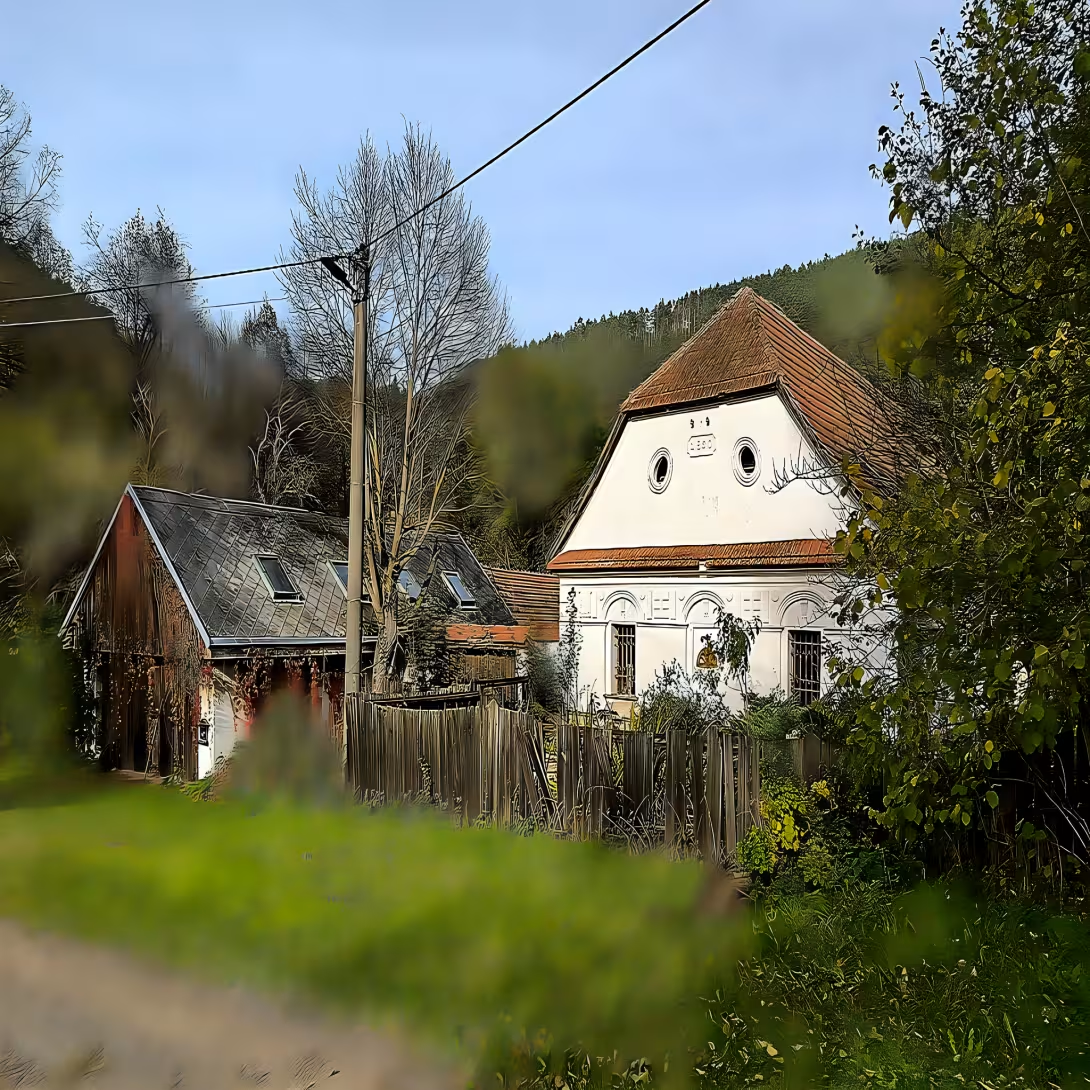
Buchalův vodní mlýn in the village Skryje (district Brno-venkov, Jihomoravský kraj) is a late Baroque technical and architectural monument. Probably from the 14th century. The building is an important proof of the mill tradition in the valley of the river Bobrovka and it is especially excellent with rich stucco decoration of the facade.
The first written mention of the mill dates back to 1368, although the owner from this period is unknown. Historically, the construction belonged to the Hadish part of the village Skryje and is located on the right flow of the river Loučka. Among the documented owners was Ondra Šťávničků miller in 1653. The last owner of the mill was František Buchal, who died in 1946.
From the point of view of architecture it is a one-storey late Baroque village building with a saddle roof. The main shield and the outer longitudinal side of the building show rich stucco; the shield is listed in 1820. According to the cadastral mapping from 1836 the mill had a higher building standard than other houses in the village. Its total area was 1700 square metres.
A detailed description from 1842 indicates that the building was 32 metres long, 7,5 metres wide and 4 metres high with a wall thickness of 60 centimetres. The residential area consisted of two large rooms with reed ceiling, kitchen, pantry and chamber. The mill part was separated by a corridor and stone stairs with ceramic tiles. The whole complex was supplemented by an economic courtyard with bows, stables, shed with walled pillars and wooden barn on the other side of the drive.
The 1842 Inventor testifies to a relatively high standard of living for owners. In the house there were painted and unvarnished tables, comodor, column and wall clocks, mirrors, 16 paintings and half-stone service. Economic assets included horses, four cows, 18 sheep, and considerable stocks of cereals and wood. In 1936, however, the state of the building was already significantly worse, for example due to rotten floors.
The technical equipment of the mill consisted of four compositions originally powered by four, later three water wheels on the top water. The water flowed into the drive through a 22,5-metre-wide meal of squamous boulders, located about 650 metres above the mill. The so-called hams - intentional points on the rocks and near the mill building - were set up to monitor the falling conditions of the water.
In 1952, the operation of the mill in the framework of nationalisation and interference of small businesses was definitively terminated. After the death of the last member of the Buchal family in 1984, the object of the state fell. In 1987 it was purchased by the Czechoslovak Academy of Sciences for the Institute of Environmental Biology, which invested in roof and interior repairs. Since 1990 the mill has been privately owned.
Buchalův vodní mlýn presents a valuable example of historical milling and Baroque rural architecture. It is possible to observe detailed craft processing of the facade as well as technical water drive solutions. Visiting the area offers insight into the economic life of the region from the previous centuries.
Then and now
Drag the slider to compare how the landmark may have looked when it was built with the view today.
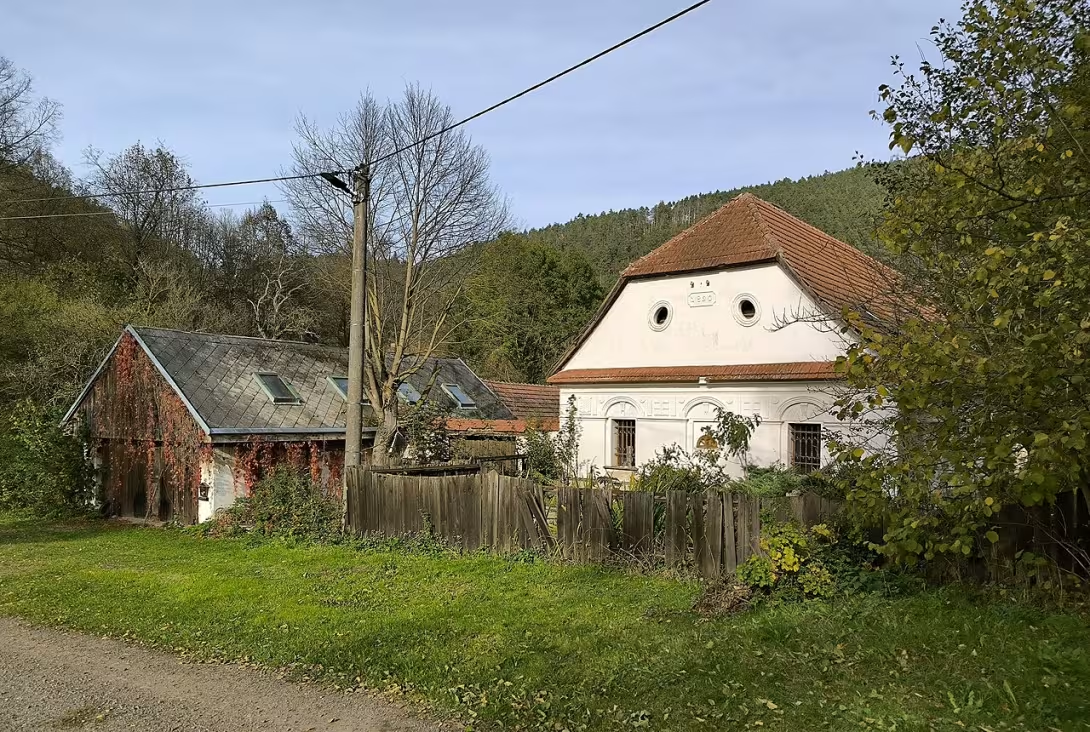
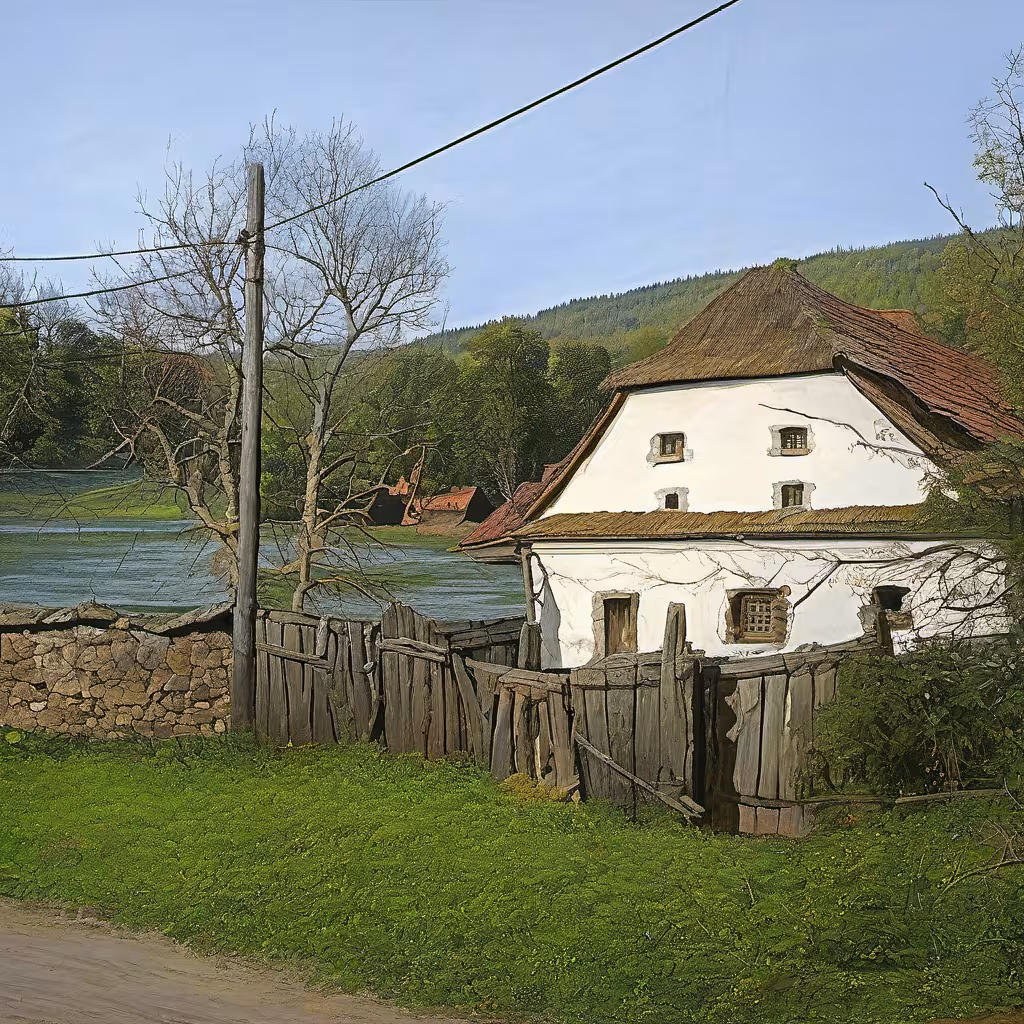
The historical appearance on the left is an AI-generated visualisation and serves as inspiration only.
Historical milestones
- 1368
- First mention of the mill in historical records.
- 1820
- The number shown on the stucco-decorated building shield.
- 1952
- Final closure of the mill.
Architectural development
It is a one-storey late Baroque village building with a saddle roof. The main shield and outer longitudinal side of the building are decorated with a rich stucco, with the shield bearing the year 1820. Originally to the building was the farm yard with bows, stables and wooden barn.
Historical events
1368: first written mention of the mill; 1952: definitive closure of the mill in the framework of nationalisation; 1987: purchase of the Czechoslovak Academy of Sciences for the Institute of Environmental Biology.
Owners
Ondra Šťávničků (1653), František Buchal (died 1946), State (since 1984), Czechoslovak Academy of Sciences (1987- 1990), Private Owner (since 1990).
Points of interest
- The construction is probably from the 14th century and the first written mention of it is from 1368. - The building excels with rich stucco decoration of the facade and has a higher building standard than other houses in the village. - In 1842, the inventory witnessed a high standard of living for owners who owned for example 16 paintings and semi-stoneware service. - Technical equipment originally powered four, later three water wheels on the upper water. - The water to the drive flowed through the food from the tiles, which was about 650 meters above the mill.
Guide
This guide is narrated by a synthetic voice generated by artificial intelligence.
Show guide text
This text was created by artificial intelligence and has not been editorially reviewed. It may contain inaccuracies.
Welcome to the village Skryje. Right now, you're standing in front of a building that carries hundreds of years of history telling the story of human work, water and craft art. In front of you is Buchalův vodní mlýn, a building that immediately protruding from the surroundings through its appearance and atmosphere. If you look at her, you might be interested in her nobility and the sense of stability she radiates. It is not just an ordinary house, but a monument to the miller tradition in the valley of the river Bobrovka, which has survived for centuries and still stands as a witness of ancient times.
Let's stop at the beginning together. Imagine what this place looked like over six styles ago. Although the building has undergone changes over time, its roots go deep into the Middle Ages. The first written mention of this mill appears in historical records already in the year three hundred and sixty-eight. It's fascinating to think that by that time, the water had driven the wheels, and there were cereals for people around here. At that time it was a key centre of economic life without which the municipality could not develop. The mill was not just a place of work, but the heart of the entire valley, where people from different layers of society met.
Now please pay attention to the architecture itself and look carefully up on the front of the building. Note the rich stucco decoration of the facade, which is one of the most distinctive elements of this house. This decoration is not random. If you look at the shield of the building, you will see there a thousand eight hundred and twenty. It is this detail that tells us about the time when the mill was in a certain phase of its boom and its owners wanted to show their prosperity to the outside world. Notice how this decoration works compared to other houses in the village. It is obvious that this house had a much higher building standard than the usual housing in the area. This was not only a question of aesthetics, but also a symbol of the social status of the people who lived and worked here.
When we think about how the mill worked, we have to imagine the technical side of things. The building served as a four-fold mill. This means that there was a difficult processing of the grain in several steps. The whole process was driven by water wheels, which used so-called top water. The water from the river Bobrovka was brought to the wheel from above, which provided sufficient power to spin the heavy mill stones. It's a beautiful example of how people in the past have used the power of nature to automate hard physical work.
Each house has the names of the people who inhaled his life. In the case of this mill they are personalities like Ondra Šťávničků or František Buchal. The name of the Buchal family has come together so closely that the building is now known as this. The mill was more than a craft at the time, it was a responsibility. The miller had to understand not only the technique of his machine, but also the running of the river and the needs of his neighbors. The life of the miller was associated with the rhythm of water and seasons.
Now I want to take you to one of the interesting things that will help us better imagine life inside these walls. Even though we see the exterior facade today, historical records reveal to us what luxury existed here at some point. In a thousand and eight hundred forty-two, an inventory of the property was made, indicating a very high standard of living for the owners. Imagine that there were 16 paintings in the house where the cereals were grinding and the dust was ruling. That was an extraordinary number at the time, and it clearly shows that the miller had not only a modest life here, but they were people educated, possessed and with taste for art. This combination of industrial work and cultural refinement makes Buchal Mill a unique place.
But there is also a sadder side to this story. Each era has its end, and for the miller tradition in this place came the final one in a thousand nine hundred fifty-two. This year the mill was definitively closed. With the advent of modern technology and large industrial mills, these smaller water structures have lost their original meaning. They stopped being necessary for the survival of the village and gradually became monuments of the past. But it is fortunate that the building has not been demolished, but it has remained so that it can tell us its story today.
Now, if you look at the building as a whole again, try to perceive the atmosphere of this place. Imagine the sound of the flowing water, the growling of the mill stones and the hKrav cars that brought in the grain. It's all been happening here for centuries. This mill is a bridge between the Middle Ages, a period of nineteenth century bloom and our present. It is a reminder of a time when man was much more dependent on natural resources and when the quality of craftsmanship of buildings was to be seen at first sight.
Notice the fascinating facade again. It's fascinating how one building can combine the technical function of the mill and the aesthetic beauty of the city mansion. The fact that such rich stucco decoration has been preserved is rare in the region and makes it a valuable architectural monument. It is proof that even in small municipalities such as Skryje, history was created, worth paying attention.
I suggest you now spend some time in silence and see the details of the facade from different angles. Watch how the light hits the decorative elements and try to imagine how the miller felt when they came out of the house in the morning and looked at their prosperous building. It's a place that teaches us patience and respect for the traditions of our ancestors.
That concludes the short journey through the history of Buchal Water Mill. I hope you enjoyed this view of the past and that this house has captured you with its beauty and its story. Now it is up to you whether you want to go further around the village Skryje or if you want to enjoy the peace of the Bobrovka River for a while. Thank you for your attention and I wish you the rest of the day to discover the beauty of our region. Goodbye.
Tips for visitors
The best time to visit is spring or autumn, when the colours in the valley of the Loučky River are the most distinctive and surrounding nature accompanies the historic atmosphere of the mill. You can reach the village Skryje by car or public transport; Check the specific path and connection in maps or search engines.
On the way we recommend shoes suitable for the terrain because the mill is located in a valley where the terrain can be humidified. The best places for photo lovers are the banks of the river and views on the architecture of the mill in the morning or late afternoon light, which will highlight the details of this building from the 14th century.
The nearby area offers walks in the valley of the Loučka River and the wider surroundings of the Bobrovka River, which are ideal ways to clear the mind in nature. Families with children will appreciate the opportunity to observe the flow of water and explore the technical elements of the water mill from the outside, which may be a great way to bring children closer to the history of old machines.
Frequently asked questions
Can the monument be visited?
This is a technical monument. Some are open as exhibitions, others are out of use or on private land. We have not verified whether this one is accessible.
What are the opening hours and admission?
We have not verified the opening hours or admission. Current information is published by the operator.
Where is the monument?
Location: č.p. 13, Skryje, Jihomoravský kraj. The map on this page shows the exact spot.
Why is the monument protected?
It is listed in the Central List of Cultural Monuments of the Czech Republic as a cultural monument (register no. 105019).
For kids
Imagine going back to the past, to a time when the earth was full of life and motion. It was like a game where every day there was a new promise. And it was at that time that Buchalův vodní mlýn, the only preserved mill in the area.
How did it look here? Who lived here? What happened here? The city was full of craftsmen and merchants who sold their goods on the market. People lived in wooden houses whose roofs were covered with shingles. The water was their largest income because they used it to grow crops and raise animals.
Businesses nearby
Do you run a restaurant, accommodation, shop, museum, rental, wellness or other visitor service near this monument? Show yourself directly to the people heading to it — this is how they will see you in the app and on the web:
Events nearby
Zdroj akcí: otevřená data měst a obcí ČR (Národní katalog otevřených dat) a kalendář akcí Národního památkového ústavu.
Nearby
🏰 Historic sites (85)
- Rysov 0.5 km
- Košíkov 1.8 km
- Víckov 2.8 km
- Újezd 2.8 km
- Hrádek 4.1 km
- Galerie MF Rojetín 4.8 km +420 724 740 363 web
- Pivovar Doubravník 5.2 km
- hrad Lúčka 5.4 km
- Michaela Richtigová 6.2 km
- Padli aby národ žil 1914-1918 6.5 km
- Galerie z ruky 6.5 km +420 566 566 494 web
- Pernštejn 6.5 km web
- Výstavní síň 6.6 km
- Čepička 7.1 km
- Josef Uher 7.6 km
- morový sloup 7.6 km
- Zdeněk Dobišar 7.8 km
- Podhorácké muzeum Předklášteří 7.8 km 00420 544 544 220
- sv. Florián 7.9 km
- Kaple sv. Floriána 7.9 km
🍽️ Restaurants and dining (128)
- Pod kapličkou 0.2 km
- Na Parníku 0.2 km
- Šafránkův mlýn 2.1 km web
- Žďárecká hospůdka 3.4 km Žďárec 42
- Hospoda Horní Loučky 3.7 km web
- Hospůdka na Kutinách U trempů 4.0 km
- Ranč U bizona 4.1 km web
- U Sedláčků 4.7 km
- Peklo 4.7 km +420 727 854005
- Hostinec u Lepků 5.2 km
- Občerstvení na Mlýně 5.9 km
- Vidonínská hospůdka 6.6 km
- U Starého pána Viléma 6.7 km
- Hospůdka Níhov 6.8 km
- Restaurace Pod Pernštejnem 7.1 km
- Bistro U Ježků 7.2 km
- Restaurace Barborka 7.3 km +420566566317 web
- Pension Pod sýpkou 7.3 km Tišnovská 3 web
- Pizzerie 16 7.3 km web
- Pohostinství na Sokolovně 7.4 km
🏨 Accommodation (32)
- T.K. Křováci Kuřim 0.9 km
- Šafránkův mlýn 2.1 km
- Domeček na Vysočině 4.8 km
- Rekreační středisko Prudká 5.2 km +420 727 823 601 web
- Hotel U Nádraží 7.3 km
- Pension Pod sýpkou 7.3 km Tišnovská 3 web
- Penzion Barborka 7.3 km +420566566317 web
- Ubytovna a penzion Hamry 8.9 km
- Penzion Laskala 8.9 km Klášterská 357 +420 720 26 67 24 web
- Pension Pluto 9.4 km +420 737 53 35 84
- Penzion Tišnovská Rychta 9.4 km Mlýnská 377 web
- Hotel Květnice 9.4 km
- Slovácka Chalupa 10.2 km web
- Penzion Zubr 10.8 km +420 723 391 919 web
- Dětský tábor Brumov 11.6 km
- Penzion Hodůnka 12.6 km +420 566 566 222 web
- Areál Šárka 12.6 km web
- Hotel Jelínek 13.0 km 566 532 462 web
- Nostop ubytování 13.0 km
- Pension Lesacka 13.1 km Masarykovo náměstí 6 +420 566 532 887 web
🚲 Rentals and sport (20)
- Orlovna 4.6 km
- sport-vysocina.cz 5.2 km +420 603 526 269 web
- Cykloski Doubek 8.1 km
- Perut 8.1 km
- Sokol Lomnička 8.9 km
- E-POHONY Šikula 9.2 km +420 530 330 785 web
- Cykloservis Tip-Ťop kolo 9.3 km +420 723 07 77 91
- Style sport 9.4 km +420 549 410 666 web
- Čas pro sebe 9.6 km web
- Sokolovna 9.6 km Drbalova 274
- Cykloport 9.7 km +420 608 50 01 36 web
- Koupalište Grado Tišnov 10.0 km web
- Sportovní klub Ujčov 10.3 km
- Offroad & military 13.8 km
- Brťovské koupaliště 14.3 km
- Atletický stadion Tomáše Dvořáka 14.6 km
- Bazén pro děti 14.9 km
- rekreační bazén 14.9 km
- Cyklo Kalina 14.9 km Pod Kaštany 39 603830197
- Stadion SK Bystřice 15.0 km
🥾 Hiking and nature (142)
- Zelená studánka 2.7 km
- Pozůstatek úzkokolejky 3.5 km web
- Babylon 3.7 km
- Sochorská skála 3.7 km
- V Kutinách 3.9 km
- Lokace pracovního tábora v Kutinách 4.0 km web
- Pozůstatek úzkokolejky 4.1 km web
- rodný dům Josefa Uhra 4.3 km
- studánka Adélka 4.6 km
- Pláně 4.7 km
- Pozůstek úzkokolejky 3 (Diana) 4.8 km web
- Křivoš 4.9 km
- Na Kutinách 5.0 km
- Pochopova skála 5.0 km
- Amorova vyhlídka 5.0 km
- Nádrž Kopyto 5.0 km web
- Mírová 5.1 km
- Chochole 5.2 km
- Kraví hora 5.5 km
- sv. Jiljí 5.5 km
Accommodation nearby
Themed route
Here is the design of the thematic route:
1. Buchalův vodní mlýn (mill) - The main destination of a trip where you can admire historical equipment and miller technique. 2. The valley of the river Loučka (natural area) - Walk along the flow, which offers a peaceful path to the mill and beauty of the surrounding countryside. 3. The valley of the river Bobrovka (natural area) - A wider space for the continuation of the journey in nature, which connects the whole visiting route.
Seasonal recommendations
In spring, the surroundings of the mill awaken to live colours, and the water in the stream gets stronger due to snow melting. The atmosphere is fresh and moist, which highlights the smell of the surrounding green. We recommend moisture resistant shoes and a visit in the morning when the light is fine and suitable for landscape observation.
Summer brings a radiant sun and deep shadows under the leaves of trees that provide a pleasant cold. The insects float around the water and the air is filled with heat. It is advisable to choose a light summer outfit and hat from the sun, taking the best time to arrive is early morning or late afternoon to avoid the greatest temperatures.
In autumn, the landscape around the monument is colored in gold and red, creating a nostalgic mood. The light is golden and milder, which underlines the historical character of the building. Practical is to take a lighter jacket or sweater and hit the field at a time when the colors of the leaves are most intense.
In winter, the surroundings of the mill can be covered with white precipitation, which calms the atmosphere and soothes the sounds. The air is freezing and clean, and the building in the snowy landscape is very separate. Hot clothes, waterproof shoes and a visit in times when the sun still shines because darkness comes very quickly.
Visualizations and artistic views


The visualisations are generated by artificial intelligence and serve as inspiration.
Photos from the area
Real photos taken near the monument


Zdroj a licence jsou uvedeny u každého snímku.
Tips from visitors
No tips yet. Be the first!
Log in and add your tip.
Sources and literature
Photos: Roman Mifek / CC BY-SA 4.0, rozlišení zvýšeno umělou inteligencí — Wikimedia Commons. The author and licence also appear when you hover over the image.
Faktickým podkladem tohoto textu byl článek na Wikipedii, jehož autory jsou přispěvatelé Wikipedie. Článek je dostupný pod licencí CC BY-SA 4.0.
Location on the map




Příběhy a pověsti
Legendy, pověsti a příběhy spjaté s touto památkou
Fotografie návštěvníků
Přidat fotografiiZatím žádné fotografie. Buďte první, kdo přidá fotografii z návštěvy!
Máte k místu vzpomínku nebo zajímavý příběh?
Log in a přidejte svou fotografii nebo hodnoťte.
Za ověřenou návštěvu v aplikaci získáte víc bodů — poznáme podle GPS, že jste na místě.
Reviews and comments