



Česká Ves Settlement
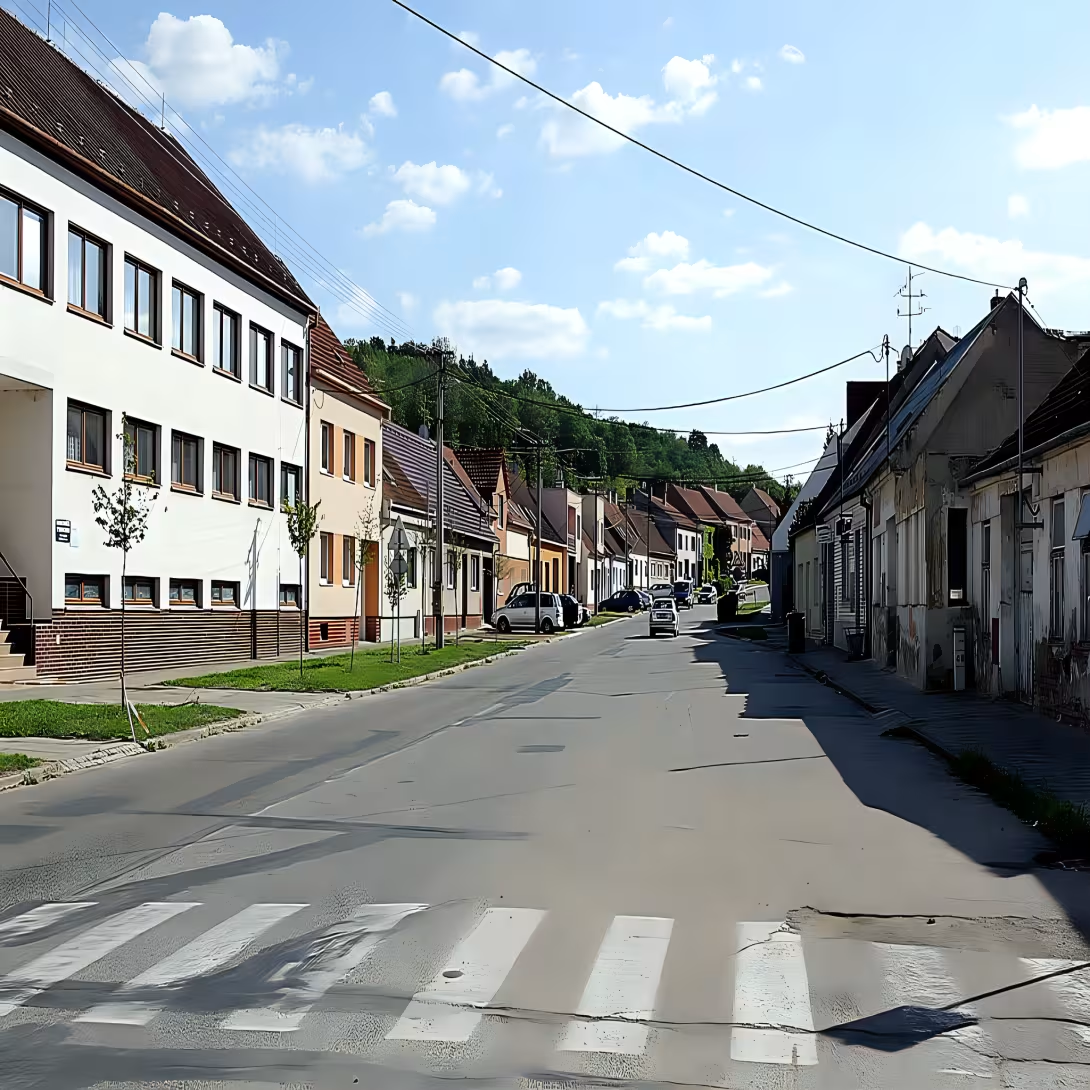
Česká Ves, in German Böhmdorf, is a former suburb of Hustopečí in the district of Břeclav in the South Moravian Region. It is the oldest settlement in the city area, whose beginnings date back to 1247. Originally formed a separate cadastral territory.
The first mention of this mansion dates back to 1247. The village was formed on the right, i.e. the west bank of the river Stinkovka. The findings of ceramics from the late 13th century suggest that on the Homoli Hill southwest of the village there was a castle. At the turn of the 13th and 14th centuries, a new town called Hustopeče was founded on the left bank of the river. As a result of this development, the original village became a suburban settlement.
The basic structure of Česká Vsi was a street street leading from the river Štinkovka southwest. It's consistent with today's Railway and Castle streets. In the first quarter of the 19th century, the building in Nádražní Street expanded to both sides. In the streets of Svatopluk Czech Republic and the camps there was a locally unilateral or bilateral construction. At the turn of the 19th and 20th centuries an evangelical church was added to the building, in the park above the Hustopečemi Chapel of St. Rocha and following the city building several schools.
There were significant changes in the surrounding area in 1886 by the creation of a Jewish cemetery west of Česká Vi. In 1894, a Hustopí railway station was built on the eastern edge of the suburbs, which served as the terminal station of the line from Šakvice. The administrative change occurred in 1950 in the framework of the cadastral reform, when Česká Ves was incorporated into the City Registry of Hustopeče.
In the 1960s the appearance of the site changed significantly. A part of the building, especially the northern part of the Railway Street, was demolished during the reconstruction of the road through the streets of Brno and Bratislava. This area was subsequently replaced by panel houses and amenities, which are now the Masaryk Square.
Today Česká Ves is fully integrated into urban development, although the original street skeleton still persists in some streets. Its value is mainly that it represents the first settlement of the region. Visiting this area allows you to track the transformation of the original village into a modern urban suburb.
Then and now
Drag the slider to compare how the landmark may have looked when it was built with the view today.
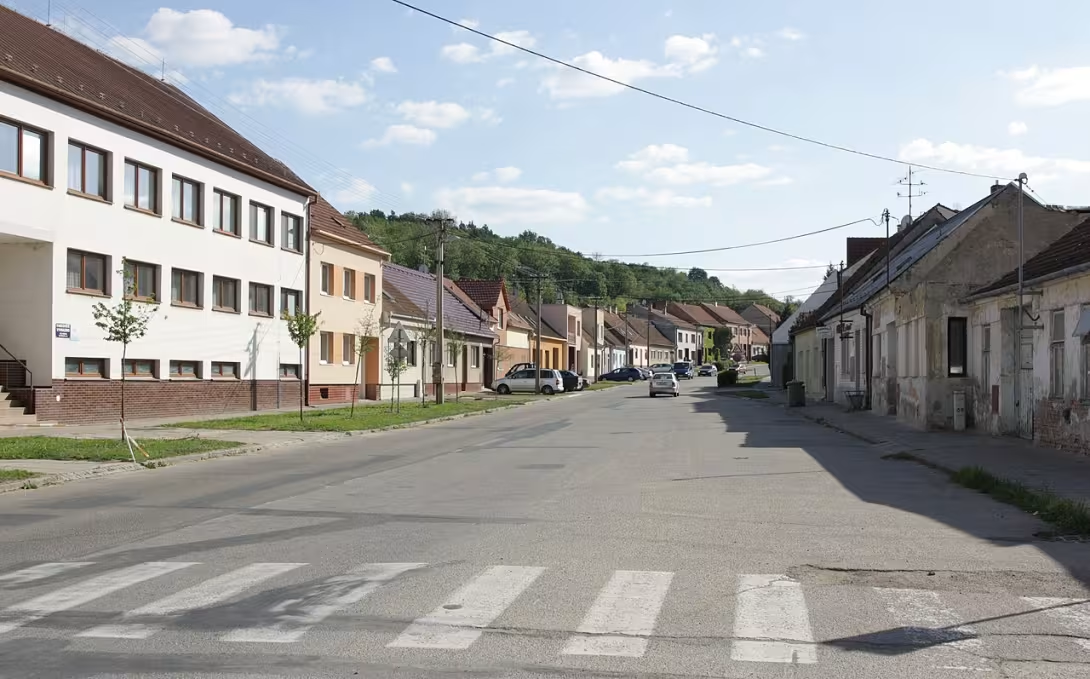
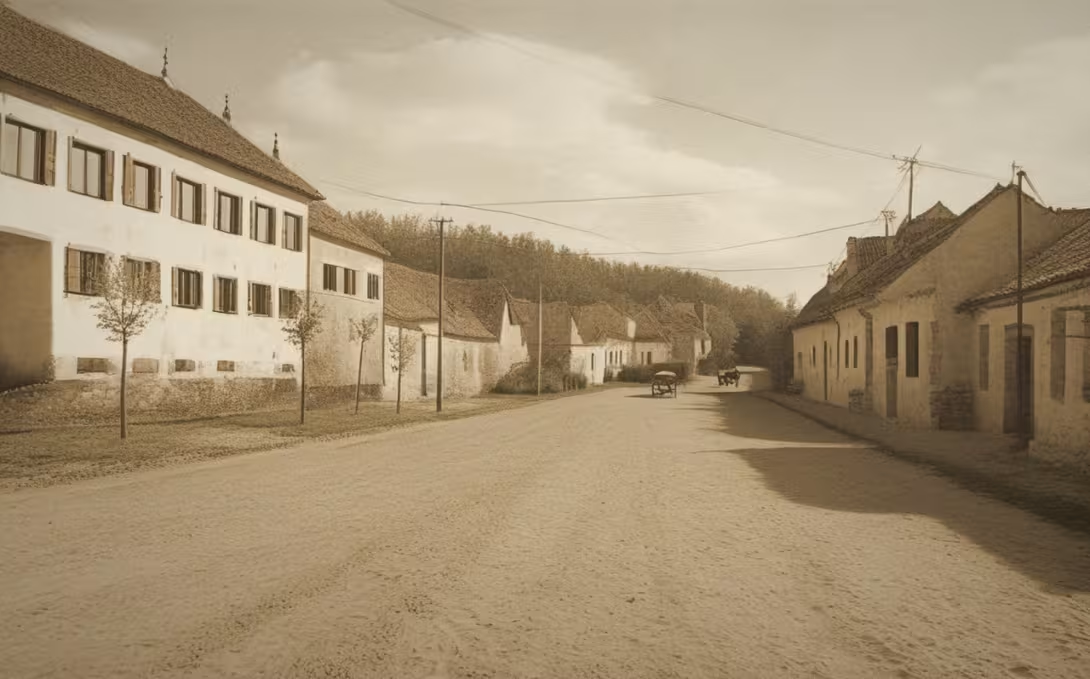
The historical appearance on the left is an AI-generated visualisation and serves as inspiration only.
Historical milestones
- 1247
- The first mention of a settlement on the right bank of the Stinkovka river.
- 1886
- The creation of the Jewish cemetery west of the Czech village.
- 1894
- Building a Hustopey station on the eastern edge of the suburbs.
- 1950
- Catastral reform and integration of the Czech village into the City Register Hustopeče.
Architectural development
Originally it was a street village leading from the Stinkovka river in the southwest direction. In the 19th century, the building expanded to today's streets of Nádražní, Svatopluk Čecha and Tábor. In the 1960s, the northern part of the Railway Street was demolished and replaced by panel houses and amenities.
Historical events
Around 1247, the first mention of the residence; in 1950, the integration of the Czech Vsi cadastrum into the City of Hustopeče.
Points of interest
- It's the oldest settlement in the city, its beginnings dating back to 1247. - The ceramic findings from the late 13th century suggest that there was a castle on the Homoli Hill. - In the first quarter of the 19th century, the building was expanded in Nádražní Street. In 1886 a Jewish cemetery was established west of the location. - In 1894 a railway station was built on the eastern edge, which served as the terminal station of the line from Šakvice.
Guide
This guide is narrated by a synthetic voice generated by artificial intelligence.
Show guide text
This text was created by artificial intelligence and has not been editorially reviewed. It may contain inaccuracies.
Welcome to Hustopec, the place where history intersects with every step you take here. You're standing in the space that once formed Česká Ves. You might think at first glance you're in the normal part of town, but look around you more carefully. Feel the atmosphere of these streets and see the space spread out here. Even though this area is now a full part of urban development, you can still feel the spirit of ancient times. If you look at the layout of the houses in some alleys, you'll notice that they kept their original skeleton. It's a silent testimony about how human dwellings have evolved for centuries. Let us now return together in time to make it clear to you exactly where you are. Česká Ves is not just an ordinary suburb, but basically the oldest settlement in the entire space of today's Hustopečí. The beginning dates back to a thousand two hundred forty-seven. So imagine what this place looked like almost 800 years ago. At that time Česká Ves formed a separate living unit. It was located on the right bank of the river Stinkovka, which left its mark in the landscape. At that time, this village was a separate community, with its own rhythms of life and economy. The historical context has changed over time. A new town Hustopeče began to emerge on the left bank of the river. With its growth and development, the role of Czech Vsi gradually changed. It became a suburb of the newly emerging city centre. This process of joining two sides of the river was a natural development that shaped today's city. Even though the border between the centre and this old village has now been deleted, the historical memory of the place remains. In the year a thousand and nine hundred and fifty then came the cadastral reform, which definitely included the Czech Ves in the City Register Hustopeče, thus completing the formal unification process. Now that you're standing in this space, pay attention to the surrounding buildings. Even if you don't find one dominant building here that overshadowed everything else, the whole neighborhood is a monument in itself. Take a look at the facade of the house and see the streets twirling and blending. It is this street skeleton we were talking about that is the most valuable element you can see here. It's a print of the original planning village that survived centuries of urbanization. Now, if we think about how this place changed in the newer times, we can focus on the eastern and western edges of this site. Let's move on to the eastern edge of the suburbs. It was here in the year one thousand eight hundred ninety-four that the Hustopean station was established. The arrival of the railway was a turning point for the whole area, brought new movement of people and goods and changed the dynamics of life in the Czech village. Changes in the development are also related to this development. In the first quarter of the nineteenth century, a significant expansion of the building in Nádražní Street started, reflecting the increasing importance of this transport artery. But when we look west, we come across a place of very deep and quiet significance. In the year of a thousand eight hundred eighty six, a Jewish cemetery was established west of the Czech village. It is a place of peace and respect that resembles the religious and cultural diversity of the people of this region. The presence of a cemetery near the old settlement tells us the story of the people who lived here, worked and left their trail in the history of the city. Now I want to take you to something that borders on mystery and mystery. Look towards the Homoll Hill. Although today may look like ordinary terrain, archaeological findings tell a different story. This is where the pottery was found from the late 13th century. These findings suggest that there was probably a castle on the hill. So imagine that over the whole Czech Vesi there was a small fortified space that was used to defend or as a seat of local power. It's a fascinating notion that beneath the layers of earth and time, the secrets of the Middle Ages are still hidden, waiting for their full disclosure. It is fascinating to realize how the small estate on the bank of the Stinkovka River has become an organic part of the modern city. Česká Ves is like an old root from which today's Hustopeče grew. It is a place where the oldest history meets the industrial development of the railway and where the silent cemetery is adjacent to the daily traffic. I hope this short trip to the past has helped you see this place in a new light. Even if you don't see monumental palaces here, history is present here in every stone and every bend of the street. I am now asking you to explore the area. Walk slowly through the alleys that still maintain their old structure, and try to imagine the lives of the people who lived here hundreds of years ago. Feel the peace and continuity of this place. Thank you for your attention and I wish you a pleasant continued journey along the history of Hustopečí. Say good-bye to this part of town and go out to discover other hidden treasures of this beautiful Moravian region.
Tips for visitors
The best time to visit this historic place is spring and autumn days, when the weather is mild and vegetation around the river Stinkovka provides a beautiful contrast to the historical environment.
Transport to Hustopečí is ensured by road network and public transport, and specific connections and departure times are always appropriate to verify in the current timetable.
In order to explore the area, bring comfortable shoes for walking on uneven terrain and plenty of drinking water, especially during the summer months. If you are planning a longer walk to the river Stinkovce or to the hill of Homol, a light jacket may be useful, because the temperature may be slightly lower in the valleys and on the hills than in the city centre.
For photography is ideal morning or late afternoon light, which creates soft shadows and emphasizes the texture of historical buildings. The best views can be obtained from the opposite bank of the river Stinkovka, where you can capture the overall context of the settlement, or from the height of Homol Hill, which offers panoramic views of the surroundings. Observe that the shadows of trees or buildings do not interfere with the main object.
In the immediate surroundings, at a short walk distance, there is a Jewish cemetery, which is an important part of the cultural heritage of Hustopečí and offers a quiet place to think about. For families with children, the surrounding area of the river Stinkovka is suitable for easy walking, although it is necessary to ensure safety at the water surface. Homol Hill can be an interesting destination for older children and adults with a short hike overlooking the city.
Frequently asked questions
Can the monument be visited?
This is a structure in a public space that can usually be seen from outside free of charge. We have not verified that this particular one is freely accessible.
Where is the monument?
Location: Hustopeče, Jihomoravský kraj. The map on this page shows the exact spot.
For kids
Imagine going back to a time when Czech villages looked a little different than today. They were mostly by the rivers and were fortified by walls and wooden towers. Castle Česká Ves was one of them.
This place was important because there were people who cared about agriculture and livestock farming. They worked in the fields, in the woods and by the river. They were real heroes who had to deal with nature.
Businesses nearby
Do you run a restaurant, accommodation, shop, museum, rental, wellness or other visitor service near this monument? Show yourself directly to the people heading to it — this is how they will see you in the app and on the web:
Nearby
Říčka Štinkovka, Homolí kopec, židovský hřbitov a hustopečské nádraží.
Accommodation nearby
Themed route
Here is the design of the thematic route:
1. Hustopean railway station (transport node) - Ideal start point for visitors arriving by train. 2. Jewish cemetery (historical place) - A place with a deep history that resembles the history of the local community. 3. Česká Ves (main monument) - Heart trip where you can admire traditional architecture and atmosphere. 4. River Stinkovka (water flow) - A pleasant walk along the water that offers peace and rest. 5. Gay hill (view) - Final point of the route from which you can look around.
Seasonal recommendations
In spring the surroundings of the monument awaken to life and the landscape around Hustopečí green. The light is fine and suitable for capturing the details of the building from the outside. We recommend shoes suitable for wet grass and visit in the morning when the air is the cleanest.
In the summer months it dominates areas of intense sun and hot air. The buildings in bright light seem very strong, but the surrounding nature can be burned. It is advisable to choose a light outfit, hat and come either early in the morning or at dusk to avoid the greatest Closing in the heat.
Autumn brings gold to the South Moravian region and a specific fog that gives the place a mysterious atmosphere. The lighting is softer and more saturated. For a walk from the outside is ideal layered clothes and solid shoes that can handle fallen leaves and cooler wind.
In winter, there is a monument in silence and calm, possibly in white snow, which highlights its outlines in space. The atmosphere is cramped and freezing. It is necessary to wear warm winter clothes and waterproof shoes, while the best time to visit is around noon when there is the most daylight.
Visualizations and artistic views


The visualisations are generated by artificial intelligence and serve as inspiration.
Photos from the area
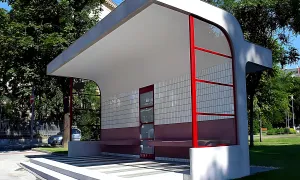
Real photos taken near the monument

Zdroj a licence jsou uvedeny u každého snímku.
Atmosphere of the place
This atmospheric visualisation of the place and period was generated by artificial intelligence. It is not real footage of the location.
Tips from visitors
No tips yet. Be the first!
Log in and add your tip.
Sources and literature
Photos: RomanM82 / CC BY-SA 4.0, rozlišení zvýšeno umělou inteligencí — Wikimedia Commons. The author and licence also appear when you hover over the image.
Faktickým podkladem tohoto textu byl článek na Wikipedii, jehož autory jsou přispěvatelé Wikipedie. Článek je dostupný pod licencí CC BY-SA 4.0.
Location on the map




Příběhy a pověsti
Legendy, pověsti a příběhy spjaté s touto památkou
Fotografie návštěvníků
Zatím žádné fotografie. Buďte první, kdo přidá fotografii z návštěvy!
Log in a přidejte svou fotografii nebo hodnoťte.
Za ověřenou návštěvu v aplikaci získáte víc bodů — poznáme podle GPS, že jste na místě.
Reviews and comments