



kaple svatého Rocha (Hustopeče) Chapel
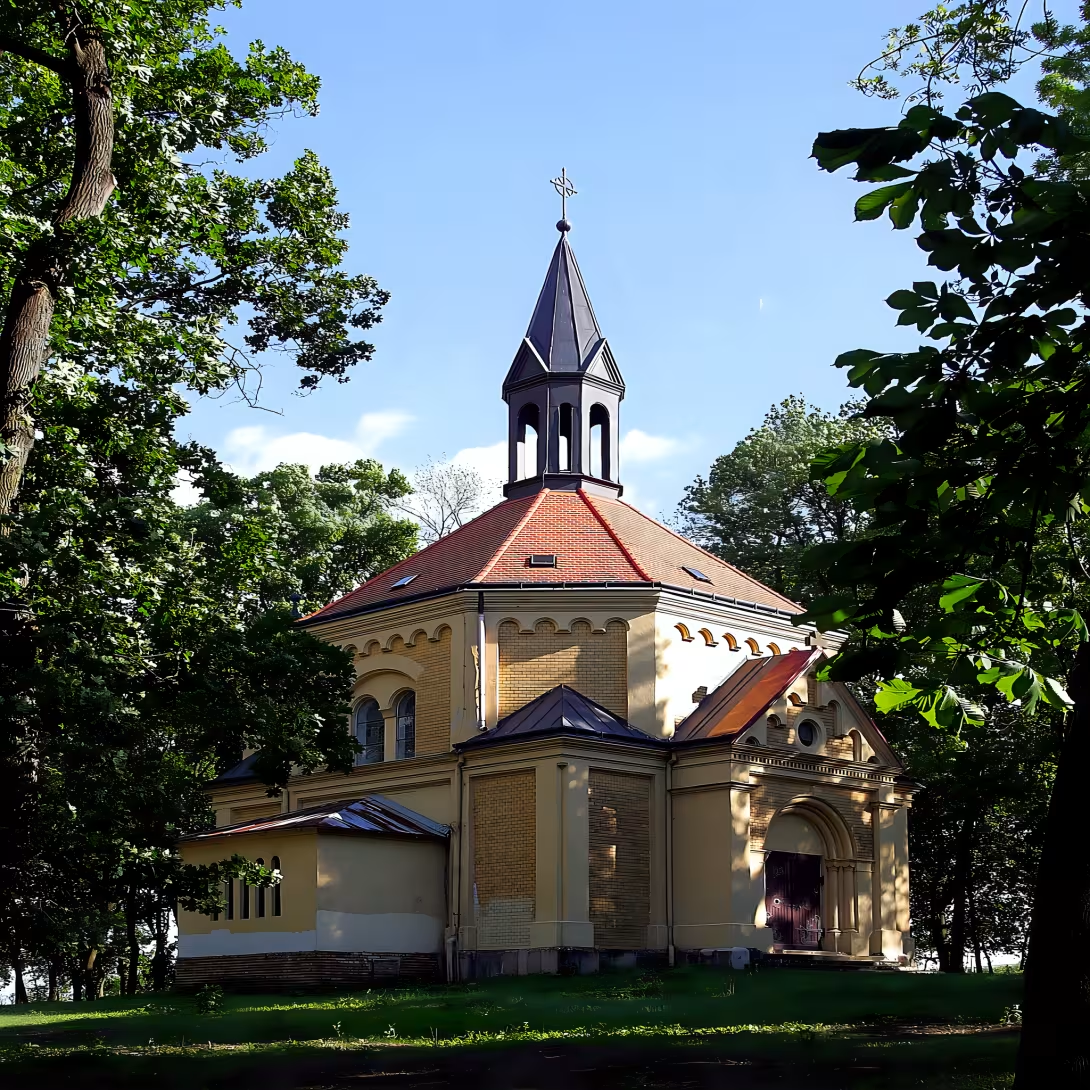
The chapel of St. Rocha stands on the hill of the Cross Hill on the southern edge of Hustopečí and represents a work from the beginning of the 20th century with a deep historical layer. It bears its name according to St. Roch, who has been dedicated for more than two centuries to a holy place in the same place.
The original building, a small baroque chapel, was built between 1682 and 1690 in honor of the rejection of the plague epidemic. Next to St. Rocha was also dedicated to St. Shebastian and St. Rosalie - the saints traditionally sown in the time of plague wounds. In the 18th century the chapel gradually gained meaning. The priest František Lober expanded it significantly in 1726, and over time it became an important pilgrimage place, through which many religious processions went through.
At the turn of the 19th and 20th centuries they decided to build a new, larger chapel. In 1901 a New Romanesque chapel was built on the site of the old building, which maintains a tradition of connection to the past. The construction has maintained its purpose for years. It was only after the demolition of the nearby parish church of St. Wenceslas in 1962 that it served as a spare space for the parish services.
Architecturally, the chapel is a one-ship building with an octagonal plan. On its east side lies apsida surrounded by four-sided spaces - sacristy and depository. From both the north and the south side, they follow the boat to the rectangular chapel. The entrance on the west side consists of a pre-planted porticus. The facade is made up of rust and plastered by the walls of New Romanesque architectural elements.
The interior of the chapel is richly equipped and decorated by famous artist Ludwig Kolk. The windows fill his stained windows. Between 1964 and 1965 a wall fresco Crucifixion was created in the presbytery - a work by which Kolek responded to the recent demolition of the church. Other frescomals spread around the presbytery: on both sides of the Apostolic Crucifixion and crowned with thorns. In the chapel itself there are two fresco masters, on each side one by one, capturing scenes from the cross road. Interior equipment - sacrifice table, ambon, tabershop and wall graphics - all come from the workshop Louis Kolka.
Today the chapel represents an extremely well preserved example of interwar sacral architecture with quality artistic equipment. Its location on the Cross Hill and the unique link between Baroque tradition and modernist processing makes it an interesting goal for visitors interested in Czech stone history and sacral art.
Then and now
Drag the slider to compare how the landmark may have looked when it was built with the view today.
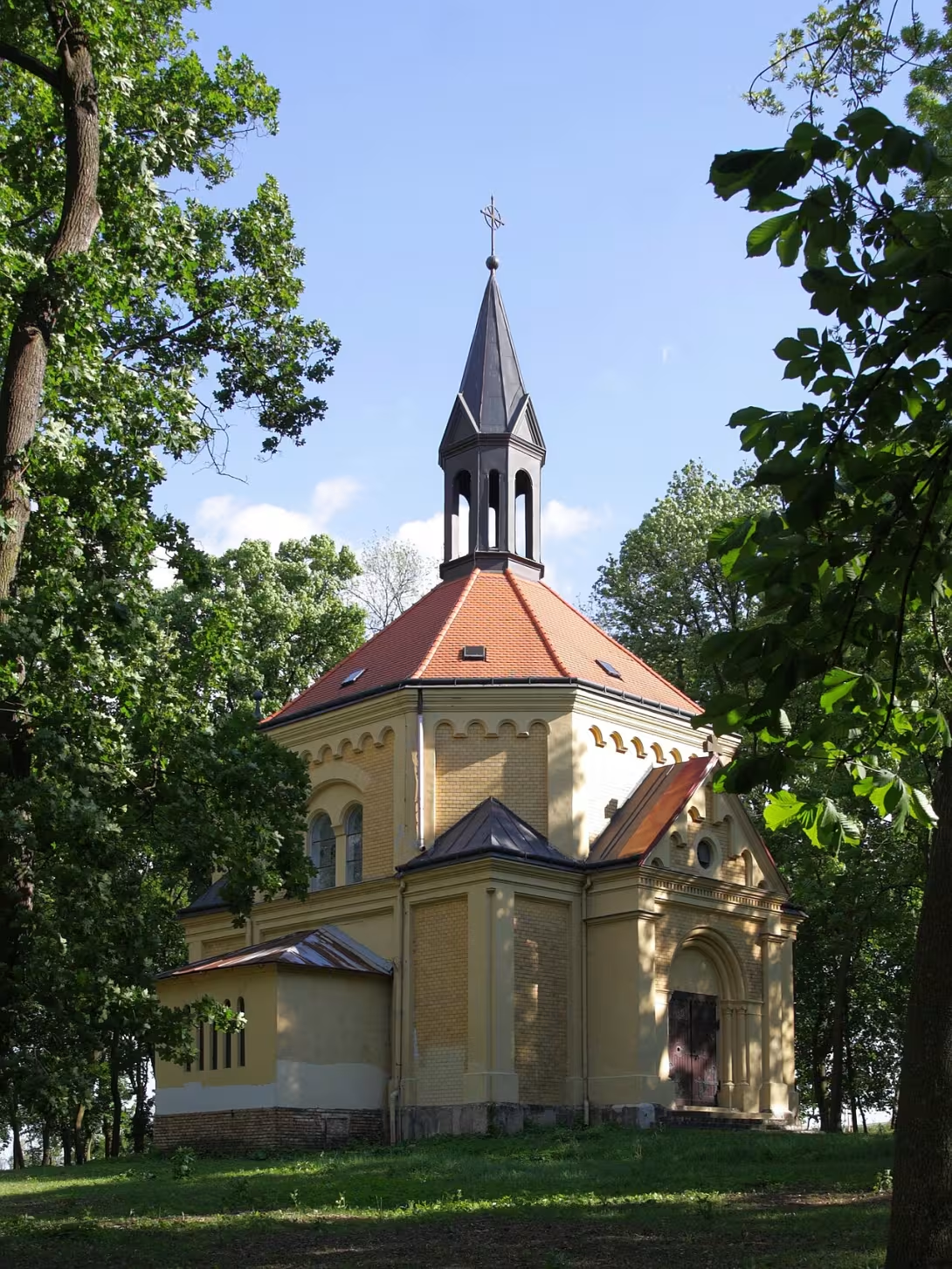

The historical appearance on the left is an AI-generated visualisation and serves as inspiration only.
Historical milestones
- 1682
- Construction of the original Baroque chapel.
- 1726
- Enlargement of the chapel by vicar František Lober.
- 1901
- Building the current New Romanesque Chapel.
- 1964
- Implementation of wall fresco in presbytery.
Architectural development
The Baroque chapel was originally built on the site, which was extended in 1726. In 1901 a new, larger chapel was built in the New Romanesque style. The building has a central octagonal plan with added apsid, sacristy and depository.
Historical events
- 1682-1690
- The creation of the original baroque chapel in honor of averting the plague epidemic.
- 1726
- Significant extension of the chapel by priest František Lober.
- 1901
- Building the current New Romanesque Chapel.
- 1962
- The destruction of the parish church of St. Wenceslas, after which the chapel served for worship.
Points of interest
- St. Rocha's Chapel stands on the hill of the Cross Hill and is a work from the beginning of the 20th century. - The original building was a small Baroque chapel built between 1682 and 1690, dedicated to St. Rocha, St. Shebastian and St. Rozalia. - In 1901 a New Romanesque chapel was built on the site of the old building. - The chapel is a one-ship building with an octagonal plan and the facade consists of a rust and plastered wall decorated with new Romanesque elements. - The inside of the chapel is equipped with parts of Louis Kolka, including color stained windows and frescoes.
Guide
This guide is narrated by a synthetic voice generated by artificial intelligence.
Show guide text
This text was created by artificial intelligence and has not been editorially reviewed. It may contain inaccuracies.
On the southern edge of Hustopeče, on a hill called Křížový vrch, in German Kreuzberg, stands the chapel of saint Roch. Today's Romanesque Revival building dates from nineteen hundred and one, but the place itself has a much older history.
Originally, there stood a small Baroque chapel here. It was built between sixteen eighty-two and sixteen ninety in honour of the warding off of a plague epidemic and was dedicated to three protectors against plague: saint Roch, saint Sebastian and saint Rosalia. In seventeen twenty-six, the parish priest František Lober significantly expanded it. In the eighteenth century, the chapel was a place of pilgrimage, to which countless processions came. In nineteen hundred and one, a new, larger building replaced the old chapel. When the parish church of saint Václav ceased to exist in nineteen sixty-two, the chapel served for a time for services.
The chapel is single-nave and has an octagonal ground plan. On the east, an apse adjoins the nave, and on its sides are a sacristy and a storeroom. On the north and south, smaller rectangular chapels are attached to the nave. The entrance on the west side is formed by a projecting portico. The facade combines exposed and plastered masonry with Romanesque Revival elements.
The interior is closely connected with the painter Ludvík Kolek. According to his design, coloured stained glass windows were created, and from him comes the furnishings: the altar table, the ambo, the tabernacle and wall graphics. He also designed and himself painted all the frescoes in the chapel.
The most striking of them is the wall-sized fresco of the Crucifixion in the presbytery from nineteen sixty-four to nineteen sixty-five. It is based on Kolek's painting The Crucified by the Ruined Cathedral, in which the artist responded to the demolition of the Hustopeče church. On the sides of the presbytery are two more frescoes, Crowned with Thorns and Crucifixion, and on each side of the nave is one fresco panel with the Stations of the Cross.
Tips for visitors
The best time to visit the chapel of St. Rocha is in the summer months, especially in the spring and autumn periods. At this time there are beautiful landscapes with flowering bushes and trees, which provides an ideal environment for relaxation and sightseeing. The view of the surrounding landscape is particularly impressive at noon or evening, when the sun illuminates the area with special light.
Rocha Chapel is well accessible by car and public transport. For those who prefer public transport, it is advisable to verify the current connection by using an online search engine or mobile application for local transport services.
When visiting the chapel of St. Rocha, it is advisable to take a camera or smartphone with you in order to capture the impressive appearance of New Romanesque architecture and surrounding landscape. Transportation clothing suitable for outdoor activities is also recommended, especially if you plan to walk around the area of the Cross Hill.
Photography: The best places for photography are mainly the east side of the chapel and the area around the Cross Hill where the light can be the most beautiful especially in the morning or evening. Photography is also worthy of the western side, when the sun sets behind the horizon and illuminates the chapel and surroundings.
What to visit in the area: Near the chapel of St. Rocha there is a cross hill, which offers beautiful search routes and views of Hustopeče and other areas. For families with children it is suitable to walk on the surrounding terrain where children can play and discover nature.
Frequently asked questions
Can the monument be visited?
Religious buildings are usually open mainly during services; at other times a visit is normally arranged with the parish or the operator. We have not verified specific times.
Where is the monument?
Location: Hustopeče, Jihomoravský kraj. The map on this page shows the exact spot.
Why is the monument protected?
It is listed in the Central List of Cultural Monuments of the Czech Republic as a cultural monument (register no. 15660/7-1257).
For kids
Imagine going back 125 years to the city of Hustopia. It was like a game where you were alone on adventure! Hustopeče was then a small town that was located by the river Dyje. People lived here partly in wooden houses, but also in brick buildings with high roofs.
There were a lot of farmers who grew grain and fruit trees. They had horses and animals on farms. In summer, people exposed to drought, snow and frost. But life was still nice here.
Businesses nearby
Do you run a restaurant, accommodation, shop, museum, rental, wellness or other visitor service near this monument? Show yourself directly to the people heading to it — this is how they will see you in the app and on the web:
Nearby
The Hustopi Cross Hill.
Accommodation nearby
Themed route
Thematic cruise route from Hustopeč
1. St. Rocha Chapel (Hustopeče) * Type: * Religious monument The chapel of St. Rocha, located in the heart of Hustopeč, is a small sacral resort with a rich history. Its simplicity and quiet environment attract visitors seeking rest and immersion in the spirit of the past.
2. Cross Hill in Hustopy * Type: * Historical site, monument The cross hill is a historic location with several stony crosses and monuments. It is a place full of history that offers a view of the Hustopeče and surrounding landscape. Exploring this area provides insight into the past of the region.
3. Park at the chapel of St. Rocha * Type: * Green zone, relaxation area The park around the chapel offers a peaceful and pleasant space for relaxation and walks. Its green courtyard is an ideal place to relax after exploring historical monuments.
4. Road by Hustopeč * Type: * Walk, landscape view A short trip around the village offers an opportunity to explore local architecture and greenery. It is an ideal way to learn more about Hustopečes and their environment.
5. The village in Hustopečech * Type: * Local center, tour The village is the heart of Hustopeč and offers an opportunity to walk through local shops and restaurants. It is an ideal place to stop after a day trip to enjoy local gastronomy or to buy souvenirs.
This route offers a comprehensive view of Hustopeče and its historical and natural beauty.
Seasonal recommendations
Spring: The Chapel of St. Rocha in Hustopeč offers visitors a special atmosphere of spring, when nature wakes up and flowering shrubs create a living contrast to historical walls. Sunshine illuminates the chapel in a special way, adding something magical and peaceful to the space. This season it is recommended to visit the memory in the early afternoon time, when the crowd rarely gets too much and you can enjoy a quiet walk. Dress appropriately for variable spring weather - mild clothes with the possibility to add layers in case of cold or rain.
Summer: For years, St. Rocha's Chapel is a popular place for an afternoon visit where people try to avoid heat and howitzers. Sunlight creates warm radiation on the walls of the chapel, which adds something comfortable and peaceful to the atmosphere. In the main summer season more people can get, so it is advisable to visit the memory earlier in the day or later in the evening to enjoy a quieter space. Dress up light and comfortable clothes, suitable for sunlight, and do not overlook UV protection.
Autumn: In autumn, the chapel of St. Rocha grows melancholic beauty when leaves of falling trees create colorful wallpaper on the way in. Sun lighting is less intense, which adds something calm and quiet to the atmosphere. This season the crowd rarely gets power, so it's a good time for a quiet tour. Dress for variable autumn weather - mild clothes with the possibility to add layers in case of cold or wet weather.
Winter: The winter visit to St. Rocha's Chapel offers a unique atmosphere where the sun's rays are projected on the snowy surroundings and create a quiet shine. This season the crowd rarely gets power and you can enjoy a quiet walk. Dress up warm clothes, suitable for cold weather, including hat and gloves to enjoy a visit without discomfort.
Visualizations and artistic views


The visualisations are generated by artificial intelligence and serve as inspiration.
Photos from the area
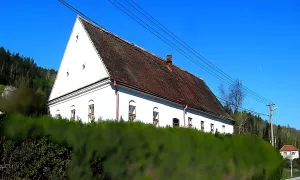
Real photos taken near the monument


Zdroj a licence jsou uvedeny u každého snímku.
Atmosphere of the place
This atmospheric visualisation of the place and period was generated by artificial intelligence. It is not real footage of the location.
Tips from visitors
No tips yet. Be the first!
Log in and add your tip.
Sources and literature
Photos: RomanM82 / CC BY-SA 3.0, rozlišení zvýšeno umělou inteligencí — Wikimedia Commons. The author and licence also appear when you hover over the image.
Faktickým podkladem tohoto textu byl článek na Wikipedii, jehož autory jsou přispěvatelé Wikipedie. Článek je dostupný pod licencí CC BY-SA 4.0.
Location on the map



Příběhy a pověsti
Legendy, pověsti a příběhy spjaté s touto památkou
Fotografie návštěvníků
Zatím žádné fotografie. Buďte první, kdo přidá fotografii z návštěvy!
Log in a přidejte svou fotografii nebo hodnoťte.
Za ověřenou návštěvu v aplikaci získáte víc bodů — poznáme podle GPS, že jste na místě.
Reviews and comments