



Černý pivovar Building
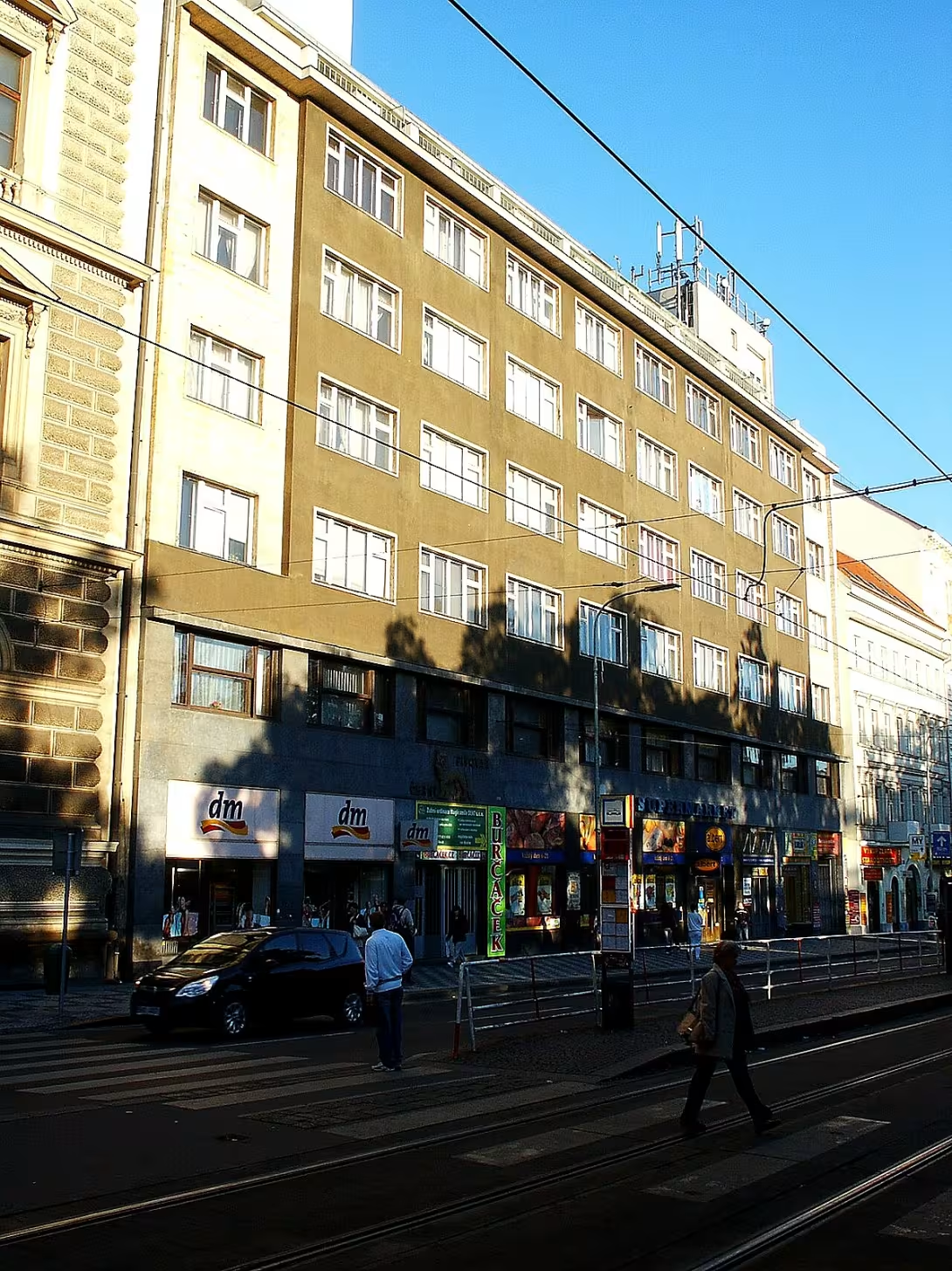
Černý pivovar is a functionalist rental house from 1933-1934, located on Charles Square in Prague 2. The building is located on the site of the former medieval brewery and is part of the cultural monument and the UNESCO World Heritage Site.
The first records of the construction of this land, which belonged to the Zderazski monastery, dates back to 1377. Soon, beer was made here. In the 19th century the brewery was the property of Ferdinand Náprstka, whose family had experience with the brewery and from the operation of the brewery U Halánky. The premises were used as a venue for meetings of Czech patriots and there were meetings and collections to support national associations. It was later owned by the Pflanzer family, who operated the brewery until 1918 and the heirs until the cancellation of the operation in 1920.
Before the construction of the current building there were two houses. The first was the Baroque Vyšebrodský, belonging to the Cistercian monastery. The second was the Classicist New Town's Golden Lion Brewery, which, thanks to the dark facade, won the nickname Pflanoblov Black Brewery. The building had a deep well and large basements for cooling beer with ice. In 1920 an Art Nouveau building of the Tribune printer, designed by architects Bohumir Kozák and Karl Roštík, was built in the yard.
In the early 1930s, the Italian insurance company Riunione Adriatica di Sicurtà bought both houses. The new owner forbade architect Karl Kotas to design a residential house with a restaurant in the street part and a residential house in the yard. The old buildings were demolished and in 1933-1934 a new construction was created for the employees of the insurance company, which was carried out by Jan Matoušek.
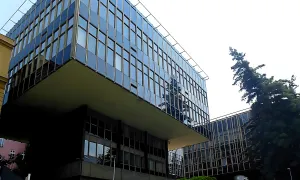
The building is a three-wing seven-storey building with a flat roof and a reinforced concrete skeleton. The last floor retreats and two symmetrical coupons are located on the level of the eighth floor. The street facade is covered with dark granite and artificial stone, while the window belts have travertine tiles. On the facade there is a metal relief with a gold lion and the inscription Černý pivovar, the author of which is František Bžoch, reminiscent of the emblem of the original Golden Lion house.
There was a restaurant and a buffet on the ground floor. Ladislav Machon and painter Alois Bílek, who designed stained windows, worked on their interior. The outside neon was created by the graphic designer Jaroslav Benda. However, these elements were not preserved in the reconstruction around 1971. The passage on the right side of the house leads to the courtyard, where the facade breaks the balconies and stairs. In front of them is a unilaterally rounded building of the original restaurant.
Currently, the building serves mainly for housing and commercial purposes. The ground floor operation was replaced by a supermarket and a drugstore around 2000. The printer in the yard was renovated in 1950. Since 2002, the building has been protected as a cultural monument.
This monument represents an important example of Prague functionalism, which was able to integrate modern architecture with historical memory of the site. Its visit offers insight into the urban development of New Town during the interwar period.
Then and now
Drag the slider to compare how the landmark may have looked when it was built with the view today.
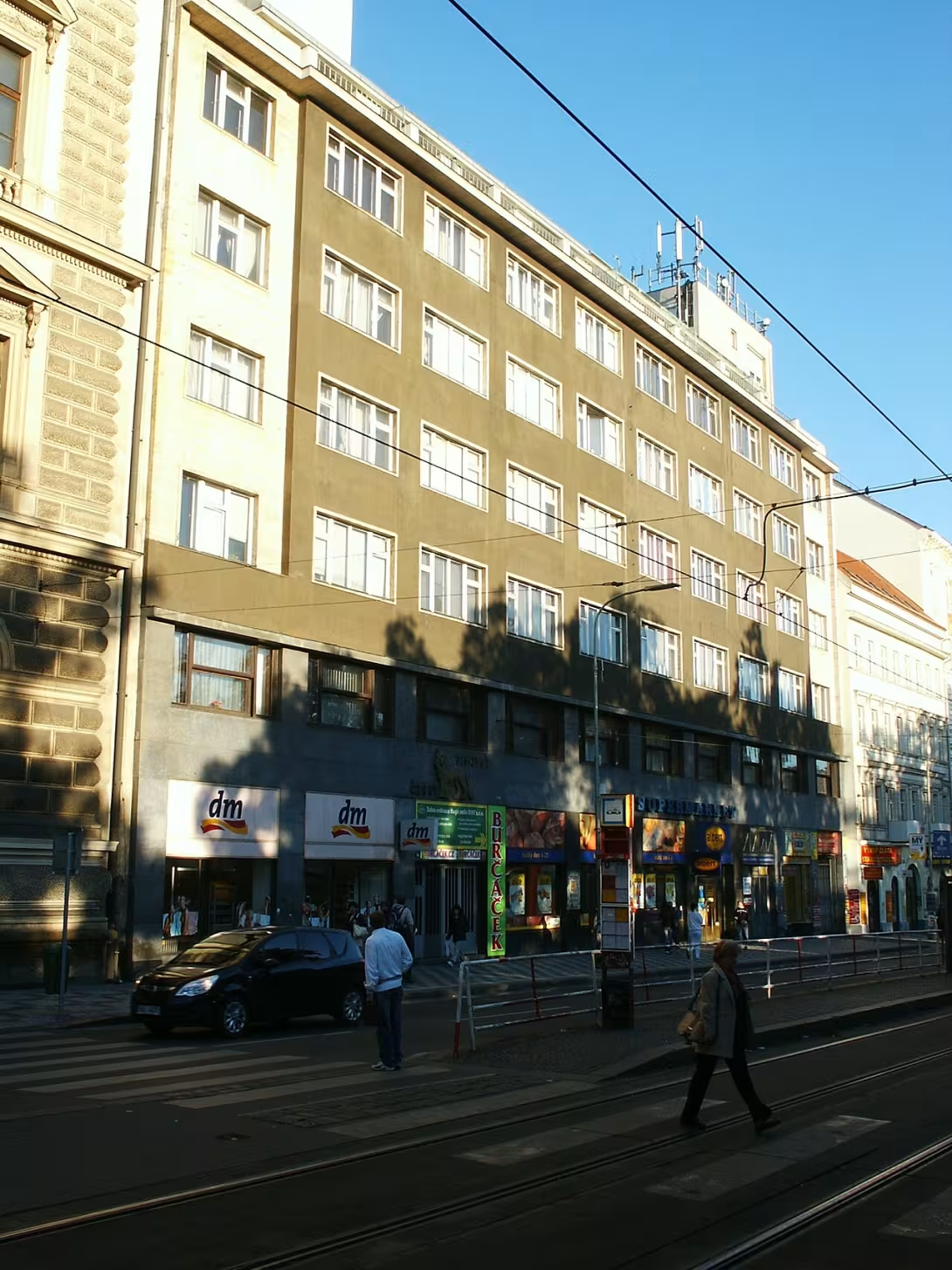
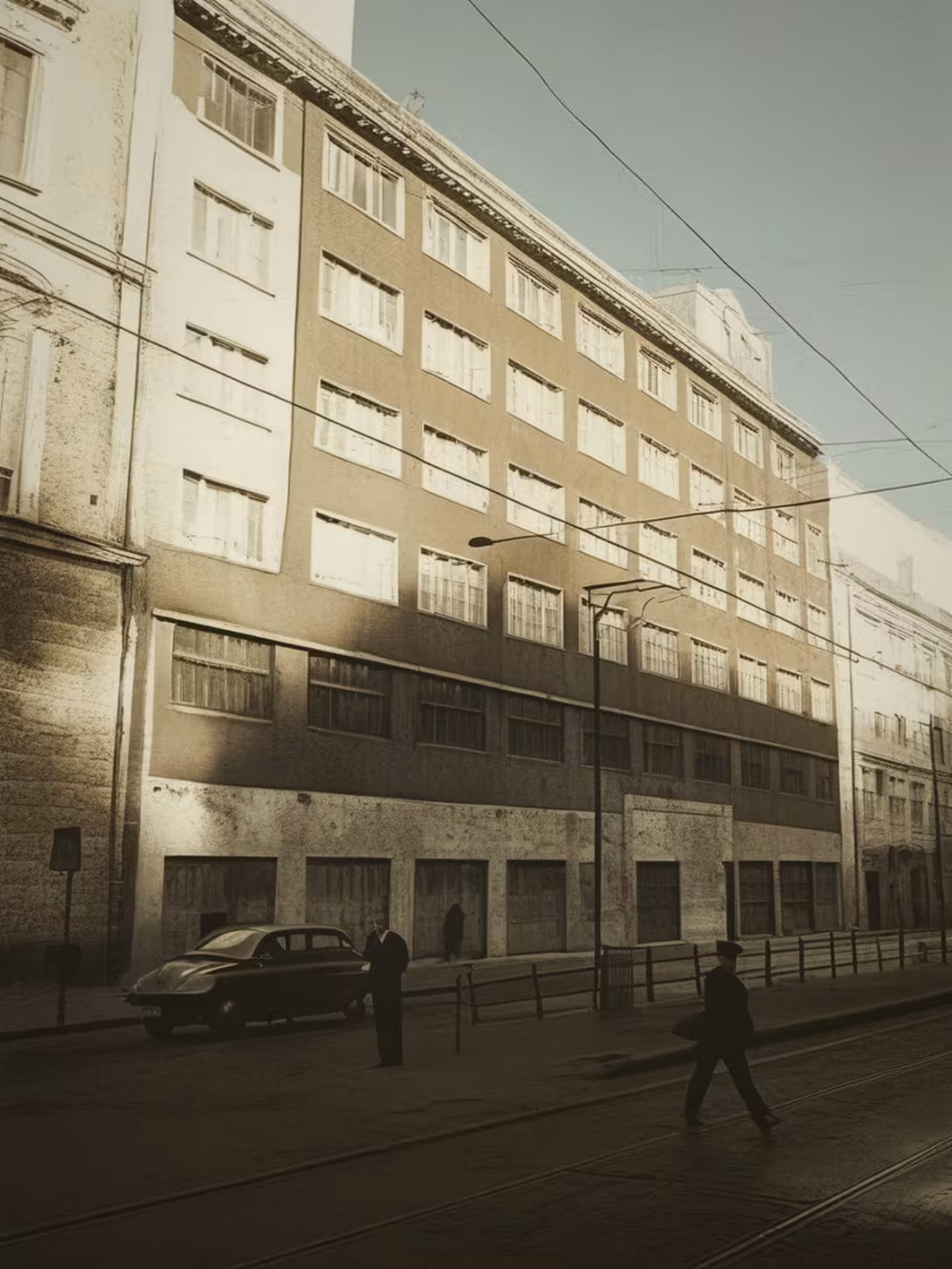
The historical appearance on the left is an AI-generated visualisation and serves as inspiration only.
Historical milestones
- 1377
- First records of construction on the site of the Zderazski monastery
- 1920
- Cancellation of brewery operation and creation of the Tribune printer
- 1933-1934
- Construction of the current functionalist house
- 1950
- Reconstruction of the printer in the yard
- 2002
- The building is protected as a cultural monument
Architectural development
Originally there was a Baroque house with a bright facade, later a classic brewery Golden Lion. In 1920, the Tribune printer was built in the yard. In 1932-1934, old houses were demolished and new buildings with functionalist architecture were created in their place.
Historical events
- 1377
- First evidence of the plot.
- 1920
- Cancellation of the brewery and subsequent construction of the Tribune printer.
- 1934
- The establishment of a functional rental house according to the Karl Košárek project.
Owners
The original brewery belonged to various owners, including the family Náprstek and Pflanzer. In 1932, the Italian insurance company Riunione Adriatica di Sicurtà bought both houses.
Points of interest
- The building is at the site of a former medieval brewery and is part of the UNESCO World Heritage Site. - The first building records on this property dates back to 1377. - Before the construction, there was the Golden Lion Brewery, which, thanks to the dark facade, was nicknamed the Pflanmonster Black Brewery. - The original brewery had a deep well and large basements for cooling beer with ice. - On the facade there is a metal relief with a golden lion, which resembles the emblem of the original Golden Lion house.
Guide
Show guide text
This text was created by artificial intelligence and has not been editorially reviewed. It may contain inaccuracies.
Welcome to a place full of history and architectural art - you are standing before the Black Brewery in Prague 2. This building, which now boasts its modern functionalist form, has a rich history that goes back to the Middle Ages.
Let's dive into the past. The first records of the buildings on this property dates back to 1377, when it was part of the Zderazski monastery. Originally, it was the place of the brewery, which had disappeared in 1920, followed by the Tribune printer instead. However, the most important changes occurred between 1933 and 1934 when the current functional building was built under the leadership of architect Karel Košárek. This building preserved the elements of the original brewery, which can be seen on the fascinating metal relief with the golden lion on the facade.
Look up and note this detail - metal relief with a golden lion is not only an aesthetic decoration, but also a reference to the history of the Golden Lion brewery. This brewery was known for its dark facade and was nicknamed the Pflanmonster Black Brewery.
The interesting thing is that this place is not only important for the history of Prague. Černý pivovar stands on land that was once part of the UNESCO World Heritage Site. This gives this place even more weight and interest.
Now let's look at what the building has to offer today. Although it once served brewing, it is now mainly a house for housing and commercial purposes. The reconstruction of the yard printer in 1950 also contributed to its modern form.
Imagine you're here in the mid-30s of the last century and you see this impressive place gradually forming into what it is today. This was a period of changes and architectural innovations that are captured in every detail.
When you walk around the building, you may wish to immerse yourself in the atmosphere of the past and realize how history and modernity coexist in harmony here. Think about the lives of people who once walked these halls or worked in a brewery.
And now that you have looked at Černý pivovar and its rich history, you can continue your Prague 2 survey. There are many other interesting places waiting to be discovered. I hope this guide inspired you to explore and explore the history of this fascinating city.
Thank you for your visit to the Black Brewery. When you return, we welcome you again on other pilgrimage trips through historical monuments of Prague!
Tips for visitors
The best time to visit the Black Brewery is an early afternoon or evening when the place is quieter and fewer people. This time allows you to enjoy historical architecture without disturbing the effects of the day.
When visiting, take with you clothes suitable for the weather and perhaps even shoes on the sidewalk if you plan to walk through the surrounding historic streets. The photos will be an excellent memory item.
Photography of the Black Brewery offers the best possibilities from the side of Charles Square, where the light is ideal for capturing architectural details. Morning and evening hours are particularly favourable because of softer light.
In the surroundings of the Black Brewery there are many other attractions such as Charles Square with its historical buildings and monuments. For families with children it can be fun to visit nearby parks or explore other cultural institutions in the centre of Prague 2.
Frequently asked questions
Can the monument be visited?
Some buildings of this kind are open for guided tours, others serve another purpose or are privately owned. We have not verified whether and when this monument is open – please ask the operator.
What are the opening hours and admission?
We have not verified the opening hours or admission. Current information is published by the operator.
Where is the monument?
Location: Praha 2, Hlavní město Praha. The map on this page shows the exact spot.
Why is the monument protected?
It is listed in the Central List of Cultural Monuments of the Czech Republic as a cultural monument (register no. 1000471958).
Businesses nearby
Do you run a restaurant, accommodation, shop, museum, rental, wellness or other visitor service near this monument? Show yourself directly to the people heading to it — this is how they will see you in the app and on the web:
Events nearby

Zdroj akcí: otevřená data měst a obcí ČR (Národní katalog otevřených dat) a kalendář akcí Národního památkového ústavu.
Nearby
Černý pivovar se nachází na Karlově náměstí v Praze 2, což je historické centrum s mnoha dalšími památkami a kulturními institucemi.
Accommodation nearby
Trips and activities nearby
Guided tours, tickets and activities nearby from GetYourGuide
Affiliate link: if you buy from the partner, we may receive a commission. The price for you does not change.
Search tours and activities →Themed route
Thematic cruise route around the Black Brewery
1. Černý pivovar (building) Type: historical building Why is it worth a visit: This monument is not only an important part of Prague's beer shop, but also a beautiful example of architecture with a rich history. The brewery was founded in 1870 and is known for its traditions and modern approach to brewing.
2. Charles University (university) Type: educational institutions Why is worth a visit: Located on Charles Square and is the oldest university in Central Europe, founded in 1348. It's a place full of history and culture that can be a fascinating sight for every traveler.
3. Charles Square (Square) Type: public square Why is worth a visit: This central town square is an important cultural and historical location. It is known for its architecture, where there are many protected buildings, such as Charles University.
4. Old Town Brewery (brewery) Type: historical brewery Why is it worth visiting: Even if it is not directly on Charles Square, it is one of the oldest beer traditions in Prague. It is possible to visit and explore its history and modern production.
5. Old Town Hall (Town Hall) Type: historical monument Why is worth a visit: This famous building is not only an architectural pearl, but also an important place in Prague history. It is famous for its exhibitions and views of the Old Town Square.
This route offers a view of the rich cultural and historical page of Prague 2, with an emphasis on tradition and architecture.
Seasonal recommendations
Spring: In the spring period Černý pivovar appears in the light of sunlight in Prague 2, which illuminates the stones of the building with a beautiful pastel palette. The flower beds around them are full of flowering herbs and the trees are starting to frown. The atmosphere is calm and friendly, making this time ideal for a relaxed visitor. It is recommended to visit early spring times when the crowds are not so dense, and clothes with a slight change of clothes is advisable because temperatures can still be cold.
Summer: In summer, Černý pivovar will turn into a shining memory under the sun. Long summer days offer a long time for tours, but also bring large crowds, especially in the main summer months. It is recommended to visit early in the morning or later in the evening when the temperature is lighter and the crowds are smaller. Clothes should be light and light to help you with a persistent sun.
Autumn: In autumn Černý pivovar offers visitors a beautiful green palette. Tree leaves turn into vivid colours and the lighting is milder, which provides a quieter atmosphere for tours. In this period the crowds are decreasing, so you can enjoy more space and peace. It is recommended to visit in the foreseeable time when the temperature is most comfortable, with clothes suitable for mild cold weather.
Winter: In winter, Černý pivovar offers a unique atmosphere under covered snow roofs and light-lit facades. The temperatures are cold, so it's important to have warm clothes, including hats and gloves.
Visualizations and artistic views


The visualisations are generated by artificial intelligence and serve as inspiration.
Photos from the area
Real photos taken near the monument


Zdroj a licence jsou uvedeny u každého snímku.
Tips from visitors
No tips yet. Be the first!
Log in and add your tip.
Sources and literature
Photos: JiriMatejicek / CC BY-SA 3.0 — Wikimedia Commons. The author and licence also appear when you hover over the image.
Faktickým podkladem tohoto textu byl článek na Wikipedii, jehož autory jsou přispěvatelé Wikipedie. Článek je dostupný pod licencí CC BY-SA 4.0.
Location on the map
Příběhy a pověsti
Legendy, pověsti a příběhy spjaté s touto památkou

Fotografie návštěvníků
Zatím žádné fotografie. Buďte první, kdo přidá fotografii z návštěvy!
Log in a přidejte svou fotografii nebo hodnoťte.
Za ověřenou návštěvu v aplikaci získáte víc bodů — poznáme podle GPS, že jste na místě.
Reviews and comments