



děkanství a fara v Táboře Deanery
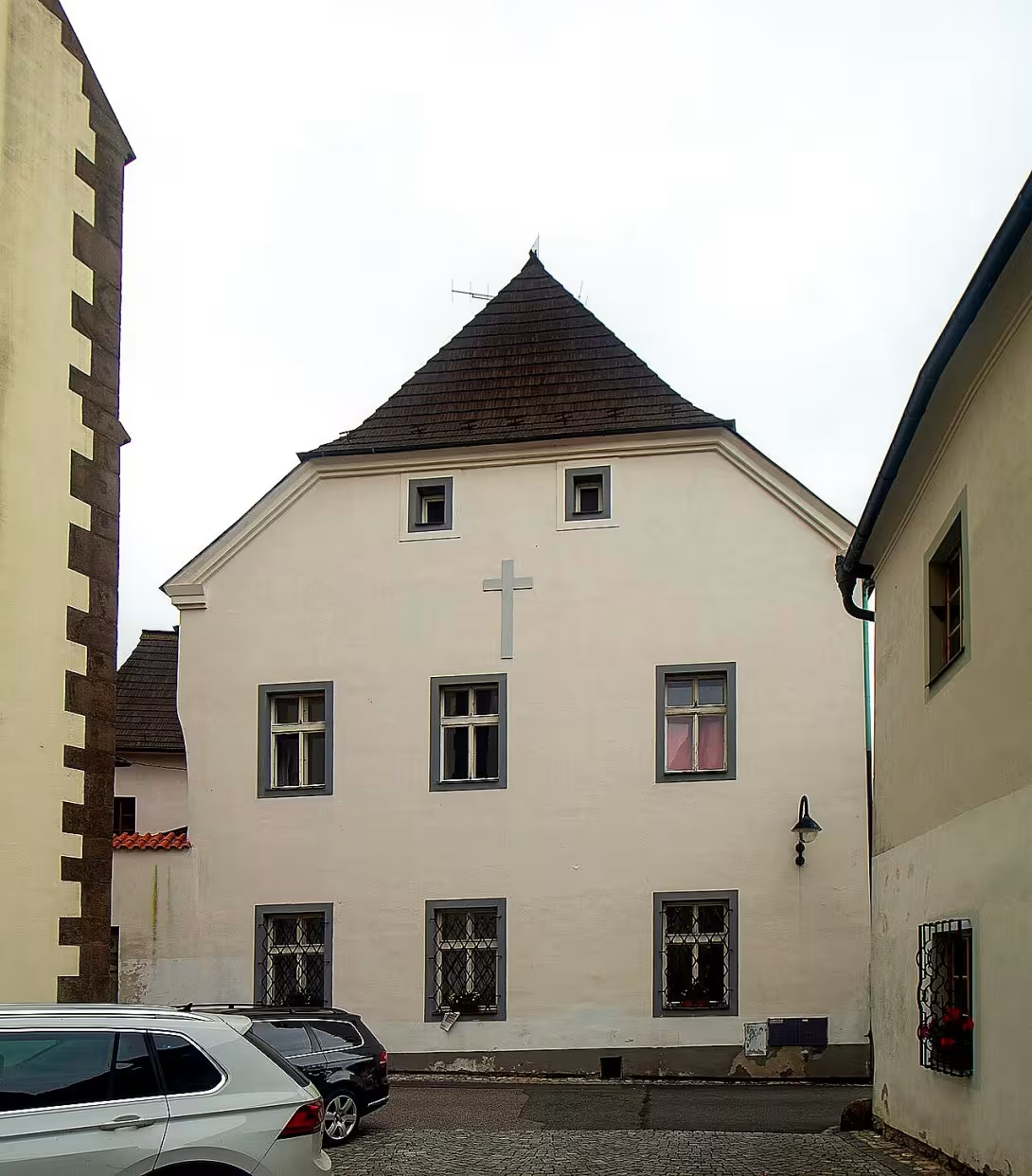
Decoration in Tábor is a historical monument located in the heart of the city, which represents a late-Gothic architecture. The area with the address Dekanská no. 305 / 6 belongs to the Catholic parish and its main element is the Church of the Transformation of the Lord from 1512. This monument is located in the city reservation and plays a key role in the composition around Žižkov Square.
The history of deanery dates back to the Middle Ages when the original building was founded. In 1645 the building burned down along with a large part of the city, which led to its stone reconstruction and use of new architectural elements. A gradual reconstruction took place after the fire; At the end of the 17th century, the floor was removed, the connecting door was sealed and the circles were torn down in the chapel. In the following years, additional additions were made, such as a round in 1741 or stables in 1772. During the first half of the 19th century, the construction was further modified due to poor engineering, especially in 1847-1853.
Architecturally, the decontamination is a single-storey with a three-axis front face on the north side. The construction contains historically valuable vaults and preserved original structures such as brick passports - arches glassed into the central pillar. In the basement is a stone rolled vault from the 16th century. The original Gothic building was gradually converted into a Baroque style, reflecting the architectural development of the period.
The Roman Catholic parish Tábor was the property and administration of the dean. In 1991, the new camp dean Vladimír Vyhlídka was appointed to ensure further repairs and modernization of the building. Key events include repairs of the facade in 1995.
Today, the deanery is not only a cultural monument, but also part of a wider network of camp cellars, which are technical monuments of the late Middle Ages. These underground areas were gradually interconnected and created an extensive network accessible to the public.
Today, the dean is in a well-maintained state and is open to visitors. It is not only an architectural treasure, but also a testimony of the history of the city of Tábora. Exploring this monument offers valuable insight into the past and an opportunity to explore unique architectural elements, important components of the cultural heritage of the Czech Republic. Visit Tábor means not only to discover history, but also to appreciate the beauty and importance of the conservation city.
Historical milestones
- 1645
- House fire
- 1741
- Addition of knees
- 1772
- Added stables
- 1847
- Start of construction-technical adjustment
- 1870
- Installation of new windows and doors
- 1894
- Repair of shingles
- 1969
- Establishment of a bathroom
- 1980
- New roof cover
- 1995
- Façade repair
Architectural development
The original medieval building was gradually rebuilt into Baroque style. During the 19th century there were further modifications and new windows and doors were installed in 1870. The building contains historically valuable vaults and stone crackers.
Historical events
In 1645, the building burned down as a result of a major city fire. In 1847-1853 there was extensive adjustment due to poor construction condition. The previous facade from the 1930s was repaired in 1995.
Owners
catholic parish Tábor
Points of interest
- Decoration in Tábor is a historical monument with late-Gothic architecture. - The main element of the complex is the Church of the Lord's Change from 1512, which is located in the city reservation. - After the fire in 1645, the building was rebuilt with new architectural elements and gradually reconstructed. - The Dean has one-story buildings with three-axis front facing on the north side, historically valuable vaults and original brick passports. - It is part of a network of camp cellars, which are the technical monuments of the late Middle Ages.
Guide
Show guide text
This text was created by artificial intelligence and has not been editorially reviewed. It may contain inaccuracies.
Welcome to the historical heart of Tábor. You are standing in front of the building of the dean and parish, which is an extremely important piece of evidence of late-Gothic construction in the center of this ancient city. When you look up from the square and look right in front of you, you will see an object with medieval origin, which forms an inseparable part of the vast archdeanery area at the nearby Church of the Transformation of the Lord. This building plays an absolutely key urban role in the composition of the whole area of Žižkov Square and the weight and beauty of the past centuries breathes upon you at first sight. The whole valuable area is a proud part of the city conservation, where every street, every house and every stone tells its own story about the history of our ancestors.
Now let's think back centuries and see how this house actually came into being and what it had to go through. The very roots of the building go deep into the Middle Ages, the time when a new form of urban life was born in Tábor and when the local builders put all their um into building a safe and spiritual home for the inhabitants. The main element of the whole church complex is the magnificent Church of the Lord's Transformation from the year fifteen hundred twelve, which stands at the very center of our city reservation and to which the deanery closely attaches. But the rectory itself was not an immutable rock, it lived its own life and passed many trials. One of the biggest wounds was a major fire in the year sixteen hundred forty-four, namely sixteen hundred forty-five, which badly damaged the building. The fire may have destroyed many, but it has not broken the spirit of this place. After this devastating event, the building was repaired, enriched with new architectural elements, and gradually passed through other and other reconstructions that changed its face so that it could serve its purpose for generations to come.
Now pay attention to the architecture itself and try to notice the details that make up the unique character of this place. The house of deanery is characterized by a variety of historical details and rarely preserved by original constructions that allow us to look under the cover of old construction. When you carefully examine the facade of the building, you will see the work of unknown masters who imprinted this house with its unique character. The chronology of building modifications is varied and shows how the house gradually grew and adapted to the needs of the time. In seventeen hundred forty-one so-called knees were added, thirty years later, in seventeen hundred seventy-two, stables were added, which served for the farm's economic background. Another important milestone occurred in 184,47, when extensive modifications of the building technical condition of the whole building to ensure its safe operation began. Decades later, in the year eighteen hundred and seventy, the house was given new windows and doors, and in the year eighteen hundred and ninety-four there was an important repair of shingles covering, which protects the roof of this historic gem. Although the names of the creators and builders remained hidden in the mists of the forgotten time, their work speaks clearly and remains to this day.
When we talk about the history of this place, we must not forget the people who have linked their lives, fates and everyday work with it. A number of important historical figures are closely linked to the deanery in Tábor, among which Mr Vladimír Vyhlídka also takes his place. People like him breathed real life into this old house, dealing with spiritual and secular matters, leading the local community through good times and bad times, and making sure that the Tábora spiritual centre never went blind. The walls of this house have heard countless prayers, important conversations, joyful events and silent worries that people have brought here in the hope of comfort and help.
Stop now for a moment and perceive the atmosphere surrounding this place. The interesting thing is that the deanery in Tábor is still admired for its honest late-Gothic architecture, which resisted the tooth of time and changes in the surrounding building. Every building intervention, from the aforementioned extinguishing of the consequences of a great fire to the exchange of roof coverings, is a testament to the fact that this house has always been cared for with great respect for previous generations. The city of Tábor is pampering its sights and the deanery is a shining example of this.
I hope you enjoyed this little walk in history and architecture and that the magic of old Tábor breathed on you. Now you can follow the footsteps of local history, explore the adjacent streets, visit the nearby church or simply continue wandering this beautiful city. Thank you for your attention, I wish you a wonderful rest of the day and see you next time you discover our sights.
Tips for visitors
The tour of the historical centre Tábora and the surroundings of the deanery excels especially in the spring and autumn months when there are fewer visitors and the atmosphere of medieval streets best stands out. With you take comfortable fixed shoes on uneven stone tiles and warmer clothes for possible entrances to underground areas. The best light for photographing the late-Gothic architecture of the deanery and the adjacent space occurs early in the morning or late in the afternoon, when the side sun rays beautifully highlight the ancient details of the facades and shapes of houses. In the immediate vicinity within 30 minutes walk you can visit the Dekanský Church of the Transformation of the Lord, Žižkov Square and the extensive underground camp, which together form a compact whole ideal for a family trip full of discovery history.
Frequently asked questions
Can the monument be visited?
Some buildings of this kind are open for guided tours, others serve another purpose or are privately owned. We have not verified whether and when this monument is open – please ask the operator.
What are the opening hours and admission?
We have not verified the opening hours or admission. Current information is published by the operator.
Where is the monument?
Location: Tábor. The map on this page shows the exact spot.
Why is the monument protected?
It is listed in the Central List of Cultural Monuments of the Czech Republic as a cultural monument (register no. 1000140010).
Businesses nearby
Do you run a restaurant, accommodation, shop, museum, rental, wellness or other visitor service near this monument? Show yourself directly to the people heading to it — this is how they will see you in the app and on the web:
Nearby
Děkanský kostel Proměnění Páně, Žižkovo náměstí, táborské podzemí.
Accommodation nearby
Themed route
I propose a thematic cruise route in the historical center of the city that connects the main destination and selected neighboring places.
1. Žižkov Square Type: Space Why is it worth a visit: This central area consists of the historical heart of the whole site. It offers a unique atmosphere of ancient houses and serves as a starting point for further discovery.
2. The Dean's Church of the Transformation of the Lord Type: Sacral construction Why is it worth a visit: This dominant tower over the city attracts its noble Gothic architecture. Its high tower is an invisible element of the entire panorama.
3. Decoration and rectory in Tábor Type: Historical building Why is it worth a visit: This main objective represents an important building monument with a rich past associated with the church life of the city. It is located near the church.
4. Tábor Underground Type: Underground system Why is it worth visiting: A large labyrinth of passages carved under houses shows the art of our ancestors. The tour offers an extraordinary experience and a view into the depths of history.
Seasonal recommendations
In the spring the surroundings awaken to life and nature around Tábora begins to offer a fresh green color. Light is soft in this period, which is ideal for observing the details on the old facades. I recommend choosing layered clothes because the morning cold can quickly turn into a warm afternoon. The best time to visit is in the morning when the air is fresh and clear.
The summer season is seen as the time of the greatest sun and the longest days. The atmosphere is full of energy, but heat can be close to historical buildings very intense. It is necessary to carry a headgear and plenty of water. For the best experiences it is worth visiting a place in late afternoon, when the sun is no longer so hot and shadows create interesting shapes.
Autumn brings melancholy beauty to the area thanks to the golden and brown shades of surrounding vegetation. The frequent fog creates a mysterious atmosphere that perfectly complements the historical character of the place. It is advisable to have a waterproof jacket and stronger shoes in case of rain. The most beauty offers the time around the sunrise when light breaks through the morning herpes.
Winter covers the place in peace and quiet, especially during cold days. The light is weak and the days are short, which gives the sights a serious and even rough look. Clothes must be very warm, including scarves and gloves, so that the cold does not surprise you. It is best to plan a walk around noon to use the maximum amount of daylight.
Visualizations and artistic views

The visualisations are generated by artificial intelligence and serve as inspiration.
Photos from the area
Real photos taken near the monument

Zdroj a licence jsou uvedeny u každého snímku.
Tips from visitors
No tips yet. Be the first!
Log in and add your tip.
Sources and literature
Photos: VitVit / CC BY-SA 4.0 — Wikimedia Commons. The author and licence also appear when you hover over the image.
Faktickým podkladem tohoto textu byl článek na Wikipedii, jehož autory jsou přispěvatelé Wikipedie. Článek je dostupný pod licencí CC BY-SA 4.0.
Location on the map


Příběhy a pověsti
Legendy, pověsti a příběhy spjaté s touto památkou
Fotografie návštěvníků
Zatím žádné fotografie. Buďte první, kdo přidá fotografii z návštěvy!
Log in a přidejte svou fotografii nebo hodnoťte.
Za ověřenou návštěvu v aplikaci získáte víc bodů — poznáme podle GPS, že jste na místě.
Reviews and comments