






Kotnov Castle
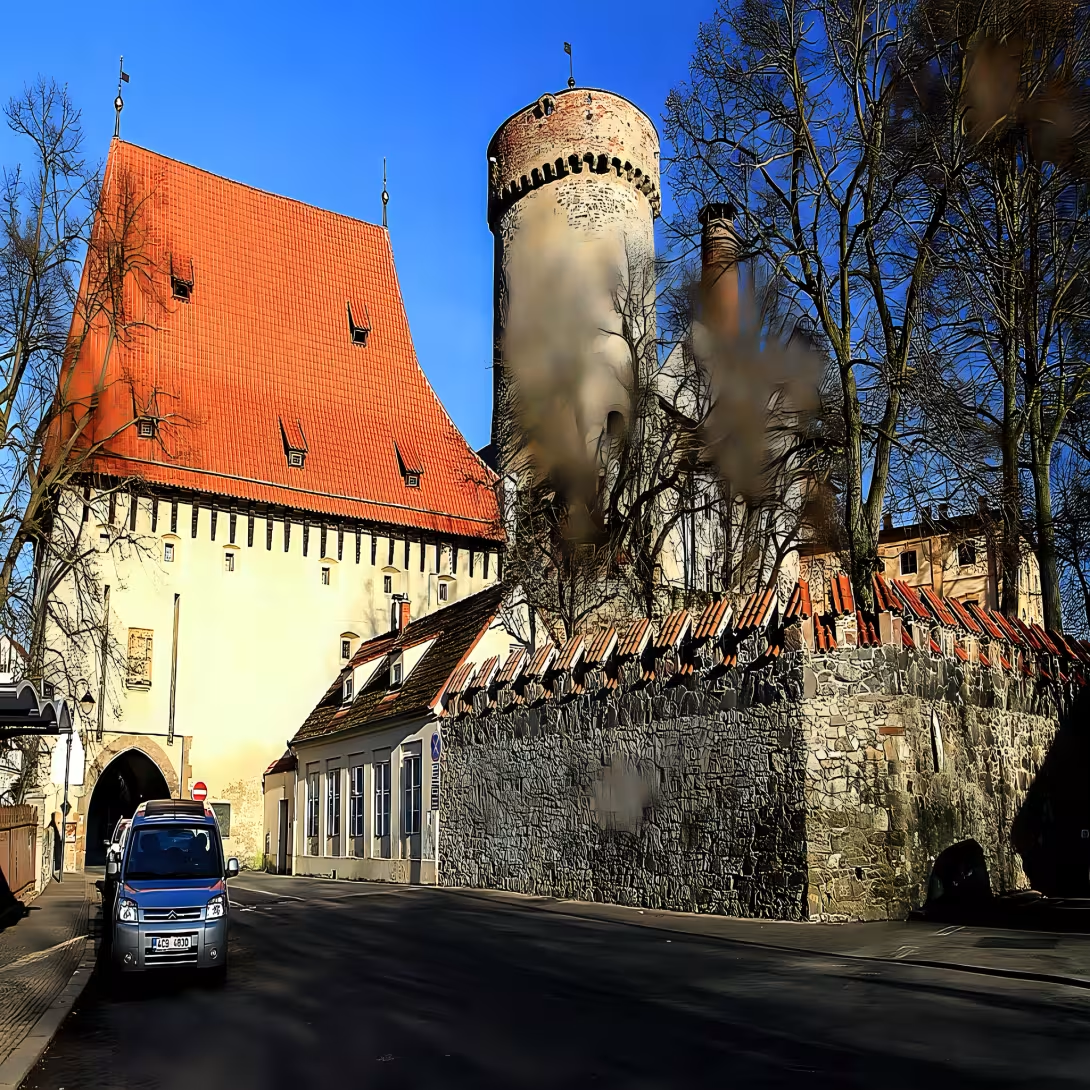
Kotnov, also known as Hradiště, is one of the most interesting architectural monuments in Tábor. It is an original medieval castle which was gradually rebuilt and used as a brewery. Since 1962, the area has been protected as a national cultural monument along with the Becyne Gate.
The castle was founded by the King Primohmi Otakar II as a city castle, although it was outside the area of its own town Hradiště. The oldest written mention of it dates back to 1370, when the city no longer existed and the territory belonged to the masters of Ústí. After the founding of Tábora, the castle was involved in the castle system, and in the 1930s, its fortifications were improved. A major breakthrough in his history was the fire in 1532, after which the castle began to be gradually transformed for economic purposes of the brewery. A number of original castle buildings were demolished for brewing needs.
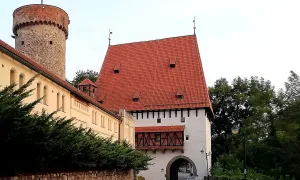
From an architectural point of view, the castle plan was five-sided and protected by at least four towers. The best preserved part is now a round battery tower, which is expected to be built after 1532. The remains of another round tower in the southeast corner and the prism tower in the northwest corner were partially preserved. On the east side there was originally a square tower and a three-space palace, as well as a long building along the wall in the northwest part. The whole area was circling a park.
The battery tower was probably created using the remains of the older tower. There are two construction phases in her image. On the ground floor and on the first floor, there are shooting grounds with spaghetti for defensive fire. In addition, there was a breach in the gunfire, which allowed the fire to go down in an angle. On the third floor there are three massive trapezoidal artillery chambers with traces of heavy-duty warheads. The fourth floor had smaller gun holes. The castle was also protected by the breast wall of the gallery with key shooting rooms equipped with beams for support of hooks.
Kotnov can be viewed in the summer months from May to September, when the exhibition of the Hussite Museum in Tábor is available here. Visitors have the opportunity to enter the tower and learn about the results of centuries of camp history - from medieval military fortifications to conversion into economic facilities to today's form of protected sites.
Historical milestones
- 1370
- First written mention of the castle
- 1532
- Fire of the castle and start of use for brewery
- 1962
- Entry into the list of national cultural monuments
Architectural development
The original five-sided castle was gradually rebuilt, after the fire in 1532 brewery buildings were built. The dominant is a round battery tower with a Gothic-Renaissance portal. The residential buildings were torn down and replaced by economic objects.
Historical events
1370: First written mention of the castle; 1532: The castle fire and the start of use for the brewery; 1962: Announcement for a national cultural monument.
Owners
Lords of Ústí (after 1370)
Points of interest
- The castle was founded by the King of the Overmind of Otakar II and later served as a brewery. - The oldest written mention of the monument dates back to 1370. - After the fire in 1532, the castle was gradually transformed for economic purposes. The castle floor plan was five-sided and protected by at least four towers. The best preserved part today is a round battery tower with artillery chambers on the third floor.
Guide
This guide is narrated by a synthetic voice generated by artificial intelligence.
Show guide text
This text was created by artificial intelligence and has not been editorially reviewed. It may contain inaccuracies.
Welcome to Camp, in the heart of South Bohemia. Stop for a moment, take a breath and feel the atmosphere of this place. You are standing right in front of Kotnov, a monument that carries layers of several centuries of history. Take a look in front of you at this resort, which is located on the edge of the southwest part of the historic city core. It is a place where the rigour of medieval defense meets the daily life of craftsmen and craftsmen. Right now, you can see the space before you that used to serve protection, but later became the center of the local economy.
Let us now return together in time to understand how this building came into being and why it is so important to us today. The history of Kotnova takes us deep into the Middle Ages. It was founded by King Přemysl Otakar the Second, one of the most important personalities of our history. Imagine a time when this landscape was full of dense forests and strategic points such as this terrain selection were absolutely crucial for controlling the environment and security. Although the castle existed earlier, the first written mention of it dates back to 1370. It is fascinating to think that at that time, more than 600 years ago, the walls that you surround today stood here. At that time, the castle was a symbol of power and stability, a fortress to keep order in the region.
Now pay attention to the architecture itself and to what you see right in front of you. If you could look at the plan of the castle from a bird's-eye perspective, you would notice it has a five-sided shape. This geometry was not random, but it was used for maximum use of terrain and effective defence. The entire complex was protected at least four towers at the original time, which served as sightseeing points and defensive works. Now look up and focus your attention on the most significant element that has survived here for centuries. It's a round battery tower. This part of the castle is today the best preserved fragment of the original building. Feel her mass and imagine how the soldiers once guarded the arrival of the aliens into the city. This tower is a silent witness to all the changes Kotnov has been going through.
But when we look at Kotnov's history, we find that his fate was not linear. Each era had a different character. The key break was 1532. This year the castle was consumed by a devastating fire. Introduce yourself in that situation where the flames burned the wooden structures and threatened to destroy the entire area. But it is this disaster that has paradoxically opened the way to a new form of monument. After the fire, the castle stopped being used primarily for military purposes. The brewery masters and workers began to stay here instead of soldiers. The castle was gradually rebuilt and transformed for economic purposes, namely the brewery. It is an extraordinary story of transformation, where, instead of weapons in the premises, barrels of beer began to accumulate, and instead of strategic meetings, there was a solution of malt boiling. This transformation from the castle to the brewery is one of the most interesting aspects of Kotnova because it shows how historical buildings have managed to adapt to the new needs of the time.
Here's one interesting thing that might interest you. It's fascinating how the role of this place changed over time. The Royal Castle, founded by Přemysl Otakar Second, became an industrial zone in the form of a brewery and eventually became a space for culture and education. This transformation is not just a change of function, but a reflection of the entire development of the city of Tábora. So Kotnov is not just a pile of stones, but a living organism that breathes through history.
In 1962, the entire complex was officially included in the list of national cultural monuments. This means that the State has recognised its invaluable importance for the whole Republic. Today there is no beer, but instead there is an exhibition of the Hussite Museum. This is very symbolic, because Tábor is closely associated with Hussite and Kotnov is thus currently a place where memory is stored for one of the most stormy and most important stages of our history.
Now that you know the basic story of this place, I suggest you review the space around you again. Notice how the castle is entering the landscape and how dominant it is in this part of town. Try to imagine the contrast between the silence of the medieval castle, the noise of the working brewery and today's peace of museum space.
I ask you now for further examination. You can enter the premises and get carried out through the exhibitions of the Hussite Museum, where you can learn more about the people and events that shaped this region. Look around the battery tower and feel its power. Kotnov still has many secrets waiting for its discoverers.
Thank you for accompanying me with the first steps to this monument. I wish you a pleasant rest of the tour Tábora and a lot of new experiences in discovering the history of our ancestors. Goodbye and enjoy your time in this beautiful city.
Tips for visitors
The best time to visit is the late spring or early autumn season when temperatures are pleasant and the surrounding landscape offers beautiful colors. There are fewer tourists in these periods than in the main summer season, which allows a more peaceful tour of the castle premises.
You can easily walk to the monument directly from the historic city centre. If you are travelling by car, we recommend you use the parking lot near the city core and then continue with a short walk. Use local connections to arrive by public transport; Check the current timetables in the mobile application or on the carrier's website.
We recommend to bring comfortable shoes suitable for uneven surfaces and water bottle. For lovers of photography are the best moments around the sunrise or sunset when light beautifully highlights the texture of historical walls. The view from the tower or from the surrounding elevated places offers great angles to capture the castle atmosphere.
There is a Bechynski Gate nearby, which is definitely not refuted during your walk. It is an ideal supplement to search the castle grounds.
For families with children it is advisable to prepare a short educational play about the history of the place to make the visit for the smallest more interesting. The castle area offers an opportunity to observe historical architecture, which may excite children.
Frequently asked questions
What is Kotnov?
The rest of the medieval castle in Tábor - a massive round tower and Bechyňská gate, the oldest preserved part of the city.
What does it have to do with the geese?
In the 15th century, the Hussites founded their fortified city Tábor, the main centre of the radical Hussite movement.
What's in the Bechy Gate?
Museum exposition dedicated to Hussite and History Tábora; Kotnov Tower is a view of the city.
For kids
Businesses nearby
Do you run a restaurant, accommodation, shop, museum, rental, wellness or other visitor service near this monument? Show yourself directly to the people heading to it — this is how they will see you in the app and on the web:
Nearby
Bechynia Gate
Accommodation nearby
Themed route
Thematic cruise route from Kotnova
1. Kotnov (castle) - Type: historical castle - Why is it worth a visit: Kotnov is one of the most famous and best preserved Gothic strongholds in the Czech Republic. It presents an interesting overview of life on castles in the Middle Ages, with the opportunity to explore its fortress walls and interior.
2. Bechy Gate - Type: historical monument - Why is it worth a visit: This gate is part of the Kotnova walls and represents an important architectural structure that illustrates the defence techniques of the Gothic era. It is an ideal place to understand the history and strategy of the castle siege.
3. Park at Kotnova - Type: park - Why is it worth a visit: Park around Kotnova offers beautiful green spaces where you can relax and enjoy the natural environment. It is an ideal place for a picnic or for a moment of peace after exploring castle structures.
4. Main courtyard Kotnova - Type: historical area - Why is worth a visit: The main courtyard is the center of Kotnova and provides a view of the overall structure of the castle. Here you can see the exhibitions that bring more information about the history and culture of the area.
5. Tower Kotnova - Type: tower - Why is worth visiting: The tower is one of the most characteristic elements of Kotnova and offers a view of the surrounding landscape. It is an ideal place for those who want to see the area from a height and understand the strategic role of the castle.
This route allows you to dive deeply into the history of Kotnova and its surroundings, each point offering a unique view of this fascinating place.
Seasonal recommendations
Spring brings to Tábora freshness and fine light, which beautifully highlights the shapes of historical walls. Nature begins to bloom again around the castle, creating a pleasant environment for walks. There is still a need for changing weather during this period, so it is recommended to wear layered clothes that can be easily modified. Visitors will avoid the rush due to fewer people, making the spring visit a very quiet experience.
In the summer months the atmosphere around Kotnova is the most lively and the sun shines the most intense. Due to the higher temperatures and great interest of people, we recommend planning a visit in the early morning to avoid the greatest crowds and the greatest heat. It is important to have enough water with you, wear a headgear and choose light, light clothes that will not restrict you too much when moving in historic areas.
Autumn is ideal for lovers of color and calm, when the surrounding landscape turns into a mosaic of golden and brown shades. The morning mist brings a mysterious mood to memory, which perfectly complements its age value. Due to wet air and colder days, it is advisable to choose firmer, waterproof shoes and warmer layers of clothing. The best time to observe beautiful autumn light is clear afternoon hours.
The winter brings peace and quiet around the monument, making it possible to perceive history in an almost intact atmosphere. Short day and frosty weather require thorough preparation, especially in the clothing area - remember the warm jacket, scarf and gloves. Always check the current opening times before travelling, which are shorter in the advent time and in the next winter months. For maximum comfort, it is best to schedule a tour around noon.
Visualizations and artistic views


The visualisations are generated by artificial intelligence and serve as inspiration.
Photos from the area
Real photos taken near the monument


Zdroj a licence jsou uvedeny u každého snímku.
Atmosphere of the place
This atmospheric visualisation of the place and period was generated by artificial intelligence. It is not real footage of the location.
Tips from visitors
No tips yet. Be the first!
Log in and add your tip.
Sources and literature
Fotografie: Ondřej Kořínek / CC BY-SA 4.0, rozlišení zvýšeno umělou inteligencí — Wikimedia Commons. The author and licence also appear when you hover over the image.
Faktickým podkladem tohoto textu byl článek na Wikipedii, jehož autory jsou přispěvatelé Wikipedie. Článek je dostupný pod licencí CC BY-SA 4.0.
Location on the map


Příběhy a pověsti
Legendy, pověsti a příběhy spjaté s touto památkou
Fotografie návštěvníků
Zatím žádné fotografie. Buďte první, kdo přidá fotografii z návštěvy!
Přihlaste se a přidejte svou fotografii nebo hodnoťte.
Za ověřenou návštěvu v aplikaci získáte víc bodů — poznáme podle GPS, že jste na místě.
Reviews and comments