



Vodárna (Tábor) Water tower
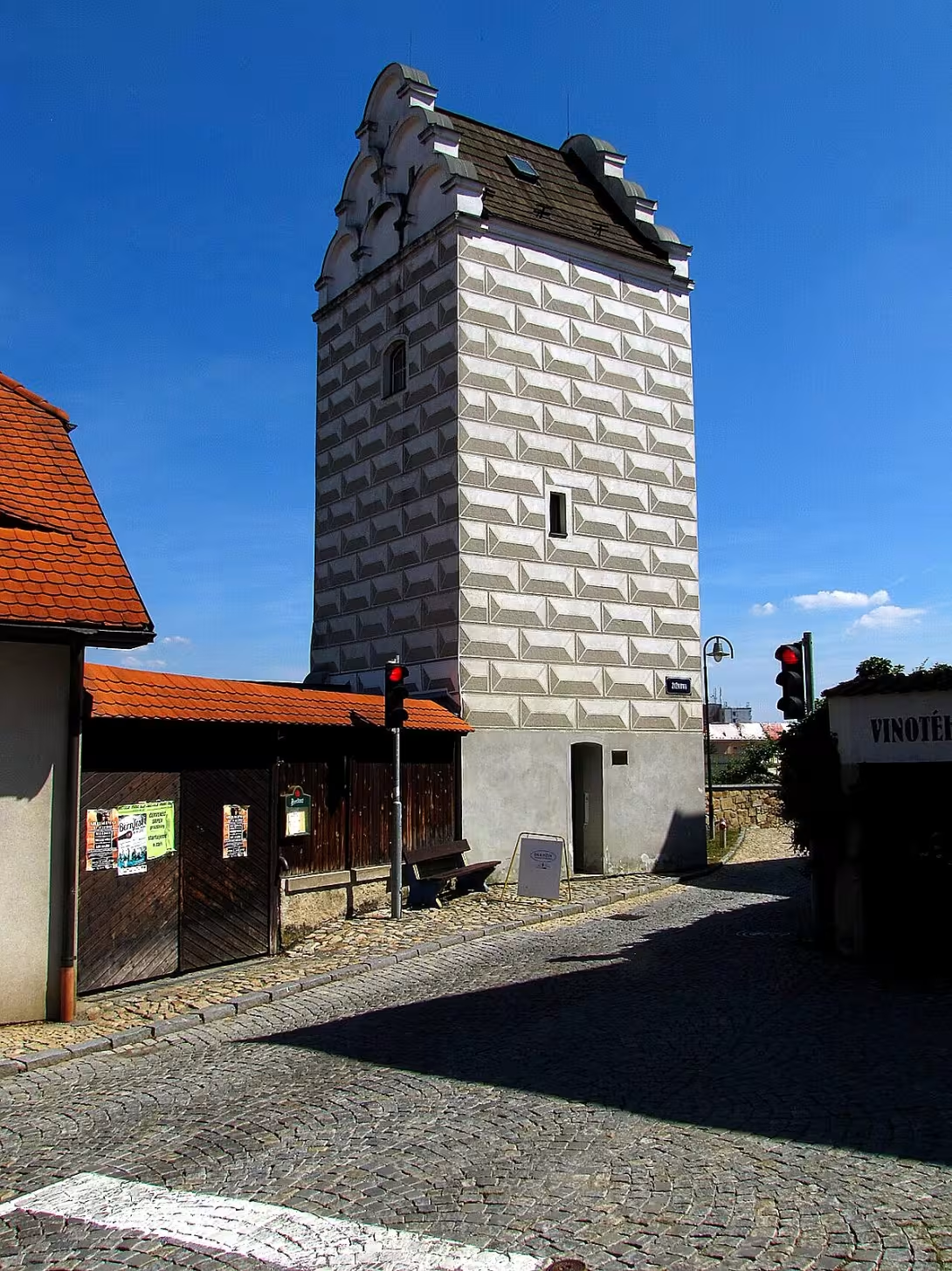
The water tower in Tábor is a Renaissance technical monument that served as a tower water tower. The construction is attached to the original city fortification and testifies to the Renaissance construction of the city. The building was built to provide drinking and utility water after the Jordan tank was created. At present, the tower serves as an art gallery.
The water tower was established at the turn of the 15th and 16th centuries, namely in 1502. The city was struggling with water shortages at the time. The construction was built into the main wall of the Premysl Otakar II administration and was located at the southern end of the Market Square. After a big fire in 1559, which destroyed the central part of the city, the tower was restored. It was rebuilt in stone form and supplemented with Renaissance architectural elements. In 1874 the reservoir was replaced and regular repairs were carried out.
The architecture of the tower is typically Renaissance. Her prism body with a rectangular plan and three floors ends with a saddle roof made of larch shingles. The facade is decorated with letter sgraffiti decoration, which covers all floors from all sides. The northern and southern facades have arc shields that give the construction a unique look. The entrance is located on the west side, the floors are accessible by narrow wooden staircase.
The ownership and management of the building have changed over the years. After construction and reconstruction, the tower was part of the urban infrastructure under the management of the city Tábora. Since 1997, the city has been operating a gallery in which art exhibitions are held today.
Key events include the construction of an old water plant in 1502 and its restoration after the fire in 1559. There were various repairs in the following years. In 1874 the tank was replaced and in 2020 there was a renovation of the coating and humidity control of the masonry by means of trace mortar.
Today, the Water Tower in Tábor is not only a technical monument but also a cultural centre. The gallery offers space for young and early artists. The building is easily accessible thanks to the vicinity of Žižkov Square, city walls and town hall.
The tower is witnessing technical progress and cultural development. Its original style and rich history make it an important part of the urban conservation. The tour of the building offers valuable insight into the past and inspiration for future generations of artists and historians. The visit is therefore not only fun, but also educational, because it enriches understanding of local history and culture.
Historical milestones
- 1502
- An old water station.
- 1559
- Restoration of the building after a major city fire.
- 1874
- Replacing the reservoir on the tower.
- 1997
- The beginning of the operation of the gallery by the city Tábor.
Architectural development
The original building was built at the turn of the 15th and 16th centuries and after the fires in the middle of the 16th century it was converted into stone. The architecture is characterized by Renaissance style with rich sgraffite decoration and arc shields. During the 19th and 20th centuries, various repairs and exchanges of technical elements took place.
Historical events
In 1502 the construction of the old water plant was completed. After the big fire in 1559, the construction and its stone reconstruction were restored. In 1874, a reservoir was replaced on the tower.
Owners
city of Tábor
Points of interest
- The water tower is a Renaissance technical monument serving as a tower water tower. - The construction was built at the turn of the 15th and 16th centuries, namely in 1502, to provide drinking water and utility water after the birth of the Jordan tank. - After a great fire in 1559, the tower was restored to a stone form with Renaissance architectural elements. - At present it serves as a gallery of art offering space for young and early artists. - It is a witness to technical progress and cultural development and is an important part of the urban heritage reserve.
Guide
Show guide text
This text was created by artificial intelligence and has not been editorially reviewed. It may contain inaccuracies.
Welcome to Tábor, a city with rich history and beautiful monuments. You are standing in front of one of the most important technical monuments of this area - the water tower, which is part of the original urban fortification. This Renaissance building was built as a tower water and today serves as an art gallery.
This water tower can be dated to 1502 when an old water plant was built. Its purpose was to provide drinking and utility water for the city after the Jordan tank was built. After the great fire Tábor struck in 1559, the tower was restored to a stone form with characteristic Renaissance elements. Over the years, the reservoir on the tower also changed, namely in 1874.
Look up and you will see elegant cuts and decorative elements that are typical features of Renaissance architecture. Note also the location of the tower within the city fortification, which highlights its historical role in the structure of the city.
Although there are no specific architects or personalities associated with the creation of this monument, it is clear that its construction and reconstruction were important events for the city of Tábor. The Water Tower was not only a technical innovation, but also a testament to the historical changes and challenges facing the city.
The interesting thing is that this water tower today serves as an art gallery. Since 1997 the city of Tábor has been operating it like this and offers visitors the opportunity to learn about various forms of artistic expression.
Let us move closer and look at the details that will help you better understand the historical context and architectural features of this monumental object. When exploring, make sure every element has its own story.
Thank you for your visit to this historic monument. If you decide to explore Tábor further, remember to visit other interesting places and discover even more about the rich history of this beautiful city. With God on your next journey!
Tips for visitors
The best time to visit the water plant in Tábor is early spring or late autumn when there are fewer people and nature offers beautiful colors. The recreation area around the monument is peaceful and ideal for relaxation.
When visiting, we recommend taking with you protective sunglasses, shoes suitable for walking on rocks and plenty of drinking. In winter it is advisable to wear a warm suit.
It is recommended to arrive at the beginning or end of the day when the light is softer and shadowy. The best places for photography are from the Zizkov Square or from the wall, which provides a charming view.
In the vicinity of the water plant there is Zizkov Square with its historic buildings and city walls. Also visit the city hall, which is interesting with its architectural appearance. For families with children it is possible to propose a walk through historical places and possibly visit the park nearby.
Frequently asked questions
Can the monument be visited?
This is a technical monument. Some are open as exhibitions, others are out of use or on private land. We have not verified whether this one is accessible.
What are the opening hours and admission?
We have not verified the opening hours or admission. Current information is published by the operator.
Where is the monument?
Location: Tábor, Jihočeský kraj. The map on this page shows the exact spot.
Why is the monument protected?
It is listed in the Central List of Cultural Monuments of the Czech Republic as a cultural monument (register no. 1000158319).
Businesses nearby
Do you run a restaurant, accommodation, shop, museum, rental, wellness or other visitor service near this monument? Show yourself directly to the people heading to it — this is how they will see you in the app and on the web:
Nearby
Žižkovo náměstí, městská hradba, radnice v Táboře.
Accommodation nearby
Themed route
Thematic cruise route Tábor
1. Vodárna (Tábor) (tower) - Type: Historical construction - Why is it worth a visit: The water plant is an icon of the city with an important history. Its tower offers not only a view of Tábor, but also an opportunity to learn about the technical progress of past times.
2. Žižkov Square - Type: Historical Square - Why is it worth visiting: The square is the centre of the city and the monument to Jan Žižka. Here is a statue of this important warlord, which makes the place ideal for knowing the history of the region.
3. City wall - Type: Historical walls - Why is it worth a visit: The city wall is a witness to Tábora's past and offers views of the city from above. It is an ideal place for a moment of relaxation and tours of historical builders.
4. Town Hall (Tábor) - Type: Historical buildings - Why is worth a visit: Town Hall is a beautiful example of Gothic architecture and served as an administrative centre of the city. Its decor and history are fascinating to anyone interested in history.
Visiting order: - We'll start with the Water House (Tábor) (tower) to adopt the historical context of the city. - Then we go to Zizkov Square, where we learn more about John Zizek and his influence on the region. - We will then explore the city wall to enjoy the views of the height and understand the defensive strategies of the past. - The design route ends at City Hall, where we look at the Gothic architecture and history of city administrators.
This route offers a compact view of the historical and cultural wealth Tábora.
Seasonal recommendations
Spring: In the spring season, the Tower of the Water Plant in Tábor is lit by sunlight, which brings live color to the green surroundings. Flowers in nearby meadows and trees begin to bloom, creating a beautiful natural atmosphere. More visitors who want to explore this time of year can get to the Waterworks, so it is advisable to visit it in the early morning or later in the evening. Clothes should be medium-warm because the weather can change quickly.
Summer: During the summer period, Tábor Water House is a popular destination for tourists. The sunny days and warm nights bring a lively atmosphere, but also the days can be very hot. In these days, it is recommended to visit the memory in the early morning or later in the evening to avoid the biggest crowds and overcrowding. Clothes should be light and comfortable, with sun protection.
Autumn: In autumn days, the Water House Tower in Tábor offers a unique experience. The colour of the leaves turns into living varieties, adding landscape beauty and creating a calm atmosphere. The weather is generally cold, so it is advisable to bring warmer clothes. Autumn visits can be less burdened by people compared to the summer period, allowing a more relaxed tour.
Winter: In the winter months, the Tower of Waterworks in Tábor offers a different view. The sunny days may be very warm, but the nights are usually freezing and cold. The lighting of the winter sky can add a romantic atmosphere. Visit the memorial at noon to avoid a cold morning or evening. Hot clothes are necessary and suitable for this season because local equipment may not be fully operational in cold months.
Visualizations and artistic views


The visualisations are generated by artificial intelligence and serve as inspiration.
Photos from the area
Real photos taken near the monument

Zdroj a licence jsou uvedeny u každého snímku.
Tips from visitors
No tips yet. Be the first!
Log in and add your tip.
Sources and literature
Photos: Standa Sojka / CC BY-SA 3.0 — Wikimedia Commons. The author and licence also appear when you hover over the image.
Faktickým podkladem tohoto textu byl článek na Wikipedii, jehož autory jsou přispěvatelé Wikipedie. Článek je dostupný pod licencí CC BY-SA 4.0.
Location on the map



Příběhy a pověsti
Legendy, pověsti a příběhy spjaté s touto památkou
Fotografie návštěvníků
Zatím žádné fotografie. Buďte první, kdo přidá fotografii z návštěvy!
Log in a přidejte svou fotografii nebo hodnoťte.
Za ověřenou návštěvu v aplikaci získáte víc bodů — poznáme podle GPS, že jste na místě.
Reviews and comments