






Děkanství v Týně nad Vltavou Deanery
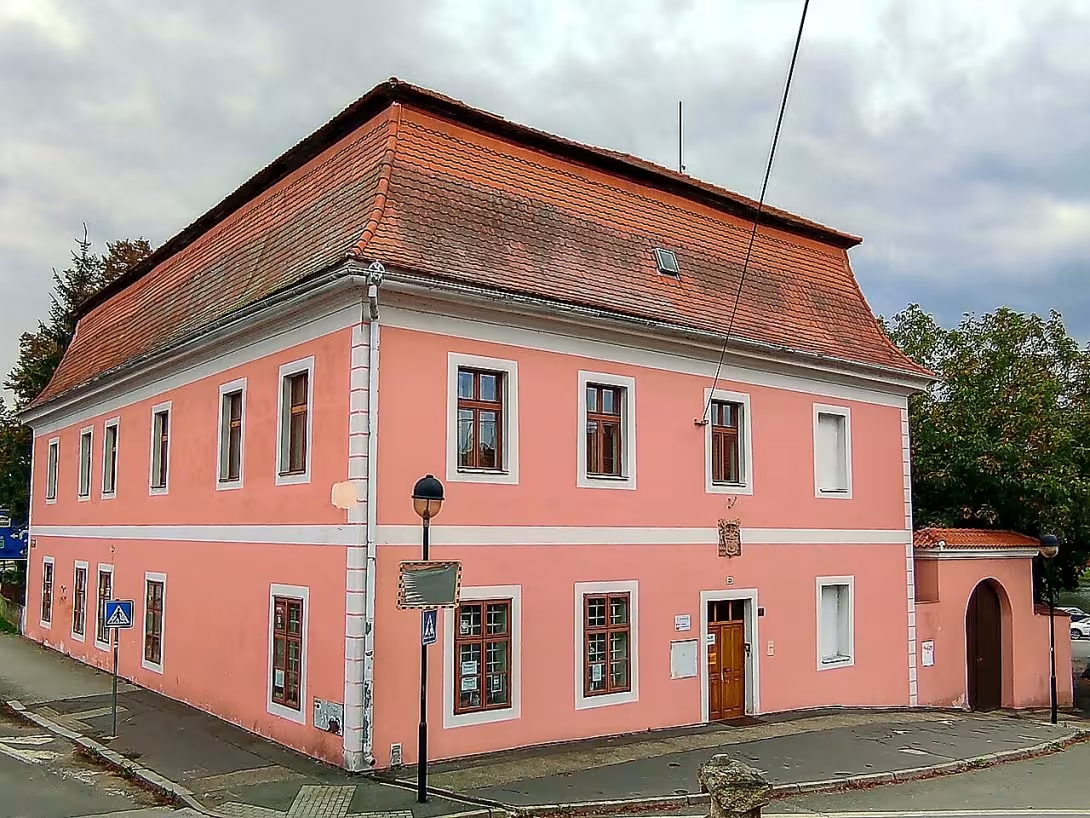
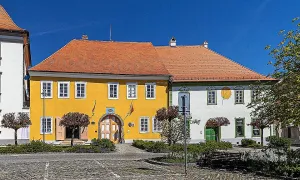
Děkanství v Týně nad Vltavou is an important Baroque building in close proximity to St. James's Church, situated in the local town monument zone. The building has undergone a major reconstruction at the turn of the 18th and 19th centuries and today serves as a seat of the Roman Catholic parish and parish charity.
The history of the construction dates back to the end of the 17th century, when the construction of the new deanery began after 1691. It was created as a replacement for an older house that was damaged during the 30-year war. Before that, the dean's office was housed in house 227, but it was not preserved. The building fits into a broader context of the Baroque restoration of Czech cities and strengthening the influence of the Catholic Church in the context of the reCatholisation after the end of war conflicts.
Architecturally, the object belongs to the Baroque style. The original form included arcades, but disappeared in a large reconstruction in the early 19th century. An important element above the entrance is the stone relief of the archbishop's coat of arms, which resembles the former church administration over this territory.
The break in the history of the building was 1796, when it was badly damaged by the historically largest city fire. The subsequent reconstruction was completed in 1800, when the house acquired its present form. Between 1790 and 1952, the object was closely linked to the existence of the Vltavotín vicariate.
Currently building at the address The Dean's 220 continues to serve as the headquarters of the Vltavotín Roman Catholic parish and the Parish charity Týn nad Vltavou operates here. The monument is part of the town monument zone and is located in the immediate vicinity of St. Jacob's Church.
The Dean is a valuable proof of Baroque architecture and church administration in the region. Visiting this place offers the opportunity to look into the history of the city and to see the preserved coat of arms, which is a silent witness to the changes of the Vltavotín parish.
Historical milestones
- 1691
- The construction of the new Baroque building of the deanery.
- 1796
- The building was badly damaged by the city's most historic fire.
- 1800
- Finishing the reconstruction of the building to the current form without arcades.
Architectural development
The building was built in a Baroque style as a renewal of an older building. After the fire in 1796 it was rebuilt in 1800 and the original arcades were removed. The architectural feature is a preserved stone coat of arms above the entrance.
Historical events
After 1691, a new building was built. In 1796, the building was badly damaged by a massive city fire. The reconstruction of the building into its current form was completed in 1800.
Points of interest
- The building was built after 1691 as a replacement for an older house that was damaged during the Thirty Years' War. - There is a stone relief of Archbishop's coat of arms above the entrance to the building, which resembles the former church administration. - The original design of the building contained arcades, but they disappeared in reconstruction at the beginning of the nineteenth century. - In 1796 the building was badly damaged by the largest city fire and the subsequent reconstruction was completed in 1800. - From 1790 to 1952, the object was closely linked to the existence of the Vltavotín vicariate.
Guide
Show guide text
This text was created by artificial intelligence and has not been editorially reviewed. It may contain inaccuracies.
Welcome to the beautiful city of Týn nad Vltavou. You've just stopped in front of a building that carries a cramped history of the entire local community. You are standing in front of the deanery, an important baroque object, standing here in the immediate vicinity of St. James's Church. Feel this atmosphere, feel the calm that rules here, even though there were storms of history under your feet. This building is not just a wall and a roof, it's a living story about renewal, about resilience and the service of people who have been in this place for centuries.
Look at this building and try to imagine what the surrounding architecture looked like when the new form of this place began to be built here. To understand why the dean stands here in this form, we must go back deep into the past, to a time when the world around us was turning into a chaos of war. There was an older house outside this building that was badly damaged during a devastating 30-year war. The war left deep wounds in the landscape, and even here in Týn nad Vltavou, the community had to find a way to rebuild. This is why the construction of a new Baroque building began after the year of the thousand six hundred ninety-one. This new building was to be a symbol of stability and a new era that was to follow the period of destruction. The Baroque style you can feel in this building has brought a sense of order and dignity to the city.
But now we must prepare ourselves for the next test that this place faced. History wasn't always about peaceful building. In the year one thousand seven hundred ninety-six, the city was struck by a tragedy that probably never happened before. It was historically the biggest fire in the city, which spread like a loose fire and kept almost nothing. Even this deanery was badly damaged and had to face the consequences of this disaster. But like the whole town, this building has risen again from the ashes. Just a few years later, in the year one thousand eight hundred, a major reconstruction took place that gave the object its present face. It was during this process that one of the most significant changes you might have found in the period reports. The original Baroque form of the building was different from the one you're seeing right now. Originally there were arcades, those beautiful, curved passages that surrounded the building and created shade and protection for pedestrians. However, during the reconstruction, these arcades were removed, turning the building into its current, closed and stricter shape.
Now pay attention to the details that are right in front of your eyes. Even though the face of the building has changed, you can still find traces of your past glory in it. Look up, right above the entrance to the object. See that rock relief there? It's an archbishop's coat of arms. This detail is not just a decoration, it is an important symbol that resembles the ancient era of church administration. This sign tells us that this place has always been associated with high authority and that there has been important management of soul needs and earthly affairs. This relief is like a fingerprint of history that reminds us of who made all the decisions in this place and who rules the order here.
When you look at this object, realize that its function remains very important. The dean serves as the seat of the Roman Catholic parish and also as a place where the parish charity works. This means that this building is not just a monument to the past, but it is a place where aid and human need meet on a daily basis. It's a place where they take care of the weak, the poor and those who need support. So when you look at these walls, don't just look at them as a stone structure, but think of them as a home for serving others.
Perhaps you are now being told whether there have been any great secrets here in the past or whether there have been hidden treasures. Although we don't know the names of the particular personalities who lived here, we can imagine the lives of many priests and people of charity who spent their days here. We can imagine their silent prayers, their efforts to help people in need and their work on restoring the city after every disaster. This building is a silent witness to their invisible but extremely important work. It's a place where history encounters a daily struggle for a better life for every resident of Týn.
When looking at the current state of the building you can feel some seriousness. The absence of the original arcades, which disappeared in the year one thousand and eight hundred, has deprived the building of its original baroque lightness, but at the same time gave it the strength and stability that we see today. It is a building that has endured war and fire and which still holds its place firmly in the heart of the city.
Now that you have taken a fundamental view of this deanery and understood its difficult journey from damaged house to baroque glory to rebuilding after the fire, I suggest you continue your tour. The city Týn nad Vltavou has many other secrets and beautiful places to discover. Walk further to the neighboring church of St. James, look at its towers and let yourself drift through the atmosphere of this historic centre. Thank you for spending this moment with us and for being interested in the history of this place. We wish you a beautiful and inspiring walk through the city. Goodbye.
Tips for visitors
The best time to visit is during the morning when the sun illuminates the Baroque facade of the building and allows you to take quality pictures without disturbing shadows. Use a car or public transport to arrive in the city, and check the current connection in the search engine. In the vicinity of the building move on foot, parking is possible on public areas near the center. Bring comfortable shoes for walking on historic tiles and a camera to capture architecture details. In the immediate vicinity, do not miss a tour of St. Jacob's Church and a walk through the city's monument zone, which offers a unique atmosphere, or go to the nearby bank of the Vltava River, which will be especially appreciated by families with children when resting by the water.
Businesses nearby
Do you run a restaurant, accommodation, shop, museum, rental, wellness or other visitor service near this monument? Show yourself directly to the people heading to it — this is how they will see you in the app and on the web:
Nearby
Kostel svatého Jakuba, Městská památková zóna Týn nad Vltavou, řeka Vltava.
Accommodation nearby
Trips and activities nearby
Guided tours, tickets and activities nearby from GetYourGuide
Affiliate link: if you buy from the partner, we may receive a commission. The price for you does not change.
Search tours and activities →Themed route
1. River Vltava - Type: Water flow. Why: An ideal place to start walking and relaxing at the water. 2. City Monument Zone Týn nad Vltavou - Type: Historical Core. Why: Walk down the streets will reveal the beauty of old urban development. 3. Church of St. James - Type: Temple. Why: A dominant building that represents the spiritual center of the village. 4. Děkanství v Týně nad Vltavou - Type: Church building. Why: The main point of the program where you can see local church history.
Seasonal recommendations
Spring brings freshness around the dean and the first hint of green. The light is fine in this period, which allows better perception of the shapes of the historical building. We recommend a visit in the morning when the air is the cleanest and people are still waking up. Clothing should be suitable for variable weather, ideally layered, so that it can be easily adjusted to temperature.
In the summer months, the surroundings are full of life and the sun shines brightest. The atmosphere is warm and warm, but due to high temperatures and larger groups of people it can be more busy with the monument. The best thing to do is to come right after the opening so you can avoid the heat of the afternoon and the biggest crowds. Don't forget the sun cap and enough water for a pleasant experience.
Autumn transforms the landscape into golden colors, and a soothing fog is often formed around the building. The atmosphere is calm and a little nostalgic at this time. It is advisable to wear warmer clothes, such as a coat or jacket, because the afternoon is cold. The ideal time to walk is around noon, when the light is still sufficient to examine the details.
Zimą is very quiet and the air is freezing. If the surrounding area is covered by snow, it is very magical and clean. For short days we recommend planning a visit in clear morning hours. It is necessary to wear very warm clothes, including gloves and hats, and also to check in advance whether the opening time is shorter during this period.
Visualizations and artistic views


The visualisations are generated by artificial intelligence and serve as inspiration.
Photos from the area
Real photos taken near the monument


Zdroj a licence jsou uvedeny u každého snímku.
Tips from visitors
No tips yet. Be the first!
Log in and add your tip.
Sources and literature
Photos: Jana Sekyrová / CC BY-SA 4.0 — Wikimedia Commons. The author and licence also appear when you hover over the image.
Faktickým podkladem tohoto textu byl článek na Wikipedii, jehož autory jsou přispěvatelé Wikipedie. Článek je dostupný pod licencí CC BY-SA 4.0.
Location on the map

Příběhy a pověsti
Legendy, pověsti a příběhy spjaté s touto památkou
Fotografie návštěvníků
Zatím žádné fotografie. Buďte první, kdo přidá fotografii z návštěvy!
Log in a přidejte svou fotografii nebo hodnoťte.
Za ověřenou návštěvu v aplikaci získáte víc bodů — poznáme podle GPS, že jste na místě.
Reviews and comments