






Dům U Zlatého slunce (Týn nad Vltavou) House
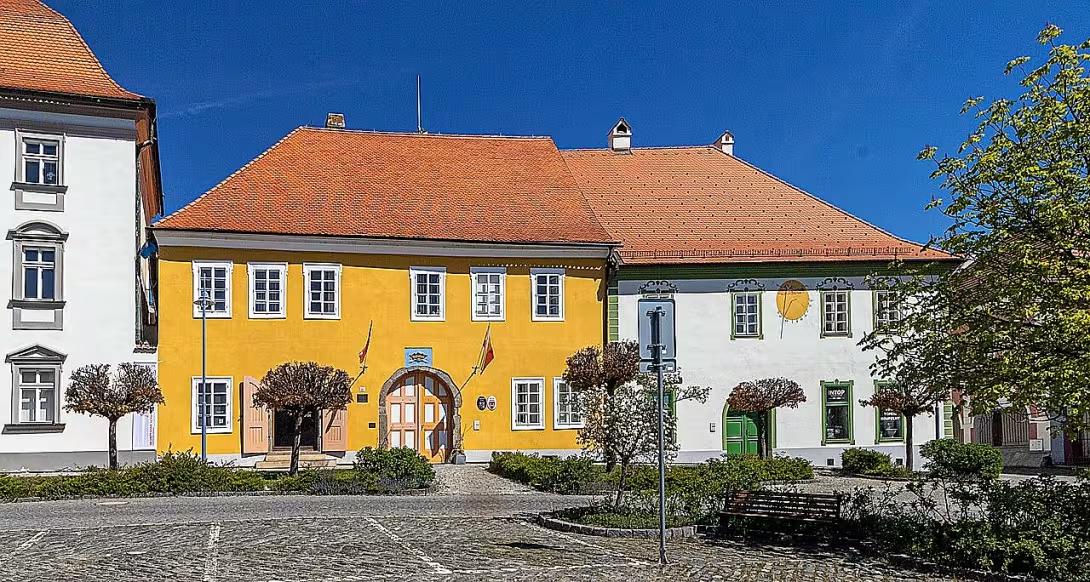
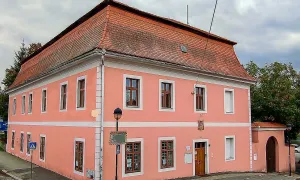
The House U Zlatý sunna č. 37 is located on the north side of the Square of Peace in the village Týn nad Vltavou, the district of České Budějovice. It is one of the cultural monuments and is part of the urban monument zone. It is a three-storey building with a saddle roof, whose history dates back to the middle of the 16th century. It was originally probably built in a Gothic style and later passed through baroque and classical reconstructions.
The original building can be dated to the period of transition from goth to renaissance, which is confirmed by the network vault. The architecture of the house includes various building styles and elements. The south facade has six window axes and on the ground floor there is a gate with a stone lining above which is placed a home sign with a golden crown, probably made between 1761 and 1763. The gate enters the arched passage leading to the yard and further to Jiráskov Street. The interior contains various types of vaults, including Gothic mains, baroque and classical rolled and flat vaults. On the first floor towards the yard there is a walled parkway from the second half of the 19th century. Under the house are preserved original cellars connected to the underground corridor system for drainage and ventilation of the city. In the west wing on the ground floor, where the town gallery is located, there is an arcade with a side well.
Historical sources show various owners of the inn, which has worked here for centuries. In 1654 Kateřina Ratajská was mentioned, in 1677 Maryana Dědryusová and between 1693 and 1696 the widow Lidmila Moučková. From 1709 to 1727 there lived the innkeeper and soaper Jan Bittner, who traded wood and salt. The relief with a picture of the crown above the gates was created during the possession of Marie Anna Detztossi, the birth of the Countess de Pasague. In the second half of the 18th century the house served as a post office in addition to the inn. The name "The Golden Sun" is recorded for the first time in 1825 when selling the house. In 1851 František Weselý bought it, which the inn in 1860 made lawful to accommodate foreigners. The Wesel family remained owner until the 1920s.
The house was the centre of social life, for example in 1845 the first Czech theatre performance took place in the city. The theatre hall was equipped with a new painting at the end of the 19th century.
After reconstruction from 2001 to 2002 the house performs various functions such as the headquarters of some offices of the city office, including the premises of the mayor and vice-mayor. There is also a town gallery and ceremonial hall, which was originally a historic hall in the style of biedermeier.
The Golden Sun House is a valuable example of architectural layers from Gothic to Classicism and an important witness to the history of the city, which remains a functional part of public space.
Historical milestones
- 1761-1763
- The creation of a relief with a picture of a crown above the entrance doors
Architectural development
The house was originally built in a Gothic style, later rebuilt by baroque and classicist elements. In the passage and rooms there are vaults of different periods, including the 16th century mains vaults.
Historical events
- 1845
- The first Czech theatre performance in the city
- 1860
- Obtaining the right to accommodate foreigners for the inn of František Weselý
Owners
- 1654
- 1677
- 1693- 1696
- 1709-1727
- 1825
- 1851
- 1920s
Points of interest
- The Golden Sun House is a three-storey building with a saddle roof and history dates back to the middle of the 16th century. - Originally it was probably built in a Gothic style, later passed through baroque and classical reconstructions. - The south facade has six window axes and the home sign with the gold crown was probably made between 1761 and 1763. - Under the house are preserved original cellars connected to the underground corridor system for drainage and ventilation of the city. - The first Czech theatre performance in the city took place here in 1845.
Guide
Show guide text
This text was created by artificial intelligence and has not been editorially reviewed. It may contain inaccuracies.
Welcome to Týn nad Vltavou, a historic town full of beauty and mystery. You are standing in front of one of the most interesting sights of this area - the Golden Sun House. Take a look up at his three storey object with a saddle roof that welcomes you with its elegant and historically rich architecture.
Let's dive into his past. The Golden Sun home has roots dating back to the mid-16th century when it was probably built in a Gothic style. Later he went through baroque and classical reconstructions, which gave his facade a unique composition and aesthetics. The south part of the house can be observed with six window axes, giving you a hint of its historical wealth and architectural changes.
Now look at the home signs - the golden crown above the entrance doors. This detail was created between 1761 and 1763, which adds a touching element to his historical image.
The Golden Sun home was not only an architectural monument but also a centre of social life. He served as an inn and meeting place for many important personalities. Among them was Kateřina Ratajská from 1654, Maryana Dědryus from 1677, Lidmila Moučková between 1693 and 1696, and Marie Anna Detztossi, rozená hraběnka de Pasague. Each of these people contributed to the rich history of this house with their own role.
If you ever wanted to learn more about places that have hidden entanglements and stories, then this is the place for you. An interesting feature is not only the architecture of the house, but also its long-term impact on the life of local people.
Allow me to invite you to explore Tyn over Vltava again. Every alley and corner can hide a new secret waiting to be discovered. Thank you for your visit to the Golden Sun house and I hope you enjoyed this beautiful historic place. When we meet again in Týn nad Vltavou!
Tips for visitors
The best time to visit is in the spring or autumn season, when the weather is pleasant and the sun illuminates architecture with retirement colors. This time of year offers a more peaceful visit without many tourists.
Parking can be found near the sights, but due to limited capacity we recommend using public transport. The best way to get to Týna nad Vltavou is by train or bus which connections can easily be found in the online search engine.
When visiting, take with you suitable shoes and clothes for possible weather, because the corridor around the monument can be cold in the winter months. Also remember to bring a camera or camera to capture beautiful architecture details.
For photography is the best place to arrive in time in the morning when the sun lights the house from the side and the shadow effects are strong. Also remember to explore the rear sides of the building where there may be unexpected views.
In the vicinity of the monument you can visit The former Archbishop's Castle, located nearby and offers interesting historical information. For families with children it can also be appropriate to walk the Square of Peace, where children can play or enjoy the quiet surroundings.
Businesses nearby
Do you run a restaurant, accommodation, shop, museum, rental, wellness or other visitor service near this monument? Show yourself directly to the people heading to it — this is how they will see you in the app and on the web:
Nearby
Bývalý arcibiskupský zámek
Dům čp. 38 (U Zlatého lva)
Accommodation nearby
Trips and activities nearby
Guided tours, tickets and activities nearby from GetYourGuide
Affiliate link: if you buy from the partner, we may receive a commission. The price for you does not change.
Search tours and activities →Themed route
Thematic cruise route from Týn nad Vltavou
1. Golden Sun House (No. 38) - Type: Historical House - Why is it worth a visit: This Baroque house is one of the oldest buildings in the city and represents typical architectural elements of the period. Its history dates back to the 16th century, making it fascinating for lovers of old monuments.
2. Former Archbishop's Castle - Type: Historical castle - Why is it worth a visit: The castle, located near the city centre, is an important historical monument. It represents a rich past period and its architecture reflects changes over the years. It is an ideal place for those who want to understand the historical development of the region.
3. Old Square - Type: Historical Square - Why is it worth visiting: The square is the heart of the city and offers a beautiful view of ancient architecture. It's a place where you can explore other historic houses and shine the light of past times. In addition, it is an ideal place for relaxing and sightseeing.
4. Old Town Church - Type: Church - Why is it worth visiting: This church is an important spiritual and architectural monument to the city. Its history dates back to the 14th century, making it interesting for those interested in the region's religious and cultural heritage.
5. Old Town Square - Type: Historical Square - Why is it worth visiting: The square is the center of local life and offers the opportunity to see other historical buildings. It's a place where you can find different cultural events and events, which makes it the perfect end point for our trip.
This route offers a view of the historical heart Týna nad Vltava and allows to explore his rich architectural and cultural past.
Seasonal recommendations
Spring: In spring, the Golden Sun House in Týn nad Vltava is celebrated with freshness and newly flowered nature, which revives the surrounding countryside. Sun rays are projected into the interior of the house, creating a strange atmosphere. Visitors should accept light clothes with the possibility of adding a layer to cooler days. The best time to visit is in the early afternoon when the crowd can still avoid it.
Summer: Summer brings long sunny days and a warm atmosphere that increases the attractiveness of historic buildings. The Golden Sun House becomes a popular place for afternoon walks. Visitors should come early in the morning or late in the afternoon to cope with warm times and avoid crowds. It is recommended to wear sun cream and plenty of drinking.
Autumn: In autumn, the Golden Sun house is covered with bright colours of leafy trees, creating a poetic atmosphere. Sunlight is reflected in the interior of the house, thus highlighting its historical architectural elements. Visitors should accept warmer clothes and consider a visit in the early afternoon when the atmosphere is quieter.
Winter: In the winter months the Golden Sun House offers unique lighting through its window windows, which are projected into the darker sky. The atmosphere is calm and quiet, which creates an intimate visit. Visitors should accept warm clothes and consider a short tour time due to shorter opening time. The best time is the morning when the crowd can still avoid it.
Visualizations and artistic views

The visualisations are generated by artificial intelligence and serve as inspiration.
Photos from the area
Real photos taken near the monument


Zdroj a licence jsou uvedeny u každého snímku.
Tips from visitors
No tips yet. Be the first!
Log in and add your tip.
Sources and literature
Photos: VitVit / CC BY-SA 4.0 — Wikimedia Commons. The author and licence also appear when you hover over the image.
Faktickým podkladem tohoto textu byl článek na Wikipedii, jehož autory jsou přispěvatelé Wikipedie. Článek je dostupný pod licencí CC BY-SA 4.0.
Location on the map

Příběhy a pověsti
Legendy, pověsti a příběhy spjaté s touto památkou
Fotografie návštěvníků
Zatím žádné fotografie. Buďte první, kdo přidá fotografii z návštěvy!
Log in a přidejte svou fotografii nebo hodnoťte.
Za ověřenou návštěvu v aplikaci získáte víc bodů — poznáme podle GPS, že jste na místě.
Reviews and comments