



Dům čp. 50 House
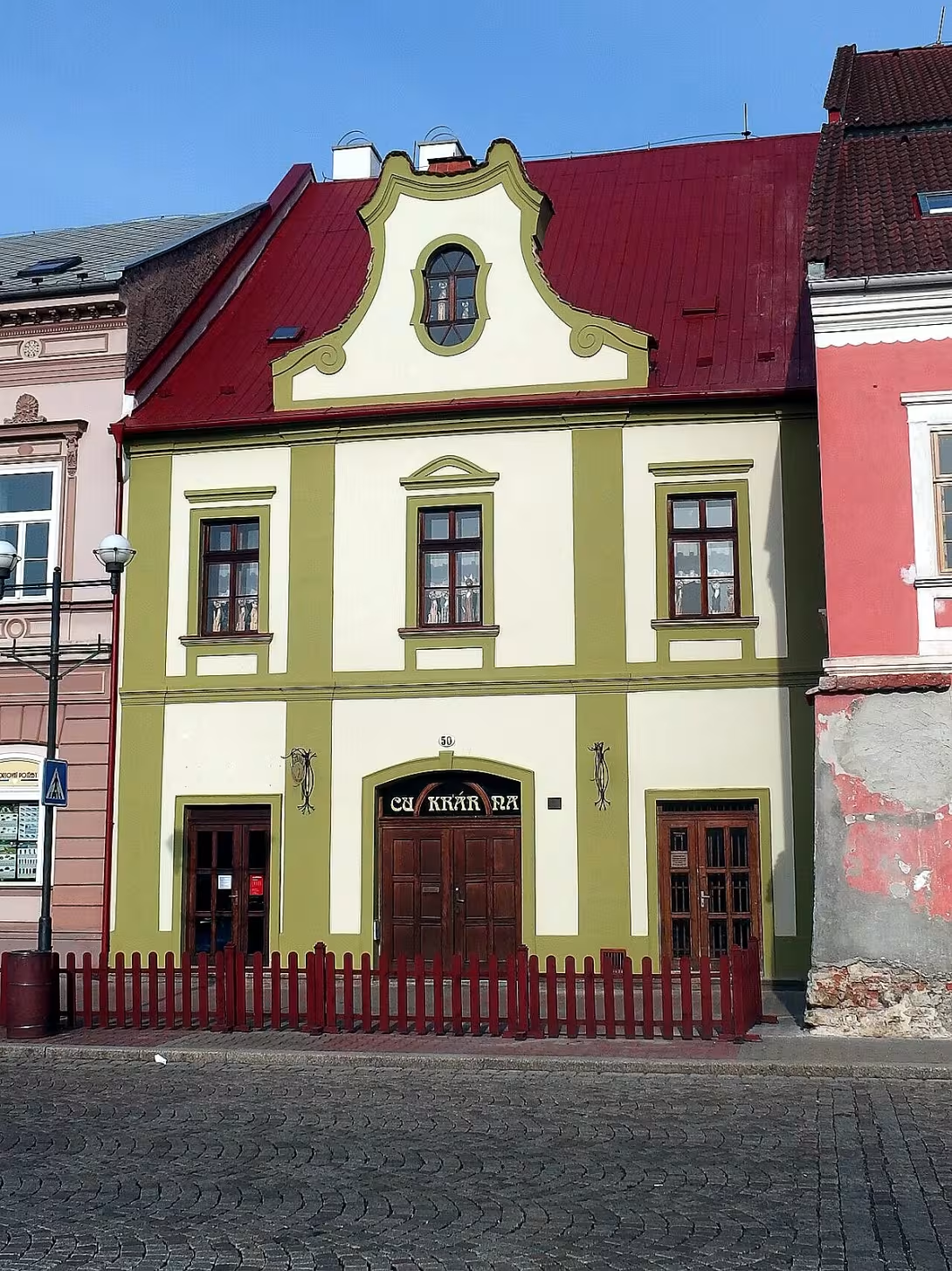
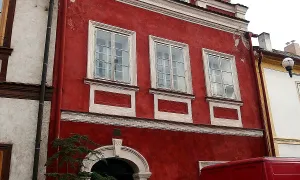
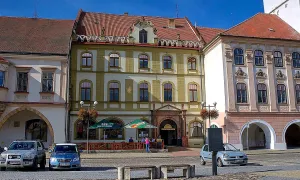
The House U Zlaté konvice (no. 50) is a township house in the Peace Square in the centre of the Kadani Old Town. It stands on the original 13th century medieval plot. It is remarkable by the continuity of ownership and history of reconstruction after devastating fires.
The building was built on land already measured when the royal city of Kadana was founded. Due to frequent disasters, the construction had to undergo several complete repairs, following major fires in 1362, 1421 and 1498.
The architectural building has changed its appearance several times over the centuries. A significant and costly reconstruction took place at the end of the 19th century as owner of Wenzel Kirsch. The current facade carries a tin display with a painted gold teapot, which was installed in 2015.
The first documented owner was the townsman Hans Czeumer in 1553. It was subsequently owned in 1564 by Hans Purrass, whose house was held until 1604. Then Andreas Funk from Annaberg, Saxon, came into possession. During the Thirty Years' War, the house was subject to fires between 1631 and 1635. The burning site was subsequently acquired by city councilwoman Johann Ulrich. After his death in 1637 the house was owned by Eva's wife, later Eva Kotz, who remained there after 1654.
In a later period, the house was owned by Jan Zikmund Hošťálek z Javořice, son of the executed mayor Maximilian Hostile. The other owners were the rhythm master Johann Ernst Schulthes and pharmacist Johann Hutschenreiter with his wife Eva Margaret. After 1701, the object switched to Leopold Florian Müller, which, however, was in debt, and the building was sold at auction in 1713.
The subsequent owner became Jakob Ignaz Otto z Ottlilienfeldu. He carried out a tax collector's office and was promoted by Emperor Charles VI of Habsburg to noble status for his merits. The Ottlilienfeld family owned the house until 1786, when another big city fire hit the building. The burning site was then purchased by Josef Anton Spindler, later inherited by Ignaz Spindler's grandson. In 1818 the house was bought by Josef Schuldes and in 1825 the township Franziska Stamm.
At the turn of the 19th and 20th centuries, the house was owned by Wenzel Kirsch. He ran a fashion store in it and was an agent of the Vienna Phönix insurance company. The last German owner was Karl Bergner, who ran the hardware store from 1924 to 1945. The Bergner family was expelled from Kadan on 23 August 1945.
An interesting feature is the symbolism of the gold kettle on the facade. In addition to the comments of Jakob Ignaz Otto and his office, the kettle in Christian iconography is the attribute of St. Elizabeth Thuringian. This saint is associated with the care of the poor and Franciscan spirituality, which is represented in Kadani by several former monasteries.
Today on the ground floor there is a café and a confectioner at the Golden kettle. The building serves as a reminder of the social rise of urban families and the history of the royal city. The visit to the building offers insight into the long development of the Kadani Centre and the fate of the people who lived and did business here.
Historical milestones
- 1553
- First mention of the owner of the house, the townsman Hans Czeumer.
- 1713
- Sale of the house at auction to Jakob Ignaz Otto from Ottlilienfeld.
- 1786
- A big fire in Kadani, after which the burning ground was purchased by Josef Anton Spindler.
- 1900
- Getting the house owned by Wenzel Kirsch and his expensive reconstruction.
Architectural development
The house was built on a medieval plot and underwent several complete reconstruction after devastating fires. At the end of the 19th century, the owner of Wenzel Kirsch performed a costly reconstruction of the building.
Historical events
The fires of the city in the years 1362, 1421 and 1498 caused reconstruction of the house. Fires in 1631 and 1635 during the 30-year war. A big city fire in 1786 that hit the house.
Owners
Hans Czeumer (1553), Hans Purrass (until 1604), Andreas Funk (1604), Johann Ulrich and Eva (after 1635), Eva Kotz (until 1654), Jan Zikmund Hošťálek z Javořice, Johann Ernst Schulthes, Johann Hutschenreiter with choti Evou Margaret, Leopold Florian Müller (until 1713), Jakob Ignaz Otto z Ottlilienfeldu (1713-1786), Josef Anton Spindler (after 1786), Ignaz Spindler (until 1818), Josef Schuldes, Franziska Stamm (1825), Wenzel Kirsch (1900), Karl Bergner (1924-1945).
Points of interest
- The house is on an original 13th century medieval plot. - Due to the large fire in 1362, 1421 and 1498, the construction had to undergo several complete repairs. - The current facade has a metal display with a 2015 gold teapot. - The symbol of the golden kettle resembles Jakob Ignaz Otto and his office, or Saint Elizabeth of Thuringian. - On the ground floor of the building there is a cafe and a confectioner.
Guide
Show guide text
This text was created by artificial intelligence and has not been editorially reviewed. It may contain inaccuracies.
Welcome to the heart of the old town of Kadana. Right now, you're standing in Peace Square, and in front of you, there's a house with a number of fifty, which many of you will recognize according to their poetic name at the Golden kettle. Stop for a moment and just feel the atmosphere of this place in peace. The view of this townhouse allows us to look deep into the history of the entire city, because the building you see is not just an ordinary house, but a real witness of centuries.
If you look at the place where the house is standing, you may not recognize it at first sight, but you are over land that has an incredibly long tradition. This plot was measured in the 1930s, when the royal city of Kadaň was founded. So imagine that beneath your feet lies a foundation that has been here for more than 700 years. It is a fascinating idea that even though buildings above the ground have been changing, repairing or rebuilding, the boundaries of this land have remained the same since the very beginning of the medieval city.
Now pay attention to the appearance of the house itself. Look up at his facade. Note the metal embossing shield that carries the image of the golden kettle. This detail was added relatively recently, namely in the year two thousand fifteen, but by its symbolism it brings us much further back to the past. This is the sign that reminds one of the former owners and his office. It's a little visual key that tells us that the house had its own specific functions and significance in the past.
Now let's switch to the people who lived here over time. The history of this house is basically a story about endurance and the ability to recover from disasters. The first written mention of the owner of this house dates back to the year of the thousand and five hundred fifty-three, when a townsman named Hans Czeumer lived here. Since then, important people have been taking turns in these walls. There was a home for rich townspeople, civil servants and nobles. Among the personalities associated with this place, for example, we can mention Jan Zikmund Hoštík from Javorice or Jakob Ignaz Otta from Ottlilienfeld, who won the house at auction in a thousand seven hundred and thirteen. In connection with the house, the name of Emperor Charles of the sixth Habsburg appears in the records.
When you look at the walls of the house today, remember that the road to their present form was filled with dramatic twists. Kadaň has been hit in the past by several devastating fires that basically wiped the city off the map. It was no different in this house. In the years of a thousand and three hundred sixty-two, thousands four hundred twenty-one, and thousands four hundred ninety-eight, the construction had to have undergone several complete repairs. The house was basically reborn several times from ashes.
But the strongest came in a thousand seven hundred eighty-six, when the great fire struck by Kadana left only the burning ground. It was at this critical moment that Josef Anton Spindler bought the house, who made sure that the building would serve its inhabitants again. This ability to recover from unhappiness is a property that has accompanied this house for centuries. Another significant milestone came at the very turn of the century off, in the year thousands of nine hundred when the house was owned by Wenzel Kirsch. It was he who invested considerable resources in a costly reconstruction that gave the house the form we know from a later period.
It is fascinating to think about how many generations of people have awakened here, how many trade agreements have been concluded and how many family dramas have witnessed these walls. The Golden kettle house is not only an architectural element of the square, but a living archive of kadani life. The fact that the house still stands on its original medieval parcel is basically a small miracle, given how many times the flames tried to destroy it.
Now try to revisit the facade and think about how the perception of beauty and functionality has changed over the centuries. From the medieval foundation to the Renaissance references, the Baroque l of the latter Closing-up of the Czech Republic to the modern reconstruction of the early 20th century. All these layers of time are connected in one building.
I hope this short trip to the past has helped you better understand the value of this place. The Golden kettle house is a perfect example of how the city of Kadaň evolved and how its inhabitants never gave up even when they lost everything in the fire. Now I invite you to slowly say goodbye to this house and continue to explore the hidden treasures of our beautiful Old Town. Let yourself be guided by the streets and discover other stories that these royal towns hold inside of you. I wish you a pleasant continued journey and many new discoveries.
Tips for visitors
The best time to visit is morning or late afternoon time when the sun hits the façade of the Golden kettle house at an angle, which will highlight the details of urban architecture. Transportation to the city centre is possible by car and public connections; Check specific options in current search engines.
We recommend taking shoes suitable for walking through the historical centre. Since it is a residential building, the tour takes place only from the outside, therefore we recommend paying attention to the details of the house and its location on the medieval parcel.
For the best photos we recommend looking for a place with a view to the whole facade of the house. The ideal light for images is shortly before sunset, when the colors of the Peace Square are most saturated.
During a short walk around you can visit the Peace Square in Kadani and the Dean's Church of the Holy Cross. For families with children it is advisable to focus on finding historical characters on houses and tell children about what the city looked like in the 13th century.
Frequently asked questions
Can the monument be visited?
This is a residential or farm building, not a museum with opening hours. Please view it from public space and respect the owners' privacy. We have no information about access to the interior.
Where is the monument?
Location: Kadaň. The map on this page shows the exact spot.
Why is the monument protected?
It is listed in the Central List of Cultural Monuments of the Czech Republic as a cultural monument (register no. 1000148025).
Businesses nearby
Do you run a restaurant, accommodation, shop, museum, rental, wellness or other visitor service near this monument? Show yourself directly to the people heading to it — this is how they will see you in the app and on the web:
Nearby
Mírové náměstí v Kadani, děkanský kostel Povýšení sv. Kříže.
Accommodation nearby
Themed route
Here is the design of the thematic route:
1. Peace Square in Kadani (central space) - The walk begins in this historic place, which forms the heart of the village and offers a beautiful atmosphere. 2. The Dean's Church of the Elevation of the Holy Cross (sacral building) - Dominant of the city, which will capture its architecture and spiritual history. 3. Dům čp. 50 (construction) - The main destination of the trip, where you can admire the details of a particular house within the urban development.
Seasonal recommendations
In spring, the surroundings of the house flourish and the fresh green beautifully complements the appearance of historical walls. For walking it is best to choose the morning when the light is fine and the air is fresh. We recommend shoes suitable for wet terrain and a light wind jacket.
In the summer months it dominates the bright sun, which highlights the details of the facade. The best time to visit is early morning or late evening to avoid the greatest heat and the largest number of people on the streets. Don't forget the hat and light, breathable clothes.
Autumn brings golden colors to the city with leaves and melancholy atmosphere. Low sun hits the building at an interesting angle, which is ideal for outdoor photography. At this time it is advisable to carry a waterproof coat and comfortable shoes for colder days.
Zimą works in quiet and quiet, often accompanied by freezing air and snow sheets. In Advent Time, the surroundings are heated by the atmosphere of anticipation. Hot clothes, gloves and tight shoes with anti-slip soles are essential for outdoor inspection.
Visualizations and artistic views

The visualisations are generated by artificial intelligence and serve as inspiration.
Photos from the area
Real photos taken near the monument


Zdroj a licence jsou uvedeny u každého snímku.
Tips from visitors
No tips yet. Be the first!
Log in and add your tip.
Sources and literature
Photos: Palickap / CC BY-SA 4.0 — Wikimedia Commons. The author and licence also appear when you hover over the image.
Faktickým podkladem tohoto textu byl článek na Wikipedii, jehož autory jsou přispěvatelé Wikipedie. Článek je dostupný pod licencí CC BY-SA 4.0.
Location on the map
More monuments – Kadaň
Show all in the municipality
Příběhy a pověsti
Legendy, pověsti a příběhy spjaté s touto památkou
Fotografie návštěvníků
Zatím žádné fotografie. Buďte první, kdo přidá fotografii z návštěvy!
Log in a přidejte svou fotografii nebo hodnoťte.
Za ověřenou návštěvu v aplikaci získáte víc bodů — poznáme podle GPS, že jste na místě.
Reviews and comments