



Dům čp. 693 Dukelských hrdinů Tenement house
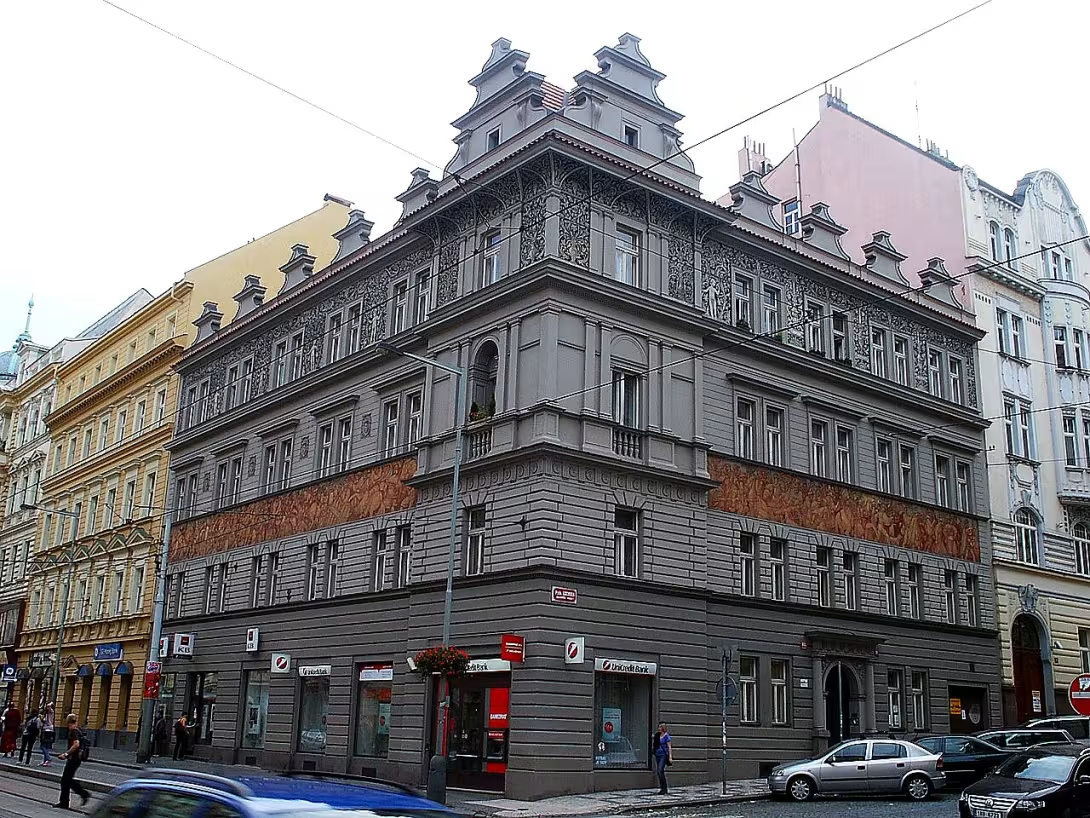
House No. 693 on the Dukel Heroes class in Prague 7 in Holešovice is a three-story building from 1894. The monument is remarkable with rich facade decoration with heroic themes. It is listed in the Central List of Cultural Monuments of the Czech Republic.
The building was built according to the design of architect Jan Zeyer. He was one of the generation of the National Theatre and was the brother of the great poet Julius Zeyer. Zeyer had already had ten buildings. He contributed significantly to the development of Holešovice and Buben as new Prague districts. In 1894 he designed in addition to this house two other rental houses on the same class and the Butcher house on the corner of the Buben waterfront and Argentine street.
Architecturally, the house is built in a neo-Renaissance style. Jan Zeyer was strongly influenced by his former associate Antonín Wiehl, who was the leader of the neo-Renaissance following the tradition of the Czech Renaissance of the 16th century. Zeyer and Wiehl in Prague designed and built five tenement houses together. At that time, their unusual concept of decor attracted the attention of experts and the public.
The facade of the house is decorated with plant ornaments and putti. Zeyer applied the principle of talking architecture here, when the building tells specific stories through decoration. To do this, he used a combination of vertical fields for individual figures and horizontal belts to display events. War scenes are located in the narrow space between the paintings above the bobsleigh on the ground floor and the first floor. Towards the Dukel hero class is oriented the battle with the Turks while into the street of the colonel. The statue is directed at the scene of a 30-year war.
In the immediate vicinity is the house No. 694, which complements the historical context of the location. Its decoration depicts the famous figures of Czech history: the kings of John of Luxembourg, Charles IV., Václav IV., Vladislav I., Jiří z Poděbrad and Saint Václav. The whole set of these structures reflects a period of effort to strengthen national identity through patriotic themes and historism.
House No. 693 is a valuable example of Czech neo-Renaissance and a demonstration of the Jan Zeyer Championship in work with facade decoration. For people interested in architecture and history of Prague, a visit to this place is an opportunity to see in detail unique painting cycles from the end of the 19th century.
Historical milestones
- 1894
- the creation of the house according to the design of architect Jan Zeyer in the Neo-Renaissance style
- 1900
- period of flowering of tenement houses and development of districts Holešovice and Buben
- 2024
- the building is registered in the Central List of Cultural Monuments of the Czech Republic
Architectural development
The building was built in a neo-Renaissance style that was influenced by the tradition of the Czech Renaissance of the 16th century. Architect Jan Zeyer was influenced in this concept by his former associate Antonín Wiehl. The facade uses the principle of "talking architecture" through thematic paintings.
Points of interest
- It's a corner three-story object from 1894 with a rich facade decoration. - The building was created according to the design of architect Jan Zeyer, who was the brother of the great poet Julius Zeyer. - The facade uses the principle of talking architecture, where decorations tell specific stories. - There are war scenes in the space above the ground floor, specifically the battle with the Turks and the scene of the Thirty Years War. - The monument is listed in the Central List of Cultural Monuments of the Czech Republic.
Guide
Show guide text
This text was created by artificial intelligence and has not been editorially reviewed. It may contain inaccuracies.
Welcome to Holešovice. Right now, you're standing in front of one of the very interesting houses of this neighborhood, specifically the building with the number six hundred ninety-three on Dukel Hero Street. Look at this massive corner object standing in front of you. It is a three-storey rental house, which in its size and appearance dominates this corner of Prague seven. The first impression of the building is a sense of stability and elegance, which is exactly what the author of the building wanted to express.
Now let's look at how this house came into being and at what time it happened. The building was built in a thousand eight hundred and ninety-four. To understand its meaning, we need to move back more than a hundred years. The end of the nineteenth century was a period of great bloom for the region of Holešovice and the Drum. Prague was growing sharply at the time and new neighborhoods were rising together. There were so-called tenement houses, which were large buildings designed to rent apartments. It is this house that is a great representative of the time when the city was modernising and expanding its face.
Now pay attention to the architecture itself. The house is brought out in a Neo-Renaissance style. If you look up at the facade, you'll see it's not left empty. It's richly decorated. Notice the plant ornaments that are wound up on the walls, and also putti, which are those little alligator figures of children that give the building lightness and playfulness. Besides, there are paintings with heroic themes. These elements are not just an ornament, but have a deeper meaning.
Here we come to one of the most interesting properties of this house. The architecture of this house uses the principle of speaking architecture. This means that the decorations on the facade are not random, but they have the task of telling specific stories. It's basically like reading a book, but instead of paper, the author uses stone and paint. When you look at the building, try to find a narrative in these paintings and ornaments about the heroics and virtues that inspired people at the time.
Who was the author of this proposal? The architect Jan Zeyer is behind the project. Jan Zeyer was not the only creative member of his family at the time. He was the brother of a very important poet named Julius Zeyer. It is fascinating to think that while one of the brothers created worlds with words in poems, the other created them in space using architecture. Both brothers thus contributed to Czech culture, each in their own way. Other personalities, such as Antonín Wiehl, are also associated with this place, which shows that people from different intellectual and social layers have moved in this environment.
Let's stop by one of the interesting things you may have missed. Notice the space above the ground floor. It is here that a large part of the richest decoration is concentrated to attract the attention of bystanders and show the prestige of the house. The whole building is today registered in the Central List of Cultural Monuments of the Czech Republic. This is not only a formal registration, but recognition that this house represents an important contribution to the development of the entire Holešovice-Buben district. Without such buildings, today's Holešovice would look completely different and lose their historical identity.
When you stand in front of this house today, feel the atmosphere of a place where the history of the late nineteenth century clashes with today's rhythm of the city. It is a monument to the time when it was believed in beauty, in art and that even an ordinary rental house can be a work of art. The facade tells us about the ambitions of the people of that time, their appetite for life and the desire to surround themselves with beauty.
Take one last look at the details, the plant patterns and the heroic paintings. Imagine what this house looked like in a thousand eight hundred and ninety-four, when it was brand-new and perhaps the most modern building in the area at that time. It's a fascinating testimony about how our Prague was changing.
Now we can say goodbye to him. I hope that you are interested in this short trip to history and that you will take a sense of admiration for the work of John Zeyer and his ability to turn an ordinary house into a talking memory. I will now invite you to explore the area. Holešovice has up its sleeve yet many other hidden treasures that await your discovery. Go through the surrounding alleys, see the architecture of other buildings and look for clues of the past that will lead you further. Thank you for your attention and I wish you a pleasant continued journey through the city.
Tips for visitors
The best time to visit is in the morning or late afternoon when the sun hits the facade at an angle that best highlights the rich plant decorating and details of the neo-Renaissance style. We recommend choosing a clear day to excel the colors and shapes of architecture.
You can reach the place by car or public transport; Check the specific connection and stop options in the current path search engine.
Because it is a residential building that can only be viewed from the outside, you do not need any special equipment. You need comfortable shoes for walking around Holesovice and a quality camera.
For the best pictures, focus on facade details and corner view of the house. The ideal light for shooting details of ornaments is in hours when the sun is not at its highest point, which prevents too sharp shadows.
In the immediate vicinity we recommend visiting the next house no. 694. He is interesting in his decoration, which depicts important Czech personalities such as King John of Luxembourg, Charles IV and St. Wenceslas. For families with children this place is suitable as a short lesson from the history of architecture and Czech plot ownce.
Frequently asked questions
Can the monument be visited?
This is a residential or farm building, not a museum with opening hours. Please view it from public space and respect the owners' privacy. We have no information about access to the interior.
Where is the monument?
Location: Holešovice. The map on this page shows the exact spot.
Why is the monument protected?
It is listed in the Central List of Cultural Monuments of the Czech Republic as a cultural monument (register no. 1000153072).
Businesses nearby
Do you run a restaurant, accommodation, shop, museum, rental, wellness or other visitor service near this monument? Show yourself directly to the people heading to it — this is how they will see you in the app and on the web:
Events nearby

Zdroj akcí: otevřená data měst a obcí ČR (Národní katalog otevřených dat) a kalendář akcí Národního památkového ústavu.
Nearby
V bezprostřední blízkosti se nachází dům čp. 694, jehož výzdoba zobrazuje slavné postavy české historie, jako jsou králové Jan Lucemburský, Karel IV. či svatý Václav.
Accommodation nearby
Trips and activities nearby
Guided tours, tickets and activities nearby from GetYourGuide
Affiliate link: if you buy from the partner, we may receive a commission. The price for you does not change.
Search tours and activities →Themed route
Here is the design of the thematic route:
1. Dům čp. 693 Dukelských hrdinů - the main monument. A place dedicated to commemorating the heroism and suffering of the war. 2. House No. 694 - neighbouring building in immediate vicinity. It is interesting thanks to its decoration, which depicts important Czech monarchs and saints, such as John of Luxembourg, Charles IV and St. Wenceslas.
Seasonal recommendations
In spring, the surroundings of the house awaken to life and fresh greenery accompanied by walks in Holešovice. Soft spring light is ideal for observing facade details. We recommend light but laminated clothing and a visit in the morning when the air is the cleanest.
In the summer months it dominates areas of intense sun and hot air. The building in bright light is very strong, while the shade of nearby trees offers relief. It is advisable to choose breathable substances and to visit the site in the early morning or late evening to avoid the greatest Closing waves of heat.
Autumn brings golden leaves to the district and a specific nostalgic atmosphere. The lighting is milder and warmer in this period, creating a pleasant contrast with the surface of the building. It is practical to carry a waterproof coat and shoes suitable for wet leaves.
Zimą The appearance of the monument turns into a dependence on snow covered landscape and a short day. Cold air and gray skies highlight the roughness of the urban environment, while lighting lights in the advent time around. Hot winter clothes, thermo-mats and fixed shoes with anti-slip soles are essential.
Visualizations and artistic views

The visualisations are generated by artificial intelligence and serve as inspiration.
Photos from the area
Real photos taken near the monument


Zdroj a licence jsou uvedeny u každého snímku.
Tips from visitors
No tips yet. Be the first!
Log in and add your tip.
Sources and literature
Photos: JiriMatejicek / CC BY-SA 3.0 — Wikimedia Commons. The author and licence also appear when you hover over the image.
Faktickým podkladem tohoto textu byl článek na Wikipedii, jehož autory jsou přispěvatelé Wikipedie. Článek je dostupný pod licencí CC BY-SA 4.0.
Location on the map



Příběhy a pověsti
Legendy, pověsti a příběhy spjaté s touto památkou
Fotografie návštěvníků
Zatím žádné fotografie. Buďte první, kdo přidá fotografii z návštěvy!
Log in a přidejte svou fotografii nebo hodnoťte.
Za ověřenou návštěvu v aplikaci získáte víc bodů — poznáme podle GPS, že jste na místě.
Reviews and comments