



Dům U dvou kamenných stolů House
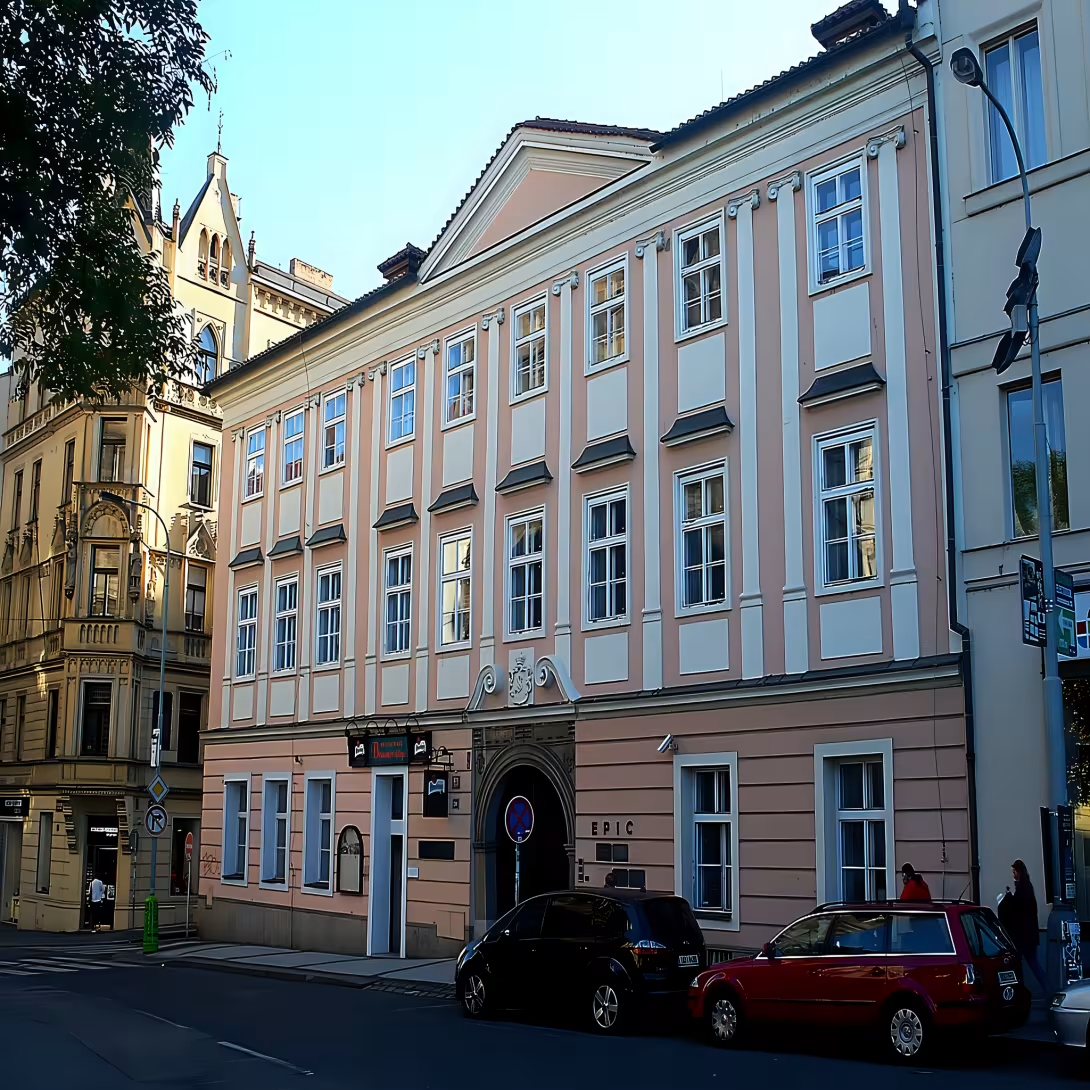
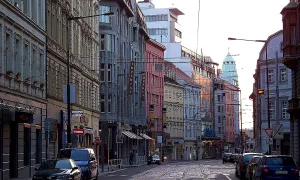
Braun's house, also known as the house At two stone tables or Salmov Palace, there is a significant corner building on Charles Square in Prague's New Town. This two-storey Classicist building with a history dating back to the 14th century constitutes a significant urban dominance opposite the New Town Hall tower. Since 1964, the building has been a protected cultural monument. Its value consists of a unique combination of Gothic, Renaissance, Baroque and classical building elements.
The history of the settlement of this plot dates back to 1377, when there were probably two Gothic houses. These objects or parts of them were part of the fortification of the New Town of Prague at the time. From the oldest building phase, cellars and some inner parts of the ground floor have been preserved until today. A fundamental transformation into a large Renaissance object occurred in 1585, which is evidenced by the year on the preserved entrance portal. We attribute this reconstruction to architect Oldřich Aostalis and its tracks are still visible especially in excellent wings.
The most famous period of the house is associated with the name of Baroque sculptor Matyas Bernard Braun. He purchased the building in 1714 for 2915 gold pieces and lived in it with an art workshop until his death in 1738. It is from this time that the name is U of two stone tables. In the 1860s, the artist's daughter Marie initiated a late Baroque reconstruction. The author was either Antonín Schmidt or Jan Josef Wirch. That's when the house acquired its palate character and its attics, according to period images, decorated a number of sculptures, but they were not preserved.
The architectural form of the palace is the result of a classic design from 1820. The main nine-axis facade to Charles Square is divided by pilasters of the high order and decorated by belt rustics on the ground floor. An important element is the asymmetrically located portal in the sixth axis, which carries Renaissance and baroque curds. The crown ledge passes over him into a triangular shield. The side facade in Řeznická Street has a corner part identical to the main facade, while the following eight-axis section is easier on the floors. The interior is particularly valuable with preserved beam painted ceilings on the ground floor of the front wing and an inner courtyard with open deck on the first floor, which is carried by volute consoles.
The property's history reflects social changes in Prague. After the Braun house in 1796, the princes of Hohenlohe- Kirchberg bought it. Subsequently, it was acquired by the Salm-Reifferscheid family, which initiated a classical reconstruction. From 1867 until the end of the Austrian-Hungarian monarchy, the palace was owned by the Earl of Thun-Hohenstein. In addition to noble residences, the house served charitable purposes. In the years 1786 to 1831, a newly founded Institute for Deaf-mute worked here in the rented premises of the second floor.
In the 20th century, the house was used for flats and shops, which led to insensitive interventions such as the penetration of the ground floor window cabinets. These modifications were removed by workers during a major reconstruction between 1989 and 1991. After privatisation, the building acquired its present form. At that time they cancelled the parking in the yard and adapted the premises for the needs of the law firm and social events. Today two halls and a courtyard serve for conferences and seminars.
Braun's house is an extraordinary proof of the building development of Prague's urban and noble architecture. His visit offers the opportunity to see where he formed one of the most important sculptors of the European Baroque and to appreciate the sensitive synthesis of historical styles in the context of New Town.
Then and now
Drag the slider to compare how the landmark may have looked when it was built with the view today.
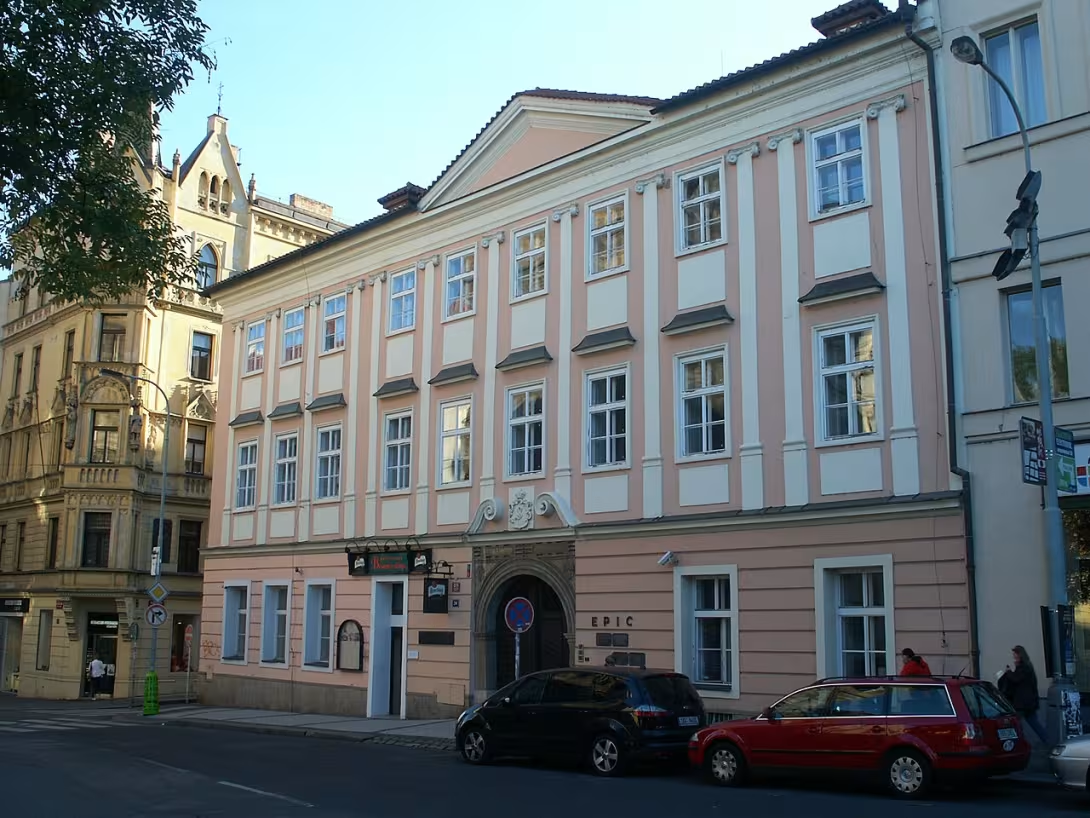

The historical appearance on the left is an AI-generated visualisation and serves as inspiration only.
Historical milestones
- 1377
- First written mention of the construction site of today's palace.
- 1585
- Renaissance house reconstruction attributed to Oldřich Aostalis.
- 1714
- The house becomes the property and place of sculptor Matthias Bernard Braun.
- 1820
- Classicism of the facade into today's form.
- 1964
- Registration of the object on the list of cultural monuments.
Architectural development
The original Gothic houses were replaced in 1585 by a Renaissance object with a preserved portal. In the 1960s, a late Baroque reconstruction followed, which impressed the house with a palace character. The final classical adjustment of the facade took place in 1820 for the Salm-Reifferscheid family.
Historical events
1714 - the purchase of the house by sculptor Braun for his workshop, 1786-1831 - the building was operated by the Institute for Deaf-mute, 1989- 1991 - a major reconstruction took place to remove inappropriate modern interventions.
Owners
Matyáš Bernard Braun (1714-1738), Marie Kuchařová (until 1796), the family Hohenlohe- Kirchberg (from 1796), the family Salm-Reifferscheid (from 1820), the family Thun-Hohenstein (from 1867), the state (1918- 1990), private owners (after 1990).
Points of interest
- Two original Gothic houses on the plot from 1377 were part of the fortification of the New Town of Prague. - In 1714 the Baroque sculptor Matyáš Bernard Braun purchased the house for twenty-nine hundred and fifteen gold pieces and lived there with a workshop until 1738. - In the sixties of the eighteenth century, Marie's daughter initiated a late Baroque reconstruction, during which the attics were decorated by a series of statues that had not been preserved. - Between 1786 and 1831, a newly founded institute for the deaf-mute was operating in the rented premises of the second floor. - The workers removed insensitive interventions such as puncturing the display cabinets during a major reconstruction between 1989 and 1991.
Guide
Show guide text
This text was created by artificial intelligence and has not been editorially reviewed. It may contain inaccuracies.
Welcome to Charles Square. You're standing in front of an important corner palace that bears the name of Braun's house, also known as the House of Two Stone Tables. Look before you at the magnificent structure whose outer face carries nine windows on one row on each floor, which forms the so-called nine-axis form.
Let's move forward in time and look at the very beginnings of this place. The first written mention of the construction on this parcel dates back to 13,700. At that time, there was a pair of original Gothic houses that were even part of the fortification of the New Town of Prague.
Now pay attention to the construction itself and to what stands before you. The current form of this building combines several different building styles and periods, from Gothic to Renaissance to Baroque to Classicism. Over the centuries, several builders and creators, among whom we know names such as Oldřich Aostalis, Antonín Schmidt and Jan Josef Wirch, have participated in the formation of this form.
While you stand and look at the facade, let's remember the key stories and personalities that breathed into this place. A Renaissance rebuilding of the house took place in the year of fifty years even five years, which history attributed to Oldřich Aostalis. But the most important chapter was written in the eighteenth century. In the year of seventeen fourteen, this house was purchased by famous Baroque sculptor Matyáš Bernard Braun for twenty-nine hundred fifteen gold pieces. This artist lived and formed his work here until the year of seventeen third eight. Later, in the sixties of the eighteenth century, the Marie Kuchařová initiated further modifications, together with František Kuchar. Today's appearance of the facade then comes from the classicist modification of the year eighteen twenta.
The interesting thing is that this house successfully resisted the tooth of time and for its value in the year niteken six four was listed as a list of cultural monuments.
I believe the view of this building has enriched you with new impressions of Prague history. Thank you for your attention, I wish you the rest of the day and a good journey on your next discovery of our history. Goodbye.
Tips for visitors
The best time to visit this important corner palace building on Charles Square is early in the morning, when the surrounding area is quieter and the sunlight ideally illuminates the historical facade.
Take with you comfortable shoes to walk on historic tiles, camera to capture unique Gothic and other building features and possibly a bottle of drinking. For the best photographic footage, stand on the opposite side of the area, from where there is an excellent view of the entire corner structure and light hitting the facade in the morning creates great shadows and depth.
Within walking distance within 30 minutes of a quiet walk there are several interesting places listed around the sights such as the New Town Hall, the extensive Charles Square, the magnificent church of St. Ignatius of Loyola, the mysterious Faust House or the nearby Řeznická Street. All of these places form a complete circle for exploring the history of New Town.
For families with children, the visit is suitable as a pleasant outdoor walk associated with the discovery of old houses and legends that bind to this location. Children can relax in the surrounding parks and in the areas and the whole route is easy on physical condition.
Frequently asked questions
Can the monument be visited?
This is a residential or farm building, not a museum with opening hours. Please view it from public space and respect the owners' privacy. We have no information about access to the interior.
Where is the monument?
Location: Nové Město, Hlavní město Praha. The map on this page shows the exact spot.
Why is the monument protected?
It is listed in the Central List of Cultural Monuments of the Czech Republic as a cultural monument (register no. 1000152216).
Businesses nearby
Do you run a restaurant, accommodation, shop, museum, rental, wellness or other visitor service near this monument? Show yourself directly to the people heading to it — this is how they will see you in the app and on the web:
Events nearby

Zdroj akcí: otevřená data měst a obcí ČR (Národní katalog otevřených dat) a kalendář akcí Národního památkového ústavu.
Nearby
Novoměstská radnice, Karlovo náměstí, kostel svatého Ignáce z Loyoly, Faustův dům, Řeznická ulice.
Accommodation nearby
Trips and activities nearby
Guided tours, tickets and activities nearby from GetYourGuide
Affiliate link: if you buy from the partner, we may receive a commission. The price for you does not change.
Search tours and activities →Themed route
I propose a thematic cruise route that will guide you through interesting places in the village Nové Město. The route is set up in a logical order and uses only predefined locations from the surrounding area.
1. Charles Square - Type: Spaces and public square - Why is it worth a visit: This vast space forms the natural heart of the whole site. You can walk here and start your walk around the surrounding historical buildings.
2. New Town Hall - Type: Historical building - Why is it worth a visit: This important monument offers a view into ancient architecture. Located in the immediate vicinity of the square.
3.Dům U dvou kamenných stolů - Type: Historical Palace (Main destination) This beautiful palace represents the main destination of your trip. It will capture you with its unique form and history.
4. Church of St. Ignatius of Loyola - Type: Sacral building and church - Why is it worth a visit: This monumental building excels with its beautiful decoration. It's a great place to calm down during your journey.
5. Faust House - Type: Historical House - Why is it worth visiting: the house is surrounded by many mysterious legends and legends. Attracts attention to his agitated past.
6. Butcher Street - Type: Historical street - Why is it worth a visit: This cosy street completes the stunning atmosphere of the entire neighborhood. Walk this way pleasantly ends your trip.
Seasonal recommendations
Spring brings awakening nature and the rays of the sun gradually reveal the beauty of the Gothic and Renaissance facades of this noble manor in New Town. The surrounding streets come to life with fresh greenery and daylight allows you to admire the master stonework in many colorful shades. During this period, tourists are still chilling, so there is a calm and thoughtful atmosphere suitable for detailed examination of architectural elements. We recommend to wear a light, but wind-resistant jacket and fixed shoes because spring weather is usually variable. The best time for arrival is the morning between 9:00 and 11:00, when the sun ideally lights up the front of the building and there are almost no tours in the courtyard.
Summer offers long sunny days, when the sharp midday light casts deep shadows on massive stone portals, creating a unique contrast for photography lovers. The atmosphere in the metropolis is very lively because the main tourist season is in full swing and surrounding parks provide a welcome shadow. Due to the large crowds of visitors, it is necessary to get up early and arrive at the palace first thing in the morning before 10:00 a.m. so that you can enjoy the tour without the pressure. Choose breathable clothes from natural materials and do not forget the cap and bottle of drinking water, as the temperatures on the paved streets can reach high values.
Autumn turns the whole area into a colorful gallery full of golden and rusty tones, which beautifully complement the historical character of an ancient building. Light is low and soft, which gives the whole place a melancholy and noble touch ideal for peaceful contemplation of ancient centuries. Practical advice is layered clothing because the wounds are usually cold, but in the afternoon you can warm a weaker sweater, as well as waterproof shoes for autumn showers. The best time to visit is the late afternoon, when the sun boils to the horizon and the rays form on the stone walls a captivating game of lights and shadows accompanied by rustling decaying leaves.
Winter breathes a mysterious atmosphere into this monument, especially when the historic core of the city is dusted with fresh snow and early constellations light up yellow street lights. The outdoor spaces are empty, which guarantees maximum concentration and a deep experience of monumental architecture without disruptive influences of surrounding activity. It is absolutely necessary to put on a warm coat, hat, gloves and winter shoes with anti-slip soles because the tiles can freeze.
Visualizations and artistic views


The visualisations are generated by artificial intelligence and serve as inspiration.
Photos from the area
Real photos taken near the monument


Zdroj a licence jsou uvedeny u každého snímku.
Tips from visitors
No tips yet. Be the first!
Log in and add your tip.
Sources and literature
Photos: JiriMatejicek / CC BY-SA 3.0, rozlišení zvýšeno umělou inteligencí — Wikimedia Commons. The author and licence also appear when you hover over the image.
Faktickým podkladem tohoto textu byl článek na Wikipedii, jehož autory jsou přispěvatelé Wikipedie. Článek je dostupný pod licencí CC BY-SA 4.0.
Location on the map
More monuments – Nové Město
Show all in the municipality


Příběhy a pověsti
Legendy, pověsti a příběhy spjaté s touto památkou
Fotografie návštěvníků
Zatím žádné fotografie. Buďte první, kdo přidá fotografii z návštěvy!
Log in a přidejte svou fotografii nebo hodnoťte.
Za ověřenou návštěvu v aplikaci získáte víc bodů — poznáme podle GPS, že jste na místě.
Reviews and comments