



Fara (Dvory nad Lužnicí) Parish house
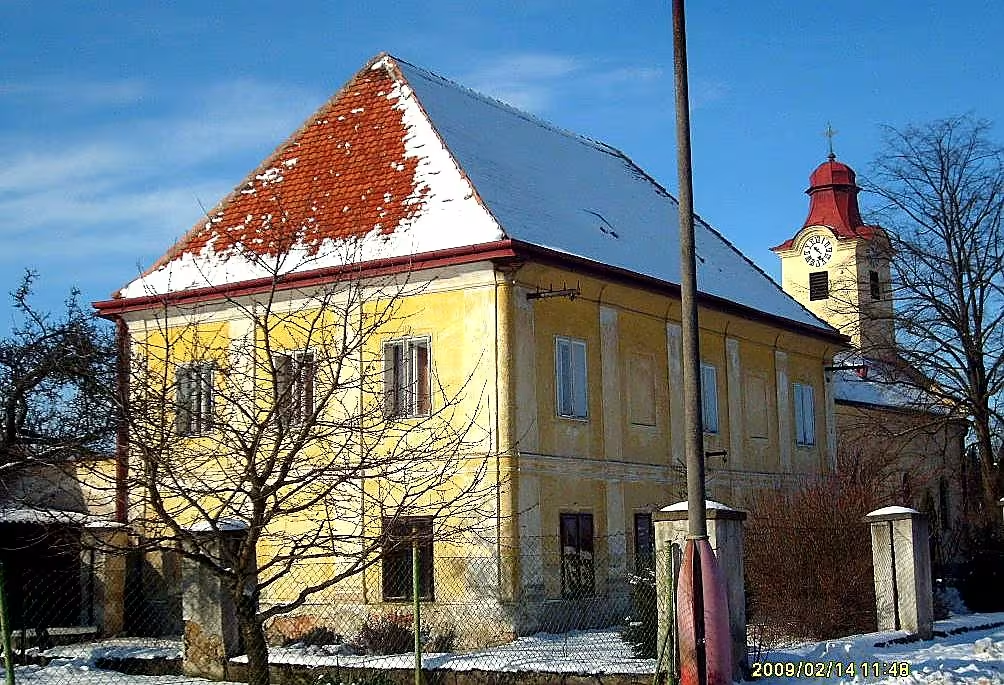
Fara in Dvory nad Lužnica is a late Baroque storey building no. 42 in the district of Jindřich Hradec. The building was entered in the state list of cultural monuments in 1963. It represents an important document of ecclesiastical construction in the Czech-Austrian border and resembles the Josephine reforms of the second half of the 18th century.
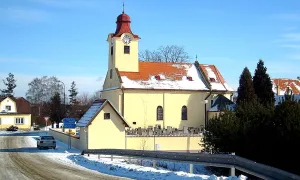
The parish in Dvory nad Lužnice was founded in 1783 in the framework of the enlightenment reforms of emperor Josef II. Before that, the village, consisting of scattered estates in the Lužík valley, was lured to Gmünd. The neighbouring Church of the Assumption of the Virgin Mary was completed in 1788, so it is assumed that the parish building and the economic area were created during the same period. The area was historically part of Vitorazska and belonged to the lower Austrian Weitra estate. The church administration was therefore subject to the Bishop in St. Pölten.
The main building of the rectory is a walled, plastered and partially glazed building with a rectangular ground plan and a valb roof covered with bobbies. The street facade is symmetrically five-axis, the side facades are three-axis. The architectural breakdown consists of plastic lizens ranging from the plinth to the underroof Fabion and horizontal interlayer strip. The windows on the ground floor are lined with stucco belt with top jewel, and are supplemented by parapet fillings with stylized fringes. The entrance portal on the ground floor is saddled, compressed, set in stone lining with handles and baroque decorated doors. The area is complemented by economic objects, namely barn and stables, which connect the wall gates with semi-circular entrances to the main building. The whole wall closes with a goal that separates the yard from the original parish garden.
The original administrator was the Bishop of St. Pölten. After the connection of Vitorazska to Czechoslovakia in 1921, the parish went under the Apostolic administration and in 1937 it was joined to the Czechoslovak diocese. The first spiritual administrator was František Pivonka, who worked here for 14 years. In the early days of the parish, he oversaw the construction of the church, while the services were carried out in a temporary wooden building. The Austrian priest Franz Hofman followed him. The separate parish disappeared on 31 December 2019 and the Church of the Assumption of the Virgin Mary became a philic church of the Roman Catholic parish in Suchdole nad Lužnice.
Today the complex is protected as a monument, which stands out for preserved facade details and internal layout typical of Baroque storehouses. The object illustrates the religious structure of the region during the Enlightenment period and its economic background indicates the way the church property was managed in the 18th century. Visiting this place offers an opportunity to look into the history of Vitorazska and appreciate the artisanal level of late Baroque architecture, which has been preserved here in authentic form.
Historical milestones
- 1783
- The establishment of a parish in the Dvory of Lužnice.
- 1788
- Completion of the Church of the Assumption of the Virgin Mary and the anticipated creation of the parish building.
- 1963
- The entry of the parish grounds into the state list of cultural monuments.
- 2019
- Termination of the parish as of 31 December 2019.
Architectural development
The wall storey building with the valbé roof was built in the late Baroque style probably along with the Church of the Assumption of the Virgin Mary. The facade is divided by symmetrical window axes and lizenas, the inner layout of which corresponds to the traditional arrangement of baroque faras. The area was gradually supplemented by economic objects and a fenced wall.
Historical events
1783: The establishment of a parish in the context of Josephine reforms. 1963: Registration in the state list of cultural monuments. 2019: Dissolution of a separate parish and addition to administration in Suchdole nad Lužnice.
Owners
Originally church property subordinate to the Bishop of St. Pölten, later the Bohemian Budejovice diocese.
Points of interest
- The parish building is a late baroque storey building, which was listed in 1963 as a state list of cultural monuments. - The parish was founded in 1783 as part of the enlightened reforms of emperor Josef II and before that the village was joined to Gmünd. - The area was historically part of Vitorazska and belonged to the lower Austrian estate Weitra, therefore the church administration was subject to the Bishop of St. Pölten. - In addition to the main building, the area includes economic objects, namely a barn and stables, which are connected by walled gates. - After the connection of Vitorazska to Czechoslovakia in 1921 the parish went under the Apostolic administration and in 1937 it was joined to the Czech-Budějovice diocese.
Guide
Show guide text
This text was created by artificial intelligence and has not been editorially reviewed. It may contain inaccuracies.
Welcome to the Court of Lužnice. You are standing in front of a building that has been the unshakeable center of local life and spiritual peace for centuries. Before your eyes, there is a rectory, an impressive storey object that immediately attracts the attention of every pilgrim and random passer. Please feel the atmosphere of peace and history floating around you. This building is not just a walled building, it is a witness to the transformations that have been going through this area for centuries and a half. The sight of her face will immediately tell you that you are in a place where everyday work is combined with a higher mission.
Now let's go back to the past together to understand why this object is standing right here and why it looks like this. To understand the origin of this building, we have to look at the end of the eighteenth century, which was a time of great change and enlightenment. In the year one thousand seven hundred eighty-three there was a crucial moment when the parish was officially founded. But it wasn't a random process. This whole arrangement was part of the wider changes that Emperor Josef II had promoted. His reforms aimed to modernise the state and the Church, thereby changing the structure of the entire estate. Before this period, this village did not exist as a separate spiritual centre, but its people had to seek a connection with Gmundo. It is thanks to these lighting processes that a new centre could be created here. Around the year one thousand seven hundred eighty-eight, when the neighbouring Church of the Assumption of the Virgin Mary was completed, this parish building was probably also a full home for spiritual administrators.
Now pay attention to the construction itself that surrounds you. Look at her floors and how the building floats above the ground. It is a late Baroque architecture, which you can tell by the elegance and rhythm in its facade. Now, if you look closer to the walls, notice the vertical elements they call the lizens. These decorative wall sockets divide its surface beautifully and give it a sense of height and grandeur. Also pay attention to the windows. Notice how their edges are decorated with stucco lining. These fine, decorative creations around the windows are not just for beauty, but they create this fine, baroque frame that gives the whole building a face. This whole object, number four-two, is an excellent example of how aesthetics associated with the need to express the importance of the site at that time.
Let us not forget, however, that the rectory was not just a home for prayer and study. If you look around you, you'll see that this object is part of a much larger whole. You see the gate, you see the barn, you see the barn. That's a very important detail that tells us the story of how this place worked. In the Czech Austrian border, church buildings were often also economic centres. The rectory had to be self-sufficient, had to have a place for farming to play its part. So this complex represents a connection between spiritual life and hard, everyday work in the fields and in the courts. It is proof of a time when faith and agriculture were not separated, but formed one whole.
There are also names in the history of this place that are closely related to this building and surrounding area. Although the exact names of architects who designed this construction today remain hidden in history, we can meet names such as František Pivonka or Franz Hofman. These people were part of the world that shaped this area. This country, historically known as Vitoraz, was a place where the various influences intertwined and where the borders between Czech and Austrian countries became a living part of everyday life.
You may now be interested in one interesting thing that carries a hint of melancholy. Although this building has been included in the national list of cultural monuments since one thousand nine hundred sixty-three and has been protected as a valuable heritage for decades, its role has changed substantially in recent years. In particular, at the end of the year, two thousand nineteen, i.e. two thousand nineteen on the third December, ended the existence of this parish. It is a strange moment when a place that has been the heart of the community for more than two hundred years now serves primarily as a historical monument. It is a reminder of how the world changes, how people's needs change, and how even the strongest institutions can disappear in time.
You are standing in front of a place that survived the reforming of emperors, the change of borders and the political storm. He is a monumental witness to the past, which today allows us to look into the life of our ancestors. I hope this brief insight into history has helped you better understand the beauty and importance of this Baroque object. Please continue your walk and pay attention to other details in the area that will reveal to you. Thank you for your journey and I wish you a pleasant continuation in discovering the beauty of this place. Goodbye.
Tips for visitors
The best time to visit is during sunny days in the late afternoon, when the low sun lights up the Baroque facade of the building and highlights its historical details. In this period the surroundings are quiet and suitable for uninterrupted observation of architecture.
You can easily reach the village by car or public transport. We recommend that the current connection and transport options be verified in the respective search engines.
For photography we recommend to use the space in front of the main gate, from where the overall composition of the storey building stands out. It is convenient to have a wide-angle lens to capture the entire area, including the entry gates.
Within 30 minutes' drive you can visit the Church of the Assumption of the Virgin Mary, the village of Suchdol nad Lužnica, the picturesque river Lužnica or the natural area of Vitorazsko, which offers beautiful walks in nature.
For families with children the location is ideal for easy trips. The surroundings of the Lukovice River and the nature of Vitorazska provide sufficient space for children to move, while the historical parish serves as an interesting educational goal for exploring the history of the region.
Frequently asked questions
Can the monument be visited?
This is a residential or farm building, not a museum with opening hours. Please view it from public space and respect the owners' privacy. We have no information about access to the interior.
Where is the monument?
Location: Dvory nad Lužnicí, Jihočeský kraj. The map on this page shows the exact spot.
Why is the monument protected?
It is listed in the Central List of Cultural Monuments of the Czech Republic as a cultural monument (register no. 1000138184).
Businesses nearby
Do you run a restaurant, accommodation, shop, museum, rental, wellness or other visitor service near this monument? Show yourself directly to the people heading to it — this is how they will see you in the app and on the web:
Nearby
Kostel Nanebevzetí Panny Marie, obec Suchdol nad Lužnicí, řeka Lužnice, přírodní oblast Vitorazsko.
Accommodation nearby
Themed route
Thematic cruise route from Dvory nad Lužnice
1.Fara (Dvory nad Lužnicí) - Type: Historical religious building. - Why is it worth visiting: The Fara in Dvory is an example of Baroque architecture with a rich history. Its interior offers a view of the artistic elements and spiritual atmosphere that characterises the region.
2. Church of the Assumption of the Virgin Mary (Dvory nad Lužnicí) - Type: Church. - Why it is worth a visit: This church is famous for its architectural beauty and history. Its interior contains artistic elements that attract lovers of spiritual art.
3. The river Lužík - Type: Natural element. - Why it is worth a visit: The river offers beautiful views and is an ideal place for relaxation. Its shores are suitable for picnic or walk, allowing you to enjoy the natural environment of the area.
4. Suchdol village over Lužnice - Type: City Centre. - Why is it worth a visit: Suchdol offers the historic heart of the city where you can find ancient houses and picturesque architecture. It is an ideal place to explore local shops and restaurants.
5. Natural region of Vitorazsko - Type: Natural reservation. - Why is it worth visiting: This area is known for its diverse fauna and flora. It is an ideal place for nature lovers who seek peaceful moments in a beautiful rural environment.
This route offers a combination of cultural and natural experiences that allow a deeper understanding of the Dvory region over Lužnica.
Seasonal recommendations
Spring: In the spring period, Fara in Dvořy nad Lužnice is affected by mild sunlight that shines on the roofs and decorating the church. Green nature is restoring itself, creating a calm atmosphere. It is advisable to come in the morning or in the evening when the crowds are less significant and can enjoy the peace. Good clothes will be light bunching, because temperatures may vary at this time.
Summer: In the summer, Fara is lit by long and hot sunlight, which emphasizes architectural details. The atmosphere is full of energy and life, especially in the main summer season when traffic increases. It is recommended to come earlier in the day to avoid large crowds, and wear light clothes suitable for warm weather.
Autumn: In autumn, Fara is surrounded by a golden and red leaf colour of trees, creating a handsome background. Sunlight becomes softer, which contributes to a quiet visitor's experience. The temperatures are mild, so it is advisable to wear clothes with the ability to dress or dress as needed. The best time to visit again is morning or evening.
Winter: During winter, Fara is lit by cold and soft rays of the sun, creating a magical atmosphere. Winter brings peace and lower attendance, allowing for a more intimate experience. It is recommended to come on a day without snow for a comfortable visit.
Visualizations and artistic views

The visualisations are generated by artificial intelligence and serve as inspiration.
Photos from the area
Real photos taken near the monument


Zdroj a licence jsou uvedeny u každého snímku.
Tips from visitors
No tips yet. Be the first!
Log in and add your tip.
Sources and literature
Photos: Stanislav Kroupa / Public domain — Wikimedia Commons. The author and licence also appear when you hover over the image.
Faktickým podkladem tohoto textu byl článek na Wikipedii, jehož autory jsou přispěvatelé Wikipedie. Článek je dostupný pod licencí CC BY-SA 4.0.
Location on the map



Příběhy a pověsti
Legendy, pověsti a příběhy spjaté s touto památkou

Fotografie návštěvníků
Zatím žádné fotografie. Buďte první, kdo přidá fotografii z návštěvy!
Log in a přidejte svou fotografii nebo hodnoťte.
Za ověřenou návštěvu v aplikaci získáte víc bodů — poznáme podle GPS, že jste na místě.
Reviews and comments