



Frýdek-Místek Railway station
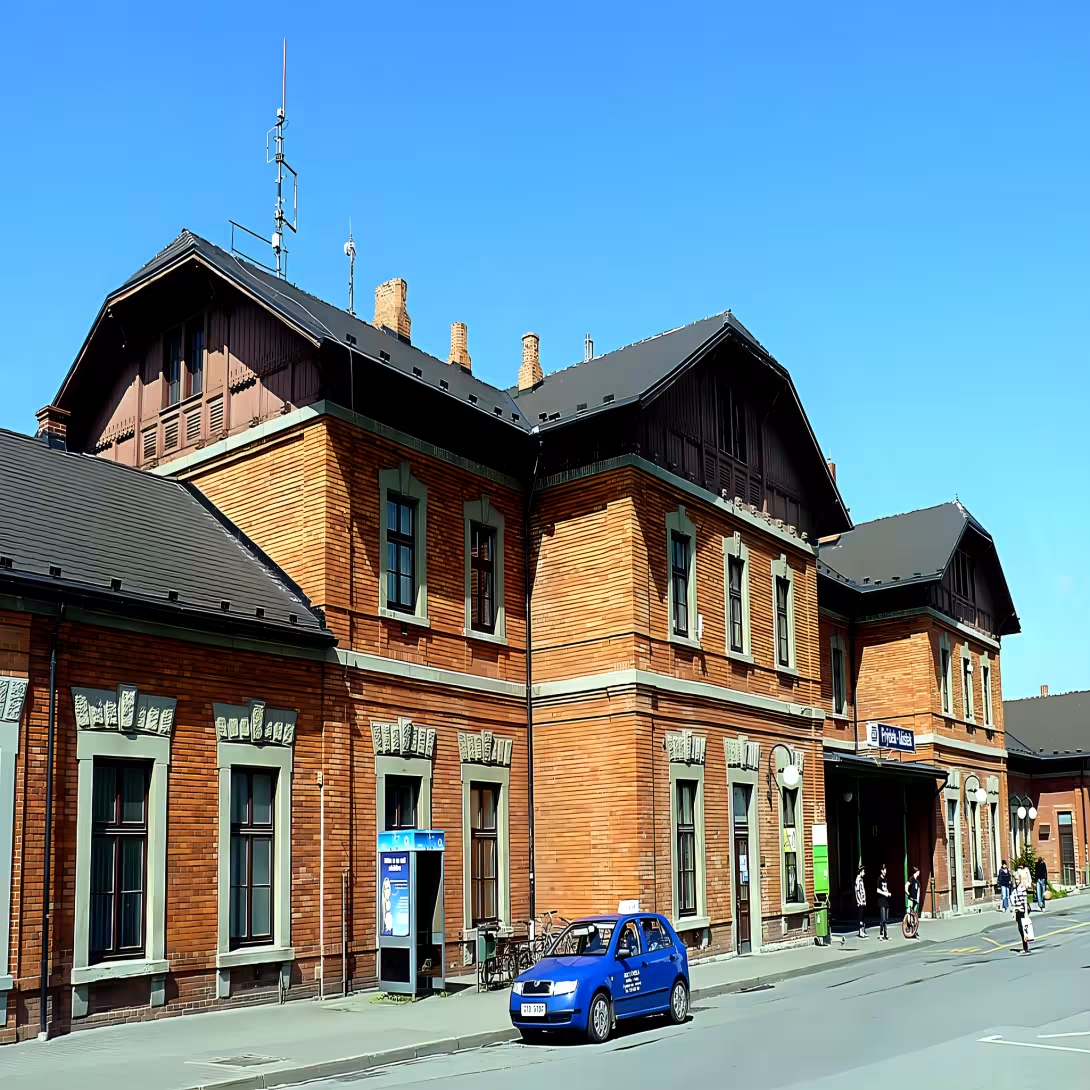
Frýdek-Místek is a railway station located in the central part of the district city of Frýdek-Místek in the Moravian-Silesian Region, near the Ostravice River. This monument is remarkable in its historical value and architectural heritage. The station was built as part of the Imperial-Royal privileged Ostrava-Frýdlant Railway (OFE) line in 1871, which was an important stage in the development of the railway network in Central Europe. In 1888, a new building of the railway station was added by the Northern railway of Emperor Ferdinand (KFNB), which is now protected as a cultural monument.
The history of the station Frýdek-Místek dates back to the period of intensive industrialization and modernization of infrastructure in Bohemia. In 1871 the station was opened along with the line connecting Ostrava and Frýdlant nad Ostravicí, which was key to the regional transport network. The station was located on the border between Moravia and Silesia, which led to difficult negotiations on the location of the tracks. In the end, the tracks were laid on the Silesian bank of the river Ostravice, although geographically the station belonged to Frýdek. The name "Frýdek-Místek" came from rivalries between the cities of Frýdek and Místek.
Architecturally, the station building from 1888 is designed by Anton Dachler and built as a solid wall made of unrolled bricks. This building is today protected by a monument, which reflects its historical significance and architectural value.
The station went through several changes of owners: after its foundation it was part of the OFE, then it went under the North Way of Emperor Ferdinand (KFNB), which extended it in 1888. In 1906 KFNB was nationalized and its routes were taken over by the Imperial-Royal State Railways (kkStB). After 1918 the station became part of the Czechoslovak State Railways (CSD), and the Ostrava-Frýdlant Railway was nationalized on 1 January 1936.
Key events in the history of the station include opening the line in 1871, adding a new building to the station in 1888 and activating the electronic building in 2004. This modernization led to the replacement of mechanical light signals.
Today Frýdek-Místek is available to the public and serves as an important transport hub in the region. Its historical and architectural values make it an interesting destination for visitors who want to know the rich history of railway transport in the Czech Republic. Visiting the station offers an opportunity to appreciate not only its historical context, but also architectural details, which show an important period in Czech history.
Historical milestones
- 1871
- Opening of the station along with the line Ostrava - Frýdlant nad Ostravicí.
- 1888
- Addition of the building of the railway station by the North Railway Emperor Ferdinand.
Architectural development
The original shipping building was built according to a typical railway station construction plan. In 1888, KFNB added a new building to a concrete masonry station made of unrolled bricks, designed by Anton Dachler. The building is today protected as a cultural monument.
Historical events
- 1871
- Opening of the station along with the line Ostrava - Frýdlant nad Ostravicí.
- 1888
- Addition of the building of the railway station by the North Railway Emperor Ferdinand.
- 2004
- Activation of electronic control and replacement of mechanical light signals.
Owners
- 1871
- 1888
- 1906
- 1918
Points of interest
- Frýdek-Místek is a railway station with historical value and architectural heritage. - The station was built as part of the Imperial-Royal privileged Ostrava-Frýdlant Railway (OFE) track in 1871. - In 1888 a new building of the railway station was added by the Northern railway of Emperor Ferdinand, which is now protected as a cultural monument. - The station building from 1888, designed by Anton Dachler, is built from unbraided bricks and is protected by a monument. - The station has undergone changes of owners, from the OFE to the North Way of Emperor Ferdinand (KFNB) to the Imperial-Royal State Railways (kkStB), and eventually became part of the Czechoslovak State Railways (ČSD).
Guide
Show guide text
This text was created by artificial intelligence and has not been editorially reviewed. It may contain inaccuracies.
Welcome to the History Sound Guide. You are standing in front of the railway station Frýdek-Místek, located in the central part of this district city. Take off the inner hustle and bustle of the day and let the atmosphere of the place where human destinies, paths and stories of the tracks intersect for generations. When you look at yourself, you see an important structure serving traffic traffic, which bears traces of centuries past and forms an important part of the local heritage. Let's go back in time together and see how this monument originated and what it went through during its existence.
The story of this station began in the 1970s. At that time the station was ceremonially opened as an integral part of a brand new railway line, built by a company bearing the noble name of the Imperial-Royal privileged Ostrava-Frýdlant Railway. The main purpose and purpose of this track was to establish a reliable and fast connection between prosperous Ostrava and the picturesque Frýdlant over Ostrava. At that time, it was a huge technological advance that opened up unsuspecting possibilities for people to travel, trade and explore the surrounding region.
Now pay attention to the building itself and its appearance. Seventeen years later, in the eighteenth nineteenth century, the station underwent another great development. At that time, a company called the North Way of Emperor Ferdinand added its own building to the original complex. The author of the design was the builder and creator of Anton Dachler. Look carefully at the facade and the total mass of the building you have right in front of you. Feel its historical value and the architectural heritage it carries. This building is now rightly protected as a valuable cultural monument, which only confirms its exceptional position throughout the region.
When we look for specific historical figures that would be closely linked to this place, the names of individual passengers, engineers or officials at the time usually remain hidden in the silence of archives. But that is what the space itself speaks about more loudly. Each beam, every brick and every meter of adjacent tracks carries the fingerprints of thousands of human stories. People were coming through here to work in factories, merchants carrying their goods, families hurrying for holidays, and soldiers called for duty. The station was and is still a place of meeting, joyful reunion and silent goodbyes.
The very fact that this station was created at a time of huge construction expansion of railways in our countries is an interesting reminder. The connection between Ostrava and Frýdlant under the leadership of the Empress-Royal privileged Ostrava-Frýdlant railway changed the face of the whole region and gave the inhabitants a new freedom of movement. A few years later, when a new station building built up by the North Railroad of Emperor Ferdinand, according to Anton Dachler's design, was added, the station took the form of our view today. It is fascinating that these buildings have served their original purpose without interruption for decades and still perform their important function in the transport network of the city.
We hope you enjoyed today's stop at the Frýdek station and that you perceived the genius loci of this place. We call on you to explore the city and its sights again, whether you follow the footsteps of history or simply discover new corners. Thank you for listening, we wish you a wonderful day and see you next stories from our lye and grove.
Tips for visitors
Take your comfortable walking shoes with you, because part of the area may be less accessible due to ongoing construction work, as well as a camera to capture the transformation of this transport node. For shooting, choose the space in front of the main station building, where the best view of the facade is. In the immediate vicinity within 30 minutes walk you can visit the shores of the nearby river Ostravice and walk around it.
Frequently asked questions
Can the monument be visited?
The building is in use (offices, a school, shops and the like). The interior is generally accessible only during operating hours and tours are not usually offered; we have not verified the details. You can see the exterior from the street. According to the heritage register restoration is under way, so access may be restricted.
Where is the monument?
Location: Frýdek, Moravskoslezský kraj. The map on this page shows the exact spot.
Why is the monument protected?
It is listed in the Central List of Cultural Monuments of the Czech Republic as a cultural monument (register no. 1999995836).
Businesses nearby
Do you run a restaurant, accommodation, shop, museum, rental, wellness or other visitor service near this monument? Show yourself directly to the people heading to it — this is how they will see you in the app and on the web:
Nearby
Řeka Ostravice
Městské autobusové nádraží
Accommodation nearby
Themed route
The route for the trip starts with the main destination, which is the railway station.
1. Railway station Frýdek-Místek Type: Transport construction Why is worth visiting: This main destination serves as a starting point for your trip. From here you can go to other selected places in the vicinity.
2. Municipality of Frýdek Type: City area and seat Why is it worth a visit: Offers a historical environment for your walk. You can discover local development and atmosphere here.
3. The River Ostravice Type: Water flow Why is worth a visit: Water flow forms a natural boundary and surrounding shores provide a pleasant environment for relaxation. It's the perfect place to track water levels during your trip.
4. City Bus Station Type: Transport node point Why is it worth a visit: This place is used to switch to other connections or to end your trip on selected locations. It is within range of other designated points.
Seasonal recommendations
Spring brings awakening nature around the transport hub in Frýdek and the historical core of the city. The surrounding trees are beginning to green and the morning fog above the Ostrava River creates a unique atmosphere, underscored by construction cranes and scaffolding of the ongoing modernization of the shipping building. In this period, you will encounter fewer passengers, which makes it easier to move around the construction site and the surrounding pavement. Put on fixed shoes with anti-slip soles because spring rains can turn unpaved paths into mud, and put on a waterproof jacket. The best time to visit is in the morning, when sunlight reveals the details of the historical facade under the gray coating of provisional barriers.
The summer starts with a sharp light and high temperatures, which are supported by metal structures and construction containers. The surrounding green is fully developed and provides shade at adjacent roads, but the station's very space is exposed to direct sun due to open areas. We recommend that you arrive early in the morning before the onset of daily heat to document the transformation of this place. Don't forget to wear a headgear, sunglasses and a bottle of drinking water, because shady places to relax during construction work are scarce.
Light is low and soft, which gives industrial elements and construction machines a specific, almost painting character. The movement of people is calming down in colder months, and on platforms you will meet local commuters rather than curious hikers. The tour requires warmer layered clothes, a wind-proof jacket and a hat, as it blows unpleasantly on open platforms. The best time to visit is around noon, when the air is slightly heated and fog recedes to the autumn sun.
Winter transforms construction and surroundings into a freezing kingdom with a white snow cover, which dampens the noise of construction technology and gives the place a quiet, almost fabulous atmosphere accompanied by early twilight. The lighting is provided by artificial lamps that light up already in the late afternoon and create sharp shadows on snow and ice-cold carriages on the weaning tracks. In the pre-Christmas time, more people are moving in for shopping on the main draws, but the station itself remains passable without big push. The need is quality winter shoes, strong gloves and a warm coat, as temperatures in the open area fall rapidly. The ideal time for visiting is around noon, when visibility is best and the daily temperature reaches its daily maximum.
Visualizations and artistic views


The visualisations are generated by artificial intelligence and serve as inspiration.
Photos from the area
Real photos taken near the monument


Zdroj a licence jsou uvedeny u každého snímku.
Tips from visitors
No tips yet. Be the first!
Log in and add your tip.
Sources and literature
Photos: Michal Klajban / CC BY-SA 3.0, rozlišení zvýšeno umělou inteligencí — Wikimedia Commons. The author and licence also appear when you hover over the image.
Faktickým podkladem tohoto textu byl článek na Wikipedii, jehož autory jsou přispěvatelé Wikipedie. Článek je dostupný pod licencí CC BY-SA 4.0.
Location on the map


Příběhy a pověsti
Legendy, pověsti a příběhy spjaté s touto památkou
Fotografie návštěvníků
Zatím žádné fotografie. Buďte první, kdo přidá fotografii z návštěvy!
Log in a přidejte svou fotografii nebo hodnoťte.
Za ověřenou návštěvu v aplikaci získáte víc bodů — poznáme podle GPS, že jste na místě.
Reviews and comments