



Homolka Housing estate
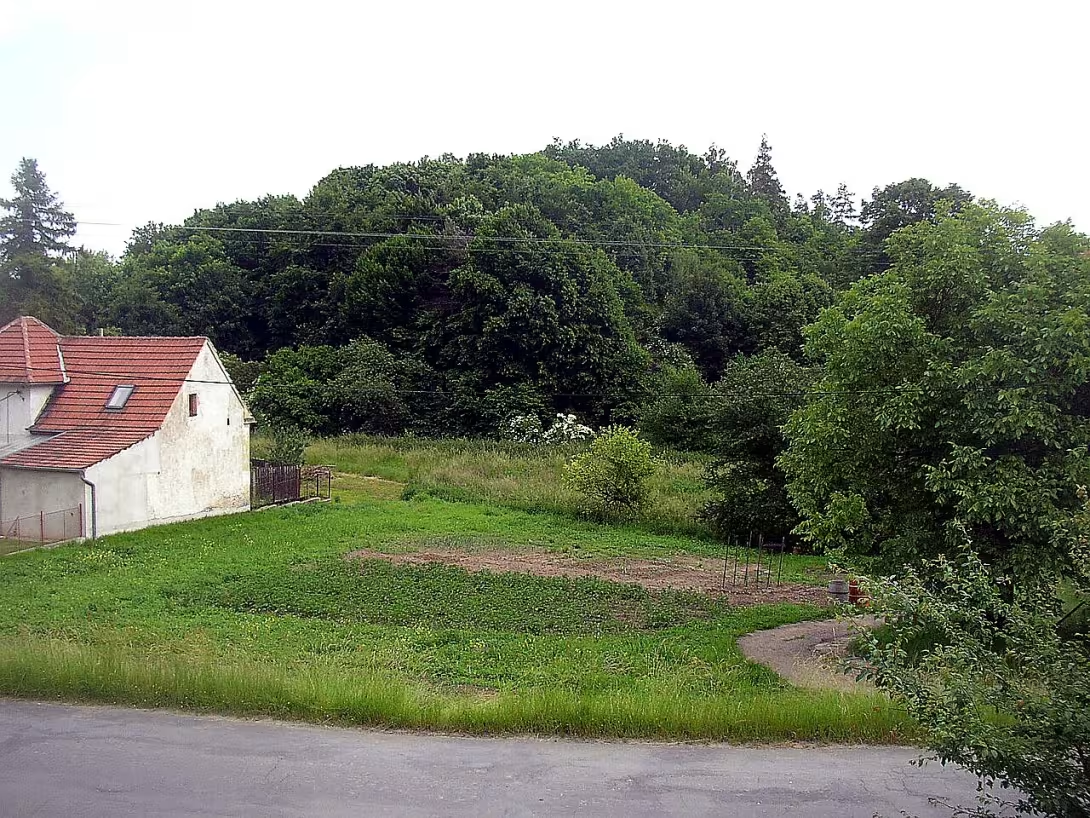
Homolka is an ancient castle located on the eastern edge of Stehelčevsi in Kladno district. This archaeological monument comes from the middle eneolite, where it was inhabited by the people of native culture, and is significant thanks to its complex building phases and documented settlement.
The fort was inhabited by members of the Jewish culture in central eneneol. The dating of this period allowed ceramic fractions, especially typical jugs with horned handles. Part of the ceramics was also part of the culture of spherical amphor and vuchedolan culture. At the time of the Bronze, there was a single cottage on the hill inhabited by members of an utenistic culture. The estate probably disappeared after the fire that occurred shortly after the construction of the younger fortifications.
The building form of the castle includes a triangular plan on the top platform of 150 × 100 metres. The north and west were protected by steep slopes. Two construction phases were documented in the search for the perimeter fortification. In the first time the fort was surrounded by a palisade whose stakes were embedded within 30 centimeters of the wide base trough. On the south side, where the slope is softer, the fortifications were reinforced by two metres wide moat carved in the rock. There were three entrances to the castle. One gate was on the south side and the other in the northeast corner of the fortifications. Both gates were about 2.5 metres wide and formed by the wings of the palisade drawn in and out of the castle. The entrance to the south gate was also protected by a pre-planted stake barrier. The smaller double goal on the north side allowed the shortest access to the water source.
At a later time there was an extension of the castle and a related strengthening of the fortifications. An external moat was added on the north side. On the south side there was a new wall moved down the slope. Its cores became a wooden wall of pairs of vertical stakes built about 2.5 meters apart, between which horizontal stakes were inserted. There was an aluminium wall spread on both sides of this wall. At the time of the younger settlement, 26 residential buildings concentrated along the wall were identified by archaeological research. There were surface and depth objects with approximately square ground plan, usually having dimensions of not more than 6 metres in length and 3 to 4 metres in width. The only larger cottage had a plan with dimensions of 8 × 5 meters.
The remains of the settlement were discovered in the late nineteenth century. In 1929-1931, archaeological research was conducted by an expedition from Philadelphia University under the direction of V. J. Fewkese. Further research was carried out in 1960-1961 by R. W. Ehrich in cooperation with Emilia Plesla. Since 1967 the castle has been protected as a cultural monument.
The hill is composed of algonkic shale of the blaze confluence and lies in the geomorphological unit Prague plateau, subunit Kladen board and district Hostivická table. The drop above the bottom of the Broodwater stream reaches 20 to 22 meters.
The location is an important point for understanding the development of prehistoric settlements and architecture in this area. Her visit offers insight into people's lives during the period of eneolithic and bronze age.
Historical milestones
- 1929
- The beginning of archaeological research expedition V. J. Fewkese.
- 1960
- The beginning of research led by R. W. Ehrich in cooperation with Emilie Plesla.
- 1967
- Protecting the castle as a cultural monument.
Architectural development
The fort went through two construction phases, when the original palisade later expanded and strengthened. At a later time a new wall with a wooden core was built from pairs of vertical poles and a saturated aluminum bead. The settlement facilities included residential buildings with approximately square ground plan.
Historical events
In the years 1929-1931, archaeological research was conducted by an expedition from the University of Philadelphia. In 1960-1961 further research was conducted under the direction of R. W. Ehrich and Emilie Plesl. In 1967 the site was declared a cultural monument.
Points of interest
- The fort has a triangular plan on the top platform of 150 × 100 meters. - The dating period allowed ceramic fractions, especially typical jugs with horned ears. - At the time of the bronze hill, there was a single cottage inhabited by members of an utenistic culture. - The manor probably died after the fire that occurred shortly after the construction of the younger fortifications. - Since 1967, the castle has been protected as a cultural monument.
Guide
Show guide text
This text was created by artificial intelligence and has not been editorially reviewed. It may contain inaccuracies.
Welcome to Homolka, the unique archaeological site that invites you to the world of ancient times. You are standing in front of this historically rich place, where there is an ancient castle on the eastern edge of Stehelchevsi. Beneath your feet is a top plateau with a triangular plan that was once protected by palisades and moat. This site awaits you with its secrets and history.
Homolka has already been inhabited in middle eneneol by people of native culture, which is proven by archaeological findings. At the time of the Bronze, there was a single cottage inhabited by members of an alien culture. This historical context enriches our understanding of prehistoric lives and societies that once prospered here.
Look up and notice the triangular plan of the castle with dimensions of 150 × 100 meters. This detail is a key element that helps us understand the architectural and strategic significance of this place. Despite its demise, the castle stands as a witness to past residents who have built a home on this hill.
Let's move forward in time and discover the key stories associated with Homolka. The beginning of archaeological research here is rooted in 1929, when he was the first to deal with this place, V. J. Fewkes. His work laid the foundations for later research. In 1960 R. W. Ehrich, together with Emilie Plesla, took over the continuation of studies that brought new knowledge of this site. Thanks to their efforts, the fort was protected as a cultural monument in 1967.
The interesting thing about this place is the ceramics that helped us determine the chronology of the period. Typical mugs with horned ears are particularly important and provide valuable information on artistic and practical aspects of the life of those people.
Now that you've looked at this history and details of Homolka, I invite you to further explore. Every stone here talks about the ancient past and waits to share its stories with anyone willing to listen. I hope this guide has inspired you to think deeper about this fascinating place. May your journey continue with other discoveries and discoveries!
Tips for visitors
The best time to visit Homolka is in the spring or autumn season when the weather is pleasant and light suitable for photography. This time of year also offers a beautiful green landscape around the site.
Means of transport: You can reach Homolka by car or public transport. You can find current information about routes and connections in the online search engine.
What to take with you: We recommend you not to sleep in sun protection clothes and sprinklers, especially during the summer period. It is also important to carry a map or GPS device for navigation on the site.
Photography: The best places for photos are from the outside, where you can enjoy panoramic view over the Brocht. The best light is in early morning or late afternoon, which provides pleasant shading and color.
What to visit in the area: Near Homolka there is a Lalovice which is suitable for short walks or picnics. In addition, you can explore the natural beauty of the Prague platform.
Frequently asked questions
Can the monument be visited?
This is a structure in a public space that can usually be seen from outside free of charge. We have not verified that this particular one is freely accessible.
Why is the monument protected?
It is listed in the Central List of Cultural Monuments of the Czech Republic as a cultural monument (register no. 1000146608).
Businesses nearby
Do you run a restaurant, accommodation, shop, museum, rental, wellness or other visitor service near this monument? Show yourself directly to the people heading to it — this is how they will see you in the app and on the web:
Events nearby
Zdroj akcí: otevřená data měst a obcí ČR (Národní katalog otevřených dat) a kalendář akcí Národního památkového ústavu.
Nearby
Lokalita se nachází nad Dřetovickým potokem v rámci geomorfologického celku Pražská plošina.
Accommodation nearby
Trips and activities nearby
Guided tours, tickets and activities nearby from GetYourGuide
Affiliate link: if you buy from the partner, we may receive a commission. The price for you does not change.
Search tours and activities →Themed route
Thematic cruise route: Homolka and surroundings
1. Homolka (archaeological site)
Type: Archaeological site
It is worth a visit by exploring one of the most important prehistoric settlements in the Czech Republic. This site offers a view of the life of the Bronze Age people until the Middle Ages, with a rich collection of finds from archaeological excavations.
2. Wooden stream
Type: Source
This stream is an ideal place for short rest and a view of the natural landscape that Homolka surrounds. Its peaceful water flows provide a unique character and are part of the geomorphological complex of Prague Plateau.
3. Prague platform
Type: Geomorphological whole
Visit this section to understand the geographical and natural conditions that shaped the history and development of the area. An opportunity to explore the landscape with a view to local topography and its influence on human housing.
4. Local View
Type: View over the stream
This place is ideal for getting a view of the whole surrounding region and the Cod stream. Here you can relax your mind, remember the history of Homolka and appreciate the beauty of nature.
5. Parking near Homolka
Type: Parking
Start or end your trip here where you can park your cars and equip yourself for further exploration. This place serves as a base for the overall knowledge of Homolka and her surroundings.
This route offers a combination of historical discoveries, natural beauties and quiet places to relax.
Seasonal recommendations
Spring: In the spring period, Homolka is transformed into a place full of hope and new life. Sun rays illuminate the stones of archaeological finds, while nature begins to bloom around. Green vegetation surrounds the location, making it ideal for relaxation in nature. Visitors can enjoy mild temperatures and sunny days, but it is advisable to prepare for sudden rain storms. A good tip is to wear clothes in several layers and carry a pocket umbrella.
Summer: During the summer period, Homolka offers an opportunity to explore the historical object under ideal conditions. Sunshine days and warm night atmosphere create a cozy mood, but shielded places are particularly attractive due to higher weather. In addition, more tourists may appear, which is the reason for the early morning or late afternoon visit. It is advisable to prepare a sunflower and plenty of fresh fresh air.
Autumn: In autumn the Homolka becomes melancholy but charming atmosphere. The grey colours of leaves and mild colder weather bring a calm mood. The sun is hiding behind the horizon soon, which means shorter days, but also beautiful light effects on archaeological sites. Visitors should remember clothes suitable for colder weather and the possibility of rain that are common this season.
Winter: During winter Homolka becomes mysterious and calm. Freezing temperatures and snow sheets can add a romantic feel to the archaeological site. Sunrise on winter days is a beautiful opportunity to visit, but visitors should be prepared for cold conditions and the possibility of snow. We strongly recommend wearing warm clothes and protective shoes for a comfortable visit on these freezing days.
Visualizations and artistic views

The visualisations are generated by artificial intelligence and serve as inspiration.
Photos from the area
Real photos taken near the monument

Zdroj a licence jsou uvedeny u každého snímku.
Tips from visitors
No tips yet. Be the first!
Log in and add your tip.
Sources and literature
Photos: User:Miaow Miaow / Public domain — Wikimedia Commons. The author and licence also appear when you hover over the image.
Faktickým podkladem tohoto textu byl článek na Wikipedii, jehož autory jsou přispěvatelé Wikipedie. Článek je dostupný pod licencí CC BY-SA 4.0.
Location on the map





Příběhy a pověsti
Legendy, pověsti a příběhy spjaté s touto památkou
Fotografie návštěvníků
Zatím žádné fotografie. Buďte první, kdo přidá fotografii z návštěvy!
Log in a přidejte svou fotografii nebo hodnoťte.
Za ověřenou návštěvu v aplikaci získáte víc bodů — poznáme podle GPS, že jste na místě.
Reviews and comments