



kaple Smrtelných úzkostí Páně Chapel
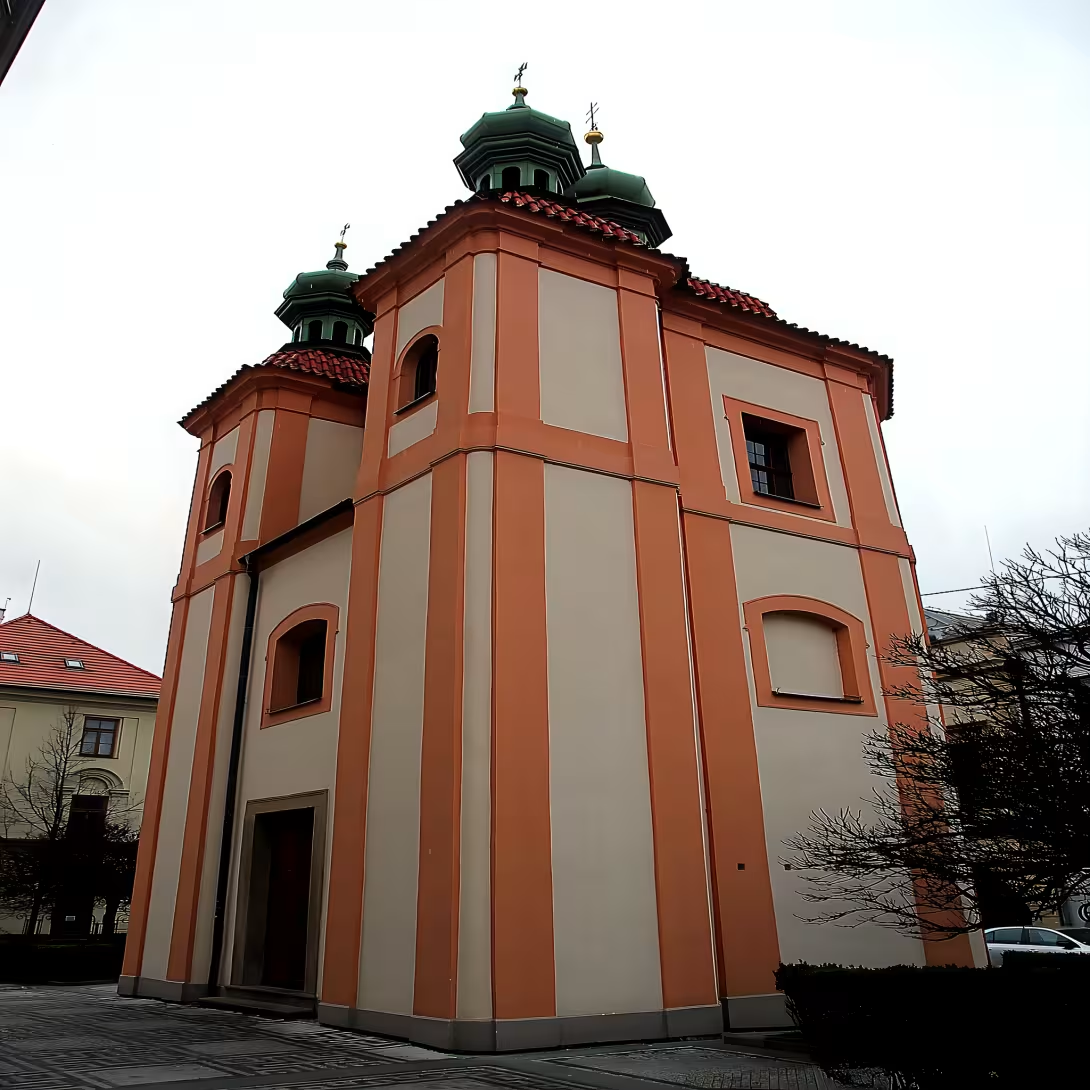
The Chapel of Our Lord’s Agonies is a square rotunda located behind St. Nicholas Cathedral in České Budějovice, Czech Republic. Constructed between 1727 and 1731, it replaced an earlier Gothic chapel built before 1377. The chapel forms part of the city's historical fabric, originally serving as part of a cemetery complex. Its significance is enhanced by its architectural style and frescoes painted by Johann Adam Schöpf in 1729.
The site where the Chapel now stands has a rich history dating back to before 1377 when a Gothic chapel dedicated to St. James was erected. This structure was replaced by the current baroque rotunda, constructed between 1727 and 1731. The chapel played an integral role in the former crossway leading to the cathedral, abolished in 1784. Following Josephine reforms in 1785, it became a storage facility, marking a shift from its religious purpose. However, Bishop Jan Valerián Jirsík ordered its restoration in 1855, restoring its spiritual significance.
Architecturally, the Chapel is noted for its baroque style and square rotunda design. The interior features frescoes by Johann Adam Schöpf, adding artistic value. Beneath the chapel lies a crypt with a barrel vault and lunettes, discovered in 2005 during archaeological research. This crypt was accessed through an original entrance covered by flat stones that once served as tombstones, revealing historical layers beneath.
Throughout its existence, the chapel has experienced various changes in ownership and purpose. Initially part of a cemetery complex, it transitioned to a storage facility following Josephine reforms before being restored for religious use. Today, it is under the administration of the Roman Catholic Church and serves as a venue for Greek Catholic services during certain holidays.
The discovery of the crypt beneath the chapel in 2005 stands out as a key event in its history. This finding confirmed historical speculations about a burial site associated with the chapel, adding depth to its narrative. The entrance to this crypt, covered by stones that were once tombstones, provides insight into past practices and architectural adaptations.
Today, the Chapel of Our Lord’s Agonies is accessible for visitors interested in exploring its history and architecture. It serves as a venue for Greek Catholic services on specific holidays, maintaining its religious significance. The chapel's historical layers, from its baroque construction to the discovery of its crypt, make it a compelling site for those intrigued by architectural evolution and cultural heritage.
The Chapel offers a unique glimpse into the past, blending art, architecture, and history in one location. Its journey from a religious site to storage facility and back again reflects broader historical shifts within the region. Visitors are invited to explore this monument, appreciating its artistic details and uncovering stories embedded within its walls.
Then and now
Drag the slider to compare how the landmark may have looked when it was built with the view today.
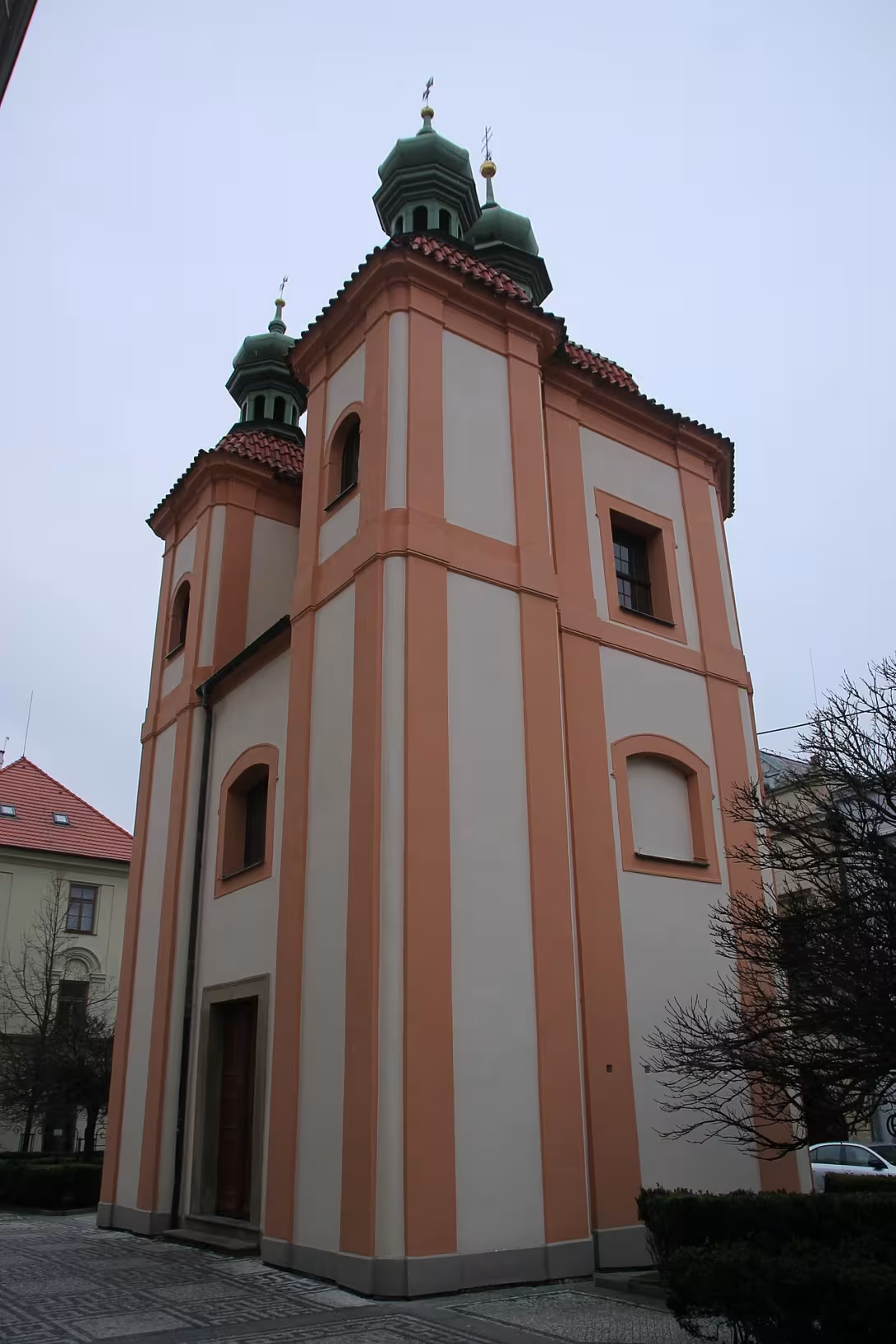

The historical appearance on the left is an AI-generated visualisation and serves as inspiration only.
Historical milestones
- prior to 1377
- Construction of a Gothic chapel dedicated to St. James.
- 1727-1731
- Building of a baroque rotunda replacing the older chapel.
- 1729
- Decoration with frescoes by Johann Adam Schöpf.
- 1784
- Abolition of the pilgrimage route leading to the chapel.
- 1785
- Conversion into storage spaces following Josephine reforms.
- 1855
- Restoration of the chapel under Bishop Jirsík's leadership.
- 2005
- Discovery of a catacomb beneath the chapel.
Architectural development
Originally built as a baroque rotunda between 1727 and 1731, the Chapel of Our Lord’s Agonies underwent significant changes over time. It was converted into storage in 1785 following Josephine reforms but was restored by Bishop Jan Valerián Jirsík in 1855. The chapel features frescoes by Johann Adam Schöpf.
Historical events
- 1784
- The crossway was abolished.
- 1785
- The chapel was converted into a storage facility due to Josephine reforms.
- 1855
- Bishop Jan Valerián Jirsík ordered the restoration of the chapel.
Points of interest
- The Chapel of Our Lord’s Agonies was originally part of a cemetery complex, highlighting its historical role as a place for both worship and burial, which reflects the medieval practice of integrating religious sites with cemeteries.
- Before it became a chapel dedicated to Our Lord's Agonies, the site hosted a Gothic chapel dedicated to St. James before 1377, showcasing how religious dedications at this location have evolved over centuries in response to changing devotional practices and architectural styles.
- The frescoes inside the chapel were painted by Johann Adam Schöpf in 1729, adding an artistic layer that enhances its baroque architecture; these frescoes are significant as they contribute to understanding the cultural and religious influences of that era.
- An intriguing archaeological discovery was made beneath the chapel when a crypt with a barrel vault and lunettes was uncovered during research in 2005. This finding revealed historical layers and confirmed speculations about burial practices associated with the site, providing insights into past architectural adaptations.
- Following Josephine reforms in 1785, the chapel's function shifted from religious to secular as it became a storage facility, illustrating how broader political and administrative changes impacted local sacred spaces during that period.
Guide
This guide is narrated by a synthetic voice generated by artificial intelligence.
Show guide text
This text was created by artificial intelligence and has not been editorially reviewed. It may contain inaccuracies.
The Chapel of the Mortal Anguish of the Lord stands behind the Cathedral of Saint Nicholas in České Budějovice. It has a square ground plan and was once part of the original municipal cemetery. Beneath the chapel, its ossuary remains to this day.
A Gothic chapel of Saint James originally stood at this location, built before 1377. It was replaced by the present chapel, constructed between 1727 and 1731. Its interior was painted in 1729 by painter and fresco artist Johann Adam Schöpf. The chapel closed off a Stations of the Cross that was built into the cemetery wall. The cemetery once bordered both the chapel and the cathedral. The cemetery was closed in 1784. A year later, as a result of Josephine reforms, the chapel's turn came. It was shut down and converted into a storage facility. It was restored in 1855 thanks to Bishop Jan Valerian Jirsík.
For a long time, historians assumed that an ossuary lay beneath the chapel. This was confirmed only by an archaeological survey of the cathedral area and the former cemetery. Archaeologists excavated three test pits. One of them, at the northern wall of the chapel, revealed a bricked brick vault. On August ninth, 2005, at eleven o'clock in the morning, researchers, in the presence of journalists and the public, penetrated through an opening in the brick wall into the ossuary. They used a miniature camera to do this.
The ossuary space is vaulted with a barrel brick vault with lunettes. The walls are made of mixed masonry of stone and brick, while the younger vaults are brick. In the southern part, bones are carefully stacked into rows that reach all the way to the ceiling. The northern part, by contrast, is filled chaotically.
In the western part, archaeologists discovered the original entrance to the ossuary. It is a brick staircase, covered by a pair of flat stones. These were originally tombstones. One of them is turned face inward toward the ossuary. Although it is worn down, quite a lot could be made out on it. At the top was a heraldic ornament, beneath it a coat of arms, and under the coat of arms fourteen lines of text with the date of death January twenty-second, 1670.
The chapel is under the administration of the Roman Catholic Church. Today it serves for Greek Catholic services, which are held there on feast days.
Tips for visitors
The best time to visit the Chapel of Our Lord’s Agonies is during late spring or early autumn when the weather is pleasant, allowing you to comfortably explore both the chapel and its surroundings. These seasons offer mild temperatures and fewer crowds compared to summer, providing a more serene experience. Additionally, visiting on weekdays can help avoid larger tourist groups that often gather on weekends.
Nicholas Cathedral in České Budějovice. It's advisable to use public transportation or park further away and walk to the site. The city center is well-connected by buses, making it easy to reach the chapel using local transit options. Always check for the latest transport schedules online before your visit.
When visiting the Chapel of Our Lord’s Agonies, consider bringing comfortable walking shoes as you may want to explore nearby areas after your visit. A camera or smartphone is recommended to capture the unique architecture and serene atmosphere of the chapel. Since it's a historic site, dress modestly out of respect for its cultural significance.
For photography enthusiasts, the best spots are around the rotunda itself where natural light filters through any openings, creating dramatic effects on the interior surfaces. Early morning or late afternoon provides softer lighting conditions ideal for capturing the chapel’s details.
Nearby attractions within a 30-minute walk include St. Nicholas Cathedral itself, which offers stunning Gothic architecture and historical significance. Additionally, you can explore the Old Town Square in České Budějovice, known for its charming buildings and vibrant cultural scene. These sites provide a comprehensive experience of the city's rich heritage.
For families with children, visiting the Chapel of Our Lord’s Agonies can be an educational outing. The chapel’s historical context offers a chance to discuss architectural styles and local history. Nearby, the Old Town Square has interactive elements that engage younger visitors, such as historic buildings and public art installations.
Frequently asked questions
Can the monument be visited?
Religious buildings are usually open mainly during services; at other times a visit is normally arranged with the parish or the operator. We have not verified specific times.
Where is the monument?
Location: Kněžská, České Budějovice 1, České Budějovice, Jihočeský kraj. The map on this page shows the exact spot.
Why is the monument protected?
It is listed in the Central List of Cultural Monuments of the Czech Republic as a cultural monument (register no. 21642/3-5438).
Businesses nearby
Do you run a restaurant, accommodation, shop, museum, rental, wellness or other visitor service near this monument? Show yourself directly to the people heading to it — this is how they will see you in the app and on the web:
Events nearby
Zdroj akcí: otevřená data měst a obcí ČR (Národní katalog otevřených dat) a kalendář akcí Národního památkového ústavu.
Nearby
The chapel is located behind St. Nicholas Cathedral in České Budějovice, a historic city known for its cultural heritage and architectural landmarks.
Accommodation nearby
Trips and activities nearby
Guided tours, tickets and activities nearby from GetYourGuide
Affiliate link: if you buy from the partner, we may receive a commission. The price for you does not change.
Search tours and activities →Themed route
Thematic Walking Tour: České Budějovice
1. St. Nicholas Cathedral (Katedrála svatého Mikuláše) - Type: Historical Landmark - Why Visit: Begin your journey at the St. Nicholas Cathedral, a stunning example of Gothic architecture that dominates the city's skyline. This cathedral is not only an architectural marvel but also serves as a spiritual center for České Budějovice. Its rich history and beautiful interior make it a must-see before exploring the nearby chapel.
2. Capella Mortuorum (Kaple Smrtelných úzkostí Páně) - Type: Chapel - Why Visit: Located just behind St. Nicholas Cathedral, this small yet significant chapel is dedicated to the Agony in the Garden of Gethsemane. Its serene atmosphere and intricate details offer a moment of reflection and peace. The chapel's proximity to the cathedral makes it an ideal next stop on your tour.
3. Old Town Square (Staroměstské náměstí) - Type: Historic Square - Why Visit: A short walk from the chapel, the Old Town Square is a vibrant hub of České Budějovice's history and culture. Surrounded by historic buildings and lively cafes, it provides an excellent opportunity to immerse yourself in the local atmosphere. The square serves as a perfect place to conclude your tour with some relaxation and people-watching.
This thematic walking tour offers a concise exploration of České Budějovice's rich cultural heritage, focusing on its architectural landmarks and historical significance.
Seasonal recommendations
Spring: Visiting the Chapel of Our Lord's Agony during spring offers a unique experience as nature begins to awaken around České Budějovice. The surrounding landscape is adorned with blooming flowers and fresh greenery, creating an enchanting atmosphere that complements the chapel’s historical significance. Early mornings are ideal for exploring this period when the light gently illuminates both the natural surroundings and the intricate details of the chapel's architecture. Visitors should consider wearing comfortable walking shoes to enjoy a leisurely stroll through nearby gardens or parks. As spring can bring unpredictable weather, carrying a lightweight jacket is advisable.
Summer: The summer months at the Chapel of Our Lord's Agony are characterized by long days filled with warm sunshine, making it an excellent time for outdoor exploration in the Jihočeský region. During this peak season, the chapel experiences increased visitor numbers, so arriving early can help avoid crowds and provide a more serene experience. The vibrant atmosphere is further enhanced by the lush greenery surrounding the area. It's recommended to wear light, breathable clothing and bring sunscreen for protection against the sun. Staying hydrated throughout your visit is also important.
Autumn: Autumn brings a spectacular display of colors as the leaves around the Chapel of Our Lord's Agony turn into shades of red, orange, and gold. This season offers a tranquil atmosphere with fewer visitors compared to summer, allowing for a more intimate exploration of the chapel’s historical details. The cooler weather makes it comfortable for walking tours in the nearby areas, which are also beautifully transformed by autumnal hues. Visitors should dress in layers to accommodate fluctuating temperatures throughout the day and consider bringing an umbrella or raincoat as this season can be rainy.
Winter: Winter at the Chapel of Our Lord's Agony provides a serene and contemplative experience, with snow often blanketing the surrounding landscape, creating a picturesque setting that enhances the chapel’s historical ambiance. The shorter days mean that visiting in the morning is advisable to make the most of the daylight hours. Due to the colder temperatures, dressing warmly in layers is essential, along with wearing comfortable shoes suitable for potentially icy conditions. Visitors should also be aware that opening times may be reduced during this season, so checking ahead before planning a visit is recommended.
Visualizations and artistic views


The visualisations are generated by artificial intelligence and serve as inspiration.
Photos from the area
Real photos taken near the monument

Zdroj a licence jsou uvedeny u každého snímku.
Tips from visitors
No tips yet. Be the first!
Log in and add your tip.
Sources and literature
Photos: Draceane / CC BY-SA 4.0, rozlišení zvýšeno umělou inteligencí — Wikimedia Commons. The author and licence also appear when you hover over the image.
Faktickým podkladem tohoto textu byl článek na Wikipedii, jehož autory jsou přispěvatelé Wikipedie. Článek je dostupný pod licencí CC BY-SA 4.0.
Location on the map
More monuments – České Budějovice 1
Show all in the municipality
Příběhy a pověsti
Legendy, pověsti a příběhy spjaté s touto památkou

Fotografie návštěvníků
Zatím žádné fotografie. Buďte první, kdo přidá fotografii z návštěvy!
Log in a přidejte svou fotografii nebo hodnoťte.
Za ověřenou návštěvu v aplikaci získáte víc bodů — poznáme podle GPS, že jste na místě.
Reviews and comments