



kaple svatého Karla Boromejského Chapel
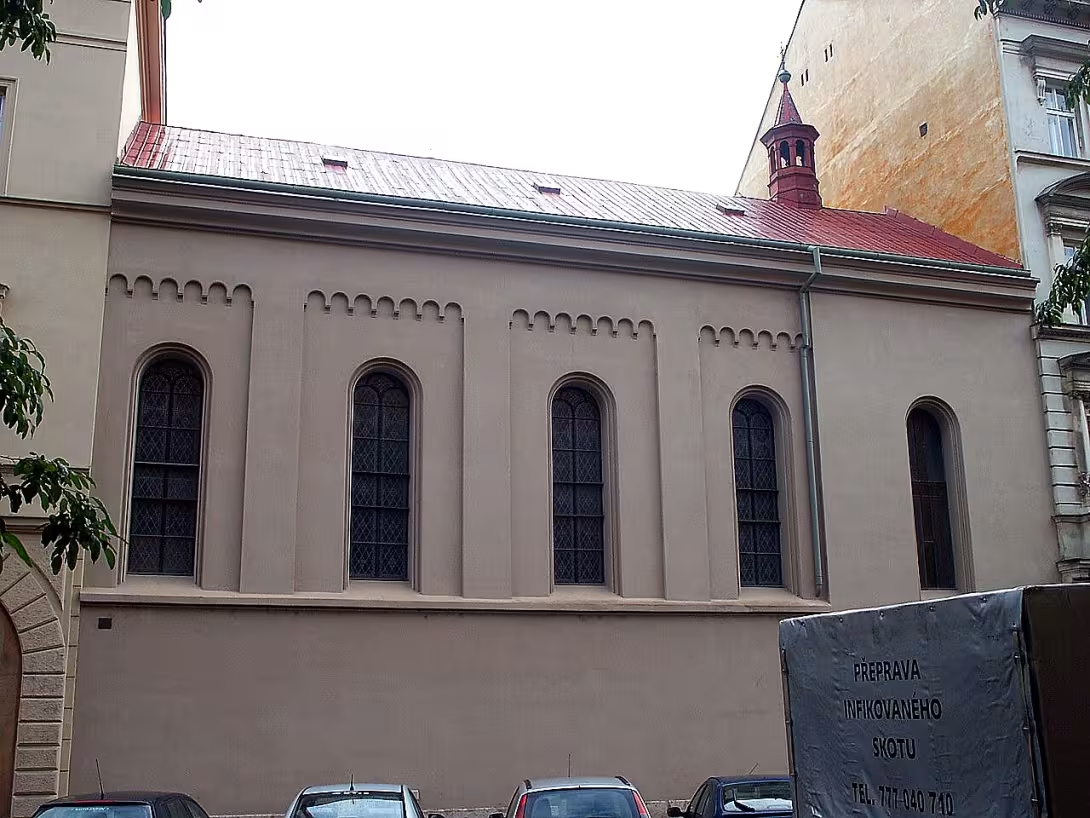
The chapel of St. Charles Boromei is a neo-Romanesque sacral building in Prague Karlín. It is located in Vítkov street opposite Karlín barracks. The building is listed in the list of cultural monuments of the Czech Republic and was created in the years 1864 to 1866 as part of the monastery complex and school for youth of the congregation of the Merciful Sisters of St. Charles Boromei.
The construction took place in the 1960s when Prague developed dynamically and new districts including Karlína were created. At that time in the Czech countries, the influence of the Church Regulations, which contributed significantly to the development of education and social care, grew. The sanctuary was intended as a home space serving the needs of the monastery school. The ceremony was performed by Cardinal Bedřich Schwarzenberg in 1866.
The construction has a rectangular plan. The main facade facing the street breaks high, half-circle arched windows. On the ridge of the saddle roof above the presbytery is located an octave tower in which the bell was previously hung. The entrance to the chapel leads from the passage. There is a circle above the entrance where the organ was previously located. The interior is decorated by hand oriental painting and dominated by a neo-gothic main altar with the painting of St. Charles Boromejský from Vienna painter Josef Kessler.
From 1866 to 1946, the building was owned and administered by the congregation of the Merciful Sisters of St. Charles Boromei. After the chapel stopped serving its original purpose, a Patent Office was established in the building. Currently, the Confederal Province uses the daughters of Our Lady of the Aids and houses a church school.
The major events in the modern history of the building were floods in 2002, which damaged the building considerably. The subsequent gradual reconstruction made it possible to preserve its historical form.
Today, this monument represents a valuable piece of historical and ecclesiastical architecture of the 19th century in Karlín. Visiting this place offers the opportunity to explore the history of education and spiritual life in the rapidly developing Prague district.
Historical milestones
- 1864-1866
- Construction of the chapel as part of the monastery and school.
- 1866
- The consecration of the chapel by Cardinal Bedrich Schwarzenberg.
- 1946
- End of operation of the chapel for original purposes and establishment of the Patent Office.
- 2002
- Significant damage to the chapel during flood and subsequent reconstruction.
Architectural development
The chapel was built in a neo-Romanesque style along with the entire monastery object. The interior is dominated by a neo-gothic altar and original oriental paintings. After the floods in 2002, the construction underwent a gradual repair.
Historical events
The consecration of the chapel by Cardinal Bedrich Schwarzenberg in 1866. The end of the original purpose of the chapel in 1946. Large damage in floods in 2002 and subsequent recovery.
Owners
The Congregation of the Merciful Sisters of St. Charles Boromei (1866- 1946), followed by the State (Patent Office), currently a province of Confederation of the daughters of the Virgin Mary of the Avocias.
Points of interest
- The chapel is a Neo-Romanesque building which was built in the years eighteen hundred and sixty-four to eighteen hundred and six as part of the monastery complex and school. - The ceremonial consecration was performed by Cardinal Bedřich Schwarzenberg in 18 hundred and sixty-six. - On the ridge of the saddle roof above the presbytery, there is an octagonal tower in which the bell was hung earlier. - The interior of the chapel is decorated with a hand oriental painting and a neo-gothic main altar with the painting of St. Charles Boromejský by the painter Josef Kessler. - After the floods in the year two thousand and two, which damaged the building, a reconstruction was carried out which preserved the historical form of the monument.
Guide
Show guide text
This text was created by artificial intelligence and has not been editorially reviewed. It may contain inaccuracies.
Welcome to the chapel of St. Charles Boromei. You are standing right where Karlín's history meets the daily movement of today's city. Feel this moment, stop for a moment and let yourself pass through the atmosphere of this place. In front of your eyes is a building that, despite its apparent modesty, bears immense strength and dignity. At first glance, you may be interested in her solid form and the way her line floats against the sky. This chapel is not just a wall and a roof, it is a witness of many fates that have taken place here over the last centuries.
Now let's go back in time together and understand why this building was created. Imagine a period of eighteen hundred sixty-four to eighteen hundred sixty-six. In these years, something very important was being built here on Vítkova Street. This chapel was not created randomly, it was not just a building for prayer. It was a solid part of a much wider whole, which formed a monastery complex and a school. These places were intended for young people and were managed by the Congress of the Merciful Sisters of St. Karl Boromei. These sisters, both in their name and in their work, bore the profound importance of helping and caring for others. So the chapel served as the spiritual heart of this place, a place where both learning and living people could stop in peace and find inner peace.
Now pay attention to what you see right in front of you. Notice the style in which this chapel was built. We say it's neo-Romanesque style. At that time, this direction of architecture returned to the ancient, firm and clear shapes that create a sense of stability and durability. If you look at the overall form of the object, you'll see that it has a rectangular ground plan. This geometric purity gives the construction a balance. And now, please look up your eyes to heaven. Look at the ridge of the saddle roof. That is where one of the most charming elements of the entire building is located. It is an eight-sided turret that sticks elegantly above the roof and gives the whole vertical direction and lightness. This tower above the presbytery is a point you should not forget because it is she who gives the chapel its characteristic appearance.
The history of this place is interwoven with the names of important personalities who left their mark. In the year eighteen hundred and sixty-six there was a big festival. The chapel was officially consecrated by Cardinal Bedrich Schwarzenberg. Imagine the nobility, the presence of the high church authorities that came at the time to sanctify this place and give it full spiritual recognition. And if you ever decide to enter the interior, your attention will undoubtedly be captured by the main altar. This one is neogotic and is decorated with a painting by Josef Kessler. This work of an artist gives space to the depth and beauty that this art carries in itself.
But history isn't just about rising and celebrating. It is also about changes that come with new times. In the year one thousand nine hundred forty-six, life in this place changed fundamentally. The chapel stopped serving its original spiritual purposes. Instead of the monastery and school facilities, an office was established, specifically the Patent Office. Imagine the contrast of how instead of prayer and learning, it became a place of administration and official affairs. This change reflects wider changes in society, where religious institutions gradually withdrawn into the background and the space occupied by the state apparatus.
Another great test for this construction came much later, in the year two thousand and two. At that time, the Karlín hit devastating floods. The water that rolled through the streets also found its way here and caused considerable damage to the chapel. It was a difficult time when this monument seemed to be lost. But that's where her strength lies. These tragic events were followed by a thorough reconstruction. People have decided not to let this history go away, and thanks to repairs, the chapel can again proudly present itself to the world. This ability to overcome destruction and rebirth from water is one of the most beautiful stories this place tells.
Now, when you look at the chapel, try to see not only the stones and bricks in it, but also all the years she survived. You see the work of the sisters, you see the nobility of the cardinal, you see the artistic feeling of the painter Kessler, and you see the strength of the people who built it again after the flood. It is a place that survived the change of its destiny and the destructive force of nature.
Thank you for your time and attention to this historic monument. We hope that this brief insight into the past has helped you better understand the character of this place. Now you can continue your journey along Karlín and discover other hidden corners and stories that this city offers. We wish you a beautiful and inspiring walk.
Tips for visitors
The best time to visit is in the morning when the sun lights up the facade of the chapel from Vítkova Street. At this time, Neo-Romanesque architectural details and stone masonry will excel, which is a very grateful subject for photographers.
Use public transport to travel to the chapel, which will take you near the Karlín district. Find the current connection in travel applications.
When shooting, focus on the facade details and a general view of the building from the street. The best lighting conditions for capturing the atmosphere of the historic building are during spring or autumn days, when the sun is below the horizon and shadows better depict the plastic elements of the building.
In the vicinity of the chapel you can visit nearby Karlín barracks that offer an interesting space for walking. For a longer trip, head towards the river Vltava, whose shores are ideal for rest, or continue by walking towards the historical centre of Prague.
The location is suitable for families with children due to flat terrain and proximity to public spaces.
Frequently asked questions
Can the monument be visited?
Religious buildings are usually open mainly during services; at other times a visit is normally arranged with the parish or the operator. We have not verified specific times.
Where is the monument?
Location: Karlín. The map on this page shows the exact spot.
Why is the monument protected?
It is listed in the Central List of Cultural Monuments of the Czech Republic as a cultural monument (register no. 1000153631).
Businesses nearby
Do you run a restaurant, accommodation, shop, museum, rental, wellness or other visitor service near this monument? Show yourself directly to the people heading to it — this is how they will see you in the app and on the web:
Events nearby

Zdroj akcí: otevřená data měst a obcí ČR (Národní katalog otevřených dat) a kalendář akcí Národního památkového ústavu.
Nearby
Karlínská kasárna, historické centrum Prahy, řeka Vltava.
Accommodation nearby
Trips and activities nearby
Guided tours, tickets and activities nearby from GetYourGuide
Affiliate link: if you buy from the partner, we may receive a commission. The price for you does not change.
Search tours and activities →Themed route
Thematic cruise route from Karlína
1. St. Karl Boromei Chapel (Chapel) This chapel is a key monument to the village Karlín and served as a prayer space for local residents. Its architecture reflects the historical development of the area and offers a view of the western part of Prague.
2. Karlín barracks This historic building is near kaple svatého Karla Boromejského. The barracks were an important military object and now serve as a cultural centre where various events and art exhibitions take place.
3. Historical Centre of Prague About 1 km from Karlína you can find the historical centre of Prague. This area is rich in architectural monuments and offers a view of Vltava, which forms a lively part of the city panorama.
4. River Vltava By approaching the kaple svatého Karla Boromejského or the historical centre you can reach the river Vltava, which is the life artery of Prague. The view of the river offers quiet moments and the possibility to walk along its shores.
This route offers a combination of historical monuments and natural beauty, which allows you to know not only Karlín but also its connection with the historical centre of Prague.
Seasonal recommendations
Spring: In the spring season the kaple svatého Karla Boromejského area in Karlín is revived by flowering shrubs and trees that bring wonderful green shine. The sun rays penetrating through the deciduous vaults give the chapel a finely variable atmosphere. It is advisable to visit this memory in the early hours of the morning when the temperature is pleasant and fewer people meet here. It is recommended that clothing with the possibility of revealing hands or head because spring weather can suddenly be warmer.
Summer: The kaple svatého Karla Boromejského is surrounded by dense greenery and flowering flower jewelry, creating an attractive and peaceful atmosphere. The sunlight illuminates the chapel's interior more clearly, highlighting its architectural details. Visitors should be prepared for warmer weather and recommended to visit in colder hours such as morning or evening. Clothes should be light and comfortable, with sun protection.
Autumn: In autumn the surroundings of the chapel turn into a beautiful gold and red jewel of falling leaves. The sunlight penetrates through empty vaults, adding melancholic beauty to the chapel atmosphere. This is the perfect time for a quiet visit, because fewer people gather here than in the summer. It is recommended to wear warmer clothes and perhaps a hat or scarf to protect against cold winds.
Winter: Winter visit kaple svatého Karla Boromejského offers a unique atmosphere where the surrounding area is covered with snow and glacier shine. The sun rays entering the interior of the chapel amplify its spiritual touch. It is advisable to visit this monument at noon, when the sun illuminates the space most clearly. Visitors should be well dressed with a warm coat and protection against cold, such as gloves and hats.
Visualizations and artistic views

The visualisations are generated by artificial intelligence and serve as inspiration.
Photos from the area
Real photos taken near the monument


Zdroj a licence jsou uvedeny u každého snímku.
Tips from visitors
No tips yet. Be the first!
Log in and add your tip.
Sources and literature
Photos: JiriMatejicek / CC BY-SA 3.0 — Wikimedia Commons. The author and licence also appear when you hover over the image.
Faktickým podkladem tohoto textu byl článek na Wikipedii, jehož autory jsou přispěvatelé Wikipedie. Článek je dostupný pod licencí CC BY-SA 4.0.
Location on the map


Příběhy a pověsti
Legendy, pověsti a příběhy spjaté s touto památkou
Fotografie návštěvníků
Zatím žádné fotografie. Buďte první, kdo přidá fotografii z návštěvy!
Log in a přidejte svou fotografii nebo hodnoťte.
Za ověřenou návštěvu v aplikaci získáte víc bodů — poznáme podle GPS, že jste na místě.
Reviews and comments