






Hlávkův most Bridge
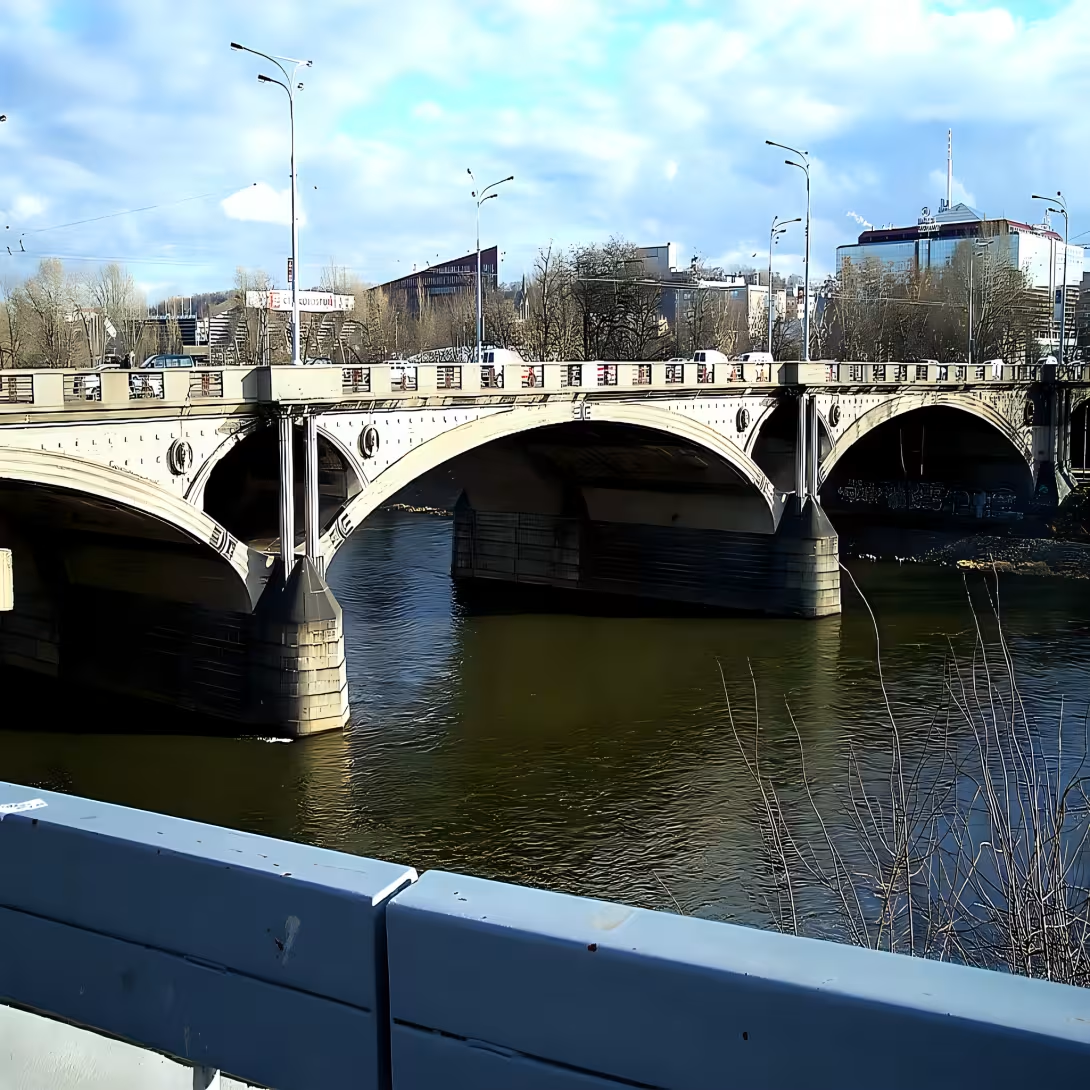
Hlávkův most connects Wilson Street on the border of New Town and Karlína with Buben Street in Holešovice, bridging Vltava and its island Štvanici. The exceptional nature of the bridge lies in its creation - it was built in two stages using different construction systems, reflecting the dispute between the younger and older generations of Prague architects of the early twentieth century.
The southern part of the bridge, leading over the right (sailing) shoulder of the Vltava, is an iron lattice bridge built between 1908 and 1910 according to the designs of engineer Mechislav Petrua. The northern part, which passes through the northern arm of Vltava, was realized in 1910 and 1911 as a reinforced concrete construction according to the designs of architect Pavel Janák and engineer František Menclo. This northern part represents a breakthrough - it was the first Czech bridge with concrete construction without traditional stone panelling. The bridge was connected directly to the bridge of the Masaryk railway station, making it a key part of the expanding Prague infrastructure.
In connection with the regulation of Vltava, the original bridge route was different from today's - led through Jerusalem Island and Crown Island. The bridge included two tolls for the selection of the myths located in the falcons of monumental sandstone sculpture Works and Humanita by sculptor Jan Štursa; these booths disappeared on a later remodel.
Between 1958 and 1962 the bridge underwent a complete reconstruction and expansion into an almost straight route. The original iron part was replaced by a reinforced concrete part, leaving only part of the original bridge decoration. The resulting northern part consists of seven arcs - three arcs bridge the Vltava (two with a span of 36 metres and a medium with a span of 19 metres), four smaller arches (17,85 meters) bridge the island of Štvanici. The south side has an arc-free filling.
The bridge structure serves road, tram and pedestrian traffic. In 1983, the northern foothold was rebuilt to a complex cross-level intersection with a set of underpasses and a pedestrian ramp. Tram track leads through the middle of the bridge. The traffic picture was changing with the time - until recently, the bus lines from Florence to the north were being transported along the bridge, their station had the island of Štvanice, but all daily lines were cancelled in 1984.
The bridge still bears the name Josef Závka, builder and philanthropic benefactor, which ranks it among the sparse Prague bridges that were never renamed. It becomes not only a transport hub but also a silent monument to its era. / p >
Then and now
Drag the slider to compare how the landmark may have looked when it was built with the view today.
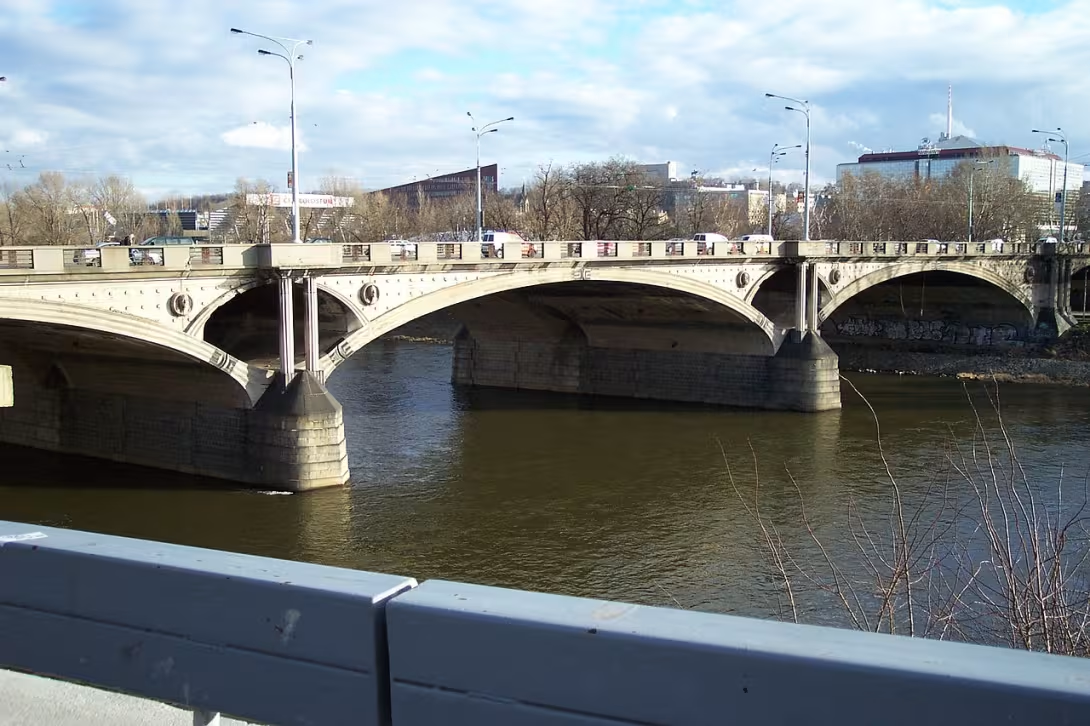

The historical appearance on the left is an AI-generated visualisation and serves as inspiration only.
Historical milestones
- 1909-1912
- Building a bridge in the original trail.
- 1958-1962
- Complete reconstruction, extension and replacement of the iron part with concrete.
- 1983
- Conversion of the northern foothills to an off-level intersection.
- 1984
- Cancellation of daily bus lines and stops on the island of Štvanice.
Architectural development
The bridge was originally made up of an iron lattice section and the first Czech reinforced concrete structure without stone lining. During the reconstruction in the years 1958- 1962, the iron part was replaced with reinforced concrete. The northern part is now seven arches of different ranges.
Historical events
1909-1912: bridge construction; 1958-1962: complete reconstruction and extension to today's route.
Points of interest
- Hlávkův most connects Wilson Street with Buben Street and brightens Vltava and Štvanici Island. - The bridge was built in two stages using different construction systems, reflecting the dispute between younger and older generations of Prague architects in the early 20th century. - The southern part of the bridge is an iron lattice bridge built between 1908 and 1910, while the northern part was realized as the first Czech concrete bridge without stone lining. - The bridge was a key part of the expanding Prague infrastructure, connected directly to the bridge bridge of Masaryk Station. - Or
Guide
This guide is narrated by a synthetic voice generated by artificial intelligence.
Show guide text
This text was created by artificial intelligence and has not been editorially reviewed. It may contain inaccuracies.
Welcome to Hlavkov Bridge, one of the most prominent architectural monuments in Prague, which connects Wilson Street with Buben Street via Vltava and Štvanice Island. You stand before a bridge whose elegant arches evolve above the flowing waters, while beneath them the changing landscape projects into your eyes. This historic bridge is not only an important transport hub, but also a witness to the rich architectural past.
Let us immerse ourselves in its origin and historical context. Hlávkův most was built between 1909 and 1912, launched as an ambitious project by philanthropist Josef Hlavka. Josef Hlávek, known for its promotion of art and education, wanted this bridge not only to be a practical construction, but also an inspiring architectural work. Architects Pavel Janák, František Mencl and Mečislav Petrů joined together to bring the Header to life, created a bridge with a unique design that combined iron and steel concrete elements. This hybrid approach was very innovative at the time, reflecting technological progress at the end of the 19th and early 20th centuries.
Look up and notice how the north side of the bridge attracts attention with its iron structure. This section is particularly interesting because it illustrates the technical differences between generations of Prague architects of the time. While the older generation preferred traditional materials and methods, younger architects tried to innovate and experiment with new technologies. This bridge is therefore not only a physical link between different parts of the city, but also a metaphor for cultural transition.
Of course, among the key personalities associated with the Head is Josef Hlávek. Its philanthropic nature and vision for Prague are reflected in this bridge, which stands as a monument to its benefits to the city. Moreover, Jan Štursa, another architect of the time, was also connected to the project, albeit in an indirect way. Its influence and style were reflected in the design of the bridge, which adds another layer of historical context.
The interesting thing about this place is its status as a witness to changes over the years. Between 1958 and 1962, the bridge was subjected to extensive reconstruction, when the iron part was replaced by concrete and overall design to suit modern needs. Furthermore, in 1983, the northern foothold was rebuilt to an off-level crossroads, which significantly changed its transport function and integration into urban infrastructure.
We will now invite you to explore this fascinating place again. The walk under the arches of the bridge offers not only a view of the Vltava and Štvanice, but also an opportunity to enjoy quiet moments in the urban environment. Don't forget to notice the atmosphere that this bridge radiates - it's a place where history and modernity live harmoniously together.
Thank you for your visit to Hlavkov Bridge. We hope that you felt at home here and that this guide helped you better understand the rich history and architectural importance of this unique place. If you have further questions or interests, do not hesitate to look at other sights of Prague. When you return to us, bring new views and views that this bridge can offer.
Tips for visitors
The best time to visit Shávkov Bridge is in the early morning or in the evening when there are fewer people and the atmosphere on the bridge becomes quieter. This period also offers beautiful lighting conditions for photography, especially at sunset when the bridge is illuminated in romantic colours.
Parking at the Hávkov Bridge can be limited, so we recommend using public transport. The nearest one is Masaryk Railway Station, which is well connected to Prague Trams and buses. For photography, remember to take a high-quality camera or mobile phone with a good lens to capture panoramic views of the Vltava and surrounding architecture.
For families with children, Hlávkův most is an ideal place to enjoy beautiful walks on the bridge. Remember to wear protective clothes and shoes suitable for walking, especially in colder months. There is a possibility to visit the island of Štvanice where children can enjoy their leisure and explore the natural environment.
There are several interesting locations in the vicinity of Návkov Bridge. Visit the Buben waterfront where you can enjoy the view of Vltava and relax in a quiet atmosphere. It is also possible to explore the historic island of Štvanice or to look at the architectural beauty of Masaryk Railway Station.
Frequently asked questions
Is Hlávkův most open to the public?
Yes, it's open all year round. The best time to visit is in the morning or in the evening when there are not so many people and it offers better photography.
How do I get to the place by car / public transport?
You can take bus No 4, 6, 9, 12, 14, 20, 22, 54, 55, 57, 58, 59, 91, 94, 96, 97, 98, 99 or tram No 1, 2, 3, 4, 6, 7, 10, 12, 14, 16, 17, 18, 20, 21, 22 and 25.
How much is the entrance fee and is it paid on the spot?
The entrance is free. You can see the bridge from both sides free of charge.
Is the tour suitable for children and seniors?
Yes, the tour is suitable for all ages. Children can enjoy taking pictures of the bridge while seniors can enjoy a quiet environment.
How long does the tour take?
The tour takes about 15-30 minutes, depending on your attention and interest in details.
What are the opening times and booking is required?
The bridge is accessible throughout the year. There is no limited opening time, but the best time to visit the bridge is morning or evening.
What's interesting in the immediate vicinity?
There is a Petrín lookout tower and park in the vicinity. You can also see other historical buildings in Prague, such as the churches of St. Stephen or St. Nicholas.
For kids
Imagine going back 115 years to Prague, which was completely different then. It was a big and noisy town with narrow streets and houses made of stone or wood. Only over 250,000 people lived in Prague at the time.
Who lived here? They were merchants, craftsmen, artists and poor people. The city was full of noise and smell. People made a living making clothes, processing wood or cooking food in bakers.
Businesses nearby
Events nearby

Zdroj akcí: otevřená data měst a obcí ČR (Národní katalog otevřených dat) a kalendář akcí Národního památkového ústavu.
Nearby
The island of Štvanice, Masaryk Railway Station, the Buben waterfront.
Accommodation nearby
Trips and activities nearby
Guided tours, tickets and activities nearby from GetYourGuide
Affiliate link: if you buy from the partner, we may receive a commission. The price for you does not change.
Search tours and activities →Themed route
1. Masaryk station (railway station) - The entry point of the route, which serves as a practical starting point for visitors. 2. Buben embankment (waterfront) - A walk along the river offers a quiet atmosphere and pleasant views of the water. 3. Hlávkův most (bridge) - The main destination of the trip, which represents an important architectural element connecting both sides of the river. 4. Island Štvanice (island) - Final stop for relaxation in green in the middle of the urban environment.
Seasonal recommendations
In spring the bridge comes alive with the arrival of the first heaths and fresh greenery in the surrounding parks. The atmosphere is full of hope and light is fine, which is ideal for observing architecture. I recommend to dress in layered clothes because weather in Karlín is usually variable. It's best to leave in the morning before the surrounding streets are filled with people.
The summer season brings sharp sun and intense lighting, which highlights the details of the bridge structure. The air is hot and the surroundings are very dynamic. Due to high temperatures and the largest number of visitors it is advisable to come very early in the morning. Don't forget light, breathable clothes and plenty of fluids.
In the autumn, the surroundings of the bridge turn into golden and brown tones, while fog often hovering over the river. The light is muted and creates a melancholy mood. The practical recommendation is to wear a waterproof jacket and visit a place in the late afternoon when the leaf colour is the most distinctive.
In the winter, the bridge is hard and cold, which underlines its industrial character. Freezing wounds and short days create a specific, quiet atmosphere. It is necessary to choose a very warm outfit, including a hat and gloves, so that you don't get caught in the water. I recommend a short walk in the time of ignition of public lighting.
Visualizations and artistic views


The visualisations are generated by artificial intelligence and serve as inspiration.
Photos from the area
Real photos taken near the monument


Zdroj a licence jsou uvedeny u každého snímku.
Atmosphere of the place
This atmospheric visualisation of the place and period was generated by artificial intelligence. It is not real footage of the location.
Tips from visitors
No tips yet. Be the first!
Log in and add your tip.
Sources and literature
Fotografie: I would appreciate being notified if you use my work outside Wikimedia. More of my work can be found in my personal gall / CC BY-SA 3.0, rozlišení zvýšeno umělou inteligencí — Wikimedia Commons. The author and licence also appear when you hover over the image.
Faktickým podkladem tohoto textu byl článek na Wikipedii, jehož autory jsou přispěvatelé Wikipedie. Článek je dostupný pod licencí CC BY-SA 4.0.
Location on the map

Příběhy a pověsti
Legendy, pověsti a příběhy spjaté s touto památkou

Fotografie návštěvníků
Zatím žádné fotografie. Buďte první, kdo přidá fotografii z návštěvy!
Přihlaste se a přidejte svou fotografii nebo hodnoťte.
Za ověřenou návštěvu v aplikaci získáte víc bodů — poznáme podle GPS, že jste na místě.
Reviews and comments