



Kašna se sochou svatého Josefa na Karlově náměstí Fountain
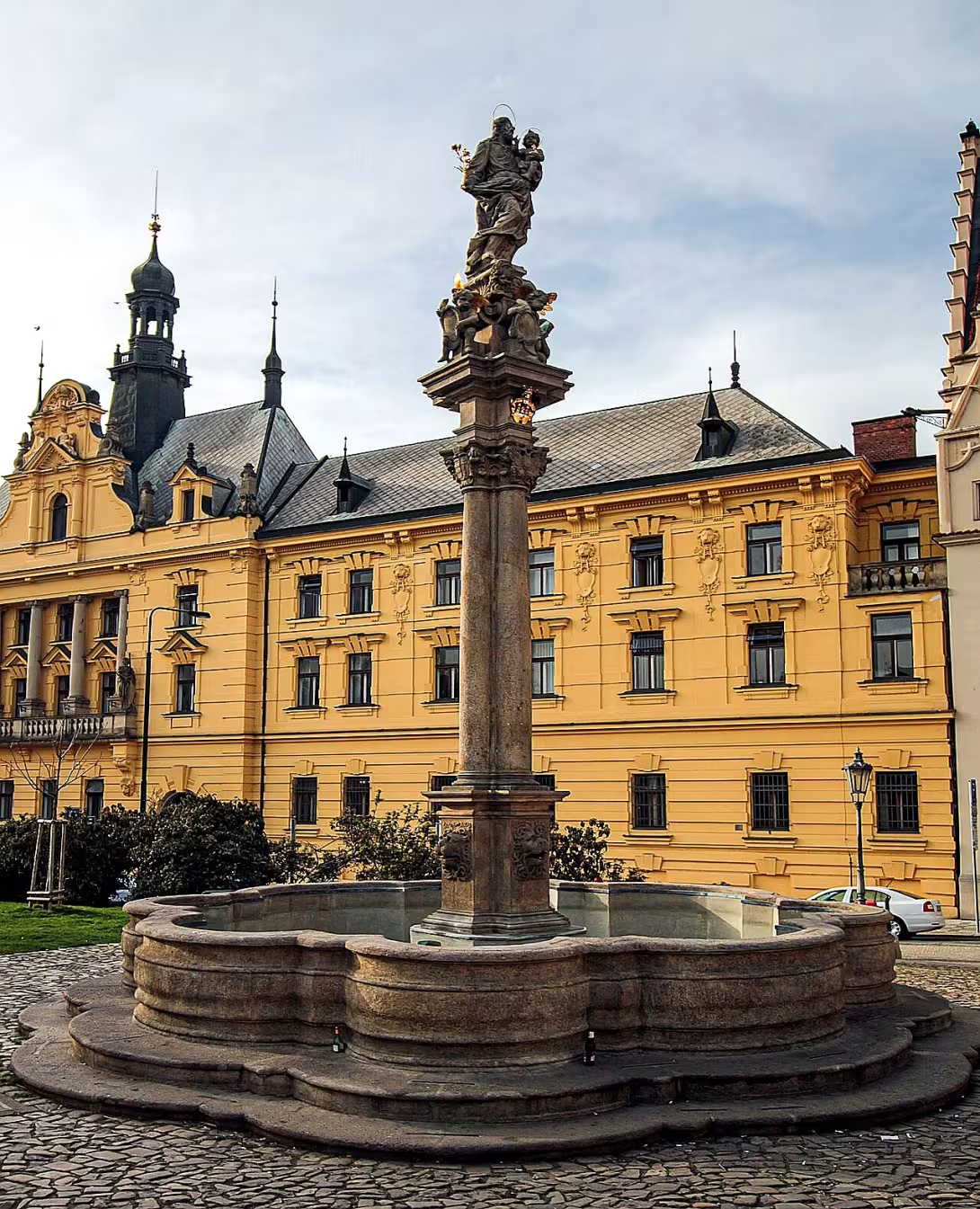
The fountain with the statue of St. Joseph is a Baroque monument from 1698, located outside the New Town Hall in Charles Square in Prague 2. It is the oldest sculpture decorating this place, the foundation of which is a pestilence built to thank for the end of the epidemic.
The building has its origins in tragic events in 1680, when Prague suffered a plague epidemic with approximately 6,000 victims. After the end of the disease, it was built in the spirit of the then European tradition as a token of gratitude. The top sculpture of St. Joseph and Jesus was created on order of the New Town Magistrate between 1697 and 1698. The author was the sculptor Matěj Václav Jäckel, which confirms the accounts from 1698 with his reward for figural accessories.
The monument consists of a polygonal water tank, in the middle of which stands a pillar consisting of four combined semi-columns with pseudo-Corinth heads. The base is equipped with four goblins in the shape of lion heads. On top is a sandstone sculpture of St. Joseph with Jesus in his arms, accompanied by four angels. The details refer to the power at the time: on the front is the sign of New Town and on the heads of the column Habsburg eagle with monogram of emperor Leopold I., together with Czech and Hungarian emblem.
Since 1998 the fountain has been included in the list of cultural monuments of the Czech Republic. Today it is an important part of the New Town Centre in Prague and is located near the New Town Hall, which makes it a natural destination for visitors to the Charles Square.
The monument represents a valuable example of baroque art and commemorates the historical fates of the people of Prague. Her visit allows close observation of the detailed work of sculptor Matej Václav Jäckel.
Then and now
Drag the slider to compare how the landmark may have looked when it was built with the view today.
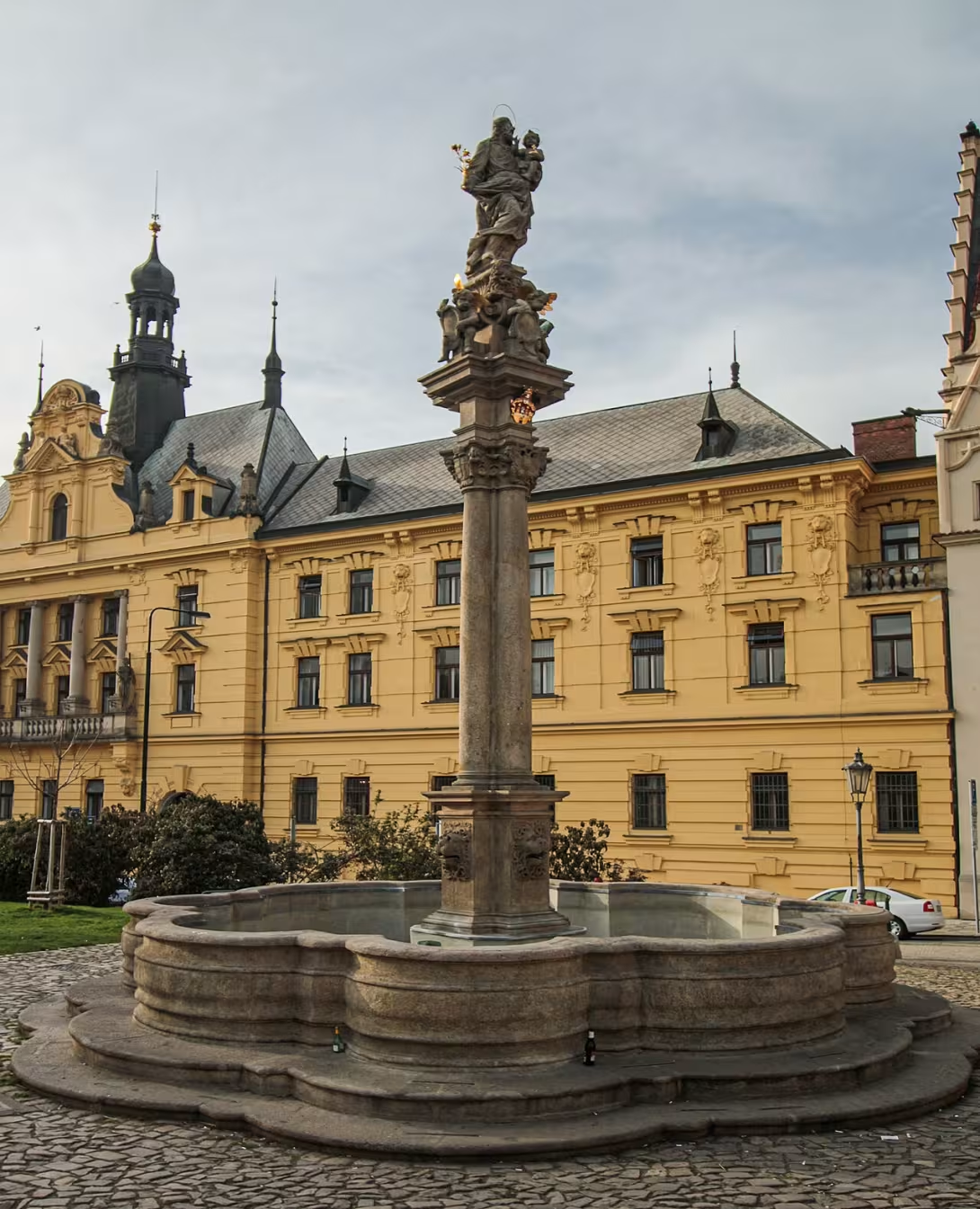

The historical appearance on the left is an AI-generated visualisation and serves as inspiration only.
Historical milestones
- 1680
- Tragic plague epidemic in Prague
- 1697-1698
- Creation of the top sculpture of St. Joseph with Jesus
- 1698
- Status of the Baroque fountain as a token of gratitude for the end of the disease
- 1998
- The inclusion of a monument in the list of cultural monuments of the Czech Republic
Architectural development
The fountain has a polygonal water tank and four combined half-columns with pseudo-Corinth warheads. On top of the column is a sandstone sculpture of St. Joseph, which is decorated by angels and characters of New Town.
Historical events
- 1680
- A plague epidemic in Prague.
- 1698
- Construction of fountain with statue of St. Joseph.
Points of interest
- It's a Baroque monument from 1698 and the oldest sculpture decorating this place. - Its foundation is a plague column built as a token of gratitude for the end of the 1680 epidemic. This epidemic had approximately 6,000 victims. - The author of the statues of St. Joseph and Jesus was the sculptor Matěj Václav Jäckel. - On top is a sandstone sculpture of St. Joseph with Jesus in his arms and four angels.
Guide
Show guide text
This text was created by artificial intelligence and has not been editorially reviewed. It may contain inaccuracies.
Welcome in the middle of Charles Square, right where the heart of New Town is pulsing. You are standing in front of a monument that at first glance seems modest, almost narrow between huge platinum alleys and flowing traffic, but in its stone body lies the history of one of the most tragic moments of Prague's past. Look ahead. You see the baroque fountain, whose central element is the pestilence column - the dark, binding pestilence pillar that rises from the pool as a silent witness of the time when the memory has not calmed down here for centuries.
Now that you've put your headphones on, try to move the noise of the present. Notice the shape of the column. It's a simple, square pillar of stone, without overdecorating, which carries on top of the statue. It is this statue, the statue of St. Joseph with Jesus in hugs and angels, that attracts the looks and gives this place its artistic weight. It is the work of the hands of Matej Václav Jäckel, a Lužický sculptor, whose mule has gained respect even for the most demanding zakaters in Prague. The statue is made of pestilence, i.e. bronze, and in the sunlight it shines with warm, brown golden tones, which perfectly contradict the colder, grey stone of the pillar and pool.
Let us now return in 1680. Prague didn't know the elegance of today. The streets were narrow, untidy, and the city was dragged into a disease against which there was neither a healing powder nor a prayer to guarantee salvation. The plague-plague spread like a dark cloud. There's talk of approximately 6,000 victims in the background. Six thousand lives in one city in a few months. This was a disaster not only demographic, but also spiritual. People were dying in families, all the streets were dying out, cemeteries couldn't keep up with the dead. Whoever could, ran to the villages who couldn't, stayed waiting for fate.
And just as the epidemic began to withdraw, when fear of narrow streets began to slowly return to normal rhythm, a promise was born in Prague. Citizens, councilmen, the Church - all who survived - felt immense gratitude that the disease had ended. Believers at the time did not seek the causes in bacteria, they sought them in God's will and deserving. And so in 1697, seventeen years after the end of the plague, the idea of building a memorial began to be born. Not as a tomb, but as a prayer of gratitude culminated in stone and all.
Between 1697 and 1698, the statue was created. Matěj Václav Jäckel, a master who could pull life out of the bronze, created a sculpture where St. Joseph holds little Jesus. It's a scene full of tenderness, parental care and protection. The angels around them are not just decorations, they are messengers, guardians, symbols of the heavenly help that Prague prayed for. Notice the details you're seeing right now: how Jäckel caught waves of clothing, how gently lies the child in the father's hands, how angels with ease hang around the column. It is the ultimate piece of the Czech Baroque, dynamic but deeply calm. And it is, as the historical record states, the oldest sculpture to decorate this place. Before her there were other sculptures, other monuments, but this one remained here as the first in line to remind us today of the history of the square.
The year 1698 then brought the completion of the whole fountain. It wasn't just a pillar with a statue. The swimming pool was built into which the water flowed, and the whole was used as a public fountain - a source of water for the surroundings, instead of meeting, but above all a permanent expression of gratitude. The water in the Baroque was a symbol of life, purity, purification. It flowed from the hoses into a stone container, took away dust and anxiety, and people poured water from it into pots for cooking, for drinking, for life. Today, the water in the pool keeps circling, even though no one's drinking anymore. But the sound of dripping and rustling is still the same - music that reminds us that life continues.
Now look closer to the stone pillar. If you look at its surface, you'll see signs of time. Erosion, moss in grooves, maybe even traces of repairs from the last century. The architects of this fountain remained unknown. We don't know who suggested a pool arrangement, who calculated the pressure of the hoses, who chose the type of stone. But we know who put a face to this place. Matěj Václav Jäckel. He was a sculptor from Lusatic, a region that gave the Czech country many talented masters. His work here is not isolated. His hand created statues on the Charles Bridge, in the church of St. Nicholas on the Malá Strana, in many other Prague temples. But this statue of St. Joseph is one of those that stands freely under the open sky, exposed to rain, snow, sun and the looks of thousands of people daily.
An interesting fact that may surprise you: although the fountain looks like an inseparable part of the square, it is not the original position in absolute sense. Charles Square went through massive reconstructions in the nineteenth and twentieth centuries. The New Town Hall before which you stand has been rebuilt, the streets have spread, the tram tracks have stretched through the pourting. The fountain was moved, dismantled, stored and reassembled. The fact that it stands here today in the form you see is proof of the care of the monuments and respect for history. In 1998 it was included in the list of cultural monuments of the Czech Republic, which gives it legal protection, but we know that the real protection is that people stop, look up and understand what they see.
You're standing in front of a monument that connects two planes. One level of pain and loss - the 6,000 victims, the empty houses, the grief of mothers and grooms. And the second plane of hope, faith and art beauty. St. Joseph, the protector of families, the patron saint of the dying, who quietly carries the burden of responsibility, seems to be an ideal patron for a place where life and death met in the most worrying form. Jesus in his arms is not only God's son, he is a symbol of the future that is born from the ruins of the past. The angels then whisper that even in the darkest night there is someone who holds his hand over the city.
Now that you have experienced this place not only with your eyes but with your heart, you can look further. Behind your back, you have a massive New Town Hall building with its tower, where once the bells sounded to warn, to rejoice, to sorrow. You have in front of you the square, which was once a market, then a park, today it is a mixed space for walks, sports and meetings. Platanus alleys that give you shade in summer were planted much later, in the nineteenth century, but now they belong inseparably to this place. Their crowns shadow the fountain, protecting it from excessive sun and rain.
Let's take a step further in your imagination. Imagine, in 1698, on the day of the discovery, the people in the Baroquas came here with their clothes on, their feathers and hats on. Princes, townsfolk, craftsmen, women with children in security. All quiet, heads down, praying for the end of the plague. The water in the fountain jumped into stone for the first time, the sound was new, clean, promise of the future. And the statue of St. Joseph in the glow of the sun shone like a new coin, like hope cast in bronze.
Today, centuries later, you can lay your hand on the cool stone of the pool. You will feel the desire of the past, but also the fortress with which this city has always risen. The fountain with the statue of St. Joseph is not just a piece of stone and metal. It's a book opened on a page that says, "We've been here, we've suffered, we've survived, and we've raised the memory so that you who come after us will know that you can overcome even the darkest time."
Thank you for stopping by and listening. Before you leave, take a moment to look at the angels at the foot of the column again. Their faces, even if destroyed by time, still express peace. And then look up to St. Joseph's face. It is expressed by wisdom, patience, silence. It's a face that's seen generations coming and going. You're one of them now. It carries on this history. Let the road guide you safely, whether you're heading towards Vltava, to Vysehrad, or just home to an apartment in the surrounding houses. Good-bye, and may Charles Square always receive you with a calm heart.
Tips for visitors
For the best experience we recommend a visit in spring or autumn months when the weather is pleasant for walks. The ideal time for observing details of the Baroque statue is early in the morning or shortly before sunset, when light is softer and less sharp.
The location is easily accessible by public transport and on foot. The current connections and routes are best checked in the Internet search engine.
For comfortable viewing of the area we recommend to bring comfortable shoes.
When shooting, focus on the statue of St. Joseph; The best angles for pictures offer views from the surrounding pavements, which capture Baroque details.
After visiting the fountain you can go to the nearby New Town Hall, which is close by.
Frequently asked questions
Can the monument be visited?
This is a structure in a public space that can usually be seen from outside free of charge. We have not verified that this particular one is freely accessible.
Where is the monument?
Location: Praha 2. The map on this page shows the exact spot.
Why is the monument protected?
It is listed in the Central List of Cultural Monuments of the Czech Republic as a cultural monument (register no. 1000152115).
Businesses nearby
Do you run a restaurant, accommodation, shop, museum, rental, wellness or other visitor service near this monument? Show yourself directly to the people heading to it — this is how they will see you in the app and on the web:
Events nearby

Zdroj akcí: otevřená data měst a obcí ČR (Národní katalog otevřených dat) a kalendář akcí Národního památkového ústavu.
Nearby
Památka je umístěna na Karlově náměstí, které je centrem Nového Města v Praze. V okolí se nachází další historické památky jako Novoměstská radnice.
Accommodation nearby
Trips and activities nearby
Guided tours, tickets and activities nearby from GetYourGuide
Affiliate link: if you buy from the partner, we may receive a commission. The price for you does not change.
Search tours and activities →Themed route
Thematic cruise route: Charles Square and its surroundings
1. Kašna se sochou svatého Josefa na Karlově náměstí (fountain) - This fountain is located in the middle of Charles Square, which is the historic heart of New Town. Its 18th century architecture attracts attention with its elegant form and statue of St. Joseph. The fountain symbolizes the city's rich past and is the ideal starting point for exploring the surroundings.
2. New Town Hall (Town Hall) - One of Prague's oldest and most important monuments is located approximately 100 metres from the fountain. Its Gothic elements and history dating back to the 13th century make it a fascinating place for visitors who want to know the political and cultural past of New Town.
3. Saint Anne's Chapel (Chapel) - This chapel is located on the south side of Charles Square, approximately 200 metres from the town hall. Its Baroque architecture and an important statue of St. Anne from 1693 makes it an important part of the cultural heritage of the square. The chapel is an ideal place for quiet moments and an understanding of historical links to the place.
4. Church of St. Nicholas (Church) - Around 300 metres from the chapel is the church of St. Nicholas, which is the oldest church in New Town. Its gothic architecture and rich interiors offer a view of Prague's spiritual life over centuries. The church is an ideal place for those who want to explore religious and architectural aspects of the history of New Town.
This route offers a compact guide to the main historical and cultural monuments of Charles Square, which is ideal for those who want to spend time in the centre of Prague.
Seasonal recommendations
Spring at Charles Square brings freshness and color - trees and beds around the fountain bloom, giving the object a lively and inviting look. The sun is already warmer, but it may rain, which gives the atmosphere a dynamic element. Light clothes are recommended, ideally with umbrella in case of bad weather. The best time to visit is early in the morning when the square is not yet a large crowd and the light is soft.
Summer in the square is a period of long, sunny days, when green trees provide a pleasant shade and the fountain appears to be the central point of living space. Tourism prevails, creating an energetic and vibrant atmosphere. Practical advice includes light and breathable clothes, sunglasses and a hat against overheating. Avoid the noon hours when the most people and the most intense sunlight, you better visit the object in the morning or late evening.
Autumn transforms Charles Square into a colorful landscape - leaves turn colors into yellow and brown tones and slowly falls away, which gives the ducks a mysterious and peaceful touch. The light is softer, often with autumn fog, which creates an introspective atmosphere. Hot clothes such as jacket and scarf are suitable for visiting, because temperatures are falling. The best time is in the afternoon when the sun sets and casts long shadows, which highlights the details of the statue.
Winter brings cold and snow cover that can surround the fountain with a white and quiet atmosphere. Short days mean that artificial lighting is often switched on, which highlights the statue of St. Joseph in contrast to the dark sky. Very warm clothing, including gloves, caps and shoes against frost is recommended. The best time for viewing is late afternoon when lamps are lit up and create a cozy, almost magical environment.
Visualizations and artistic views


The visualisations are generated by artificial intelligence and serve as inspiration.
Photos from the area
Real photos taken near the monument

Zdroj a licence jsou uvedeny u každého snímku.
Tips from visitors
No tips yet. Be the first!
Log in and add your tip.
Sources and literature
Photos: VitVit / CC BY-SA 4.0 — Wikimedia Commons. The author and licence also appear when you hover over the image.
Faktickým podkladem tohoto textu byl článek na Wikipedii, jehož autory jsou přispěvatelé Wikipedie. Článek je dostupný pod licencí CC BY-SA 4.0.
Location on the map

Příběhy a pověsti
Legendy, pověsti a příběhy spjaté s touto památkou

Fotografie návštěvníků
Zatím žádné fotografie. Buďte první, kdo přidá fotografii z návštěvy!
Log in a přidejte svou fotografii nebo hodnoťte.
Za ověřenou návštěvu v aplikaci získáte víc bodů — poznáme podle GPS, že jste na místě.
Reviews and comments