






Kostel svatého Jana Křtitele v Oboře Church
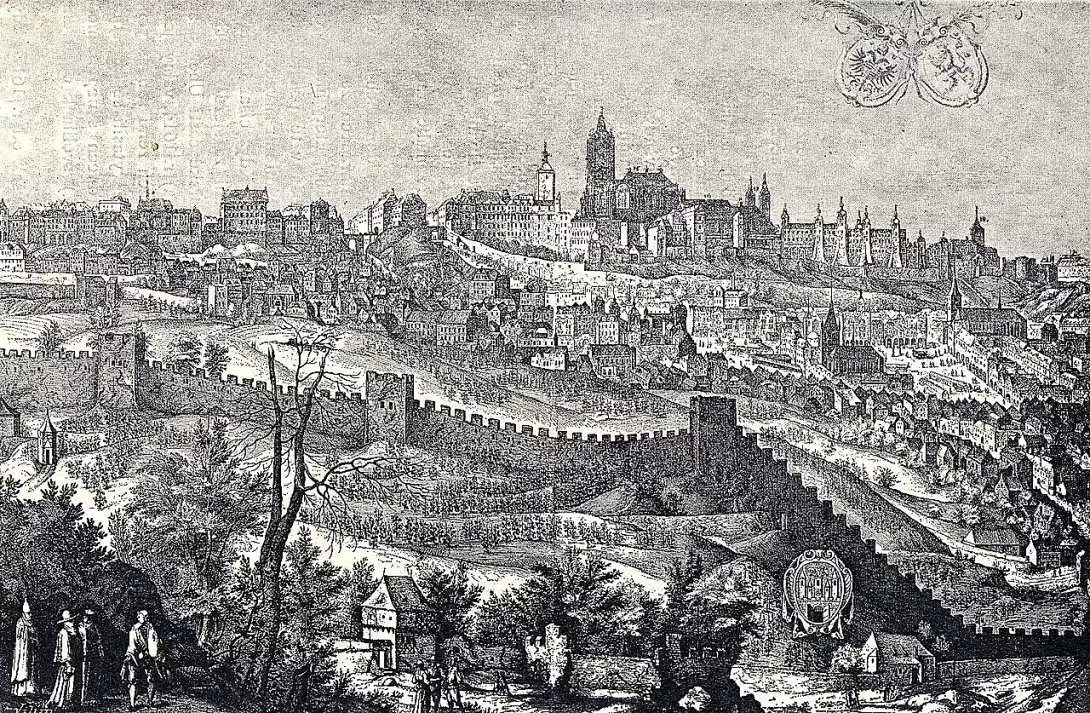
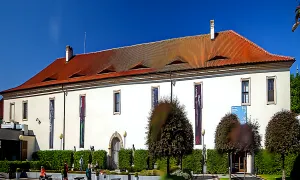
The St. John the Baptist Church in Obora, located in Prague's Malá Strana district, is a historical monument from the 12th century. Originally built in the cemetery, it evolved from a simple rotunda into a more complex structure in the early 16th century. The church served as a parish until its dissolution during the Thirty Years' War and later became a filial church. His cemetery was especially the last resting place for many Italian artists, including Jan Blažej Santini-Aichel and Aegidius Sadeler.
The origin of St. John the Baptist church in Obora dates back to the 12th century when it began as a chapel in the cemetery. The first construction was rotunda with opus quadratum walls, featuring a ship with an internal diameter of 5,20 m and a wall thickness of 1,02 m This original design has been completed by an app with stronger walls. Significant modifications were made at the beginning of the 16th century: on the west side of the rotunda, an oblong boat of 23.6 metres long was added and a new sacristy was replaced on the oldest Gothic. These changes increased the status of the church within the company.
From an architectural point of view, the church has undergone several transformations in its history. The original rotunda performed in Opus quadratum walls, characteristic of early medieval construction. In the 16th century the ship was enlarged by 70 cm and covered with ceramic tiles, while rotunda served as a chancel until the dissolution of the church. Later the expansion under Utrakvista in 1546 further changed its structure and reflected wider architectural trends.
Owning and managing the church has seen dramatic changes in its entire history. Originally served as a parish since at least 1363, it was documented for the first time during the famine between flights 1278 and 1282, when it operated as one of the four mass graves. The Utravists acquired the church in 1546, extending it to royal support. During the 30 years of war, however, the parish was dissolved and the church became a filial entity of St. Wenceslas's Church. In 1784, under Josephine reforms, the church was officially dissolved and later converted into a residential property in 1794.
The key events on the ground include his establishment as a mass grave during the famine of the late 13th century and his role as a parish from 1363 to the Thirty Years' War. The acquisition and extension of the Utrakvista church in 1546 meant another significant period which was driven by royal influence. His dissolution in 1784 led to his transformation into a residential building, indicating the end of his ecclesiastical function.
Today, pages retain some architectural elements from the past. Inside the boundary wall remains a stone portal from the 17th century and parts of the original church structure are integrated into contemporary buildings. The area known as the Janský top serves as a reminder of the historical importance of the church. Although it no longer works as a place of worship, its rich history and association with remarkable figures make it an interesting place for visitors who are interested in the architectural and cultural heritage of Prague.
The Church of St. John the Baptist in Obora is a testament to the dynamic history of Prague, reflecting both religious and secular transformation for centuries. Its legacy persists thanks to preserved architectural elements and its connection with important historical figures. Visitors are invited to explore this site to get an overview of the rich tapestry of the Prague past.
Then and now
Drag the slider to compare how the landmark may have looked when it was built with the view today.
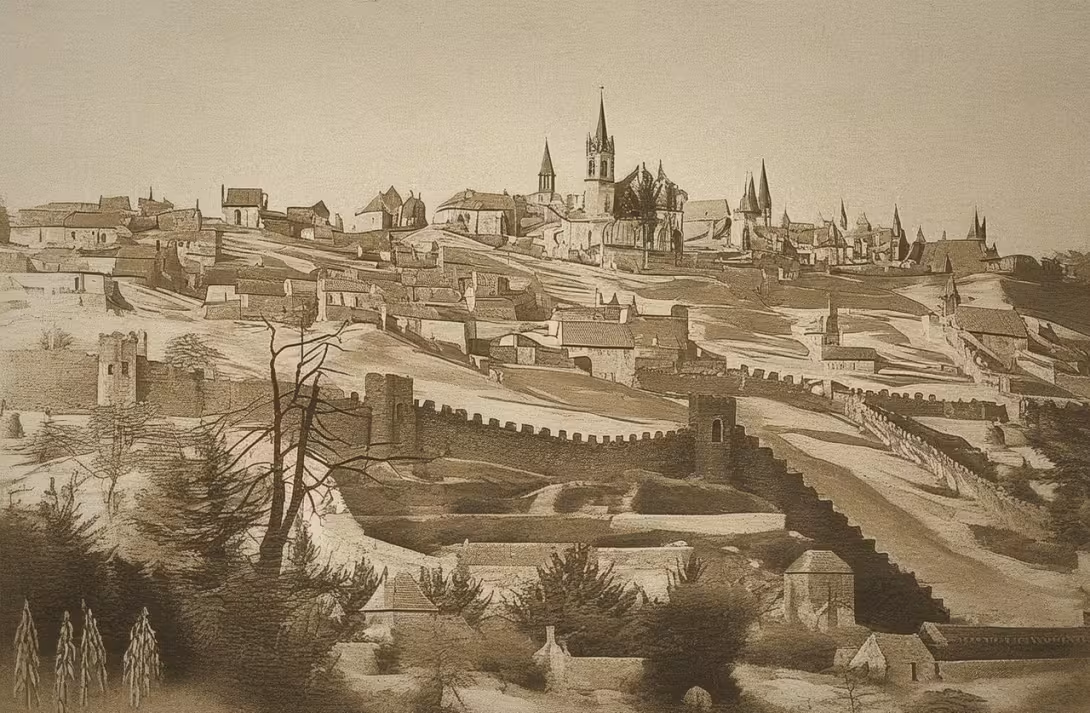
The historical appearance on the left is an AI-generated visualisation and serves as inspiration only.
Historical milestones
- 1278- 1282
- It was founded as one of four mass graves during famine.
- 1363
- First documented parish priest Jan served here until his death.
- 1546
- The Utradivists have acquired and expanded the church.
- 1784
- The church was dissolved under Josephine's reforms.
Architectural development
The original rotunda from the 12th century represented opus quadratum walls, with the ship raised by 70 cm at the beginning of the 16th century. The new sacristy replaced the older Gothic and the church was extended under a tradivistic influence in 1546. After reconstitution, it was converted into a residential building in 1794.
Historical events
1278-1282: the church was documented as one of four mass graves created during famine.
1363: First recorded parish priest John served here until his death the same year.
1546: The Utradists acquired and expanded the church.
1784: The church was dissolved under Josephine reforms.
Points of interest
- The Church of St.
Guide
This guide is narrated by a synthetic voice generated by artificial intelligence.
Show guide text
This text was created by artificial intelligence and has not been editorially reviewed. It may contain inaccuracies.
Welcome to this historic place of mystery and beauty - Church of St. John the Baptist in Obora. You are standing in front of a unique monument located in the middle of the views of the Little Party, with its calm and historical scent of Prague. There's not just a church in front of you; It is a living story of the ancient community that flourished in this area.
Let's dive into his history. St. John the Baptist Church has roots dating back to the 12th century, when it was built as a chapel in a cemetery during famine between 1278 and 1282. This space served as one of four mass burial sites for the victims of the plague, highlighting both its original spiritual purpose and its tragic context.
Over time, the chapel evolved into a wonderful structure. By 1363 it was already a key centre for the local parish, when John was the first documented priest to serve there until his death. This period saw the creation of rotunda with opus quadratum walls, architectural style characterized by square stones.
Now focus on the development of the church into the 16th century, when an elongated ship and a new sacristy were added. This architectural progress was made thanks to the efforts of the Utraquists in 1546, stressing its role as a centre for the reform movement.
The Church of St. John the Baptist also attracted attention from some of the most important figures of his time. Among them was Jan Blažej Santini-Aichel, an architect known for his work in Baroque style and Aegidius Sadeler, a famous painter. Their connection with this monument contributes to its historical significance.
The interesting fact is that the church served as a parish until 1784 when it was abolished under Josephine reforms. This transition from the centre of spiritual life to the filial church reflects wider socio-political changes in the region.
Look up and feel the atmosphere of this place. Although specific architectural elements are not specifically mentioned, you can imagine the structure of the rotunda with its carefully arranged walls and spatial transformations to the nav church.
The invitation for further examination is that although its appearance has changed over time, the spiritual and historical nature of this place remains unchanged. As you continue to walk through the streets, notice how this church has been preserved as evidence of rich history and culture.
Thank you for your attention. I hope your visit was an encouraging immersion in the past of this important local heritage. May this church inspire you to further explore the history surrounding it.
Tips for visitors
The best time to visit the place of St. John the Baptist church is at the end of spring or early autumn. During these seasons, the weather is usually mild, making it comfortable for walking and exploring the area. In addition, leaves around the Little Party offer a picturesque background that increases the historical environment of the site.
Transport to the site can be conveniently managed by public transport because the efficient network of Prague is connected directly to the Malá Strana. Alternatively, parking options are available nearby for those who prefer driving, but it is advisable to check the current availability and limitations on-line over your visit. Remember that traffic in the centre of Prague can be difficult during peak hours.
When visiting, consider bringing comfortable walking shoes, because you may want to explore more small pages outside the church site itself. A camera or smartphone is recommended for photography, especially if you are interested in capturing historical architecture and picturesque view of the area. The sun cream and hat is also recommended during the sun days.
For lovers of photography there are some of the best places around the former church with elevated views that offer panoramic views of the Prague panorama. Early morning or late afternoon light is ideal for capturing the city's golden shades against its historic buildings. Keep in mind other visitors when taking photos so that everyone has a pleasant experience.
The iconic Charles Bridge and Prague Chateau are nearby attractions within a 30-minute walk of the former church, offering rich historical views and amazing views. For families with children, consider visiting the Summer Park for your playground and open spaces where children can run freely while parents enjoy the picturesque surroundings.
Businesses nearby
Events nearby

Zdroj akcí: otevřená data měst a obcí ČR (Národní katalog otevřených dat) a kalendář akcí Národního památkového ústavu.
Nearby
ITEX Show interactive overview of the surroundings - restaurants, accommodation, rentals and other places within a 15 km radius.
Data: OpenStreetMap contributors, 15 km radius.
‡ Historical monuments
- Jaroslav Vrchlický (0.3 km)
- Kolovrat Palace in Waldstein [v okolí] (0.9 km - Waldstein 150 / 4)
- Clam-Gallas Palace in Praze [v okolí] (1.5 km - Husova 156 / 21)
- House U Kohouta [v okolí] (1.5 km)
- Hlavkova railway [v okolí] (1.9 km - Gorazdova 1994 / 9)
- Trolleybus Transport Memorial on Hanspaulce (2.9 km)
- Gorlice [v okolí] (3.0 km)
- Bra [v okolí] (3.0 km - In strength 46 / 1)
Restaurant and catering
- Pizzeria U Penguin
- Restaurant River's smokelab (1.9 km - Lidická 2)
- McDonald 's (2.0 km - Vodičkova 736 / 15)
- LegendA (2.8 km)
- Yi Xiang Ge (6.6 km)
- McDonald's (6.8 km)
- Švejk restaurant U Brážek (6.8 km - U Libertariv 18)
- Pizzeria Giovanni (6.8 km - Střelnice)
Accommodation
- The Mozart Prague (1.2 km - Carolina Light 208 / 34)
- Old Town Jewel Apartments (1.6 km - Elišky Krasnohorské 10 / 2)
- Old Prague Hotel (1.6 km - shell 421 / 5)
- Hotel AXA (2.7 km - Na Poříčí 40)
- EA Hotel Tosca (3.3 km - Blanická 718 / 10)
- Theatrino (3.9 km - Bořivova 1216 / 53)
- Plaza Prague Hotel (4.3 km)
- Hotel Olšanka (4.3 km)
› Rental and sports
- Floral expert (1.1 km)
- U Tyrše (1.2 km - Jaselská 464 / 38)
- Kieser Training (2.4 km)
- Bike Gallery (2.5 km - Kladenská 19)
- Free Time Centre Botič (2.6 km)
- JUN (2.6 km - Haškova 629 / 7)
- Velox Sport (2.7 km)
- Cycloservice Richard Eger (2.7 km)
© Tourism and nature
- Prague Chateau (0.3 km)
- Masaryk prospect (0.5 km)
- Petrinka (0.5 km)
- Information and booking centre (1.5 km - Maiselova 38 / 15)
- Vyšehrad (3.0 km)
- Gabrielka (4.2 km)
- Šestáková studika (5.8 km)
- ÚAMK, a.s. (5.9 km - On the Union 1837 / 9)
Accommodation nearby
Trips and activities nearby
Guided tours, tickets and activities nearby from GetYourGuide
Affiliate link: if you buy from the partner, we may receive a commission. The price for you does not change.
Search tours and activities →Themed route
Thematic walking tour: Malá Strana and St. John the Baptist Church
1. Church of St. John the Baptist (Church of St. John the Baptist) - Type: Historical landmark - Why Visit: Start your journey in this amazing Baroque church, a masterpiece designed by Christoph Dientzenhofer. Its decorative architecture and quiet atmosphere make it a crucial stop for anyone interested in Prague's rich religious history.
2. Church of St. Nicholas (Church of St. Nicholas) - Type: Historical landmark - Why Visit: Just a short walk from the church of St. John the Baptist, the church of St. Nicholas is another jewel on the Little Side. This church, famous for its beautiful Baroque interior and famous statue of St. John Nepomuk, offers insight into Prague's spiritual heritage.
3. Church of the Virgin Mary before Tyn - Type: Historical landmark - Why Visit: Continue your survey with a visit to the Church of Our Lady before Tyn, an iconic Gothic church with two impressive towers. Its historical significance and architectural beauty are a perfect addition to former Baroque monuments.
4. Small Party Square (Malostranski Square) - Type: Historical Square - Why Visit: Quit your tour of Malá Strana Square where you can enjoy panoramic views of Prague Chateau and the River Vltava. This lively square is surrounded by charming cafes and shops that offer a wonderful place to reflect the architectural wonders that you have explored.
This theme walking tour offers a deep dive into the religious and historical architecture of the Little Party, where some of Prague's most revered monuments will be presented.
Seasonal recommendations
Spring: In the spring period, the town's town, where the church of St. John the Baptist in the Obora, was revived by cultures of gardens and foggy musculature. This should be adapted to warm sunny days, which are ideal for prochs around the historical sites of Little Party. Excessive beauty is only once and a soothing atmosphere, with small olive saints. The applications should be used in the event that it could be established that in no case substantial action will occur. HEREBY RECOMMENDS NOT TO BE KNOWN BY MOVEMENT AND THROUGH CUT INDUSTRIES BY THE ARTICLE OF THE MORNING AND CITIZENS OF THE PUBLIC ENTERTAINMENT WHICH THE STATE IS ALMOST DIFFERENT IN JARO'S INTEREST.
Summer: Summer is the main source for its own historical data in Prague days and weather. The local church of St. John the Crusader, offered by the steel sunny days, is ideal for photography and production of surrounding gardens. The atmosphere is full of life with many tourists that increase the capital of Praha in summer traffic. They should survive early in the morning or in the afternoons to avoid the peak of the crowds that are expected around noon. Warm rounded and sun protection such as hats and cream suntanning, are essential for the guaranteed use of the law.
Autumn: Autumn of recalculating mild temperatures and rich red spectrum in places around the skeleton of St. John the Crusader in the Sector. November leaves offer a golden and red palette, which gives the atmosphere of the place a melancholy touch. Significant number of adjacent with selected summer crowd, which includes intense production history and architectural properties. The ingredients should be converted into cold conditions with these cups which are ideal for the respective prosthetics and embedded clothing, such as the cap or jacket. Short days thus indicate planned changes at the time the tests were carried out.
Winter: Winter months recalculating the cold and often snowy command to the place where you became St. John the Baptist in the Obor. The atmosphere is characterized by calm and quiet, which are considered necessary in case a romantic state could occur based on historical condition. The entrustment bodies should be tested in order to ensure that the monuments can be the subject so that appropriate measures are taken for the period concerned. The heat pack, the list of fur coats and other quantities per reduced dose is quiet to ensure delivery of goods. Despite the cold, the room offers itself as a place of rest and reflective binding on history.
Visualizations and artistic views


The visualisations are generated by artificial intelligence and serve as inspiration.
Photos from the area
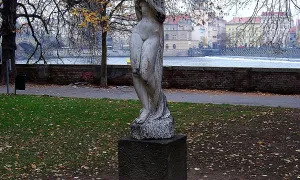
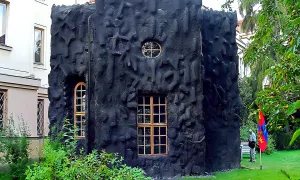
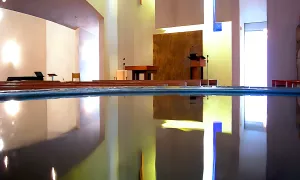
Real photos taken near the monument


Zdroj a licence jsou uvedeny u každého snímku.
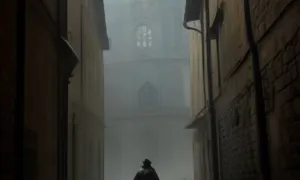
Atmosphere of the place
This atmospheric visualisation of the place and period was generated by artificial intelligence. It is not real footage of the location.
Tips from visitors
No tips yet. Be the first!
Log in and add your tip.
Sources and literature
Fotografie: Dr.J. Kosina; Jiljí Sadeler (1607) / Public domain — Wikimedia Commons. The author and licence also appear when you hover over the image.
Faktickým podkladem tohoto textu byl článek na Wikipedii, jehož autory jsou přispěvatelé Wikipedie. Článek je dostupný pod licencí CC BY-SA 4.0.
Location on the map

Příběhy a pověsti
Legendy, pověsti a příběhy spjaté s touto památkou
Fotografie návštěvníků
Zatím žádné fotografie. Buďte první, kdo přidá fotografii z návštěvy!
Přihlaste se a přidejte svou fotografii nebo hodnoťte.
Za ověřenou návštěvu v aplikaci získáte víc bodů — poznáme podle GPS, že jste na místě.
Reviews and comments