






Kostel svatého Jana Křtitele (Vřeskovice) Church
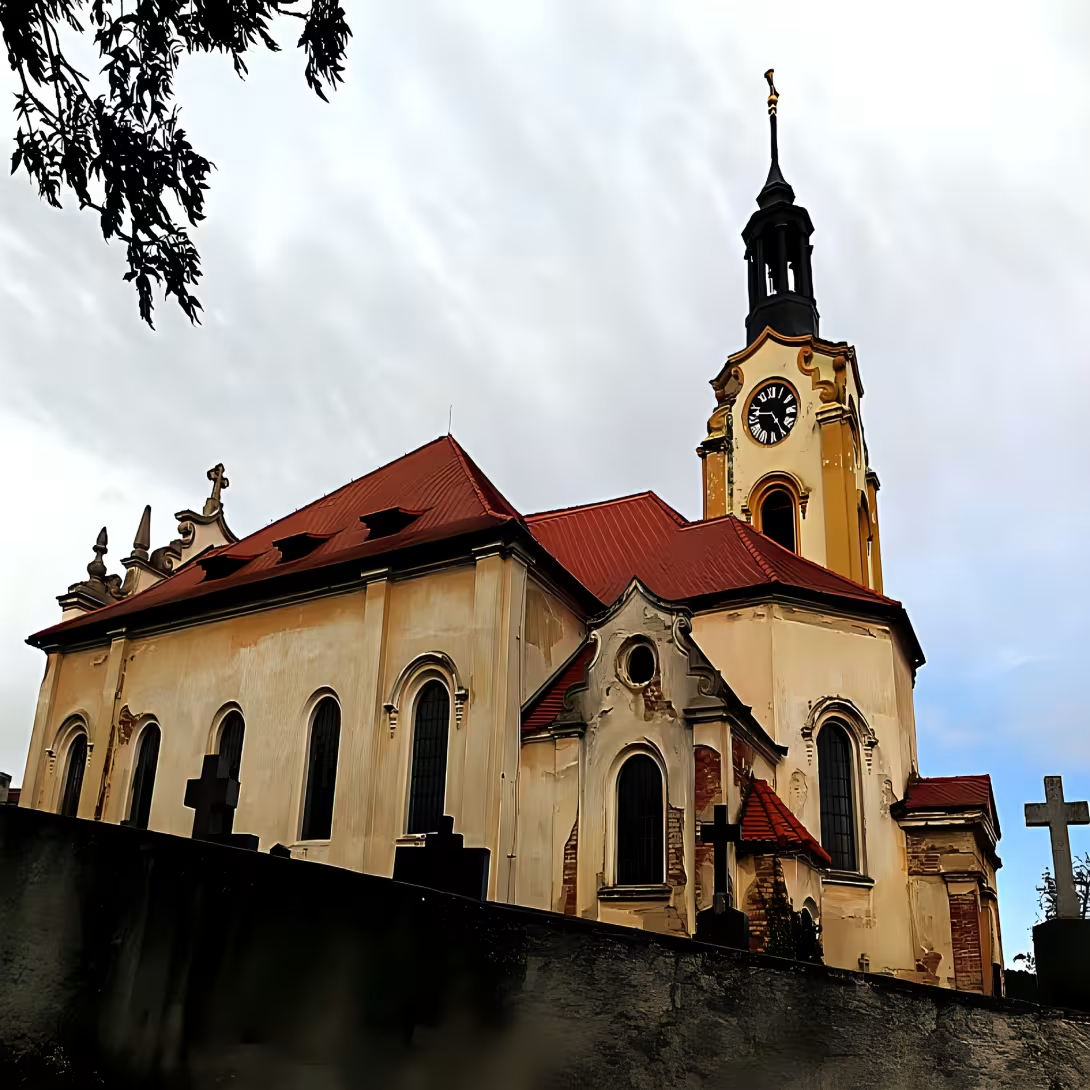
The Church of Visiting the Virgin Mary in Vrískovice presents an interesting composition of architectural styles. Due to its elevated position and significant tower, it becomes a landscape dominant, which orients the view of the landscape from far away. The temple has been protected since 1958 as a cultural monument and serves as a centre of the personal parish of extraordinary rites.
The origin of the church goes deep into the Middle Ages. It is assumed that it was created in the first half of the 14th century, although some sources date back to the end of the 13th century. The first written mention of the church dates back to 1384. From this time, the presbytery in its original Gothic form has been preserved to date. In the 16th century, probably in 1592-1593, the church underwent reconstruction. However, the most fundamental transformation was made in 1870 when a reconstruction was carried out combining a classical and neo-Baroque style. At that time, the original single ship was built from both sides by side ships, thereby gaining a tripod character. There was also a breach of the arcades, a new encroachment of the middle ship and a reconstruction of the presbyterium. The tower was increased by the second and third floors, supplemented by a stairwell and attached oratoriums. In the 20th century the church was kept continuously, with repairs in 1933, 1940, 1989 and 1999- 2000.
The building form of the church speaks of a long process of ongoing modifications. The tripod layout was established in the 19th century, when side boats spread around the original temple hall (originally 13 metres long and 7.5 metres wide). These are separated from the middle ship by wide arches and square pillar. The presbytery is terminated by a five-sided conclusion with a radiant clasp. The Segment Victory Arch separates the presbytery from the rest of the temple. A high three-story clock tower is adjacent to the left side of the presbytery. The ship's space is illuminated by four windows from each side with semi-rounded peaks. There is a cemetery around the church with a neo-Baroque morgue built in 1870.
The interior of the temple is mostly baroque. The dominant is the main altar of St. John the Baptist from the 18th century, decorated with a painting of the Baptist Christ and an oily one with the motif of the head of St. John the Baptist. Part of the altar are statues of St. Peter and St. Paul in natural size. The side altars with the paintings of the Holy Philomena and the Virgin Mary also come from the Baroque era, as well as the statue of St. Felix. The interior is supplemented by an ambony with three reliefs representing Christ as a shepherd, Saint John the Baptist in the desert and Christ as a sower. The tin baptizer is decorated with two allied coats of arms: the grave eagle and the cross-edged blade. In the right ship lies two tombstones of red marble with figures of man and woman - Elizabeth Šic and Albrecht Šice from Drahonice. The organ dates back to 1863 from Prague's master Josef Garther and Ferdinand Guth from Clean near Rakovnik. Four bells were stored in the tower of the temple, the two oldest of which dates back to 1465 and 1514. During World War II, three bells were seized, the largest of which was later returned.
The Church of the Visitation of the Virgin Mary is a place where the story of the construction from the late Middle Ages to the present days is bound. Architectural value, rich interior and landscape location make it an interesting goal for those interested in Czech ecclesiastical architecture and regional history.
Then and now
Drag the slider to compare how the landmark may have looked when it was built with the view today.
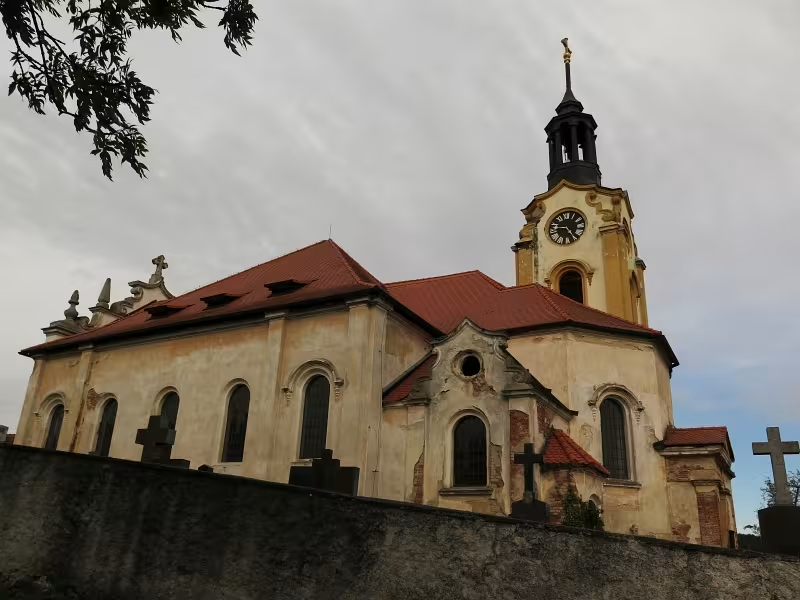

The historical appearance on the left is an AI-generated visualisation and serves as inspiration only.
Historical milestones
- 1384
- First written mention of the church in Vřeskovice.
- 1465
- Making the oldest preserved bell in the church.
- 1514
- Making a second preserved bell in the church.
- 1870
- A fundamental reconstruction of the church into a three-boat building with neo-Baroque and classical elements, including the construction of a morgue in a cemetery.
- 1958
- Listed on the list of cultural monuments.
Architectural development
The original Gothic church from the 14th century was preserved only in presbytery. In the 16th century he went through minor modifications. In 1870, the original single-boat structure was extended with side boats, attached tower and orator, and the whole interior was newly sealed. Regular maintenance and repair work was carried out in the 20th century, especially on the roof, facades and groves.
Historical events
- 1384
- First written mention of the church in Vřeskovice.
- 1592-1593
- Reconstruction of the church at this time, probably with modifications to the interior.
- 1870
- A fundamental reconstruction of the church into a three-boat building with neo-Baroque and classical elements.
Points of interest
The church has been protected as a cultural monument since 1958.
- The original Gothic presbytery dates back to the first half of the 14th century, the first written mention of the church is from 1384.
- In 1870 the church underwent a large reconstruction, which created a three-boat layout, increased the tower and added oratoriums.
- In the interior there is the main altar of St. John the Baptist from the 18th century with the paintings of Christ the Baptist and the head of St. John the Baptist.
- The church tower was originally three storey and contained four bells, two of which came from 1465 and 1514.
Guide
This guide is narrated by a synthetic voice generated by artificial intelligence.
Show guide text
This text was created by artificial intelligence and has not been editorially reviewed. It may contain inaccuracies.
Welcome to the church of St. John the Baptist in Vreskovice. You are standing in front of one of the oldest sacral structures in this part of Plzeň, whose roots go deep into the Middle Ages. In front of you is a three-boat church with a distinctive tower surrounded by a quiet historical cemetery. Notice how its silhouette is projected into the surrounding countryside - here the Gothic core meets with later baroque and classical adjustments that give the church its present form.
Let's go back to the past. The first written mention of this church dates back to 1384, but its oldest part - the Gothic presbytery - is a century older. It dates back to the first half of the 14th century, where there was a simple but dignified sacral structure, serving local residents and travellers. Know that it was here, in this church, that two bells from the 15th century were preserved - one of them was smoked in 1465, the other in 1514. They are thus some of the oldest preserved bells in this area and their sounds probably accompanied the life of the village for centuries.
Now pay attention to his architecture. Although the church had undergone a large reconstruction in 1870, which gave it a three-boat form and neo-Baroque elements, its original core was preserved. Look at the facade - here you will find traces of the time when the church was only a modest chapel. Look closely at the tower that dominates the area. During the reconstruction, it was increased and enriched with other architectural details that add to the complex its today's majesties. Don't forget to notice the historical cemetery surrounding the church. The Neo-Baroque morgue, built during the reconstruction, gives the place a special atmosphere of peace and memory.
Who was behind this church? Unfortunately, the names of his builders and those who supported him in the past have not been preserved. However, we know that it has always been an important centre not only for the religious but also for the social life of the village. Over the centuries, not only religious services, but also meetings of local residents, wedding ceremonies and funerals. Every stone you see bears traces of these stories - even if their particular form remains hidden.
And now something interesting. Imagine that it was here, at this church, that there were events in the past that we know little about today. For example, at the time of Hussite wars, the church could have been a focus of attention, as Vřeskovice was on an important business trip. There may also have been some of the local patrons who supported the church, but their names were lost in the stream of time. One thing we know for sure: this church is not only a monument to our history, but also a place where the past meets the present.
Take another look at this place before you leave. The Church of St. John the Baptist in Vrískovice is protected as a cultural monument since 1958 for good reason. Its walls bear memories of centuries of faith, work and life. If you have time, go around the cemetery - every tombstone, every old tree here has a story. And if you look up to the tower, remember that right here, between these walls, the history of this village was written.
Thank you for taking the time to visit this place. We hope that you have taken away not only the impression of his architecture, but also the feeling of connection to the past. If you ever come back here again, I'm sure you'll find new details that will escape at first sight. May this monument bring you peace and inspiration. Goodbye!
Tips for visitors
{'content': 'Best time to visit the church of St. John the Baptist in Vřeskovice is during the morning hours when the sun is sideways and creates interesting shadows on the gothic stones of the presbytery. The ideal period is spring or autumn, when the weather is pleasant outside and the place is not crowded with tourists. In the summer months it is advisable to avoid the noon hours when the interior may be hot and the traffic may be high.', 'reason': 'This way you can see detailed carvings and paintings on the walls without disturbing light and crowds.'
{'content': 'Church is available by car, parking is possible in public parking by road leading to the village. It is recommended to arrive on your own because public transport to Vřeskovice is not very common. The current connection and departure times can be found in the traffic search engine.', 'reason': 'Parking is free of charge and is only a few minutes' walk from the entrance to the church. '}
{'content': 'When visiting take a comfortable shoe because the church is located in a small village and the way from the parking lot can be unequal. Next I recommend you take a small towel or cloth, because the interior can be humid, especially in the presbytery. It is advisable for children to bring some activity such as painting or small toys so that they can spend some fun time during the visit.', 'reason': 'This way you will feel ready for all conditions and visit will be more enjoyable.'}
{'content': 'The best places for photography are the exterior of the Gothic presbytery and the interior of the church, where the main altar is richly decorated. For quality images it is ideal to light the morning or afternoon sun to illuminate the details of stone elements. In the interior, avoid lightning to avoid damage to the paintings.', 'reason': 'This way you will capture the beauty of architecture and details without damaging the monument.'}
{'content': 'There are several interesting places around Vřeskovice that are worth visiting during your trip. In particular I recommend visiting the parish church of St. Jacob the Greater in Útvina, located about five kilometres from Vrískovice. This church is an important sacral object and the seat of the parish to which Vřeskovice belongs. Another interesting thing is the Chateau in Útvina, which is about six kilometres away and offers beautiful Baroque architecture with surrounding park.', 'reason': 'These places will complete your visit with historical and cultural experiences.'}
{'content': For families with children it is advisable to visit the church at a time when there are fewer people in the interior, for example on Monday morning. It may be interesting for children to explore ancient stone elements and explain the history of the church. In the vicinity of Útvina you can visit the chateau where children can explore nature in the park and have fun in the open area. For children of older age, it may be interesting to visit the parish church of St. Jacob the Greater and compare its architecture with the church in Vrískovice. ',' reason ':' This way children learn about history while enjoying active time outdoors. '
Frequently asked questions
Is Kostel svatého Jana Křtitele (Vřeskovice) open to the public?
Yes, the church is open to the public. The opening hours are from 9: 00 to 16: 00.
How do I get to the place by car / public transport?
The church is located in the heart of the village Vřeskovice. By car you can arrive directly in front of the church, public transport is available from nearby square.
How much is the entrance fee and is it paid on the spot?
Payment can only be made in cash.
Is the tour suitable for children and seniors?
Yes, the church is accessible to all ages. The tour is suitable for families with children as well as for seniors.
How long does the tour take?
The tour takes approximately 30 minutes. However, you can also sit down and relax in a nearby park.
What are the opening times and booking is required?
The church is open to the public from 9: 00 to 16: 00. Reservation is not necessary, but it is recommended to contact the church administrator in advance when visiting larger groups.
What's interesting in the immediate vicinity?
In the vicinity of the church there is a historical centre of the village Vřeskovice with several other cultural monuments. You can also visit nearby forests and meadows.
For kids
Imagine coming back 156 years... Until the church of St. John the Baptist was still young and full of life. There were people here who believed in God and tried to be good Christians.
At that time, the church stood like a Gothic chateau, with a high tower and massive walls. It was a community center where weddings, funerals and other important events took place. Local people gathered here in prayer and singing to pray for their village.
Businesses nearby
Do you run a restaurant, accommodation, shop, museum, rental, wellness or other visitor service near this monument? Show yourself directly to the people heading to it — this is how they will see you in the app and on the web:
Events nearby
Zdroj akcí: otevřená data měst a obcí ČR (Národní katalog otevřených dat) a kalendář akcí Národního památkového ústavu.
Nearby
{'memories': [{\ 'nazen': 'Parish Church of St. Jacob the Greater in the Tur', 'remote': 'cca 5 km', 'description': 'another significant sacral object in the surrounding area': 'Baroque chateau with a park which is another cultural centre of the region'}], 'priroda': {'description': 'Vřeskovice lies in a slightly wavy landscape with a transverse forest and fields. There are several nature reserves in the surroundings, such as the Black Forest Nature Reserve (about 7 km).'}}
Accommodation nearby
Trips and activities nearby
Guided tours, tickets and activities nearby from GetYourGuide
Affiliate link: if you buy from the partner, we may receive a commission. The price for you does not change.
Search tours and activities →Themed route
Thematic cruise route from Vřeskovice
1.Kostel svatého Jana Křtitele (Vřeskovice) * Type: * Sacral monument This church is the main destination of our route, represents an important cultural and historical object in the village Vřeskovice. Its architecture and artistic elements are fascinating for visitors interested in the history of Czech sacral construction.
2. Parish Church of St. Jacob the Greater in the Feast * Type: * Sacral monument This church is located approximately 5 km from Vrískovice and serves as a seat of the parish, which includes Vřeskovice. Its architectural beauty and history make it an important cultural centre in the region.
3. Chateau in the Feast * Type: * Cultural landmark The Baroque chateau with a park is located approximately 6 km from Vřeskovice and is another cultural centre of the region. Its beautiful spaces, history and parks offer visitors the opportunity to explore the rich heritage area.
4. Park near the chateau in Útvina * Type: * Natural and cultural monument The park that accompanies the Baroque chateau is an ideal place for relaxation and tours. Its natural beauty and carefully maintained gardens provide a comfortable atmosphere to relax after visiting churches and chateau.
This route offers a combination of historical, cultural and natural attractions in the region of Pilsen Region, making it ideal for a day trip.
Seasonal recommendations
Spring: In the spring season, the Church of St. John the Baptist in Vřeskovice boasts beautiful flowers, where surrounding meadows and groves offer a healthy palette of colours. The sunny clarity illuminates the church interior in an unforgettable light, which contributes to the atmosphere of calm and restoration. For a visit it is recommended to come on weekends when it can be milder to the crowd than on working days. Due to the warm weather, it is advisable to bring light clothes and possibly sunflower if you plan to spend time on an outdoor walk around the church.
Summer: In the summer period, the Church of St. John the Baptist is a perfect destination for those seeking escape from the city floods. The sunny days bring warm and bright interiors of the church, which is an ideal time for a photograph. Summer is also the period of the highest attendance, so it is recommended to come earlier in the day to enjoy a quieter space. Hot clothes and sun protection are essential as well as enough drinking.
Autumn: In autumn the Church of St. John the Baptist is wrapped in the colours of golden and red leaves, adding a romantic atmosphere to the church. Sundays are more common than in winter, so the interior can be illuminated by beautiful light. This time is ideal for quiet visits because the crowd is not too much. It is recommended to wear warmer clothes and to bring blankets or coat tissues for comfort on winter days.
Winter: Winter brings the Church of St. John the Baptist a quieter atmosphere, when the surrounding landscape is covered with snow and the water in the fountains stops. The interior of the church offers fine reflections of light from lamps, which contributes to a sense of peace and quiet. Winter visits are often shorter due to limited opening time, so it is recommended to check the current time before the trip. Hot clothes and protection against cold are necessary for a comfortable visit during this period.
Visualizations and artistic views


The visualisations are generated by artificial intelligence and serve as inspiration.
Photos from the area
Real photos taken near the monument


Zdroj a licence jsou uvedeny u každého snímku.
Tips from visitors
No tips yet. Be the first!
Log in and add your tip.
Sources and literature
Fotografie: Sovicka169 / CC BY-SA 4.0, rozlišení zvýšeno umělou inteligencí — Wikimedia Commons. The author and licence also appear when you hover over the image.
Faktickým podkladem tohoto textu byl článek na Wikipedii, jehož autory jsou přispěvatelé Wikipedie. Článek je dostupný pod licencí CC BY-SA 4.0.
Location on the map
More monuments – Vřeskovice
Show all in the municipality

Příběhy a pověsti
Legendy, pověsti a příběhy spjaté s touto památkou
Fotografie návštěvníků
Zatím žádné fotografie. Buďte první, kdo přidá fotografii z návštěvy!
Přihlaste se a přidejte svou fotografii nebo hodnoťte.
Za ověřenou návštěvu v aplikaci získáte víc bodů — poznáme podle GPS, že jste na místě.
Reviews and comments