






Kostel svatého Karla Boromejského (Praha 1) Church
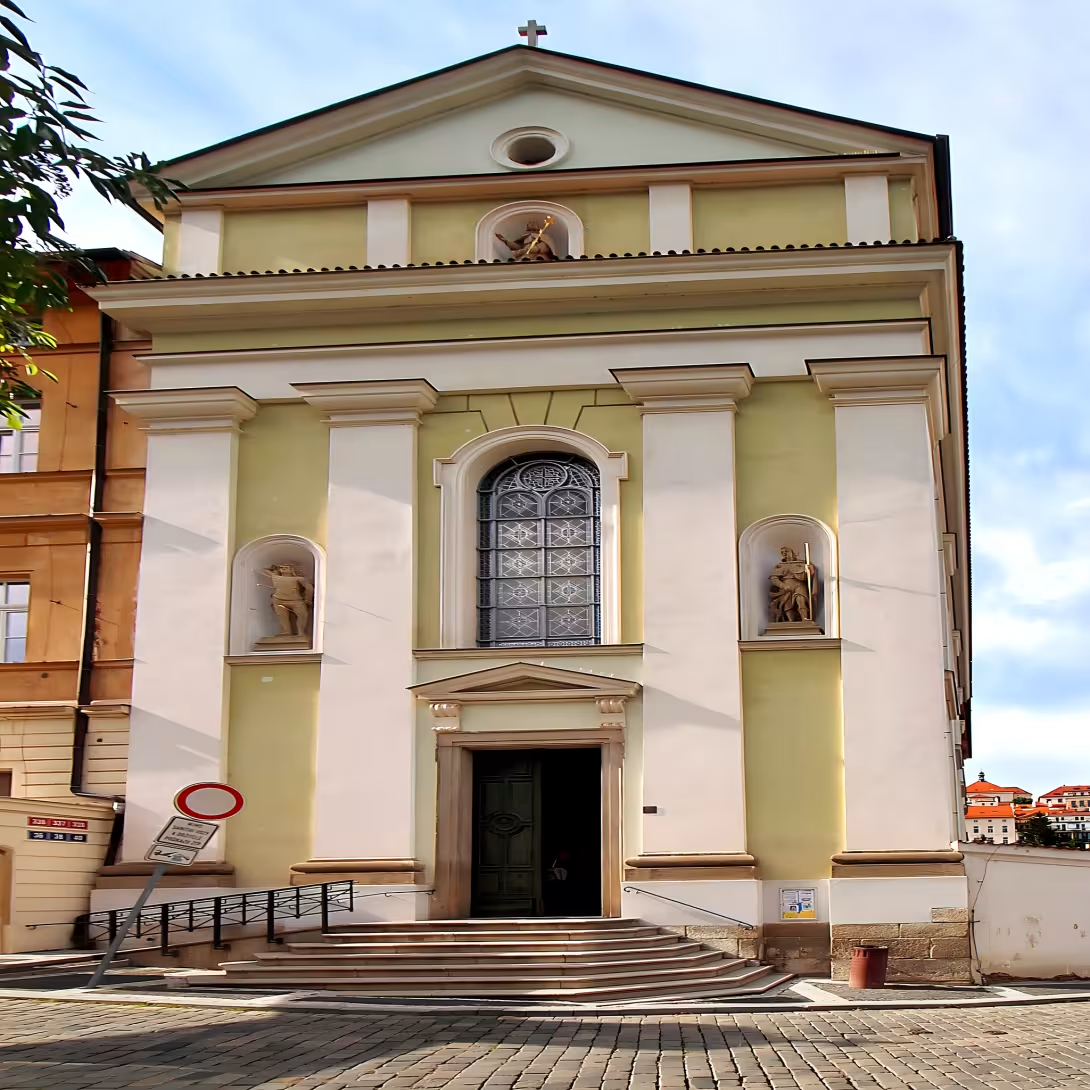
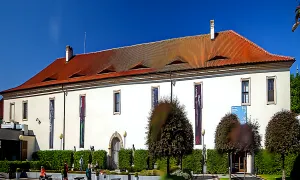
The church of St. Charles Boromejský in Prague 1 is originally a monastery temple of Röm Catholic Church located on the premises of the Hospital of the Merciful Sisters of St. Charles Boromejský "Pod Petrín" in Malá Strana. It is located at Vlasská 336 / 36 and is protected as a real-estate cultural monument. His story is an expression of faith and human solidarity in the Czech architecture of the 19th and 20th centuries.
The story of the church begins with a далеко. The Congregation of the Sisters of St. Karl Boromei was founded in 1652 in Nancy, France. These Merciful Sisters came to Prague in 1837 at the invitation of Alois Klar. Four years later, in 1841, the former vineyard of Strahov premonstrates with a house by Baron Josef Bretfeld was acquired on the Lesser Side. With the help of devout donors, especially the siblings František Jiří and Helena Lobkovice, they founded their mother monastery and hospital there. The builder Adalbert Gudera designed for them a church in a late classical style. The temple was ordained November 4, 1855.
The architecture of the church reflects its purpose. It is a single-boat hall building with a semi-circular apside arched condom and a sanctus turret. The interior is oriented by the main altar towards the north. Three statues of the holy patrons of the congregation are placed on the south facade: in the shield of St. Joseph the guardian of the Lord, under him St. Shebestian and St. Roch - both patrons against the plague. The crust is two storey, the upper floor is directly accessible from the hospital so that the sick can be present in the isolation service. The painting of the Virgin Mary the Queen of Angels in the apside of the Prague painter Vilem Kandler from 1855 was preserved from rich painting equipment. In 1853-1854, the Kandler also created a painting of St. Charles Boromei in Milan leading the procession to the cross for the main altar. The side altars are decorated with paintings by Vienna's painter Josef Neugebauer, sculptures created by sculptor Václav Levý. At the entrance to the hospital stands the stone Baroque sculpture Piety among the angels from Jan Brokoff from 1695, originally from the Charles Bridge.
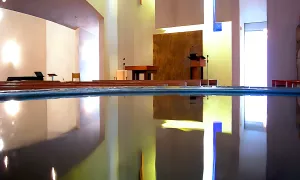
The second half of the twentieth century did not smile at the church. On August 15, 1952, the nurses had to leave the hospital. The church remained in operation until 2 September 1962 when it was consecrated and abolished. The State Health Institute then established a literature depository for nearly 90,000 volumes of books. This period ended on 23 April 1990 when the church was returned to the Congregation of Sisters of Boromejek. This was followed by a thorough restoration under the guidance of Josef Hýzler, the construction plant Pavel Široký and the restorer Marie Kolaf. The temple was reconsecrated on August 22, 1993. In 1996, the reconstruction of the presbytery sanctified by Archbishop Miloslav Wolf was completed. The new stone altar, an ambon and a shrine of marble was designed by sculptor and restorer Petr Váňa. The architect Karl Filsak deserves a thank you for the cross with crucified Christ now in apsid. In 2021, the sisters managed to recover from Košice the altar painting which is now hanging on the western wall of the presbytery.
Then and now
Drag the slider to compare how the landmark may have looked when it was built with the view today.
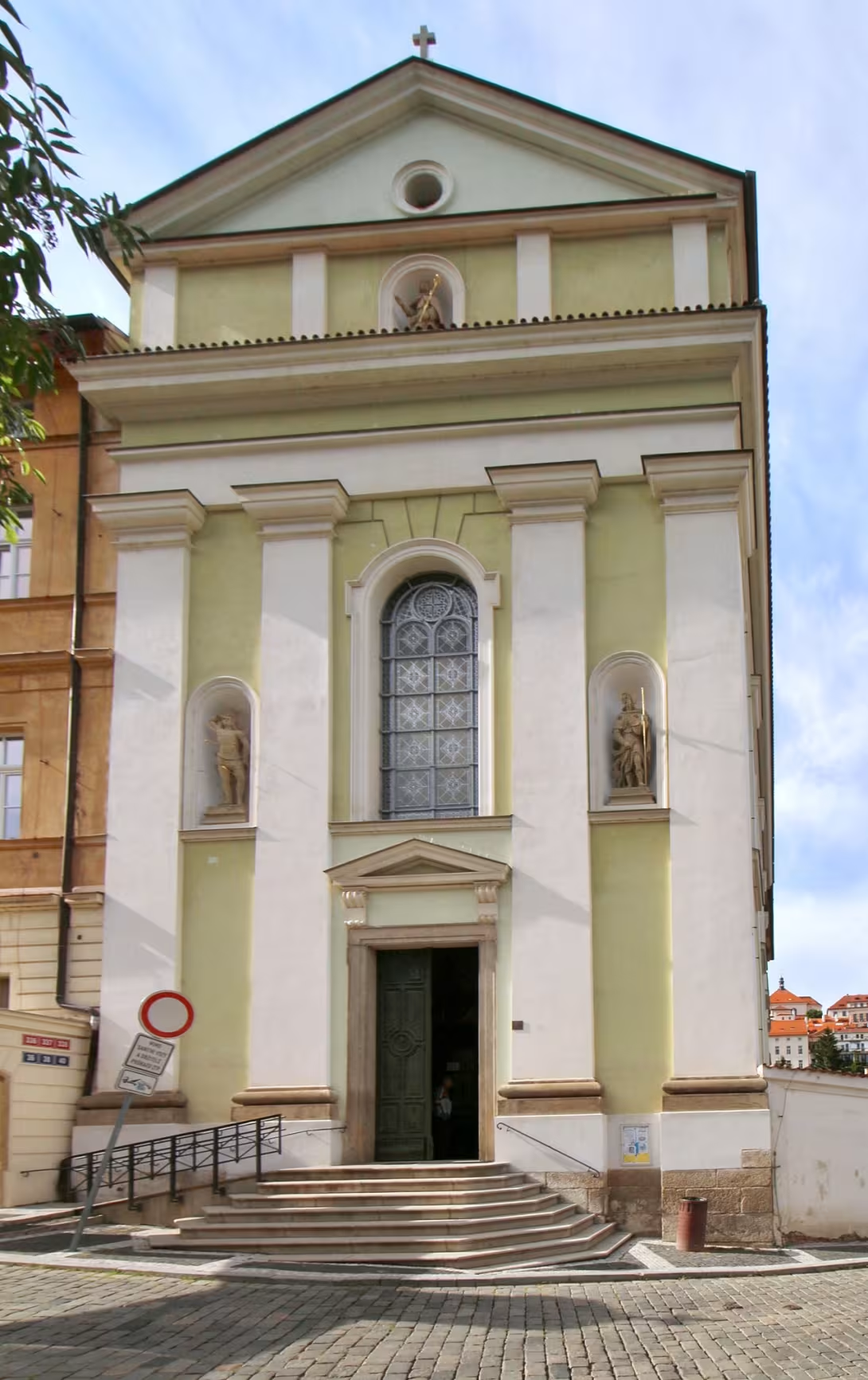
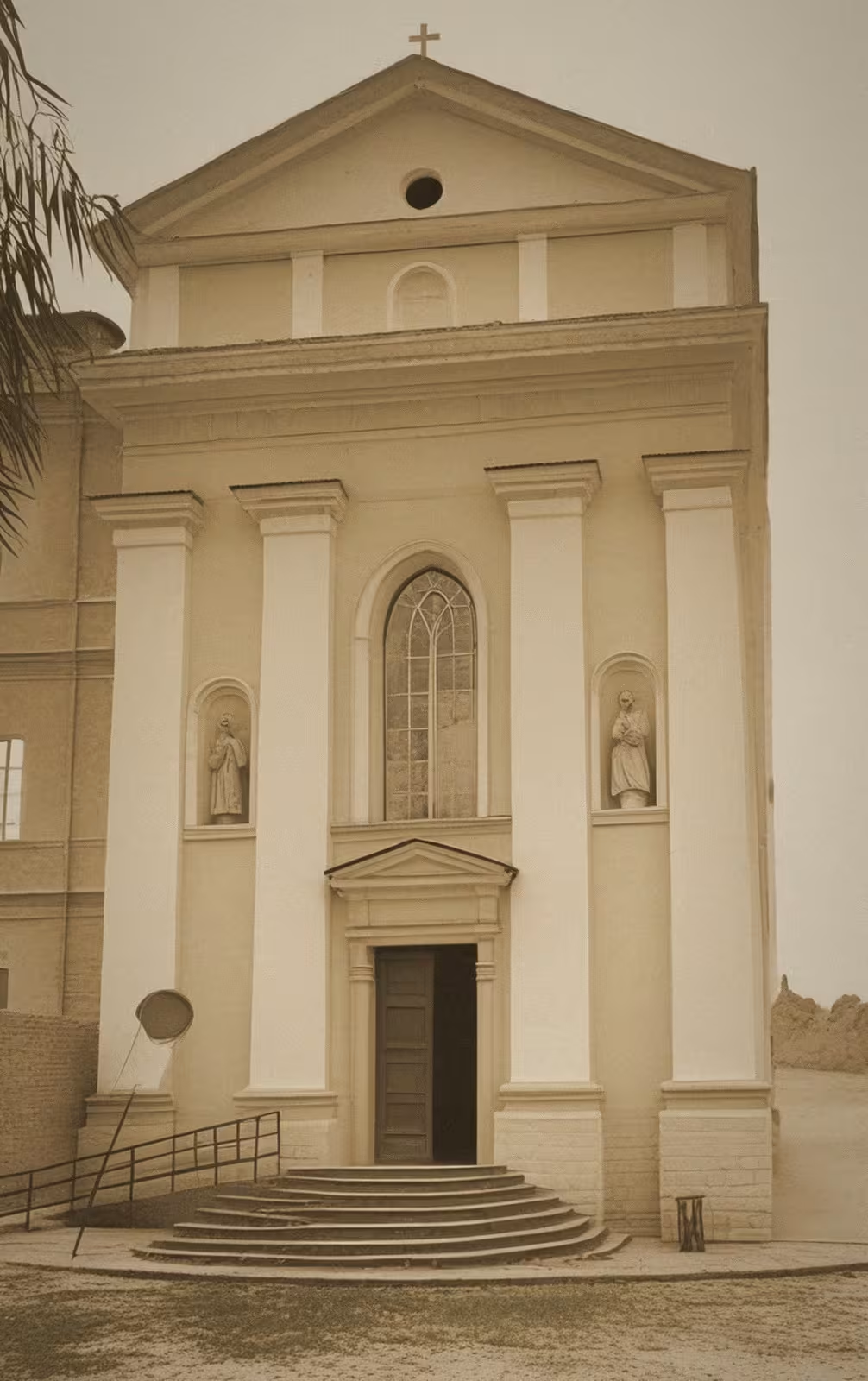
The historical appearance on the left is an AI-generated visualisation and serves as inspiration only.
Historical milestones
- 1652
- Establishing the Congregation of the Sisters of St. Karl Boromei in France
- 1837
- The arrival of the Merciful Sisters in Prague
- 1841
- Acquisition of land in the Small Party for the establishment of a monastery and hospital
- 1855
- The ordination of a newly built church
- 1962
- Abnegation and abrogation of church
- 1990
- Returning the Church to the Congregation of Sisters Boromejek
Architectural development
The church of St. Charles Boromejský is a one-boat hall building in a late-classical style, with a semi-circular apside arched condom and a sanctum tower. The interior has a main altar oriented towards the north and a two-story circle.
Historical events
- 1855
- The church was ordained.
- 1952
- The nurses had to leave the hospital and the house.
- 1990
- The congregation of the Boromek sisters was returned to the church.
- 1993
- The temple has been reconsecrated.
Points of interest
- The church is a single-storey hall building in a late classical style designed by Adalbert Gudera. - The upper floor of the circle is directly accessible from the hospital so that the sick can be present in the isolation service. - At the entrance to the hospital stands the stone Baroque sculpture of Pietta by Jan Brokoff, originally from the Charles Bridge. - After the consecration in 1962, the temple served as a depository of literature for nearly 90,000 volumes of books. - In 2021, the sisters were able to recover Kandler's altar painting from Košice.
Guide
This guide is narrated by a synthetic voice generated by artificial intelligence.
Show guide text
This text was created by artificial intelligence and has not been editorially reviewed. It may contain inaccuracies.
Welcome to the heart of Little Party. You're standing right in front of a place that carries extraordinary peace and deep sense of service to others. While you may be surrounded by a stream of tourists and urban tourism, this space creates a sense of dignity and quiet endurance. Before your eyes is the church of St. Charles Boromei, a building which is not just a stone building, but above all a symbol of humanity and care for the most vulnerable of us. Feel this atmosphere, feel the weight of history that is so tangible in these alleys here.
To understand why this temple is standing right here, we need to go back deep into the past. The story you're living here didn't start at the Little Party, but far west, in France. Already in the year one thousand six hundred fifty-two was founded the congregation of the merciful sisters of St. Charles Boromei. This order community has become synonymous with great kindness and care for the sick. These sisters came to Prague much later, in the year one thousand eight hundred thirty-seven, and immediately began their service in our city. The need to have a place for prayer and patient care was clear, and so in the year one thousand eight hundred forty-one the sisters won the land right here, on the Lesser Side, where they could start their monastery and hospital.
The church itself, which you are now observing, was built in the years between a thousand and eight hundred fifty-one and a thousand eight hundred pades six. It was a time when the world and architecture changed, and this temple became a fixed anchor for the entire hospital district. After his consecration in the year one thousand eight hundred fifty-five, he became a spiritual center for the sisters and all those who sought comfort in the disease.
Now pay attention to the architecture of the building itself. If you look at its overall form, you will see that it is designed in a late classical style. This style is characterized by its purity, order and balance. The church designed by architect Adalbert Gudera is a single-storey building. This means that there is a large, open space within which both the visitor and the believer have a sense of unity and simplicity. When you look at the facade and the overall structure of the building, notice the kind of harmony that Gudera put into the work. There is no unnecessary decorating, everything seems dignified and meaningful, just as a place for prayer and reflection should be.
But when you're looking around, you realize this church never stood alone. It is a solid part of a larger whole that forms a monastery and hospital of merciful sisters. And in this connection lies the deepest human history of this place.
I want to invite you now to take a deeper look at how the architecture of this place was directly linked to its mission. You may not see it at first sight, but it is one of the most impressive properties of this temple. On the top floor of the circle is created access directly from the hospital premises. Imagine those times when a disease like isolation was a common thing. In order for sick people who could not leave their beds or could only move in limited space, to be present to the service, this special approach was designed. This circle allowed people in great need to share the spiritual life of the church in isolation, but still in the community. It's an architecture that literally serves human suffering and finds a way to be close to it.
This spiritual and human dimension also undermines the neighbourhood with the works of art you will find here. If you move towards the entrance to the hospital, you will encounter a stone baroque sculpture of Pieta. This work was created by a great sculptor Jan Brokoff. This statue, depicting the mother of Mary with the body of her son Jesus, serves as a silent guardian of the entrance to places where people encounter pain and hope. It is a reminder of the patience and compassion that are crucial to this whole site.
But the history of this place was not always about peace and service. The church also went through very difficult times. In a thousand and nine hundred and sixty-two, the church was desecrated and its function as a religious place was abolished. It was a time when the role of religious institutions in society was fundamentally changing. Yet the spirit of this place has not disappeared. After long years of waiting in the year one thousand and nine hundred and ninety something fundamental happened - the church was returned to the congregation of sisters of pine trees. This moment meant a renewal of tradition and a return to the original meaning to which this building has been determined since the middle of the nineteenth century.
Now, when you look at these walls and the whole structure of the church, try to create a picture of all the generations of people here looking for comfort. You can see here not only the work of architect Gudera, but above all the work of thousands of nurses who cared for the sick, and thousands of hearts of people who sought strength here.
I hope that this view of St. Charles Boromei's church has helped you see this place not only as a historical object but as a living witness to the human faith in good and compassion. Continue your walk on the Lesser Side now, pay attention to the other details of these beautiful streets and don't let yourself get carried away just by the speed of the city, but stop where it will reach you. Thank you for spending this moment with us. We will brighten you with a pleasant further discovery of Prague.
Tips for visitors
The most suitable time for visiting is late afternoon hours, when softer light breaks into the interior of the classical temple, highlighting the architectural details and atmosphere of the monastery complex. The morning visit is calmer, but the afternoon light offers better conditions for the perception of space.
Transport availability is ensured both by car and public transport. Due to the historical center of Malá Strana we recommend to use public transport or to park in the nearest underground parking garage and walk the rest of the way. Check the current connection and available parking options in the search engine before travelling.
Take the appropriate clothes to the church corresponding to the spiritual character of the place, i.e. covered shoulders and knees. We also recommend comfortable shoes because in the vicinity of the monastery and the Hospital of the Merciful Sisters of St. Karl Boromei you can move on the uneven surface of historical paving.
It is ideal for photography to capture the facade of the church on a sunny day, when the contrast between white stone tiles and surrounding greenery excels. Inside, focus on the classical elements of the interior and light falling windows that create dramatic shadows. Always check in advance whether visitors are allowed to enter on the day in question and whether there are restrictions on photography.
Since there are no specific places in the area in the background, we recommend to walk around the Mala Strana after visiting the church and discover its historic streets and squares which are in the immediate vicinity. It is important for families with children to expect that in the church it is necessary to keep quiet and calm, therefore it is advisable to inform the children in advance and shorten the visit so that they are not tired.
Frequently asked questions
Is Kostel svatého Karla Boromejského (Praha 1) open to the public?
Yes, the church is open to visitors. However, it is important to know about the current closing times and possible changes due to liturgical actions.
How do I get to the place by car / public transport?
Parking is limited upon arrival by car, so we recommend using public transport. The nearest metro stations are Malostranska (line A) or Peace Square (lines B, C).
How much is the entrance fee and is it paid on the spot?
The church entrance is free. If you want to support the monastery, there may be a contribution to maintaining the premises.
Is the tour suitable for children and seniors?
Yes, the church offers a quiet environment suitable for all ages. The surrounding flower bed can be interesting for children.
How long does the tour take?
The church tour can be spent from 30 minutes to an hour, depending on how thoroughly you want to look at its architecture and interior.
What are the opening times and booking is required?
The opening hours of the church are usually from 8: 00 to 17: 00. Reservation is not necessary, but it may be useful to check the current opening hours on the web or by phone.
What's interesting in the immediate vicinity?
In the vicinity of the church there are several interesting places such as Malostranska Garden, Klementinum or National Gallery. All are available on foot within 30 minutes walk.
For kids
Imagine going back 150 years to Prague and discovering a small but beautiful hiding place with the beautiful church of St. Charles Boromei. He stands there as a protector, surrounded by old houses and decorated with flowers. It's a place full of secrets and adventure!
Businesses nearby
Events nearby

Zdroj akcí: otevřená data měst a obcí ČR (Národní katalog otevřených dat) a kalendář akcí Národního památkového ústavu.
Nearby
ITEX Show interactive overview of the surroundings - restaurants, accommodation, rentals and other places within a 15 km radius.
Data: OpenStreetMap contributors, 15 km radius.
‡ Historical monuments
- Jaroslav Vrchlický (0.2 km)
- Kolovrat Palace in Waldstein [v okolí] (1.0 km - Waldstein 150 / 4)
- Clam-Gallas Palace in Praze [v okolí] (1.6 km - Husova 156 / 21)
- House U Kohouta [v okolí] (1.7 km)
- Hlavkova railway [v okolí] (1.9 km - Gorazdova 1994 / 9)
- Trolleybus Transport Memorial on Hanspaulce (2.9 km)
- Brick gate [v okolí] (2.9 km - In strength 46 / 1)
- Gorlice [v okolí] (3.0 km)
Restaurant and catering
- Pizzeria U Penguin
- Restaurant River's smokelab (1.9 km - Lidická 2)
- McDonald 's (2.1 km - Vodičkova 736 / 15)
- LegendA (2.8 km)
- Yi Xiang Ge (6.7 km)
- McDonald's (6.8 km)
- Švejk restaurant U Brážek (7.0 km - U Libertariv 18)
- Pizzeria Cerreto (7.0 km)
Accommodation
- The Mozart Prague (1.3 km - Carolina Light 208 / 34)
- Old Town Jewel Apartments (1.7 km - Elišky Krasnohorské 10 / 2)
- Old Prague Hotel (1.7 km - shell 421 / 5)
- Hotel AXA (2.8 km - Na Poříčí 40)
- EA Hotel Tosca (3.4 km - Blanická 718 / 10)
- Theatrino (4.0 km - Bořivova 1216 / 53)
- Hotel Olšanka (4.4 km)
- Plaza Prague Hotel (4.5 km)
› Rental and sports
- Floral expert (1.2 km)
- U Tyrše (1.4 km - Jaselská 464 / 38)
- Bike Gallery (2.5 km - Kladenská 19)
- Kieser Training (2.5 km)
- Free Time Centre Botič (2.6 km)
- Cycloservice Richard Eger (2.7 km)
- JUN (2.7 km - Haškova 629 / 7)
- Velox Sport (2.9 km)
© Tourism and nature
- Petrinka (0.4 km)
- Masaryk prospect (0.5 km)
- Prague Chateau (0.5 km)
- Information and booking centre (1.6 km - Maiselova 38 / 15)
- Vyšehrad (2.9 km)
- Gabrielka (4.1 km)
- Šestáková studanika (5.7 km)
- Šárka (5.8 km)
Accommodation nearby
Trips and activities nearby
Guided tours, tickets and activities nearby from GetYourGuide
Affiliate link: if you buy from the partner, we may receive a commission. The price for you does not change.
Search tours and activities →Themed route
1. Church of St. Charles Boromei (Temple) - Admire the rich decoration and religious elements inside this building. 2. Chateau near the church (Area) - Take a walk around the building and observe its appearance from the outside. 3. Internal exposition (Exposure) - Focus on detailed artistic processing of the altar and architectural elements directly in the temple.
Seasonal recommendations
Spring: In the spring period, the Church of St. Charles Boromejský in Mala Strana appeared in a new light when the sun rays illuminated its Baroque architecture. Flowers and trees around the church are beginning to bloom, which gives the surroundings an attractive green shine. At this time the atmosphere may be milder with weather variable between sunny and rainy days, so it is advisable to equip yourself with clothes for all possibilities. Best to visit the church in the morning or in the evening when there are fewer visitors and the atmosphere is quieter.
Summer: Summer brings a lively atmosphere to the Little Party with long sunny days, which means ideal conditions for walking around the church. The sun illuminates its facades in full beauty and local green areas become popular places to relax. Summer is the most visited season, so it is advisable to come earlier on the day in order to save yourself from long queues and avoid peak times. Don't forget to wear your sunglasses and drink enough.
Autumn: In autumn, the Church of St. Charles Boromea becomes melancholic beauty when the leaves in the trees colour in months like October and November. Sun rays light up through a cool atmosphere and illuminate church architecture, creating views of calm. This time is usually less demanding on the crowd than summer months, so you can relax here and see the church in a mild winter atmosphere. We recommend wearing warmer clothes for colder nights.
Winter: Winter brings peace and quiet to the Little Party when the church appears in the lighting of the glacial light. Snow can cover the streets around the temple and give the area a romantic view. This season the opening hours of the visitors are often shorter, so make sure you check the actual hours before the visit. Winter requires warm clothes and suitable shoes on a cool surface. You would visit the church in the morning or in the middle of the week when there are fewer people, allowing you to enjoy a quiet walk along the historic street.
Visualizations and artistic views


The visualisations are generated by artificial intelligence and serve as inspiration.
Photos from the area
Real photos taken near the monument


Zdroj a licence jsou uvedeny u každého snímku.
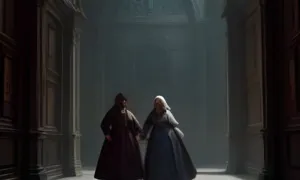
Atmosphere of the place
This atmospheric visualisation of the place and period was generated by artificial intelligence. It is not real footage of the location.
Tips from visitors
No tips yet. Be the first!
Log in and add your tip.
Sources and literature
Fotografie: VitVit / CC BY-SA 4.0, rozlišení zvýšeno umělou inteligencí — Wikimedia Commons. The author and licence also appear when you hover over the image.
Faktickým podkladem tohoto textu byl článek na Wikipedii, jehož autory jsou přispěvatelé Wikipedie. Článek je dostupný pod licencí CC BY-SA 4.0.
Location on the map

Příběhy a pověsti
Legendy, pověsti a příběhy spjaté s touto památkou
Fotografie návštěvníků
Zatím žádné fotografie. Buďte první, kdo přidá fotografii z návštěvy!
Přihlaste se a přidejte svou fotografii nebo hodnoťte.
Za ověřenou návštěvu v aplikaci získáte víc bodů — poznáme podle GPS, že jste na místě.
Reviews and comments