



Kostel svatého Klimenta (Mirovice) Church
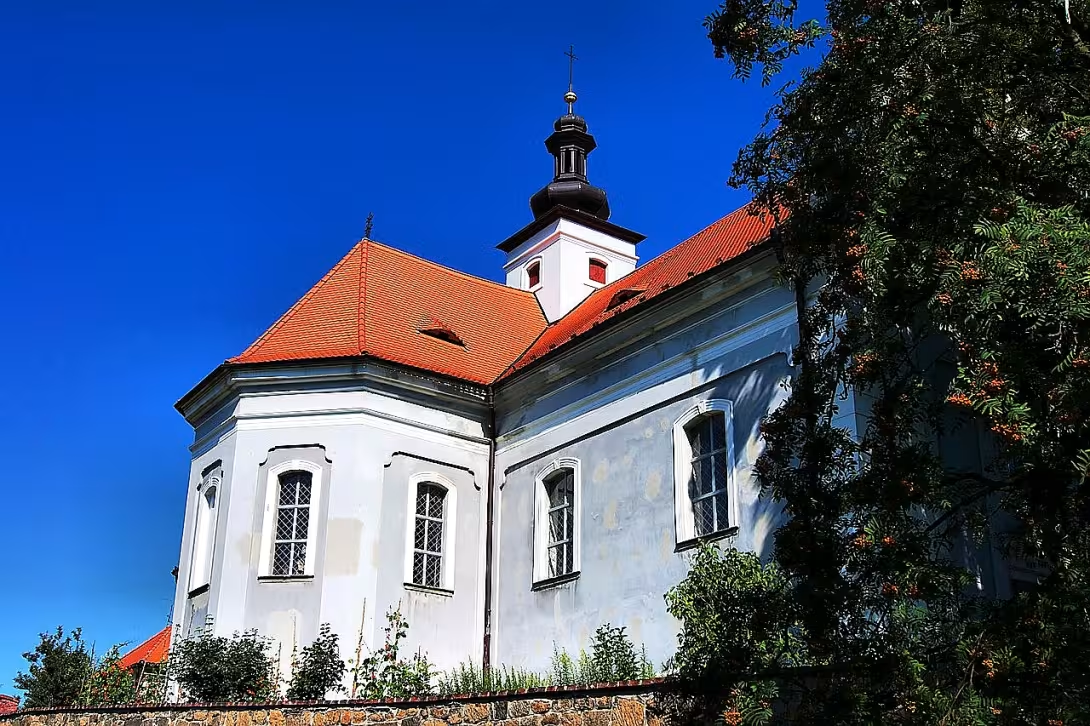
The church of St. Kliment in Mirovice, district Písek, is a protected cultural monument dedicated to St. Kliment, Pope and martyr called Klement Rimský. He's one of the Czech-Budějovice diocese.
The construction was created in the middle of the 13th century as a work of the animal-sand building hut. The original construction preserved part of the masonry and early Gothic portal from 1240-1250 on the north side. It is assumed that the church was fortified at the time of its creation and served as a guarding chateau on a trade path leading above the Brod of the Skalice (also called Mlčava or Vlčava). The local name "Na Hradec" suggests this theory. The first mention of the church dates back to 1342, the first known priest was the priest Ondřej in 1359.
The most important reconstruction took place in 1720-1726. Its realtor, Krumlov builder Franz Jakob Fortin, reoriented the church, transferred the altar from the east to the west side and extended it with a new presbytery with two lateral chaplains. The construction has acquired a new appearance by scarring. The last general repair took place in 1932.
The exterior of the church is decorated with a plastic sign Schwarzenberg above the main entrance, a statue of St. Florian in a niche and an iron cross with a cock. Above the crossing of the ship, the four-sided eyelid is switched off, covered by an eight-sided needle with a lantern and a flask.
The interior of the church hides rich art equipment. The wooden statue of the Madonna from the first quarter of the 15th century is particularly valuable in a slightly naked attitude that is held in the left hand of the naked Jesus. It was restored in 1948. The most valuable object is the Gothic monstrans-- during World War II, the vicar Jan Skřivan saved it by hiding it on a nearby farmhouse in Podskalí and is today located in the depository of the bishop. The church also contains tombstones of red marble from the 16th and 17th centuries (from 1571, 1589, 1601), tin baptizer from 1632 or 1633 and illusory painting behind the main altar from 1736. The author of the last painting is not clear - one is attributed to the dryness and mirovic painter Jan Chlumecký, according to others was painted by Jan Kaspar Schmidtgunster.
In recent decades, the church has undergone successive renovations. The facade was restored in 1992, later the windows and roof were replaced. The interior has been modified following the decision of the Second Vatican Council.
Then and now
Drag the slider to compare how the landmark may have looked when it was built with the view today.
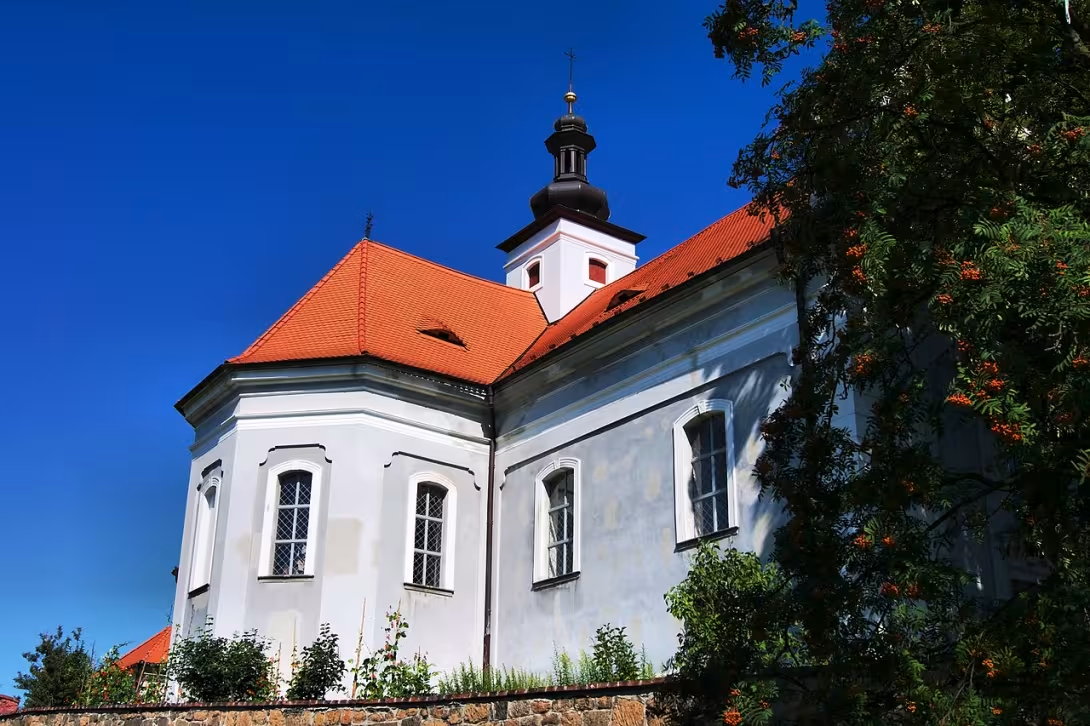

The historical appearance on the left is an AI-generated visualisation and serves as inspiration only.
Historical milestones
- 1240-1250
- The creation of an early Gothic portal and parts of the original wall.
- 1342
- First written mention of the church.
- 1720-1726
- Baroque reconstruction and relocation of the altar to the west side.
- 1932
- Last general repair of the interior.
Architectural development
The church is listed in the ecclesiastical catalogue of the Czech-Budějovice diocese.
Historical events
- 1342
- First written mention of the church in Mirovice.
- 1359
- The first known vicar, Andrew, is mentioned.
- 1720-1726
- Baroque church reconstruction at Schwarzenberk expense.
- 1932
- Last general repair of the interior.
Points of interest
- The church of St. Kliment was originally probably a fortified building serving as a guarding chateau on a business road above the Brod of the River Skalice.
- The preserved early Gothic portal on the north side dates back to 1240-1250.
- The most significant reconstruction of the church took place in 1720-1726, when the church was svarokied and moved from the east to the west side.
- In the interior there is a valuable wooden statue of Madonna from the first quarter of the 15th century with Jesus in his arms.
During World War II, the Gothic Monstrance was hidden by the vicar on a nearby farm, and today it is located in the depository of the bishop.
Guide
This guide is narrated by a synthetic voice generated by artificial intelligence.
Show guide text
This text was created by artificial intelligence and has not been editorially reviewed. It may contain inaccuracies.
The Church of Saint Clement in Mirovic is dedicated to the pope and martyr Clement the First, also called Clement of Rome. It belongs to the České Budějovice diocese and is a protected cultural monument.
The church was built in the mid-thirteenth century by the Zvíkov-Písek building workshop. From that period only part of the masonry and an early Gothic portal on the north side dating from 1240 to 1250 have survived. It is assumed that the church was originally fortified and guarded the trade route above the ford of the Skalice stream, which is also called Mlčava or Vlčava. This is where the name Na Hradci comes from, which has been preserved to this day. Whether the dedication was connected with the transfer of the castle administration from nearby Bozna to Zvíkov, experts and archaeologists have been unable to determine. The first written mention dates from 1342. The first known priest was Andrew in 1359.
A fundamental transformation came with the reconstruction between 1720 and 1726. The Krumlov builder Franz Jakob Fortin Baroquized and reoriented the church. He moved the altar from the east side to the west and added a new presbytery with two side chapels. Above the crossing of the nave stands a square turret with an octagonal spire, which transitions into a lantern with a dome. Above the main entrance is a sculptured Schwarzenberg coat of arms, in a niche is a statue of Saint Florian, and at the top is an iron cross with a rooster. In 1992 the facade was restored, and later the church received a new roof, covering, and windows.
Inside, among the most precious works is a wooden Madonna from the first quarter of the fifteenth century. It stands in a slightly inclined posture and holds a naked Christ Child on its left arm. The statue of Saint Wenceslaus from 1696 originally stood in a niche of a house in the square, where it was placed by the local wax maker Padovec after its purchase. On the walls and in the floor of the main nave are tombstones of red marble from 1571, 1589, and 1601. The largest of them covered the entrance to the crypt.
Behind the main altar is an illusionistic painting from 1736. The register keeper Jan Toman attributed it to the painter Jan Chlumecký, but Alexander Debnar considers Jan Kaspar Schmidgunster to be the author. In 1781 the painter Špelta repainted the work. The church also has a tin baptismal font from 1633 with an extensive inscription.
The most precious monument is a Gothic monstrance, now kept in the bishop's repository. During the last war it was hidden on a farm in nearby Podskalí by the priest Jan Skřivan.
Tips for visitors
The best time to visit the church of St. Kliment is in the morning or in the morning when there is a quiet and pleasant light for photography. During the summer months it is advisable to avoid the noon hours when the interior can be hot and crowds of visitors. The Baroque frescoes and Gothic elements in the interior emit better in the light of the morning rays of the sun which penetrates the windows from the south side of the ship.
The church is easily accessible by car because it is located in the center of Mirovic. If you arrive by public transport, the stop is near the church, but the current connection must be checked in the traffic search engine. It is recommended to come on foot as the church stands in the picturesque historical core of the village.
When visiting take on comfortable clothes and shoes as the church and its surroundings offer several staircases and uneven terrain. It is often cold in the interior, so bring a light sweater or coat. For photography, prepare a macro lens that allows you to capture details of Gothic stone elements and baroque painting details.
The best places for photography are the entrance portal with Gothic vaults, Baroque altar and frescoes on the ceiling of the ship. For quality images it is ideal to use natural light from window holes, especially in the morning. In the exterior we recommend to capture the church tower and surrounding green area, which creates a harmonious contrast with historical architecture.
In the vicinity of Mirovic you can see Bošná Chateau, just about three kilometres from the church, which offers a picturesque Baroque mansion with historical gardens. Another interesting thing is the chateau of Zběkov, which is located about ten kilometres from Mirovic and represents an important medieval fortress with rich archaeological findings. Both of these monuments are ideal for trips within 30 minutes' availability from St. Kliment's Church.
For families with children, a visit to St. Kliment's church is interesting thanks to its historical storytelling and possibilities for interactive learning. Children can see Gothic stone statues and Baroque decoration, which is often fascinating. It is possible to play on a small playground around the church or to see the surrounding nature. It is interesting for older children to visit the castle Zděkov, where there is an archaeological museum with interactive exhibitions.
Frequently asked questions
Can the monument be visited?
Religious buildings are usually open mainly during services; at other times a visit is normally arranged with the parish or the operator. We have not verified specific times.
Where is the monument?
Location: Pod Kostelem, Mirovice, Jihočeský kraj. The map on this page shows the exact spot.
Why is the monument protected?
It is listed in the Central List of Cultural Monuments of the Czech Republic as a cultural monument (register no. 15985/3-2633).
For kids
Imagine going back to when the church of St. Kliment in Mirovice was still a new and lively place. How did it look here? Who lived here?
It was like a game where you were a hero and you had your own story. There lived people who tried to live a good life according to Christ's learned. They were farmers who took care of fields and cattle, merchants who brought news from cities, and craftsmen who made beautiful things for everyday life.
Businesses nearby
Do you run a restaurant, accommodation, shop, museum, rental, wellness or other visitor service near this monument? Show yourself directly to the people heading to it — this is how they will see you in the app and on the web:
Events nearby
Zdroj akcí: otevřená data měst a obcí ČR (Národní katalog otevřených dat) a kalendář akcí Národního památkového ústavu.
Accommodation nearby
Themed route
Thematic cruise route: Baroque spirit Mirovic and Bodkov
1.Kostel svatého Klimenta (Mirovice) * Baroque sacral pearl * - Originally a Roman church from the 13th century was rebuilt into a Baroque temple with richly decorated interior in the 18th century. He excels in particular his historically valuable paintings and sculptures which reveal the artistic soul of the South Bohemian Baroque.
2. Bošná Chateau (3 km from Mirovic) * Baroque residence with mystery * - This chateau, originally Renaissance, was rebuilt in the 17th century into a Baroque residence with large gardens. Its architecture and natural surroundings offer a peaceful walk between old trees and historical fountains.
3. Castle Vědkov (10 km from Mirovic) * Medieval fortress with legends * - The dominance of the landscape is this massive chateau fortress with rich history since the 13th century. Outputs to the chateau towers reward panoramic views and the possibility to explore archaeological findings from the past centuries.
4. Nature Reservation Animal hills (5 km from Mirovic) * Natural treasure between rocks * - Narrow valley with lush vegetation and rock formations is ideal for a short tourist tour. Especially in the spring months there are rare plants that attract the attention of scientists and peace lovers.
* Recommended order: * Start in Mirovice near the church, continue to Bošné for relaxation in the park, culminate with a visit to the Chateau of Bůzkov and finish with a walk in the animal hills. The route combines sacral history, Baroque architecture and natural beauty.
Seasonal recommendations
Spring
In the church of St. Kliment in Mirovice, in the spring days there is a magical atmosphere where green leaves around the church become a living background for rare frescos and icons. Especially after rainy weather, the interior shines with bright colours when light penetrates through silver stained glass and alternately illuminates the altar image of St. Kliment. The outer space is surrounded by flowering trees and flowering bushes, which provide a soft, natural scent to the place. In this period it is also ideal to observe how the church becomes part of the spring festivities, when there are often small cultural events with musical performances or reading old books.
Practically, I recommend visiting a monument in the early morning time when there are fewer people and nature is still calm. Suitable clothes should be light but sufficiently resistant to moisture, because spring rains are frequent. It is also important to take warm clothes on any cooler evenings when the interior can be damp. Don't forget the comfortable shoes, because the church area is sometimes impassable because of plants. Since spring visits tend to be less massive than in the summer months, the likelihood of crowds is minimal, but there may be other tourist attractions near the city that might attract other people.
Visualizations and artistic views


The visualisations are generated by artificial intelligence and serve as inspiration.
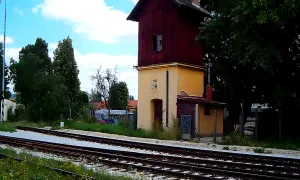
Photos from the area
Real photos taken near the monument

Zdroj a licence jsou uvedeny u každého snímku.
Atmosphere of the place
This atmospheric visualisation of the place and period was generated by artificial intelligence. It is not real footage of the location.
Tips from visitors
No tips yet. Be the first!
Log in and add your tip.
Sources and literature
Photos: ZdendaK / CC BY-SA 3.0 — Wikimedia Commons. The author and licence also appear when you hover over the image.
Faktickým podkladem tohoto textu byl článek na Wikipedii, jehož autory jsou přispěvatelé Wikipedie. Článek je dostupný pod licencí CC BY-SA 4.0.
Location on the map




Příběhy a pověsti
Legendy, pověsti a příběhy spjaté s touto památkou
Fotografie návštěvníků
Zatím žádné fotografie. Buďte první, kdo přidá fotografii z návštěvy!
Log in a přidejte svou fotografii nebo hodnoťte.
Za ověřenou návštěvu v aplikaci získáte víc bodů — poznáme podle GPS, že jste na místě.
Reviews and comments