



Kostel Zmrtvýchvstání Páně Church
This page was machine-translated from Czech. The translation has not been language-checked and may contain errors.
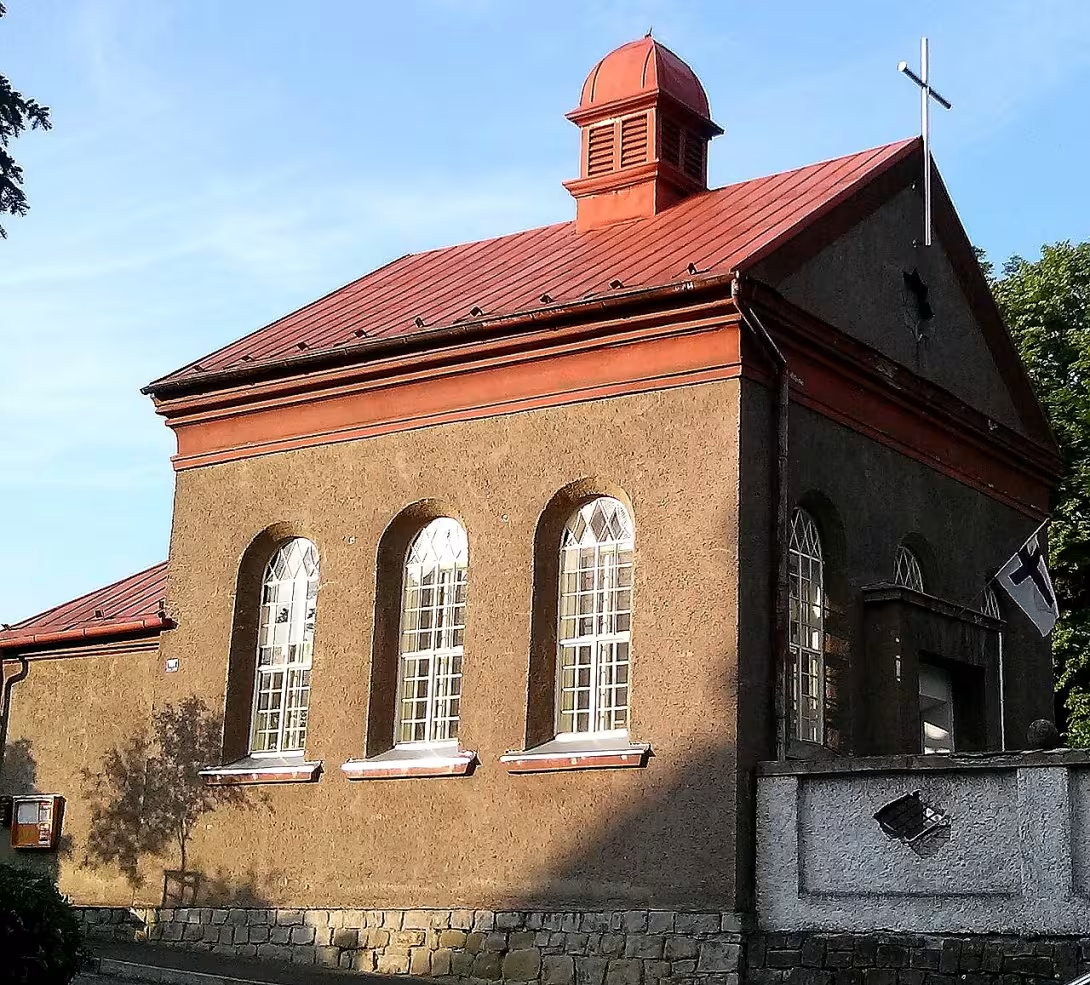
The Evangelical Church of the Resurrection (Kostel Zmrtvýchvstání Páně) stands in Hřbitovní Street in Český Těšín, at the entrance to the central cemetery. It belongs to the congregation of the Lutheran Evangelical Church of the Augsburg Confession. It has only been a church since 2010–2011. Before that, the building served as the funeral hall of the Jewish section of the cemetery. That is also the church's only connection with the Jewish community.
A cemetery for a new town
When Těšín (Cieszyn) was divided in 1920, all Jewish places of worship and the Jewish cemetery remained on the Polish side of the Olza river, and the dead had to be taken across the border. The new town of Český Těšín therefore needed a cemetery of its own. The municipal cemetery in Hřbitovní Street opened in October 1925. It had three separate sections: for Protestants, for Catholics and for the Jewish community. The Jewish section lay to the north of the entrance, behind the funeral hall.
The cemetery buildings, namely the chapel, the Jewish funeral hall, the administration building and the fencing, were completed by 1928. They were built by the Těšín firm of Eugen Fulda. The group of cemetery buildings has been a cultural monument since 2003, and today's church with it.
The Jewish section of the cemetery
The gravestones in the Jewish section stood in ten rows. During the Second World War the Nazis badly damaged it. The last burial took place there in 1986.
From funeral hall to church
The congregation of the Lutheran Evangelical Church A.C. bought the former funeral hall from the town and converted it into a church in 2010–2011. The first service was held on 31 October 2010 and the church was consecrated on 1 May 2011. Inside hangs a large crucifix whose corpus was made by Artur Szoldra from Ustroń.
The building
The church is a free-standing masonry building. Its central part, on a square plan, has a gabled roof with a small sanctus turret and is covered by a single cloister vault. Lower extensions for the sacristy, the chancel and the porch adjoin it. The porch on the east side has a hipped roof and its entrance is framed by an aedicule. A second entrance with a gable is on the west side. The chancel on the north side has a gabled roof and a barrel vault.
Then and now
Drag the slider to compare how the landmark may have looked when it was built with the view today.
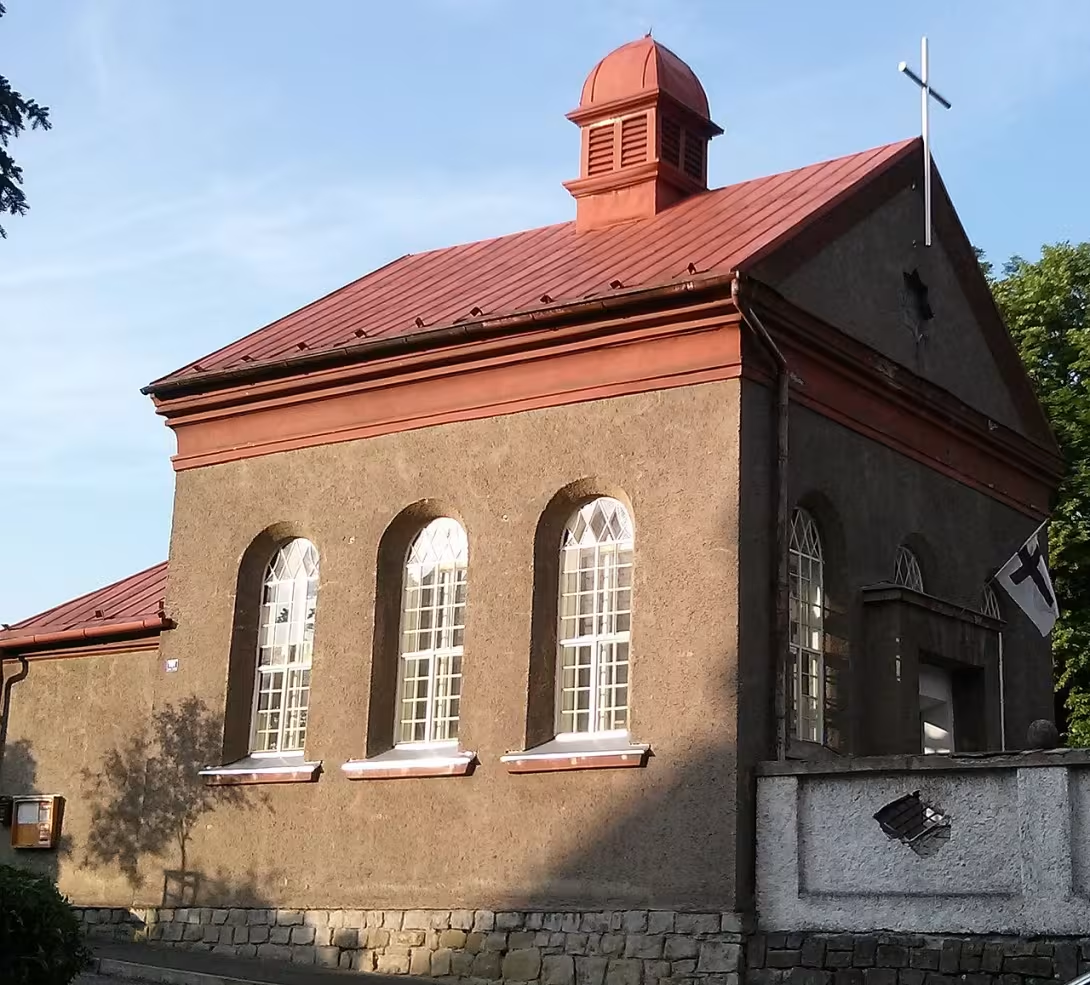

The historical appearance on the left is an AI-generated visualisation and serves as inspiration only.
Historical milestones
- October 1925
- The municipal cemetery opens with a separate Jewish section.
- by 1928
- The firm of Eugen Fulda completes the cemetery buildings, including the Jewish funeral hall.
- Second World War
- The Nazis badly damage the Jewish section of the cemetery.
- 1986
- Last burial in the Jewish section.
- 2003
- The group of cemetery buildings is declared a cultural monument.
- 2010–2011
- The Lutheran Evangelical Church A.C. converts the funeral hall into a church.
- 31 Oct 2010
- First service.
- 1 May 2011
- Consecration of the church.
Architectural development
The funeral hall was built in the 1920s as part of the group of cemetery buildings, which were completed by 1928 by the firm of Eugen Fulda. It is a centrally planned building with a gabled roof and a small turret in the middle, with lower extensions for the sacristy, chancel and porch. In 2010–2011 the building was converted into a Protestant church.
Historical events
In October 1925 the municipal cemetery of Český Těšín opened with a separate section for the Jewish community. By 1928 the cemetery buildings, including the Jewish funeral hall, were completed. During the Second World War the Nazis badly damaged the Jewish section; the last burial there took place in 1986. In 2003 the group of cemetery buildings was declared a cultural monument. In 2010–2011 the congregation of the Lutheran Evangelical Church A.C. converted the former funeral hall into a church. The first service was held on 31 October 2010 and the consecration on 1 May 2011.
Owners
The building was erected as the funeral hall of the Jewish section of the municipal cemetery of Český Těšín. Later the congregation of the Lutheran Evangelical Church A.C. bought it from the town, converted it into a church in 2010–2011 and still uses it today.
Points of interest
- The church was created from a building erected for the Jewish community as a funeral hall at the cemetery entrance.
- The Jewish community needed a new cemetery because after the division of Těšín in 1920 its cemetery remained on the Polish side of the Olza and the dead had to be taken across the border.
- The corpus of the large crucifix inside was made by Artur Szoldra from Ustroń.
- The church is not listed on its own. The whole group of cemetery buildings is protected: the chapel, the former funeral hall, the administration building and part of the fencing at the entrance.
- Before it had a church of its own, the congregation of the Lutheran Evangelical Church A.C. also used the Na Nivách Protestant church in 1995–2011.
- Among those buried in the cemetery are Ladislav Báča, founder of the Český Těšín museum, mayor Josef Koždoň, Polish poet Henryk Jasiczek and painter Ida Münzbergová.
Guide
This guide is narrated by a synthetic voice generated by artificial intelligence.
Show guide text
This text was created by artificial intelligence and has not been editorially reviewed. It may contain inaccuracies.
Welcome to the Evangelical Church of the Resurrection in Český Těšín. You are standing at the entrance to the central cemetery in Hřbitovní Street. This building has only been a church since 2010 and 2011. It was built as a funeral hall for the Jewish section of the cemetery.
Why was a new cemetery needed here at all? Until 1920 Těšín was one town. Then the border divided it along the Olza river and the old centre went to Poland. All the Jewish places of worship and the cemetery also remained on the Polish side, and the dead had to be taken across the border. The new town of Český Těšín therefore set up its own municipal cemetery. It opened in October 1925 and had three separate sections: for Protestants, for Catholics and for the Jewish community. The Jewish section lay to the north, behind the building in front of you.
The cemetery buildings, the chapel, the Jewish funeral hall, the administration building and the fencing, were completed by 1928 by the Těšín firm of Eugen Fulda. Notice the design of the funeral hall: a centrally planned building on a square plan with a gabled roof and a small turret, with lower extensions for the sacristy, chancel and porch.
During the Second World War the Nazis badly damaged the Jewish section of the cemetery. Burials continued after the war, and the last one took place here in 1986.
In the end the congregation of the Lutheran Evangelical Church of the Augsburg Confession bought the building from the town and converted it into a church. The first service was held on 31 October 2010, and on 1 May 2011 the church was consecrated. Inside is a large crucifix whose corpus was made by Artur Szoldra from Ustroń.
Since 2003 the whole group of cemetery buildings has been a cultural monument, and this church with it. As you leave, take a look at the cemetery chapel at the entrance, which now serves as a funeral hall. Thank you for your visit, and please be considerate in the cemetery.
Tips for visitors
The church stands in Hřbitovní Street at the entrance to the central cemetery. It is used for services of the Lutheran Evangelical Church A.C. congregation. You can view the church and the other cemetery buildings from outside whenever the cemetery is open. Remember that you are in a cemetery and be considerate towards mourners and the dignity of the place.
Frequently asked questions
Can the monument be visited?
Religious buildings are usually open mainly during services; at other times a visit is normally arranged with the parish or the operator. We have not verified specific times.
Where is the monument?
Location: Hřbitovní, Český Těšín, Moravskoslezský kraj. The map on this page shows the exact spot.
Why is the monument protected?
It is listed in the Central List of Cultural Monuments of the Czech Republic as a cultural monument (register no. 100096). It is protected as part of a larger listed ensemble.
For kids
Did you know that this church was not always a church? When it was built about a hundred years ago, it was a funeral hall. That is a building where people say goodbye to someone who has died before they are buried in the cemetery. It belonged to the Jewish community, which had its own section of this cemetery.
Why did the town build a new cemetery? In 1920 a border along the Olza river split the town of Těšín into two parts, a Czech one and a Polish one. The old Jewish cemetery stayed on the Polish side, so Český Těšín needed its own. It opened in 1925.
Businesses nearby
Do you run a restaurant, accommodation, shop, museum, rental, wellness or other visitor service near this monument? Show yourself directly to the people heading to it — this is how they will see you in the app and on the web:
Accommodation nearby
Themed route
Interwar Český Těšín: start at the Church of the Resurrection, the former Jewish funeral hall. The cemetery chapel also stands at the cemetery entrance, a historicist building on a central plan with Baroque and Empire elements. Today it serves as a funeral hall and its restoration was completed in 2022. A passage with open arcades links it to the administration building. All these buildings were completed by 1928. Then head into the town centre. About 1.5 km away as the crow flies, in Masarykovy sady, stands the neo-Gothic Church of the Sacred Heart of 1891–1894, built before Těšín was divided. Finish at the Na Nivách Protestant church of 1931–1932. It was built by a Polish-speaking Protestant congregation, and in 1995–2011 it was also used by the congregation that owns the Church of the Resurrection today.
Seasonal recommendations
You can view the church and the whole group of cemetery buildings from outside in any season. The easiest way to see the interior is during the services of the Lutheran Evangelical Church A.C., whose times the congregation publishes. Around All Saints' Day and All Souls' Day the cemetery is busier than usual, so please be especially considerate.
Visualizations and artistic views


The visualisations are generated by artificial intelligence and serve as inspiration.
Photos from the area
Real photos taken near the monument


Zdroj a licence jsou uvedeny u každého snímku.
Tips from visitors
No tips yet. Be the first!
Log in and add your tip.
Sources and literature
- Wikipedie: Kostel Zmrtvýchvstání Páně (Český Těšín)
- Wikipedie: Hřbitov v Českém Těšíně
- TIC Český Těšín: Soubor staveb hřbitova
- TIC Český Těšín: Židovské památky
- Wikidata (Q8410118)
- Památkový katalog NPÚ
Photos: Qasinka / CC0 — Wikimedia Commons. The author and licence also appear when you hover over the image.
Faktickým podkladem tohoto textu byl článek na Wikipedii, jehož autory jsou přispěvatelé Wikipedie. Článek je dostupný pod licencí CC BY-SA 4.0.
Location on the map


Fotografie návštěvníků
Zatím žádné fotografie. Buďte první, kdo přidá fotografii z návštěvy!
Log in a přidejte svou fotografii nebo hodnoťte.
Za ověřenou návštěvu v aplikaci získáte víc bodů — poznáme podle GPS, že jste na místě.
Reviews and comments