

Krytá mostní chodba mezi zámkem a kostelem ve Fryštátě Bridge
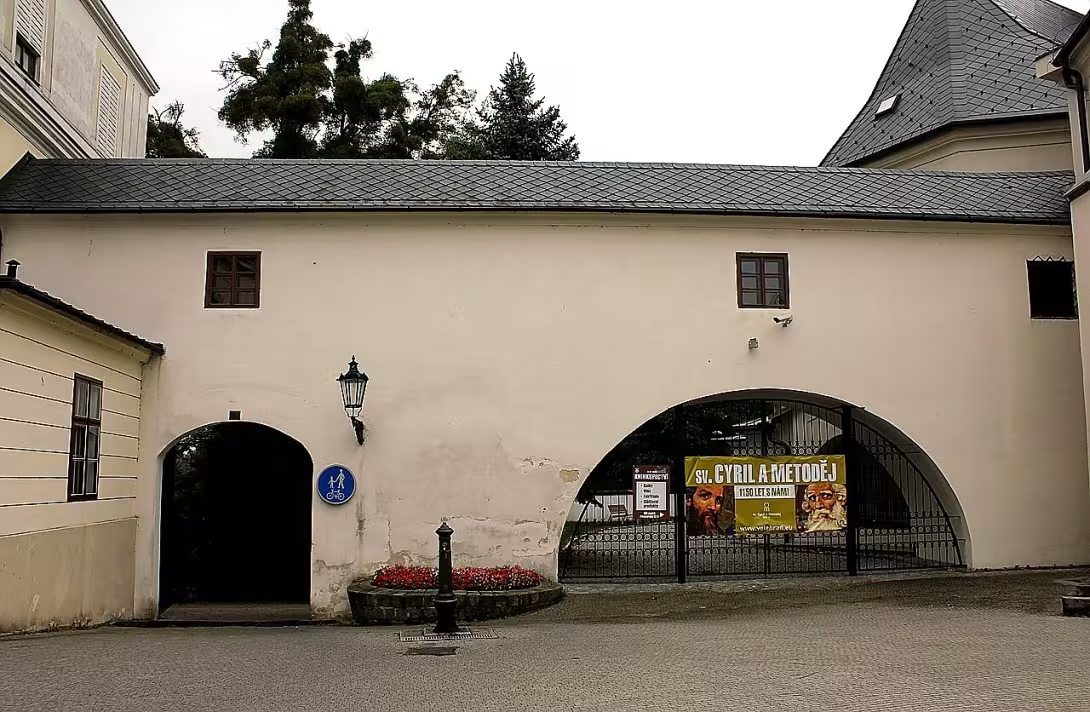
The covered bridge corridor in Fryštát is an architectural element connecting the castle building with the adjacent church of the Holy Cross. This connection was created during the reconstruction of the castle into the Empire form. It serves for direct access between residence and church space. The building is located in the valley of the Olše river in the Moravian-Silesian region on the edge of Karviné.
The hall is part of a wider complex, which consists of the only residence of the Silesian Principality in the Czech Republic. Originally, it was a separate building of the medieval castle, which was built in 1288 by the Silesian prince Měšek I of the genus Piastovce. In the first half of the 15th century, Princess Eufemie Mazovská began the reconstruction into a residential residence which Piastovci had used until 1572. The Church of the Holy Cross was built in the immediate vicinity of the castle.
It was only during the reign of Larisch-Mönnich who settled here in 1792 that the buildings covered by the passage were connected. The funds for the extensive reconstruction brought them the discovery of black coal on their manor in 1776. Within this reconstruction, the castle was converted into an empirical form and unified with a Gothic church into one building unit. Similarly, the Lottyhaus building was connected via the corridor on the first floor with the main lock.
The property has changed over the centuries. After the Piastes' manor in 1572, the earth's captain Václav Cikán ze Slupska bought it. Subsequently, various nobles, including the Irish House of Taafi, took turns leaving cultural clues. Since 1792 Larisch-Mönnichové was based here, which defined the objects in their present form. After 1945 the castle with the park was confiscated and it belonged to the Czechoslovak State. For example, the buildings served as the headquarters of Ostrava-Karvinsky mines or the Karviné Municipal National Committee.
In addition to the connection with the church, the complex is supplemented by a castle park with a pond, a horseradish and a dairy. These buildings were built in 1850 by Count Henry Larisch-Mönnich. At the time of the aristocracy, many European monarchs visited the castle, including the Austrian archduke František Ferdinand d'Este, the German emperor Vilhelm II or the Bulgarian Tsar Ferdinand.
Today, the entire complex is protected as a cultural monument. After significant reconstruction, the castle was opened to the public in 1997. In 2003, Lottyhaus followed, where the branch of the National Gallery in Prague is now based. Visitors can take advantage of tours during the season from March to October and take part in cultural events in castle areas, church or park during the year.
The covered bridge corridor presents a unique architectural detail documenting the transformation of the medieval castle into a representative empire mansion. It is a significant testimony about the connection of secular power and church administration within one site. We recommend to visit this place and explore the entire historical complex in Fryštát.
Then and now
Drag the slider to compare how the landmark may have looked when it was built with the view today.
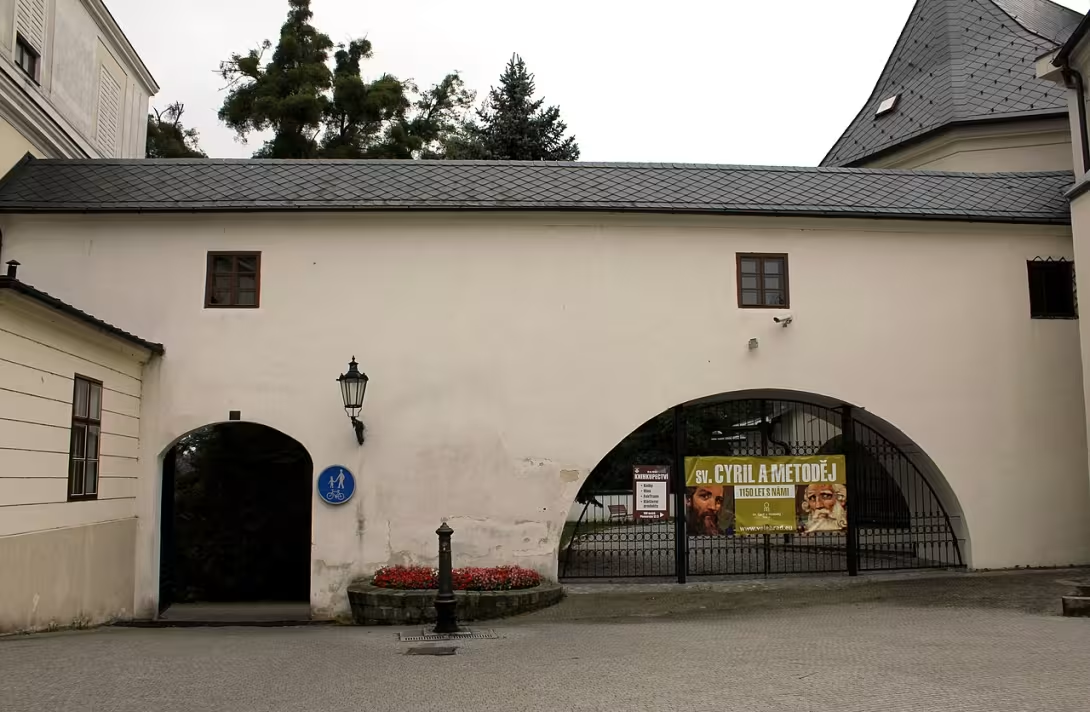
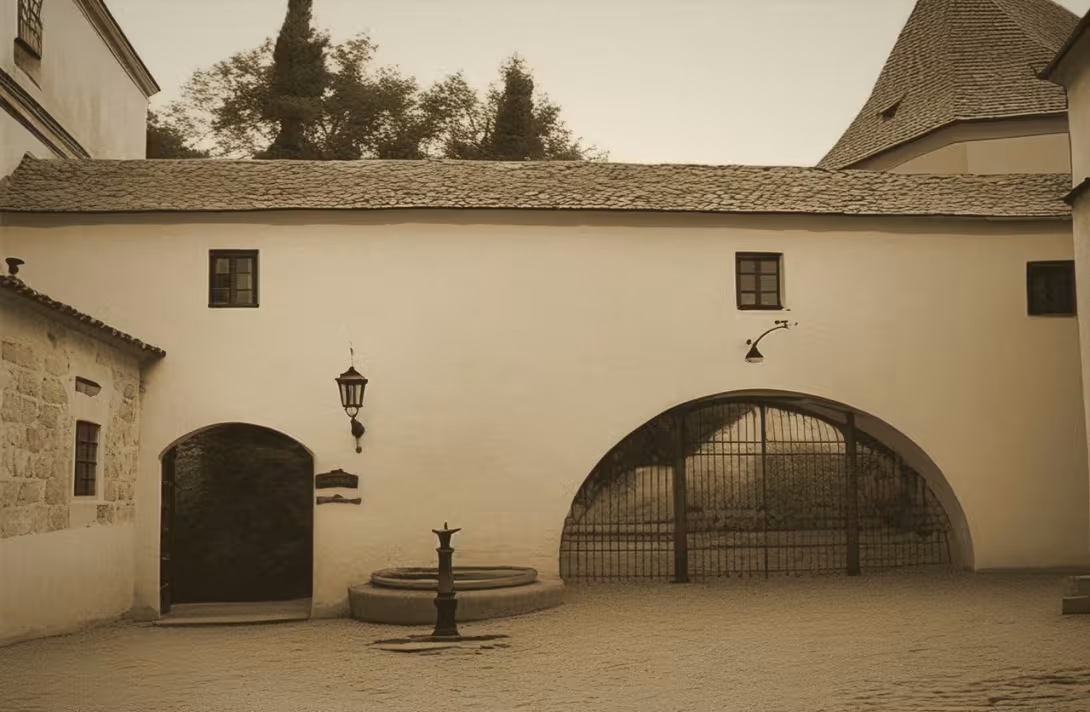
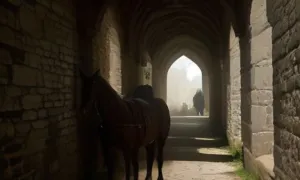
The historical appearance on the left is an AI-generated visualisation and serves as inspiration only.
Historical milestones
- 1288
- Construction of the medieval castle by Silesian prince Měšek I.
- 1572
- The end of the Piast period and the purchase of the manor by Václav Gypsy from Slupsk.
- 1792
- The establishment of the genus Larisch-Mönnich and the subsequent reconstruction into the Empire form.
- 1850
- Building a horticulture, dairy and castle park.
- 1945
- Confiscation of the castle and takeover of the buildings by the Czechoslovak State.
- 1997
- Accessing the castle to the public after significant reconstruction.
Architectural development
Originally, these were separate buildings within the medieval castle. At the time of Larisch-Mönnich the castle was rebuilt into an empirical form and at this stage it was connected with the Gothic church in one whole.
Owners
Piastovci (until 1572), Václav Cikán ze Slupska (from 1572), Taafu family, Larisch-Mönniche family (from 1792)
Points of interest
- The hall connects the building of the castle with the Church of the Holy Cross and was created during reconstruction of the castle into an empire form. - The interconnection of buildings covered by the passage took place during the reign of Larisch-Mönnich. - The money for the extensive reconstruction brought the discovery of coal to the manor in 1776. - The Lottyhaus building is connected to the main lock using the corridor on the first floor. - The corridor is a testament to the connection of secular power and church administration within a single area.
Guide
This guide is narrated by a synthetic voice generated by artificial intelligence.
Show guide text
This text was created by artificial intelligence and has not been editorially reviewed. It may contain inaccuracies.
Welcome to Fryštát. Right now, you're facing one of the most interesting connections in the city. Look before you at this covered bridge corridor, which as an elegant bond connects two important buildings, the castle and the church of the Holy Cross. It is a view that immediately transmits you to a time when noble generations ruled here and life took place in the rhythm between the administration of the estate and church duties. This corridor is not just an ordinary passage, but a symbol of the unification of two worlds into one whole. Stop for a moment and think about how this place has changed over the centuries. History began here much before this corridor was built. Already in the year one thousand two hundred eighty-eight, the Silesian prince Měsek built the first medieval castle. So imagine that under your feet and around you once spread out the fortresses that were supposed to protect the strategic place in the region. After centuries, namely in the year one thousand seven hundred seventy-two, the period of the Piastas ended and the estate was purchased by Václav Cikán ze Slupska. But this was only a prelude to the great change that came with the end of the eighteenth century. Now pay attention to the architecture of this connection itself. The covered corridor was created at a time when the castle was transformed into what we call the Empire style. It was during this period, after the Larisch-Mönnich family settled here in the year one thousand seven hundred and ninety-two, that a fundamental change of the entire area took place. The goal was to unite the castle and church into one building unit. Notice how this corridor naturally links the residence of princes to the church space. This allowed members of the nobility family direct access to the temple without having to leave the safety and privacy of their premises or step outside in every weather. When you look at this structure, see it as part of a larger complex that served as the only seat of the Silesian princes. The whole area was gradually expanded and improved. A little later, around the year a thousand and eight hundred and fifty, the horticulture, dairy and large castle park, which still forms a beautiful background for the whole set of buildings. Although today the corridor seems to be of course, at the time of its creation it was the peak of comfort and the status of owners. Now let's think about what it was actually possible to finance this extensive reconstruction and reconstruction. You may be surprised that the key to the wealth of this place was not only the original nobility, but nature itself. In the year one thousand seven hundred seven four seventy six black coal was discovered on the estate. It was this discovery that brought huge funds that the Larisch-Mönnich family could invest in the conversion of the castle and the construction of this link between home and church. It's fascinating to realize that the underground deposits of coal directly affected the shape of the buildings you see above the ground today. This corridor served as a silent witness to history. She witnessed celebrations, but also difficult moments. It passed through the era of the greatest glory, but also the times of the demise of the old order. In the year one thousand nine hundred forty-five the castle was confiscated and the entire building was taken over by the Czechoslovak state. A decade followed when the monument had to deal with a new era. But luck was that thanks to significant reconstruction, the castle and its surroundings could be reopened to the public in the year one thousand nine hundred ninety-seven, allowing you to stand here today and admire this architectural element. Try to imagine the people who went through this corridor. Princes in expensive clothes, accompanied by servants, bound for morning mass or ceremonies. The corridor was more than just a journey from point to point, a journey between worldly power and spiritual silence. It all connects together this very space that you see before you. We now ask you to look at the overall composition of the buildings. Feel the atmosphere of the place where the history of the medieval castle meets the elegance of the later period and the industrial take-off of the region. This bridge corridor is a small but very important piece of the puzzle that makes up the identity of Fryštát. Thank you for spending a moment with us at this historic monument. We hope this short trip over time helped you better understand the importance of this place. We now invite you to further explore the surroundings of the castle and the park, where further traces of the past await you. We wish you a pleasant ongoing tour and enjoy the beauty of this historic area. Goodbye.
Tips for visitors
The best time to visit is during spring or autumn, when the colors of the castle park perfectly complement the look of the bridge corridor and church. The location is easily accessible by car and public transport; Check the current connection in the search engine.
Take a walk with comfortable shoes so that you can walk the entire area around the castle and church in peace. We also recommend to have a camera with you to capture details of building connections.
For the best photos we recommend morning or late afternoon light to highlight the architecture of the corridor.
In the immediate vicinity, you can visit the castle park with a pond and a horticulture, the Lottyhaus building or the Fryštát castle itself and the Church of the Holy Cross.
Families with children will appreciate walking in the surrounding park and watching fish in the pond, which is a pleasant addition to the tour of the bridge corridor from the outside.
Frequently asked questions
Can the monument be visited?
This is a structure in a public space that can usually be seen from outside free of charge. We have not verified that this particular one is freely accessible.
Where is the monument?
Location: Fryštát. The map on this page shows the exact spot.
Why is the monument protected?
It is listed in the Central List of Cultural Monuments of the Czech Republic as a cultural monument (register no. 1000138241_0002). It is protected as part of a larger listed ensemble.
Businesses nearby
Do you run a restaurant, accommodation, shop, museum, rental, wellness or other visitor service near this monument? Show yourself directly to the people heading to it — this is how they will see you in the app and on the web:
Nearby
🏰 Historic sites (165)
- sv. Jan Nepomucký 0.1 km
- Madona 0.1 km
- Socha TGM 0.1 km
- Obětem 1. a 2. světové války 1.2 km
- Zdar Buh! Sześć Boże! 2.3 km
- Poslední vozík z dolu Darkov 4.0 km
- Poslední vozík z dolu ČSA 4.0 km
- Socha svatého Jana Nepomuckého 4.0 km
- Poslední vozík z dolu ČSM 4.0 km
- Poslední vozík z dolu 9. květen 4.0 km
- Panna Marie 4.2 km
- Kościół pw. Podwyższenia Krzyża Świętego w Kaczycach 4.3 km Ludowa 7
- Pomník horníkům 4.5 km
- KWK Morcinek – Zostali na wiecznej szychcie 4.7 km
- Pomnik św. Jana Nepomucena 4.8 km
- Ofiarom wojny 1914-1918 5.4 km
- Pomnik Ofiar II Wojny Światowej 5.9 km
- Zginęli za wolność i lud 6.0 km
- Ofiarom I Wojny Światowej 6.0 km
- Kościół pw. Wniebowzięcia Najświętszej Maryi Panny 6.0 km
🍽️ Restaurants and dining (458)
- Elektra 0.1 km Masarykovo nám. 5/4
- U Koplíků 0.1 km
- cafe BB bar 0.1 km
- Restaurace Baron 0.1 km
- Venezia 0.1 km
- Rest&rt 0.1 km
- Bok of Ka 0.1 km Svatováclavská 33/2
- Antalya Kebab 0.2 km
- Vanilla 0.2 km web
- Restaurace Zlaté časy 0.3 km
- DLOUHÉ VIDLE, s.r.o. 0.3 km
- Dinos Restaurant 0.5 km +420 774 002 162 web
- Panda 0.9 km
- Delikana 0.9 km web
- Adamo Restaurace 1.0 km
- Majaček 1.1 km
- Le Café 1.1 km
- Občerstvení u kruháče 1.2 km
- Kino Centrum Café 1.3 km tř. Těreškovové 2234/24
- Společenský dům Lázní Darkov 1.3 km
🏨 Accommodation (59)
- Apartmany BB 0.1 km
- Koleje Slezká univerzita 1.9 km Na Vyhlídce 1079/1
- Lázně Darkov, a.s. 2.2 km Čsl. armády 2954/3 +420596372210 web
- Country Motorest 7.1 km
- Nasz Folwark 7.8 km
- Hotel Sport 8.2 km web
- Vulture 8.5 km U Pošty 371/4 web
- Hotel Impuls 8.8 km U Hřiště 1324/13b web
- Penzion Urban 9.6 km +420603783554 web
- Penzion Pod Zámkem 9.7 km +420 725 178 819
- U Jelena 10.1 km +420 608 751 517 web
- Penzion Amerika 10.3 km +420 736 627 315 web
- Penzion U Popelků 10.3 km +420 724 200 838 web
- Resort Těrlicko 10.4 km +420 724 387 666 web
- Restaurace a penzion U Lesa 10.5 km +420 732 595 205 web
- Hotel "Dąbrówka" 10.6 km
- Willa "Dąbrówka" 10.6 km
- Willa "Dąbrówka" II 10.7 km
- Noclegi Wiktoria 11.0 km Powstańców Śląskich 22 +48 534 544 416
- Hostel Dzika Kaczka 11.2 km +48 730 888 240 web
🚲 Rentals and sport (92)
- STaRS Karviná - víceúčelová hala 0.2 km
- Sportisimo 0.8 km
- Tipsport 0.8 km
- Hala házené 1.2 km
- Bazén Stars 1.4 km
- KKS Spójnia Zebrzydowice 5.9 km
- Petrovická kotlina 6.0 km Dolní Marklovice 253 +420 608712504 web
- Spójnia zebrzydowice 6.2 km
- Boisko Kończyce Małe 6.5 km
- Sportovní hala 6.8 km
- LKS OLZA Pogwizdów 7.3 km
- Sportovní centrum Na Císařství 7.4 km web
- Kola Go 7.5 km
- Sportovní hala Horní Suchá 7.5 km
- Letní koupaliště 7.8 km
- sportovní areál 8.0 km
- Klub Sportowy LKS Błyskawica 8.2 km
- Sportisimo 8.2 km web
- Squash centrum 8.7 km
- Cyklo ADS cykloservis 8.8 km
🥾 Hiking and nature (93)
- sady Bedřicha Smetany 0.4 km
- Sad Boženy Němcové 0.4 km
- Univerzitní park 0.5 km
- Vrchlického sady 1.0 km
- Lázeňský park 1.2 km
- Lázeňský park, Lázně Darkov 2.4 km
- Kostel Nanebevstoupení Páně 4.8 km
- zámecký park 5.4 km
- Park Rudolfa Kolaczka 5.9 km
- Drewniany kościół św. Anny 7.1 km
- Zespół pałacowy 7.5 km
- Něbrojův kopec 7.8 km
- Lazy 7.9 km
- Zámecký park 7.9 km
- Park Ludowy 8.2 km
- Pastuchovka 8.6 km
- Volontérská studánka 8.8 km
- Stacja Szotkowice 8.9 km
- Zádomí 9.7 km Těšínská 230+
- Rezerwat Kopce 9.8 km
Accommodation nearby
Themed route
Here is a proposal for a thematic walk:
1. Castle Fryštát - historical construction. It serves as a point of entry and a demonstration of noble architecture. 2. Covered bridge corridor - unique link. It's the main destination of a trip that connects the mansion to the house of God. 3. Church of the Holy Cross - religious building. Dominant of the place to which the corridor is headed. 4. Castle park with pond and horticulture - green area. Ideal place to relax in nature and explore old buildings for horses. 5. Lottyhaus - building in the premises. A smaller structure that complements the overall picture of the historical complex.
Seasonal recommendations
In spring, the surroundings of the corridor awaken into colours and the blooming green creates a fresh frame for historical construction. Soft spring light is ideal for observing details from the outside. We recommend shoes suitable for wet terrain and visit in the morning when the air is the cleanest.
In the summer months, it dominates the space of intense sun and hot air, which highlights the contrast between the shadow covered corridors and illuminated surroundings. It is advisable to choose the time early in the morning or late in the evening to avoid the most dangerous. Don't forget the light clothes and the hat on your head.
Autumn brings golden shades of leaves to Fryštát that match the colours of the historical object and create a nostalgic atmosphere. The light is lower and more golden in this period, which is pleasant for sight. It's practical to carry a lighter jacket or a raincoat.
Zimą is a monument in quiet and calm, with any layer of snow highlighting its shapes and purity of lines. The atmosphere is cramped and mysterious, especially at the Advent time. It is necessary to choose warm winter clothes, waterproof shoes and plan to arrive at a time when there is still enough daylight.
Visualizations and artistic views


The visualisations are generated by artificial intelligence and serve as inspiration.
Photos from the area
Real photos taken near the monument


Zdroj a licence jsou uvedeny u každého snímku.
Tips from visitors
No tips yet. Be the first!
Log in and add your tip.
Sources and literature
Faktickým podkladem tohoto textu byl článek na Wikipedii, jehož autory jsou přispěvatelé Wikipedie. Článek je dostupný pod licencí CC BY-SA 4.0.
Location on the map
Příběhy a pověsti
Legendy, pověsti a příběhy spjaté s touto památkou
Fotografie návštěvníků
Přidat fotografiiZatím žádné fotografie. Buďte první, kdo přidá fotografii z návštěvy!
Máte k místu vzpomínku nebo zajímavý příběh?
Log in a přidejte svou fotografii nebo hodnoťte.
Za ověřenou návštěvu v aplikaci získáte víc bodů — poznáme podle GPS, že jste na místě.
Reviews and comments