



kubistická lampa Technical monument
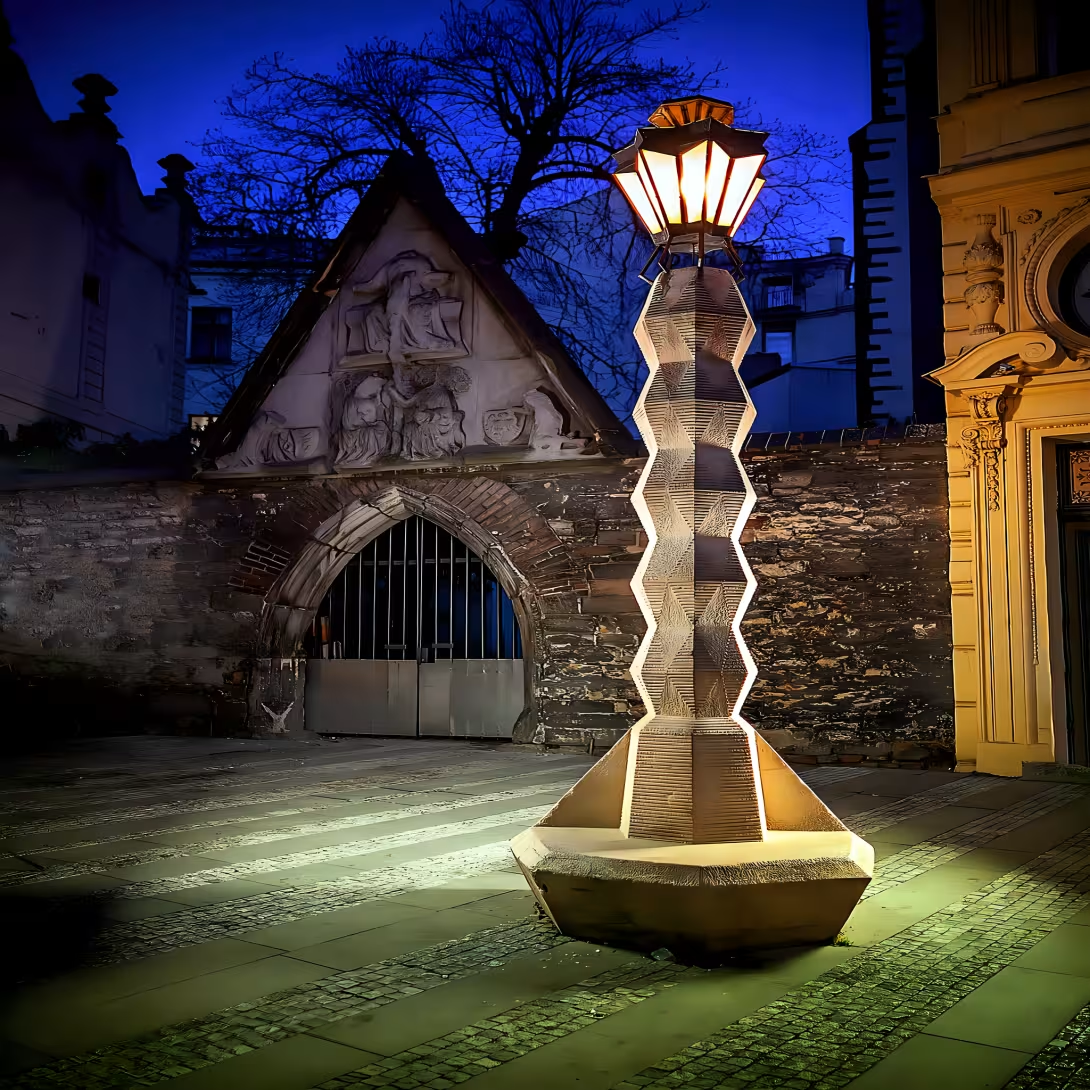
The cubist lamp in Prague is a unique work of art from 1913 and belongs to the icons of Czech architectural cubism. Located on Jungmann Square in New Town near the gate of the cemetery behind the church of Our Lady of Snow.
The object was designed by architect Emil Králíček. The lamp was created as part of Adam's pharmacy project, which was built between 1911 and 1913. The origin of the monument fits into the period of flowering of avant-garde directions in Bohemia. At that time cubism represented a unique Czech contribution to European architecture.
The mound is removed from artificial stone and is formed by a series of self-built chamallow needles. The surface is decorated with plastic décor from alternating serrated and smooth triangles. In accordance with the cubist expression, the lantern itself is shaped in this style of metal and glass.
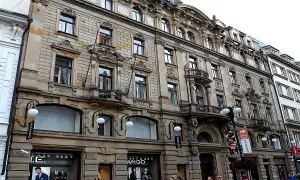
The spatial location of the object relative to the building to which it belongs is interesting. Although the lamp is part of the Adam's Pharmacy project, it stands at its rear facade on Jungmann Square. The main facade of the pharmacy is oriented to Wenceslas Square. In the immediate vicinity of the lamp lies the cemetery and church of Our Lady of Snow.
Today, this object serves as a significant example of applied cubism in urban space. It is available for all visitors to the centre of Prague and represents a valuable detail of the architecture of the beginning of the 20th century.
The combination of non-traditional materials and geometric shaping makes this lamp an important point on the map of Prague's cubism. It is appropriate to include it in the New Town architecture tour.
Then and now
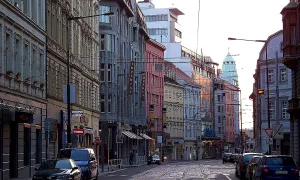
Drag the slider to compare how the landmark may have looked when it was built with the view today.
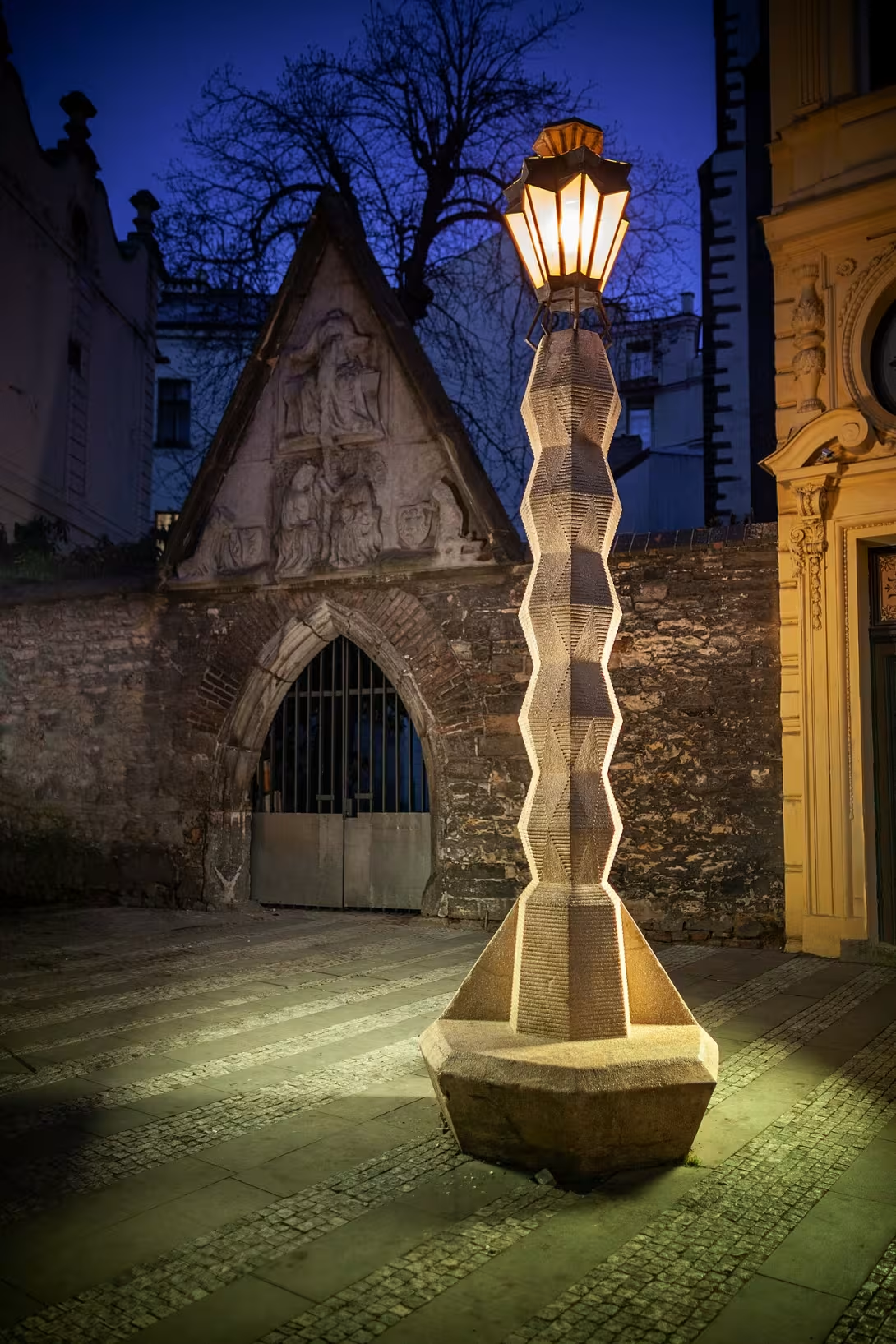
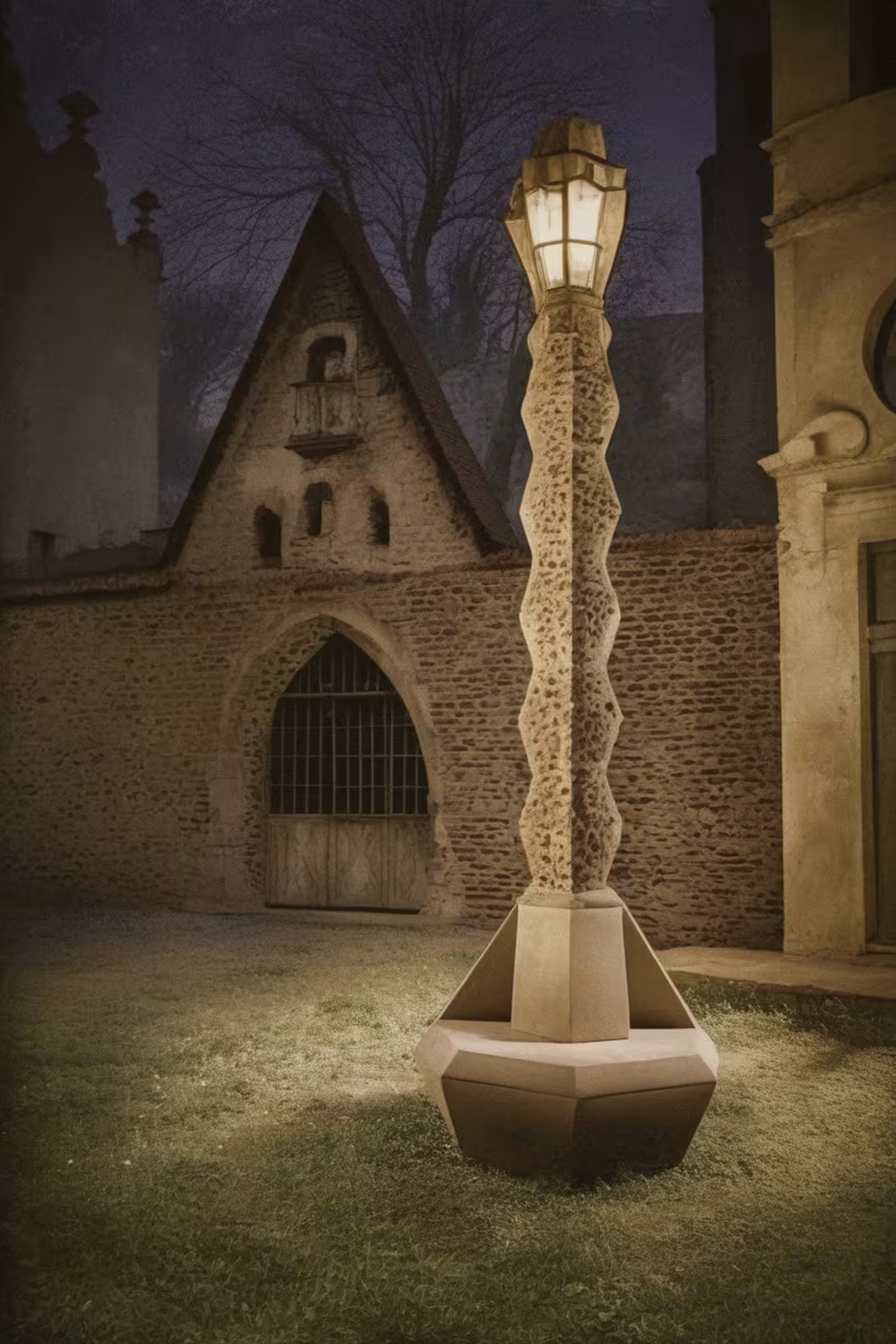
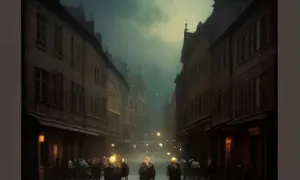
The historical appearance on the left is an AI-generated visualisation and serves as inspiration only.
Historical milestones
- 1911
- Start of Adam's Pharmacy Construction
- 1913
- Completion of the pharmacy and development of a cubist lamp
- 1920
- Period of use of the lamp in urban lighting
- 2024
- The building serves as a monument to applied cubism in Prague
Architectural development
The stem of the lamp is made of artificial stone and is formed by a series of chamallow needles. The surface is decorated with alternating ribbed and smooth triangles. The lantern itself is made of metal and glass in cubist shape.
Points of interest
- The 1913 lamp is a unique work and belongs to the icons of Czech architectural cubism. - It was designed by architect Emil Králíček as part of Adam's Pharmacy project. - The artificial stone mast consists of a series of chamallow needles with glued and smooth triangles. - The lantern is made of metal and glass in cubist style. - Although she's part of the pharmacy, she's standing by her rear facade at Jungmann Square.
Guide
Show guide text
This text was created by artificial intelligence and has not been editorially reviewed. It may contain inaccuracies.
Welcome to the heart of New Town, where your steps have now stopped before one of the most fascinating pieces of Prague's public space. You're standing in front of an object that at first sight may look like an ordinary element of urban lighting, but it's actually the real jewel of world art. Look carefully at this cubist lamp. It's a work that carries courage, experiment and desire to change the world's view. It's more than just a light source, it's an embodiment of geometry that explores the boundaries between architecture and sculpture.
Let us now go back more than a hundred years together until Prague became a laboratory of new directions. It's nine hundred and thirteen. It was this year that this work was completed. To understand why this lamp even exists, we need to look at a broader context. The lamp was not created as a separate element that was randomly placed on the corner of the street. It was designed as an integral part of Adam's pharmacy's overall project. The construction of this pharmacy began two years earlier, in the year tyre nine hundred eleven, and the entire space was to be a unified artistic total. At that time a unique direction was born in Prague, which tried to transfer the principles of cubism from painting plates to three-dimensional space, stone and metal.
Now pay attention to the appearance of the lamp itself, because it is in the details that its power hides. Look up and follow the line of the entire object. Note the blade made of artificial stone. It's a fascinating game of shapes. Instead of a smooth column, you see a series of chamallow needles. There are gorged surfaces and smooth triangles that clasp together and form a dynamic rhythm. It is a typical expression of cubist shape, where straight lines are broken and create a sense of movement even in stationary material.
If you carry your view even higher, you'll see the lantern itself. It's made of metal and glass. Notice how accurately it follows the geometry of the shank. The whole object acts as one continuous organism where each angle has its meaning and each edge of its function. It's a fascinating example of how even a practical object like a street lamp can be turned into an artistic expression.
The architect Emil Králíček is behind this unique work. He was the visionary who could translate theoretical ideas about space into a specific form. Rabbit wanted the details in the streets to reflect the spirit of their time. The lamp was thus not only used to illuminate the road for people who were heading to or around the pharmacy, but was also a silent witness to the city's changes. In the year nine hundred and twenty, the lamp was a full part of the city's lighting, a commonly used element, which, however, deviated from the tradition at the time.
The interesting thing is that today we are located in Jungmann Square, at the gate of the cemetery behind the church of Our Lady of Snow. Imagine what contrast that must have been when the lamp was new. Modern, bold, geometrical structure located near the historical church and silent cemetery. It is in this tension between old and new that lies the magic of this place. The lamp is now considered one of the icons of Czech architectural cubism. It is a unique work that survived for decades and today, in the year two thousand twenty-four, serves as an important monument to applied cubism in Prague.
Now imagine for a moment what this lamp looked like the night before the century. As the light passed through the glass of the lantern and cast shadows on the chamber needles of the shank. It's a fascinating idea that such a small object can tell such a big story about people who wanted to llamate the line and look for new ways in art. It is a reminder of when Prague was one of the most important centres of modern thinking in Europe.
When you look at a lamp, you realize that you're looking at something that is essentially unprecedented. It is proof of the courage of architect Emil Rabbit, who was not afraid to go upstream and create something that at that time could seem very untraditional. Today, it is tangible evidence for us of genius work with material and form.
Now, let's take some time to see all of these details for yourselves. Walk around the lamp around, change the angle of view, and watch the triangles change into sticks depending on your motion. Feel the atmosphere of this place where the history of the pharmacy meets, the silence of the cemetery and the courage of cubist art.
I hope this short trip to the world of geometry and history has brought you new views of Prague. This lamp is just one of many hidden treasures that our city offers to those who can notice the details. Now invited to further explore the New Town area. There may be other traces of cubism or other architectural attractions on other streets waiting to be discovered. Thank you for your attention, and I wish you a nice continued journey on the streets of Prague. Goodbye.
Tips for visitors
The best time to visit is on a bright day when natural light hits the square shapes of the luminaire, highlighting its unique geometry. Transportation to the centre of New Town is possible by car and public connections; Check the current options in the search engine.
We recommend taking a high-quality camera for the tour. The best angles for images are from the level of vision at the cemetery gate, where you can capture the contrast between the modern form of lamp and the historical background.
During a short walk in the surroundings you can visit the Church of Our Lady of Snow, the cemetery behind this church, Adam's Pharmacy or Wenceslas Square.
For families with children we recommend a game to find unusual shapes and sharp edges that are typical of this style, which helps children to better understand the principles of cubism.
Frequently asked questions
Can the monument be visited?
This is a technical monument. Some are open as exhibitions, others are out of use or on private land. We have not verified whether this one is accessible.
What are the opening hours and admission?
We have not verified the opening hours or admission. Current information is published by the operator.
Where is the monument?
Location: Nové Město. The map on this page shows the exact spot.
Why is the monument protected?
It is listed in the Central List of Cultural Monuments of the Czech Republic as a cultural monument (register no. 1000151852).
Businesses nearby
Do you run a restaurant, accommodation, shop, museum, rental, wellness or other visitor service near this monument? Show yourself directly to the people heading to it — this is how they will see you in the app and on the web:
Events nearby

Zdroj akcí: otevřená data měst a obcí ČR (Národní katalog otevřených dat) a kalendář akcí Národního památkového ústavu.
Nearby
Kostel Panny Marie Sněžné, hřbitov za kostelem Panny Marie Sněžné, Adamova lékárna, Václavské náměstí.
Accommodation nearby
Trips and activities nearby
Guided tours, tickets and activities nearby from GetYourGuide
Affiliate link: if you buy from the partner, we may receive a commission. The price for you does not change.
Search tours and activities →Themed route
Here is the design of the thematic route:
1. Wenceslas Square (square) - The starting point of the road where you can feel the atmosphere of the center of the village. 2. Adam's pharmacy (pharmacy) - A place with a history that complements the image of an old town. 3. Cubist lamp (other) (lamp) - The main destination of the trip, where you admire the unique shapes of this art object. 4. Church of the Virgin Mary Snow (church) - A significant building that dominates the surrounding areas. 5. The cemetery behind the church of Our Lady of Snow (cemetery) - A quiet place to think in the immediate vicinity of the temple.
Visualizations and artistic views


The visualisations are generated by artificial intelligence and serve as inspiration.
Photos from the area
Real photos taken near the monument

Zdroj a licence jsou uvedeny u každého snímku.
Tips from visitors
No tips yet. Be the first!
Log in and add your tip.
Sources and literature
Photos: Coweeczwech / CC BY-SA 4.0, rozlišení zvýšeno umělou inteligencí — Wikimedia Commons. The author and licence also appear when you hover over the image.
Faktickým podkladem tohoto textu byl článek na Wikipedii, jehož autory jsou přispěvatelé Wikipedie. Článek je dostupný pod licencí CC BY-SA 4.0.
Location on the map
More monuments – Nové Město
Show all in the municipality


Příběhy a pověsti
Legendy, pověsti a příběhy spjaté s touto památkou
Fotografie návštěvníků
Zatím žádné fotografie. Buďte první, kdo přidá fotografii z návštěvy!
Log in a přidejte svou fotografii nebo hodnoťte.
Za ověřenou návštěvu v aplikaci získáte víc bodů — poznáme podle GPS, že jste na místě.
Reviews and comments