






Kubistický dům v Neklanově ulici Tenement house
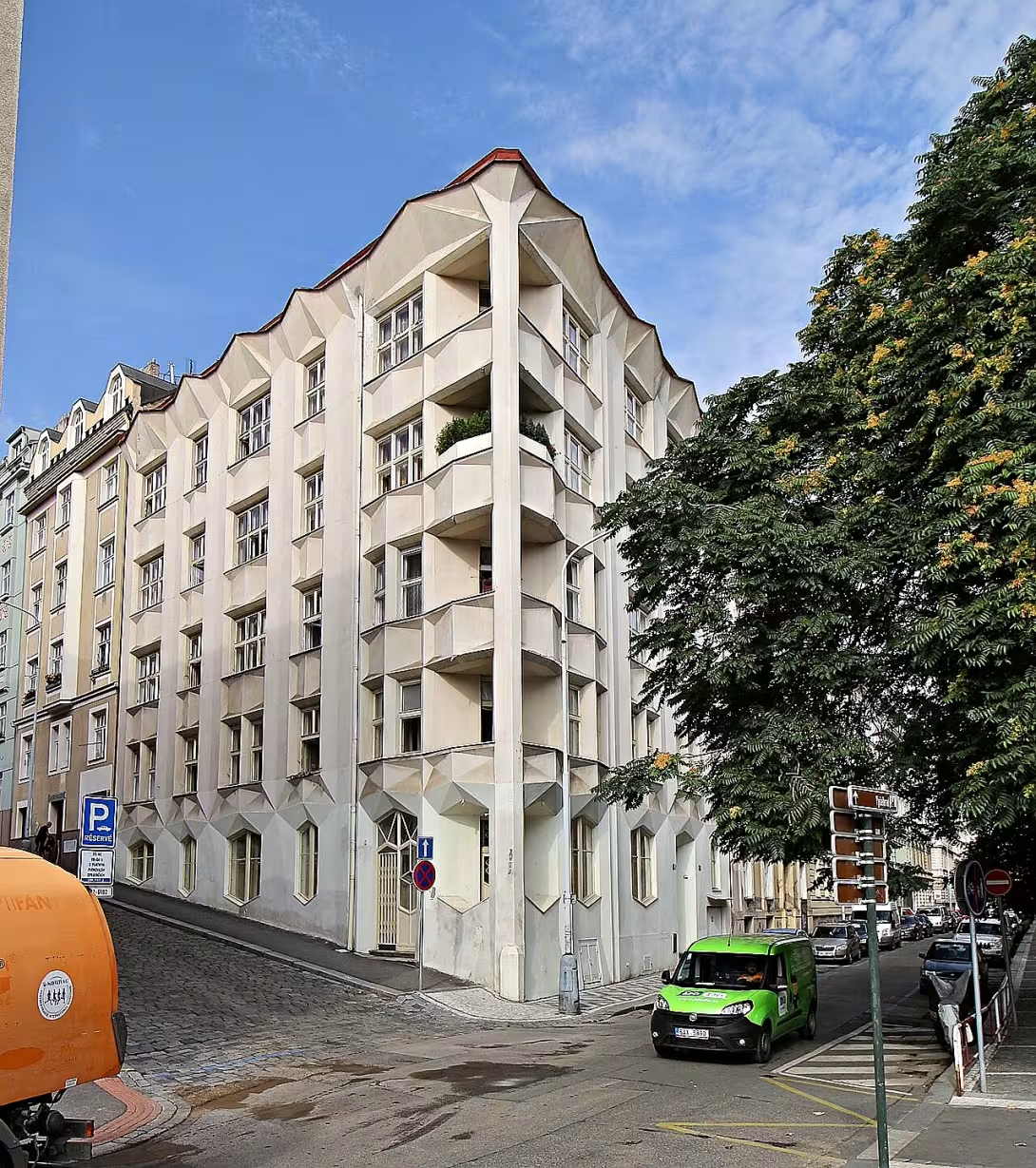
The Cubist tenement house in Neklan Street 30 on Prague's Vyšehrad is one of the most important and original constructions of Czech cubist architecture. The building was completed in 1914 according to the design of architect Josef Chochol. Thanks to the unique solution of the corners it is considered a work of world importance.
The construction was built on a narrow trapezoidal plot at the foot of the Vyšehrad Massif, at the crossing point of Neklan and Přemysl Street. The project for investor František Hodk, who supported the architect in the long term, began to be developed at the end of 1913. The house was realized during the flowering period of Czech cubism, which in such pure form did not appear anywhere else in European architecture.
Architectural rendition uses typical cubist textures. This manifests itself in broken surfaces of facade, parapets and realms. A very unique element is the solution of sharp corners, where balconies are clamped into an eight-sided column. Many original details have been preserved in the interior, including doors, railing in public areas and doorknobs.
The building, also known as Hodkova's tenement house, underwent an adjustment in 1939, during which the entrance to the garage to the facade of Neklan Street was demolished. Since 1964, the building has been protected in a memorable way and has, until now, maintained its original availability and mass.
The house represents an exceptional proof of the period of effort to connect cubist aesthetics to the housing function. The visit to Neklan Street offers the possibility to see one of the cleanest realization of this style in the Czech environment, which remains an architectural unique even after more than 100 years.
Then and now
Drag the slider to compare how the landmark may have looked when it was built with the view today.
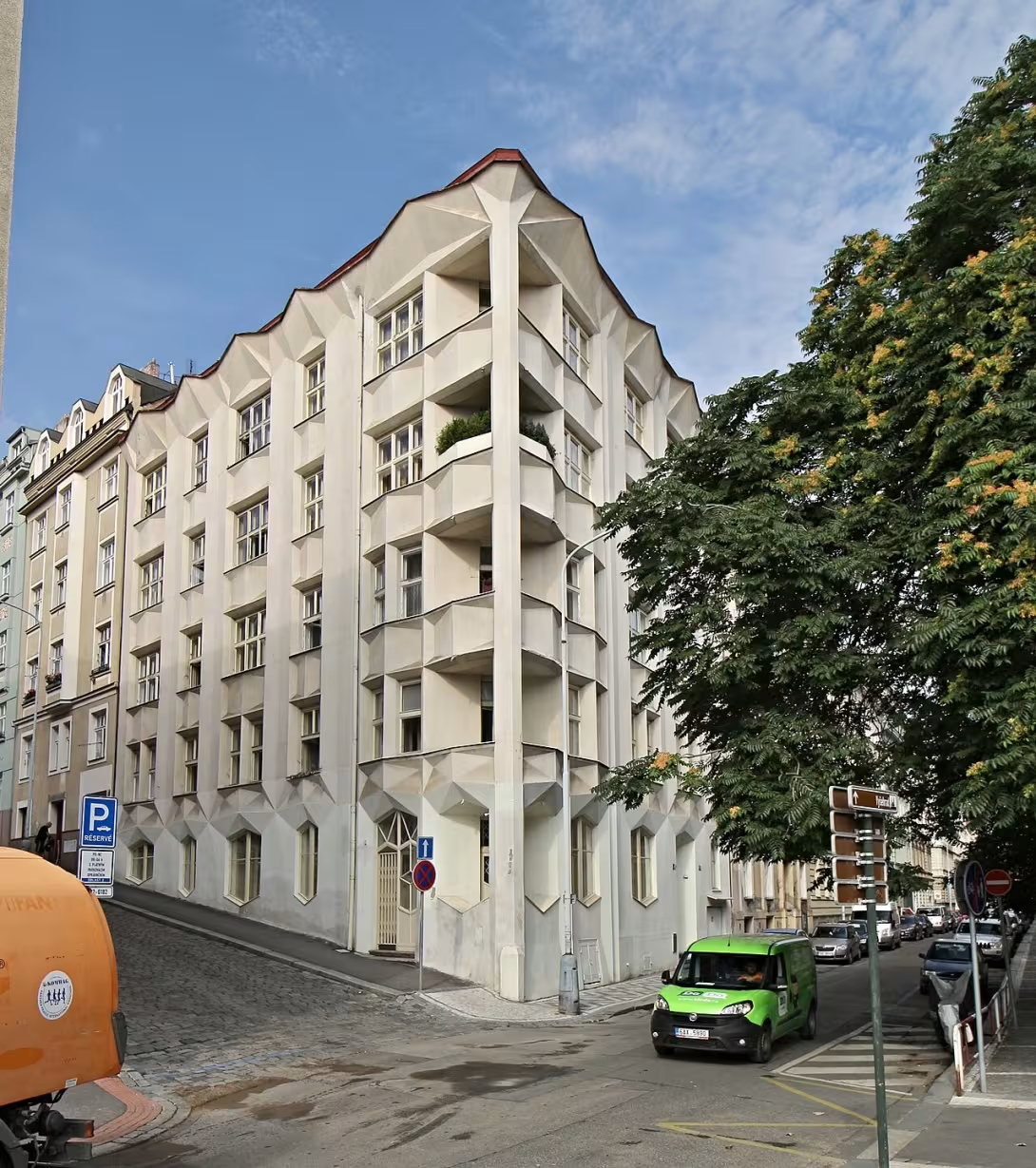
The historical appearance on the left is an AI-generated visualisation and serves as inspiration only.
Historical milestones
- 1913
- Architect Josef Chochol started working on the house project.
- 1914
- Completion of the construction of an apartment building.
- 1939
- Breaking into the garage into the facade of Neklan Street.
- 1964
- The house has been declared a protected monument.
Architectural development
The house was built on a sloping trapezoid plot on the corner of Neklanov and Přemyslová. The architecture uses cubist curvature, which manifests itself in broken facade surfaces and a specific solution of the corner column. In 1939, there was an intervention into the original facade from Neklan Street for setting up a garage entrance.
Historical events
In 1939, the facade was disturbed by the entrance to the garage. Since 1964, the house has been registered as a protected building.
Points of interest
- The house is considered a work of world importance thanks to a unique corner solution. - The construction was built on a narrow trapezoidal plot at the foot of the Vyšehrad Massif. - The interior preserved original details like doors, railing and handles. - In 1939, a garage entrance was crashed into the facade of Neklan Street. - Since 1964, the building has been protected by monuments and has retained its original availability and material.
Guide
Show guide text
This text was created by artificial intelligence and has not been editorially reviewed. It may contain inaccuracies.
Welcome to one of the most beautiful and quiet streets of Prague's Vyšehrad. Please stop for a moment, take a breath, and focus fully on the building that is standing in front of you right now. You stand before one of the most important works of Czech architecture, which carries courage, experiment and extraordinary imagination. The first impression of this house is often both fascinating and disturbing. Look at the surface. You don't see smooth, flat walls that you know from most ordinary apartment buildings. Instead, you are welcomed by the game of light and shadow, sharp edges and surfaces that break in unexpected angles. It is a building that not only compares with the environment, but actively communicates with it in its unshakeable form.
Let's go back more than a hundred years together. It is the year of a thousand and nine hundred and thirteen and in Prague the atmosphere of creative turbulence and search for new paths reigns. It was this year that the talented architect Josef Chochol started working on the project of this house. It was no ordinary task. The goal of the Chochol was to create something that would shift the boundaries of then's understanding of beauty and functionality. The investor who gave him a green lamp for this investment and provided financial facilities was František Hodek. The cooperation of these two men resulted in a thousand nine hundred fourteen in the completion of the construction you see today. It was a time shortly before the great world of the coup, but there was space in this street that was meant to emit both stability and modernity.
Now I ask you to pay your full attention to the details that are right before your eyes. Look up at the ledge, the horizontal protruding parts under the roof or between the floors. Notice how they're not straight, but they're made of typical broken surfaces. Now move your view down to the windows. Follow their parapets. Here, too, you see the same principle. Architect Josef Chochol did not work with the surface of the wall as a surface on which only something would stick, but worked with the matter of the house as a whole. All these elements, from roms to window details, are designed to create a dynamic rhythm. It's almost like watching a crystal that grew right out of Prague. Feel the rays of the sun bounce from the different angles of the facade, causing the house to look a little different every hour of the day.
If we think more about who created this house, we must acknowledge the genius of Josef Chochol. He was able to take the practical purpose of an apartment building, that is, buildings designed to rent apartments, and turn it into an artistic object. František Hodek, as an investor, had to have extraordinary taste and courage to implement such a proposal. It wasn't obvious at the time. This house was not just a byte, it was an expression of a new age, an attempt to pluck architecture from the frames of old traditions and give it a new, modern face.
Now please move slowly to the corners of the building. This is where one of the largest attractions of the entire building is located. The house is considered a work of world importance because of the unique solution of this corner. Notice how naturally and yet boldly the building bends and adapts to space. It's a masterpiece of geometry. And it is geometry that brings us to another fascinating fact. If you look at the way the house is on the ground, you'll find that the land on which it was built wasn't easy at all. The construction was built on a narrow terrain and the plot itself was shaped like a trapezoid. This means that the architect had to work with a very specific and irregular space to fit this monumental house into it. The fact that the result is so harmonious and balanced suggests the enormous expertise of Josef Chochol.
When you go around the house, notice one strange change in the form of an entrance to the garage in the facade of Neklan Street. This element was not originally here. It was only destroyed in the year one thousand nine hundred thirty-nine. It is an interesting contrast between the original, pure aesthetic vision of the architect and the later practical needs of the people who had already started using cars. Even though this intervention disrupted the original face of the facade, today it reminds us of how life in the city changed and how buildings had to adapt to new technologies.
While we are standing outside now admiring the exterior, allow me to take you for a brief picture in the inner space. In the interior there are rare details that are as important as the facade itself. Imagine the original doors, railings and handles that were designed in the same spirit as the rest of the house. Every touch of such a handle is a touch of history and art. These details are proof that the architect did not only solve what was seen from the street, but wanted the whole experience of the house to be united from the first step in the hall to the last ledge on the roof.
Given how unique this building was, it was quite natural that the state recognized its value. In a thousand and nine hundred and sixty-four, the house was officially declared protected. This means that its appearance and essence are now protected for future generations so that this example of Czech courage in architecture is not lost in time.
Now, if you look at the whole house for the last time, try to perceive its atmosphere. It is a building that combines the stability of the Hungarian Massif, at whose foot it stands, with the ease and dynamics of modern thinking. It's where mathematics met poetry and where concrete and stone began to dance in sharp angles.
Thank you for stopping by this special house on Neklan Street. I hope you've found the time to see the little breaks and the big visions that make this space. Now I invite you to continue to explore the Vyšehrad area, to perceive its quiet calm and to look for other traces of history that keeps this place so beautifully inside. I wish you a pleasant further walk and many new discoveries. Goodbye.
Tips for visitors
The best time to visit is in the morning when the sun illuminates the front of the house and highlights its geometric shapes and cubist details. You will avoid the afternoon shadows that could cover up unique architectural elements.
The location is available by public transport and by car. I recommend you use the link search to find the nearest stop. Parking in the vicinity of Vyšehrad is usually limited, so it is more appropriate to use public transport.
It is ideal for photography to have a wide-angle camera with you to capture the entire facade from the opposite pavement. The best light for shooting details is during bright days when sharp edges and plastic structure of the building stand out.
In the vicinity you can visit the Rotunda of St. Martin, the Basilica of St. Peter and Paul or walk along the bandage on the right bank of Vltava. All of these places are within walking distance of 30 minutes.
The location is suitable for families with children due to the proximity of Vyšehrad, where there is enough room for movement. The house itself is residential, so when you are outside, take care of the peace and respect the privacy of the people.
Businesses nearby
Do you run a restaurant, accommodation, shop, museum, rental, wellness or other visitor service near this monument? Show yourself directly to the people heading to it — this is how they will see you in the app and on the web:
Events nearby

Zdroj akcí: otevřená data měst a obcí ČR (Národní katalog otevřených dat) a kalendář akcí Národního památkového ústavu.
Nearby
Vyšehrad, rotunda svatého Martina, bazilika svatého Petra a Pavla, náplavka na pravém břehu Vltavy.
Accommodation nearby
Trips and activities nearby
Guided tours, tickets and activities nearby from GetYourGuide
Affiliate link: if you buy from the partner, we may receive a commission. The price for you does not change.
Search tours and activities →Themed route
1. Kubistický dům v Neklanově ulici, building, admire unusual geometric shapes and unique style of this building. 2. Flood on the right bank of the Vltava, waterfront, enjoy a pleasant atmosphere along the river. 3. Vyšehrad, historical area, explore this important place full of history. 4. The Rotunda of St. Martin, a religious object, visit this ancient round temple. 5. The Basilica of St. Peter and Paul, the temple, look at the magnificent building with impressive inner space.
Seasonal recommendations
Spring: In the spring period, a visit to the Kubistic House in Neklanov Street is special thanks to the warm sunlight, which highlights the architectural details of the building. Flowers begin to bloom around the monument and add a colorful mood to the atmosphere. For the best experience we recommend visiting the memory in the early afternoon time when the temperature is pleasant and the crowds are less. Due to mild weather conditions, light clothing with winter helmets is sufficient.
Summer: Summer offers long days with intense sunlight, which can be exceptionally beautiful at the Kubistic House. However, because of the heat and the large number of tourists, it is advisable to visit the memory in the morning or late evening to avoid the peak hours. Early arrival also means shorter waiting for entry. We recommend to wear light clothes and consider sunscreen.
Autumn: In autumn, the atmosphere around the monument is slightly melancholic when leaves on trees begin to fall and create a coloured carpet. The sun appears for a shorter time and illuminates the building from different angles than in summer, which can be very interesting. Visit the memory in the early afternoon time when the temperature is still pleasant and the crowds less. Clothes should be mild with the possibility of adding a layer for winter.
Winter: Winter visit to the Kubistic House offers unique lighting, where the sun appears for a shorter time and emphasizes architectural structure with its rays. The atmosphere is calm with less crowd than in other seasons. The monument usually opens late, so look at the current opening time. We recommend wearing warm clothes and protective shoes against freezing so that you can enjoy a visit without weather problems.
Visualizations and artistic views


The visualisations are generated by artificial intelligence and serve as inspiration.
Photos from the area
Real photos taken near the monument

Zdroj a licence jsou uvedeny u každého snímku.
Tips from visitors
No tips yet. Be the first!
Log in and add your tip.
Sources and literature
Photos: VitVit / CC BY-SA 4.0 — Wikimedia Commons. The author and licence also appear when you hover over the image.
Faktickým podkladem tohoto textu byl článek na Wikipedii, jehož autory jsou přispěvatelé Wikipedie. Článek je dostupný pod licencí CC BY-SA 4.0.
Location on the map

Příběhy a pověsti
Legendy, pověsti a příběhy spjaté s touto památkou
Fotografie návštěvníků
Zatím žádné fotografie. Buďte první, kdo přidá fotografii z návštěvy!
Log in a přidejte svou fotografii nebo hodnoťte.
Za ověřenou návštěvu v aplikaci získáte víc bodů — poznáme podle GPS, že jste na místě.
Reviews and comments