



Lesní kaple s hrobkou Battagliů a Enisů Chapel
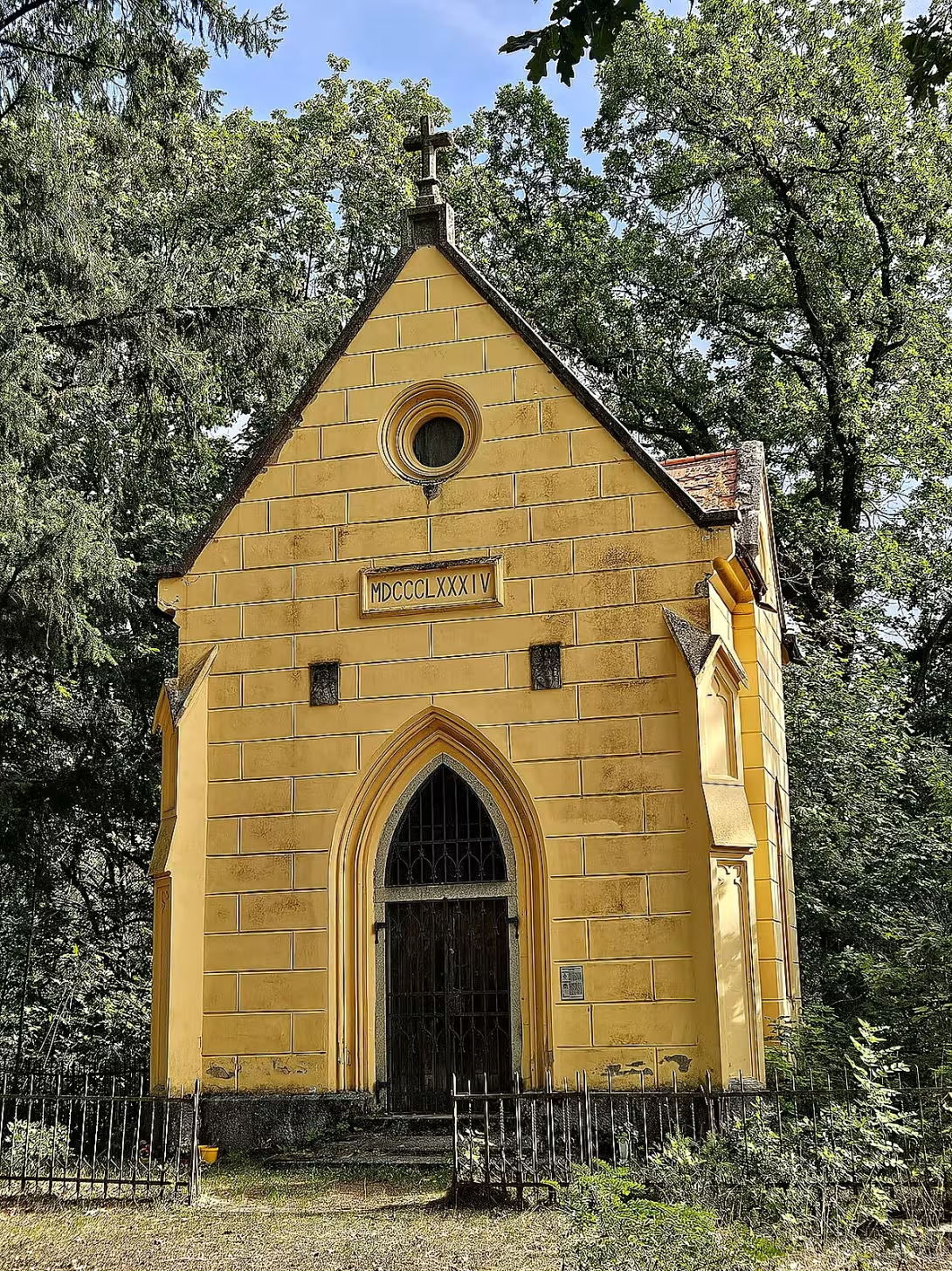
Lesní kaple s hrobkou Battagliů a Enisů is located at an altitude of 541 metres approximately two kilometres south of Jindřichovice near Blatná in the district of Strakonice, in the forest of Chvalov. They serve as burial grounds for the noble families of the Battaglias de Sopramonte e Ponte alto, owners of the Bratronice Chateau, and their related Enis, owners of the Lažana Chateau. The two chateau houses are approximately the same distance from the chapel by air line - the brotherly about two kilometres southwest, the Lažanski southeast. Near the chapel there is a historical grove and a lake Chvalov.
The origin of the chapel is linked to the unification of these families by marriage. The Enis, originally from the ancient Irish family mentioned in the fifth century, acquired Lažana Manor in 1673, when Marie Kateřina Částolárová from Dlouhévsi came here. Her husband was Jan Arnešt Enis from Atter and Iveaghu, who was promoted to Czech nobility in 1680. The Enis' family held the Lažanas until 1874, when the great estate switched to Henry from Schönau, who married Josef Battaglia. He inherited the chateau of Bratronica in 1864 from his uncle. The chapel was built in 1894, probably at the expense of his grandson Quida Julia Battaglia. After the consecration, the remains of former owners of Bratronic, originally buried in the cemetery in Záborí, were transferred to the new tomb.
The construction is followed by elements of late historism in a neo-gothic style and is made of bricks. It has a slightly rectangular plan and it's heading south. The main north facade and similarly south wall are ended with triangular shields. The entrance portal is narrow and nimble, equipped with granite frame, above it is a circular window. Among these elements is a rectangular field with an MDCCCLXXXIV - which is misstated in 1884 instead of 1894. The decoration of the portal is stone coat of arms - the left coat of arms of Enis with two-tail lion and palm, the right coat of arms of Battaglias with a swallowed shield and a moss. The facade of an excellent stone cross. Side walls break rizalite with window ended with a broken arch and a small circular window in a triangular shield. Side and rear walls are plastered and spaced in such a way that they are optically reminiscent of quad rustics. The roof is saddle and the chapel is enclosed by a grid fence.
The chapel is glazed with a cross vault and preserved by tombstones. Buried here are four family members from both families. The chapel is protected as a cultural monument and is privately owned - its interiors are not usually accessible. It was completely renovated between 2003 and 2010. It is one of the few forest chapels of this type in the Czech Republic, which preserved its original purpose and appearance.
Then and now
Drag the slider to compare how the landmark may have looked when it was built with the view today.
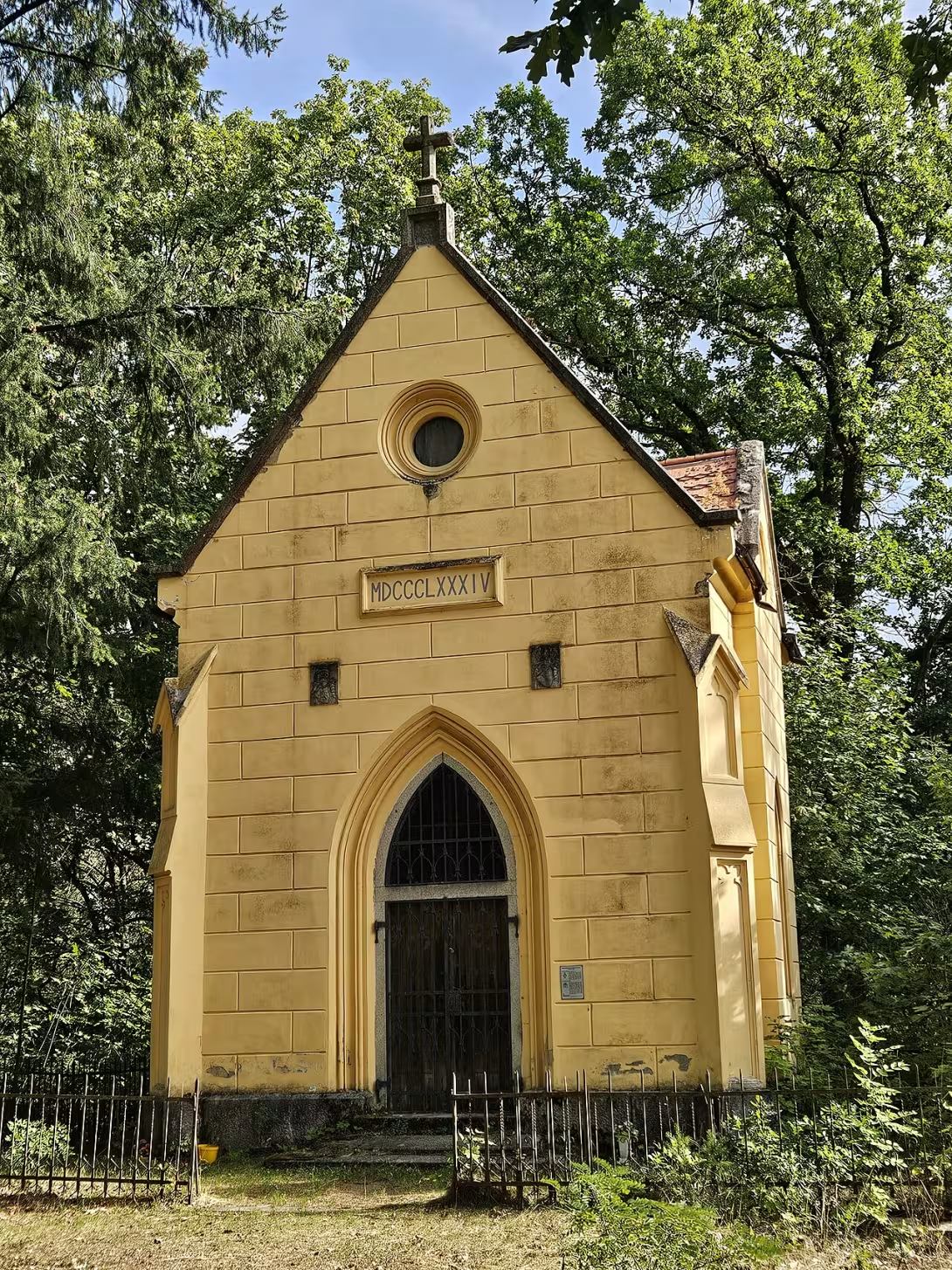
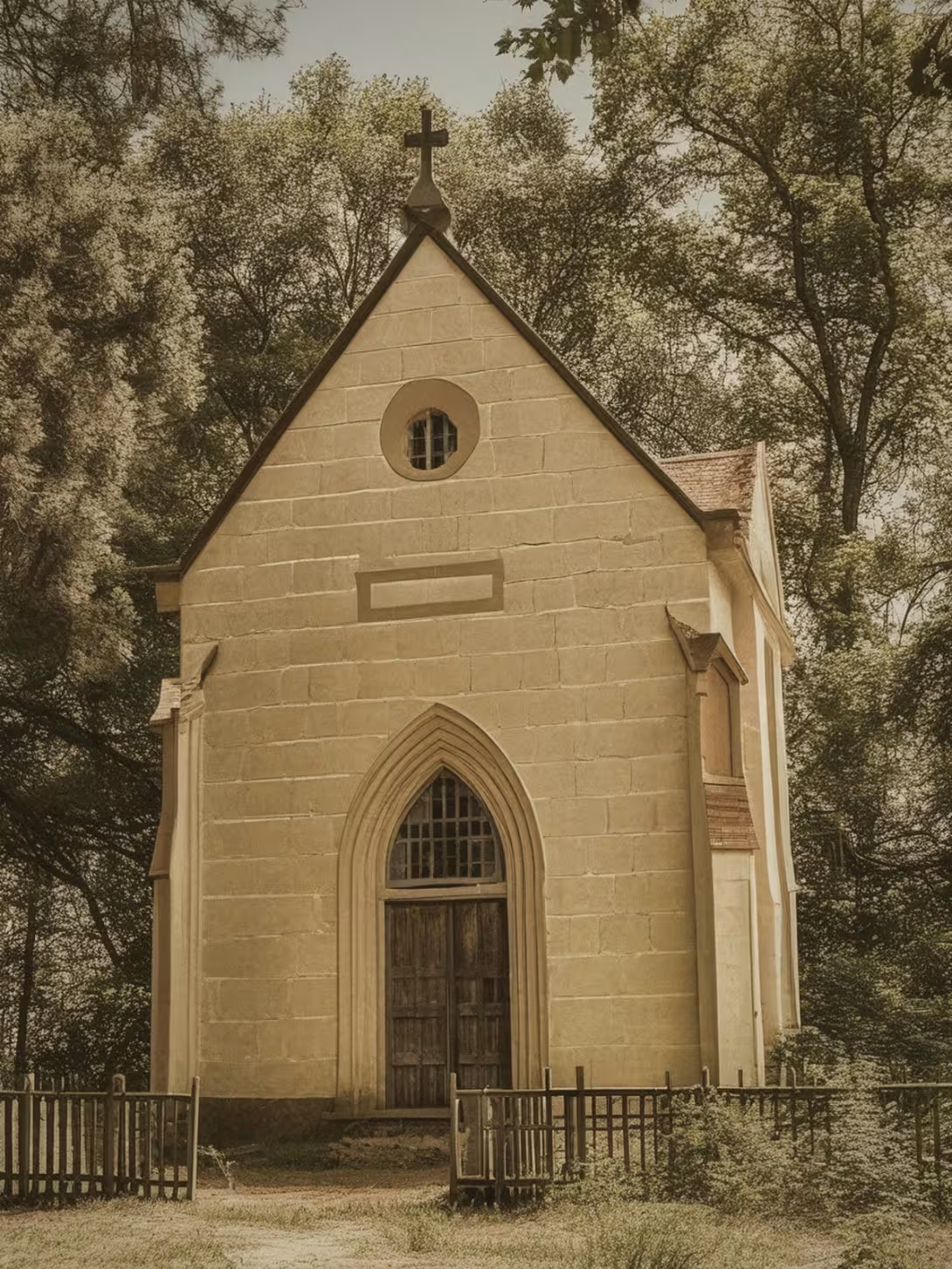
The historical appearance on the left is an AI-generated visualisation and serves as inspiration only.
Historical milestones
- 1673
- Marie Kateřina Častolářová of Dlouhévsi bought Lažana Manor for her husband Jan Arnošt Enis, making the Enis family owner of this estate.
- 1680
- Jan Arnešt Enis of Atter and Iveaghu was awarded the Czech ecclesiastical and was recognized by the knighthood.
- 1864
- Josef Battaglia inherited the Bratronica and became owner of a large estate, making the Battaglia family an important noble family in the region.
- 1894
- Built in a forest chapel as a burial chapel for the Battaglias and Enis families, where remains were transferred from the cemetery in Záborí and other places.
Architectural development
The chapel was built in a neo-gothic style with elements of late historism from brick wall on a slightly rectangular ground plan. The main facade ends with a triangular shield with a circular window and a high pointy portal. The side walls are broken down by risalities with windows ending with broken arches. The roof is saddle-shaped, plastered walls imitate block rustic. The chapel is enclosed by a grid fence. The interior is glazed with a cross vault and the tombstones are preserved here.
Historical events
- 1864
- Josef Battaglia inherited the great estate of Bratronice and became its owner, making the Battaglia family an important noble family in the region.
- 1874
- The Lažana estate went to Jindřiška from Schönau, married to Josef Battaglia, which brought the two estates together within the Battaglia family.
- 1894
- Built in a forest chapel as a burial chapel for the Battaglias and Enis families, where remains were transferred from the cemetery in Záborí and other places.
- 2003-2010
Owners
- 1864
- 1673
- 1894th present
Points of interest
- The chapel serves as a burial ground for the noble families of the Battaglias de Sopramonte e Ponte alto and Enis, owners of the chateau of Bratronica and Lažana.
- The origin of the chapel is linked to the unification of these families by marriage, when the Enis acquired Lažana Manor in 1673.
- The chapel was built in 1894, probably at the expense of Quid Julius Battaglia's grandson.
- The northern facade of the chapel is erroneously indicated in 1884 instead of the correct year 1894.
- The chapel is one of the few forest chapels in Bohemia, which has preserved its original purpose and appearance.
Guide
This guide is narrated by a synthetic voice generated by artificial intelligence.
Show guide text
This text was created by artificial intelligence and has not been editorially reviewed. It may contain inaccuracies.
The forest funeral chapel of the Battaglia and Enis families is located near Chvalov at Jindřichovic, which is part of Blatné in the Strakonice district. You will find it outside the village, about two kilometers to the south, at an altitude of 541 meters. Nearby there is a gamekeeper's lodge and the Chvalov pond.
The chapel was built in 1894 as a tomb for two related aristocratic families. The Battaglias de Sopramonte e Ponte alto owned the Bratronice manor, the Enises owned the Lažany manor. Both estates are located approximately the same distance from the tomb as the crow flies. Bratronice about two kilometers to the southwest, Lažany to the southeast.
The Battaglias were originally a Venetian family. They obtained noble status in 1677 and thirty years later became free lords. Josef Battaglia inherited Bratronice in 1864 from his uncle Josef Kristián Talacko from Ještětica. The Enises came from an old Irish family and arrived in Central Europe in the first half of the seventeenth century. Marie Kateřina Částolárová from Dlouhévsi, wife of Jan Arnošt Enis from Atteru and Iveaghu, purchased Lažany in 1673. He obtained Czech incolate and recognition of his knightly title in 1680. The Enises held Lažany until 1874. Then it passed to Jindřiška from Schönau, the wife of Josef Battaglia.
The construction was probably paid for by Quido Julius Battaglia. After consecration, the remains of the former owners of Bratronice were transferred here. They had originally been buried in the cemetery in Záboří. Four family members rest in the tomb.
The chapel is a neo-Gothic brick building with a slightly rectangular floor plan. It is not oriented to the east as is customary, but faces south. Both the northern façade and the southern wall are topped with triangular gables. The entrance façade features a tall pointed portal with narrow granite framing and a circular window in the gable. Between them is a field with an inscription which uses Roman numerals to state the incorrect date of 1884. Above the portal are stone coats of arms. On the left the Enis coat of arms with a two-tailed lion and a palm, on the right the Battaglia coat of arms with a cossy bar in a divided shield. The façade is crowned with a stone cross.
The side walls are divided by a risalit with a window in a broken arch and a circular window in the gable. The plaster on the walls imitates ashlar masonry. The roof is gabled and the chapel is surrounded by a lattice fence. Inside there is a cross vault and funeral slabs have been preserved. Between 2003 and 2010 the chapel underwent complete renovation. Today it is in private ownership and is a protected historical monument.
Tips for visitors
The best time to visit this forest chapel is in the spring or autumn when nature is around the most beautiful and light creates pleasant shadows. In summer the forest can be quite hot and humid, while in winter the chapel is often surrounded by snow, creating a picturesque atmosphere. It is recommended to visit the chapel early morning or late afternoon when there are fewer visitors and the light is ideal for photography.
The chapel is located in the forest, therefore it is best to reach it by car. In the vicinity of the village Jindřichovice you can find free parking, which is usually free. If you arrive by public transport, it is recommended to check the current connection to the village Jindřichovice in the search engine. From the stop the chapel is available a short walk through the forest path, which is not very demanding.
When visiting the chapel, wear comfortable shoes and suitable clothing because it is located in the forest and the way to it can be unbalanced. It is also convenient to take a small umbrella or raincoat with you, because the weather in the forest can change quickly. If you plan to stay longer, bring water and perhaps refreshments because there are no shops around the chapel.
Chapel is a great place for photography, especially in the morning or afternoon light. The best places for photos are the entrance part of the chapel and surrounding the tomb, where the neo-gothic processing of the building is well captured. It is also recommended to photograph from different angles to capture the beauty of the surrounding forest and nature. The entrance gate of the chapel is also an interesting motif.
In the vicinity of the chapel, two interesting locks are worth visiting, which are only a few kilometres away. The Bratronice Chateau, located about two kilometres southwest, was owned by the Battaglias family and offers the opportunity to know the history of noble families. Lažana Chateau, located about two kilometres southeast, is another interesting place to visit. Both locks are well accessible by car.
For families with children a visit to the chapel is suitable thanks to its picturesque location in the forest. Children can explore the neo-gothic architecture and explore the surroundings of the chapel. It is also recommended to take advantage of the opportunity to take a short walk through the forest, which is safe and interesting. If you go on a trip to the surrounding area, you can also visit nearby chateaux, where children will find a lot of attractions and possibilities for exploring.
Frequently asked questions
Is Lesní kaple s hrobkou Battagliů a Enisů open to the public?
Yes, the chapel is open all year round. The best time to visit, however, is from April to October, when the weather is mild and the surrounding landscape is in full floral colour.
How do I get to the place by car / public transport?
You can get to the location by car or public transport. Parking is possible in front of the chapel or in the nearby centre of Blatná village.
How much is the entrance fee and is it paid on the spot?
Payment is made directly at the chapel.
Is the tour suitable for children and seniors?
Yes, the tour is suitable for all age groups. The chapel is accessible barrier-free, so even seniors or people with movement problems can visit.
How long does the tour take?
The visit to the chapel takes approximately 30 minutes. You can also walk the surrounding countryside and discover other sights.
What are the opening times and booking is required?
The chapel is open all year round from 9:00 to 5:00. Reservation is not necessary, but if you want to visit the chapel with a guide, you must book it in advance.
What's interesting in the immediate vicinity?
In the immediate surroundings there are other historical monuments such as Blatná Chateau or St. James Church. You can also walk through the surrounding landscape and discover the original forest paths.
For kids
Imagine going back 132 years, until the forest chapel with the tomb of the Battaglians and the Enis was still new and full of life. It was a time when the nobles ruled over the surroundings and when someone was buried, it was like a big festival.
There were people who lived here who had big locks and goods, and their lives were full of balls and fun. And among them was the family of the Battaglias de Sopramonte e Ponte alto, which owned the Bratronica Chateau, and the Enis who owned the Lažana Chateau. They were quietly buried here in a forest chapel built in a neo-gothic style.
Businesses nearby
Do you run a restaurant, accommodation, shop, museum, rental, wellness or other visitor service near this monument? Show yourself directly to the people heading to it — this is how they will see you in the app and on the web:
Accommodation nearby
Themed route
Thematic cruise route: Lesní kaple s hrobkou Battagliů a Enisů
1.Lesní kaple s hrobkou Battagliů a Enisů (chapel) * Why is it worth a visit: * This picturesque chapel is a key historical place where members of the Battaglia and Enis families are buried. It is a place full of history and quiet calm that offers a unique insight into the past of this area.
2. Bratronice Chateau * Distance: * about 2 km southwest * Why is it worth a visit: * This chateau was once owned by the Battaglia family and offers views of the surrounding countryside. Its historical appearance and architectural features attract visitors who are interested in the history of the region.
3. Lažana Chateau * Distance: * about 2 km southeast * Why is it worth visiting: * The original owner of this chateau was the Enis family. Its beautiful buildings and large areas offer a view of historical architecture and the natural landscape.
4. The Hay House * Why is it worth a visit: * Hamehouse in the village Jindřichovice is the ideal place for those who want to learn more about local trees and their care. It is a place that offers a view of sustainable management of nature.
This route will guide you through the historical and natural jewels of the village Jindřichovice and surrounding locations, allowing you to know the rich heritage of the region.
Seasonal recommendations
Spring: In the spring season of the chapel and surrounding forests come to life in a wider range of colours, when the first shrubs and trees bloom green. The sunny days offer ideal light for photography and dazzling views on the tomb of Battaglias and Enis. Although the first visitors may appear at this time, the chapel is not yet crowded, which allows a peaceful walk. We recommend clothes by temperature - short gloves and light coat can be useful in colder mornings or evenings.
Summer: During the summer season the chapel celebrates long sunny days that highlight its historical architecture and natural beauty surrounding it. This season is most popular with visitors, which can lead to larger crowds especially on Wednesday. We recommend that you visit the chapel faster and in advance to avoid the biggest flood of people. Sun hat and protective cream carriers ensure comfort during the tour.
Autumn: In the autumn of the chapel becomes melancholic atmosphere when leaves colour the woodland in living colors. Sunny days are still common and provide ideal conditions for visiting, although the weather can change quickly. This season is especially suitable for a quiet walk with a minimum crowd. We recommend wearing warmer clothes and perhaps blankets for any sudden temperature reduction.
Winter: During the winter season the chapel takes a calm and quiet character, where it is covered with snow or a light pink crown of glaciers. The atmosphere is beautiful, but accessibility can be limited due to the weather and shorter opening of the sights. Visitors should wear warm clothes, including leather shoes or umbrella for snow or wet soil. We recommend visiting the chapel at the beginning of the day when the temperature is lighter and the crowd is minimal.
Visualizations and artistic views


The visualisations are generated by artificial intelligence and serve as inspiration.
Tips from visitors
No tips yet. Be the first!
Log in and add your tip.
Sources and literature
Faktickým podkladem tohoto textu byl článek na Wikipedii, jehož autory jsou přispěvatelé Wikipedie. Článek je dostupný pod licencí CC BY-SA 4.0.
Location on the map




Příběhy a pověsti
Legendy, pověsti a příběhy spjaté s touto památkou
Fotografie návštěvníků
Zatím žádné fotografie. Buďte první, kdo přidá fotografii z návštěvy!
Log in a přidejte svou fotografii nebo hodnoťte.
Za ověřenou návštěvu v aplikaci získáte víc bodů — poznáme podle GPS, že jste na místě.
Reviews and comments