



Měšťanský dům (Karviná, 1000120935) House
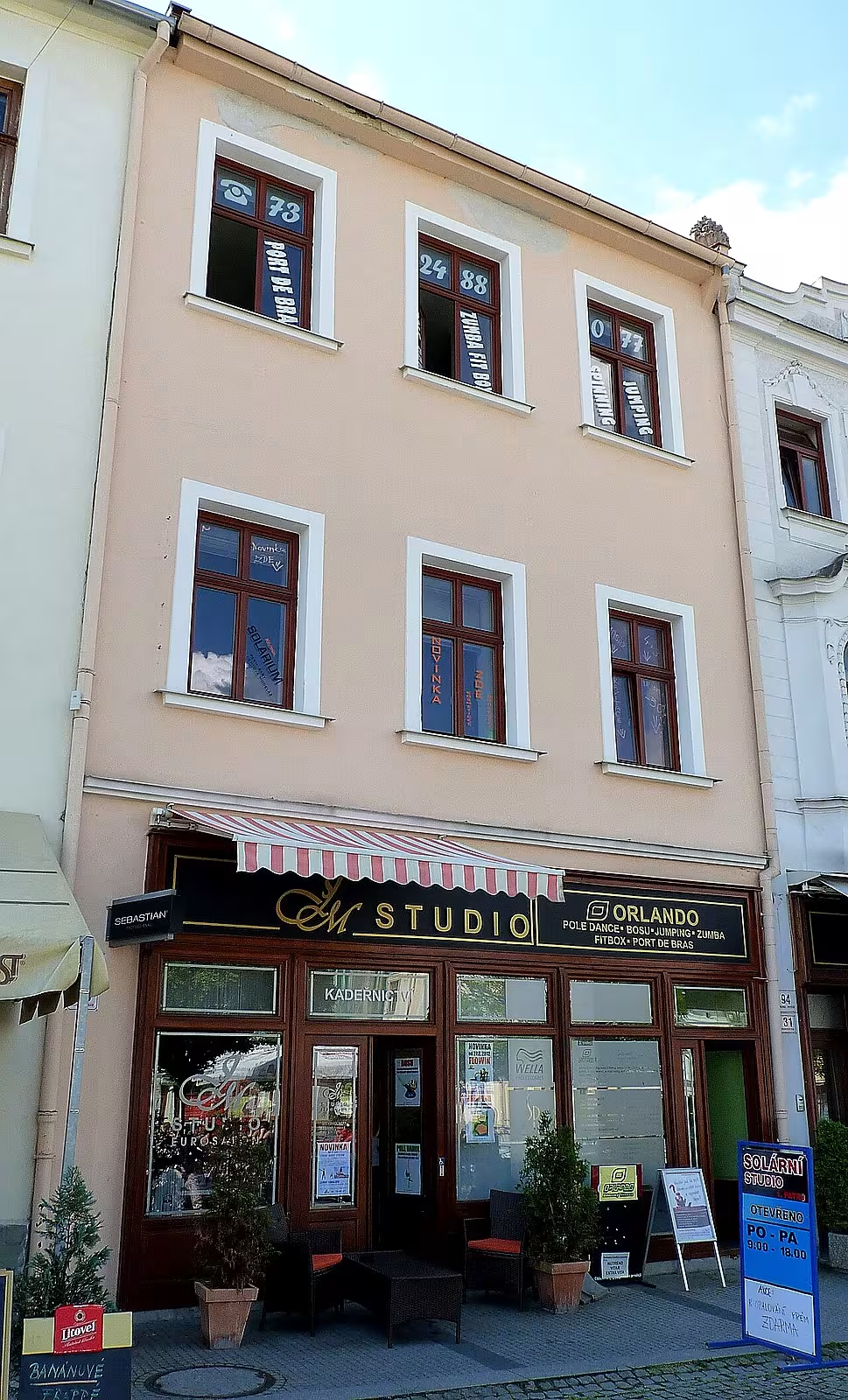
The town house No. 93 on Masaryk Square in Fryštát is a historic building with a Renaissance core. In 1993, the building was declared a cultural monument. It is particularly important with preserved vaults from the 18th century and history associated with the right of shenka, which in the past was an important urban privilege.
The oldest history of the house was left with little news, but the Renaissance core demonstrates the importance of the place during the flowering period of urban culture. The creation of the building falls within the development of urban construction. Later modifications in the 19th century reflect changes in an industrially emerging region.
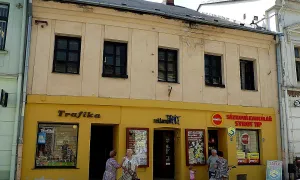
Architecturally, it is a two-storey walled building in a series of buildings. It has a rectangular plan and a saddle roof covered with sheet metal. The smooth facade of the facade is divided by three window axes. The windows are lined with flat shamrans with post-date robes. On the ground floor there is today a modern interpretation. The interior of the house is remarkable by its vault layout. The shop is covered with Prussian and Valued vaults. The entrance corridor and courtyard rooms also use Prussian vaults. The basement spaces are built of quarry stone and carry a brick-filled vault. On the floor there is a corridor with a vaulted vault, divided by glazed wooden walls, and smaller spaces with flat or semi-circular vaults.
A significant building change took place after 1850, when the house was raised to two storey. This adjustment has fundamentally changed its external form and adapted it to the demands of urban housing and entrepreneurship at that time. Since 1993 the house has been protected as part of the historical centre Fryštát, which is now part of Karviné.
House No. 93 is a valuable proof of urban architecture, which combines Renaissance foundations with Baroque vaults and 19th century modifications. When visiting the Masaryk Square in Fryštát, in the immediate vicinity of the castle, this building commemorates the rich history of local urban rights and the building development of the region.
Historical milestones
- around 1550
- The creation of the Renaissance language of the house in the period of development of the city building industry
- around 1750
- Construction of baroque vaults in the interior of the building
- after 1850
- Building modification and raising the house to a two-story building
- 1993
- The declaration of the object for the cultural monument
Architectural development
The original Renaissance core was supplemented with rolled and Prussian vaults in the 18th century. After 1850 there was an increase in construction by the second floor. The facade is smooth, divided by three window axes with flat shambles.
Historical events
After 1850 the house was increased to a two-story building. In 1993, the house was declared a cultural monument.
Points of interest
- The house has a Renaissance core and was declared a cultural monument in 1993. - The history of the house is linked to the right of shenanigans, which in the past was an important urban privilege. - The interior is remarkable with vaults, while the shop and corridors use Prussian and rolled vaults. - The basement spaces are built of quarry stone and have a brick-filled vault. - After 1850, the house was raised to two stories, which changed its external appearance.
Guide
Show guide text
This text was created by artificial intelligence and has not been editorially reviewed. It may contain inaccuracies.
Welcome to Masaryk Square in Fryštát. Right now, when you stand here and listen to these words, you are at the heart of a place that has undergone many transformations over several centuries. In front of you is townhouse number ninety-three. Look at him and perceive his presence in this series of buildings. This object is not just an ordinary building, but an important element of historical urban architecture, which forms an integral part of the entire square. Even though you may think you're looking at a common house, you're actually standing before a witness to history that carries layers of different times and styles.
Now let's go back to the past together to understand where this house comes from. Imagine a time of about a thousand five hundred fifty. This was the time when urban construction began to develop and shape as we know it today. It was at this time that what the experts now call the Renaissance core of this house arose. Although the appearance of the building has changed over the years, this core represents its original foundation, its invisible skeleton, which gives it stability and historical depth. This house has therefore grown along with the city and its basic structure is proof of the then expansion of urban life.
Now, our thoughts must move forward another 200 years. We're getting into the eighteenth century, about a thousand seven hundred fifty. At this time the house changed again and its inner space gained a new character. At that time, valuable vaults were added to the interior of the building, which brought a baroque touch to the interior. These vaults are not just a technical solution to keep the ceiling up, but they are an artistic element that at the time provided the houses with nobility and beauty. Imagine how these shapes changed the light and space inside the rooms when people moved in them centuries ago.
If you look at the overall height and shape of the building now, you might wonder why it looks like this. The key break in her appearance came after a thousand eight hundred and fifty. At this time the house underwent a very significant building modification. The building was then increased and converted into a two-storey building. This change corresponded to the growing needs of the city and the changing lifestyle in the nineteenth century. Thanks to this modification, the house has become a more representative element in the urban landscape and has acquired the form you perceive right now when you are standing in front of its front.
Now I want to take you to one of the most important things that defines this house. This object was not just an ordinary house for living. In the past, this house has had a very important urban privilege, which is called the right of a shank. What does that even mean? It was a very important thing at the time. This right meant that the owners of the house could offer drinks in this place and host people. Imagine the lively atmosphere, how people gather in this house, how business takes place and how the social life of the entire neighborhood takes place here. The right of a member of this house made an important point on the city map, a place where people met and shared newspapers and stories.
If you could now look deeper inside this building, your attention would certainly have to be acquired by the inner spaces. The corridors and shops are equipped with very interesting shapes of ceilings. Here you will find Prussian vaults and also rolled vaults that create a fascinating and solid space in the interior. These structural shapes are typical of quality construction and give the house its unique character. Even basement spaces, which are part of the whole building, are built to serve many generations. So this whole house is composed of these different layers, from the Renaissance base to the Baroque details to the nineteenth century.
Finally, I would like to mention why this house is so important to all of us today. In the year one thousand nine hundred ninety-three, this object was officially declared a cultural monument. This means that its history, its architecture and its importance to our city are now protected. You're standing in front of a place that has its own soul that reminds us of how the city evolved and how the lives of the people who lived here changed.
Thank you for your time and attention to this historic monument. We hope that this view of the history of house number ninety-three helped you better understand the atmosphere of Masaryk Square. We wish you a pleasant rest of the walk on Fryštát and invite you to further discover the beauty and secrets of our historic places. Goodbye.
Tips for visitors
The best time to visit is in the morning or late afternoon, when the sun pleasantly illuminates the facade of the house on Masaryk Square and creates plastic shadows on historical architectural elements.
The site is located directly in the historical core of Fryštát. To achieve the goal, a passenger car or local public transport can be used, and you can easily find the current connection in internet search engines.
Bring quality shoes for walking on historic tiles and camera. The best pictures of the house are taken from the opposite side of the square, where the overall composition of the building and its Renaissance features stand out.
In the immediate vicinity you can admire the entire historical center of the city, which breathes old times. We recommend a walk around Masaryk Square and a visit to nearby castle Fryštát, which is a significant dominant area.
For families with children, the location is ideal for easy walking. Children can discover details on historical facades and enjoy the atmosphere of the square while parents appreciate the calmer pace of this place.
Frequently asked questions
Can the monument be visited?
This is a residential or farm building, not a museum with opening hours. Please view it from public space and respect the owners' privacy. We have no information about access to the interior.
Where is the monument?
Location: Fryštát. The map on this page shows the exact spot.
Why is the monument protected?
It is listed in the Central List of Cultural Monuments of the Czech Republic as a cultural monument (register no. 1000120935).
Businesses nearby
Do you run a restaurant, accommodation, shop, museum, rental, wellness or other visitor service near this monument? Show yourself directly to the people heading to it — this is how they will see you in the app and on the web:
Nearby
Masarykovo náměstí ve Fryštátě, historické centrum města, zámek Fryštát.
Accommodation nearby
Themed route
Thematic cruise route in Fryštát
1. Masaryk Square (Type: Square) - The Masaryk Square is the heart of Fryštát, where history and modernity meet. It is a place for relaxation and walking where you can enjoy a beautiful view of the surrounding buildings and learn more about the history of Fryštát.
2. Historical Center Fryštát (Type: History) - A walk on the streets of the historic centre will allow you to appreciate the architectural beauty and rich history of the city. Here you will find medieval houses that tell stories about the time when Fryštát prospered as an important business center.
3. Castle Fryštát (Type: Castle) - The castle is one of the most famous monuments of Fryštát and is worth visiting with its architectural significance and history. It's a place where you can explore beautiful interiors and enjoy the views of the surrounding countryside.
4. Town House (Karvina) - The main destination of the route is the Town House, which represents a significant part of the cultural heritage of Fryštát. It's a place where you can explore historical interiors and understand the lifestyle of the people of the past.
This route offers a view of the most beautiful parts of Fryštát and its rich history, with all places close to each other.
Seasonal recommendations
Spring: In the spring, the town house in Fryštát is revived by flowering shrubs and trees, which brings living colour to the surrounding environment. Sunlight is reflected on historical facades, which is especially advantageous for photography. For visitors this period offers mild temperatures and a pleasant atmosphere that is ideal for walking on the surrounding streets. It is recommended to wear light clothes with the possibility to add a layer for winter or rain in case of sudden frosty storms that are common. The best time to visit is in the morning or in the evening when the temperature is milder and the crowds usually smaller.
Summer: Summer brings long days with long daylight, meaning that the townhouse in Fryštát can be viewed in sunlight until late afternoon. The temperatures are usually higher, which means it is advisable to prepare for heat with light clothes, sunglasses and plenty of drinking water. The atmosphere is full of life because many people visit Fryštát during this period. To avoid the hottest hours, it would be advisable to visit the memorial in the morning or late evening. The days are long and offer much time to explore the surrounding historical parts of Fryštát.
Autumn: In autumn, the Town House in Fryštát is transformed into a remarkable work of art because of the colorful return of leafy trees that surround the memory. Sunlight is less intense and long winter evenings come faster, creating a melancholy and calm atmosphere. It is advisable to dress in layered clothes to be ready for falling temperatures and sudden rains that are typical of this time of year. The best times for walking are in the morning or in the middle of the day to avoid cold evenings and possible rain.
Winter: Winter in Fryštát brings a special atmosphere to the townhouse, where the surrounding countryside is covered with snow. The light is weaker and short, giving the sights an extraordinary mysterious look. It's important to prepare yourself for a cold with warm clothes, a protective leg and perhaps an umbrella for snowstorms. This time of year is usually less demanding from the point of view of crowds, which allows for a calmer walk and knowledge of historical details without the presence of a large number of people. The best time to visit is usually the evening when the temperature is tempered, even if it should be careful with cool night winds.
Visualizations and artistic views

The visualisations are generated by artificial intelligence and serve as inspiration.
Photos from the area
Real photos taken near the monument


Zdroj a licence jsou uvedeny u každého snímku.
Tips from visitors
No tips yet. Be the first!
Log in and add your tip.
Sources and literature
Photos: Michal Klajban / CC BY-SA 3.0 — Wikimedia Commons. The author and licence also appear when you hover over the image.
Faktickým podkladem tohoto textu byl článek na Wikipedii, jehož autory jsou přispěvatelé Wikipedie. Článek je dostupný pod licencí CC BY-SA 4.0.
Location on the map
Příběhy a pověsti
Legendy, pověsti a příběhy spjaté s touto památkou
Fotografie návštěvníků
Zatím žádné fotografie. Buďte první, kdo přidá fotografii z návštěvy!
Log in a přidejte svou fotografii nebo hodnoťte.
Za ověřenou návštěvu v aplikaci získáte víc bodů — poznáme podle GPS, že jste na místě.
Reviews and comments