






Zámecká rodová hrobka Larisch-Mönnichů Tomb
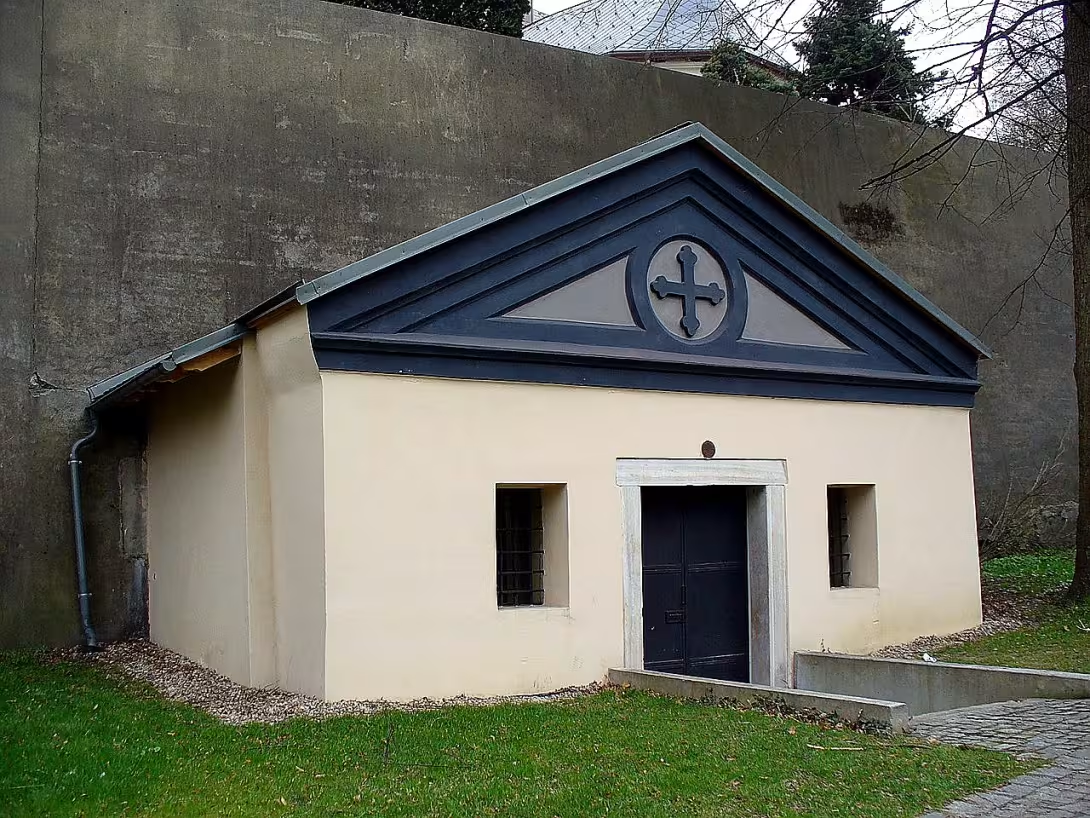
Zámecká rodová hrobka Larisch-Mönnichů is a classical building in the northwest part of Božena Nemcová Park in Fryštát. The building, which has been protected as a cultural monument since 2006, was built in 1821 by Count Henry von Larisch-Mönnich as the last resting place of his parents.
The history of the tomb is closely linked to the Larisch-Mönnich family, which owned and administered it. The construction was created during the Austrian Empire period, when European society was dealing with the consequences of the Napoleon wars and emerging conservatism. The tomb was intended for John de Math Josef Antonín Count Larisch-Mönnich, who died in 1820 in Opava, and his wife Anna Countess von Larisch-Mönnich, who died in 1829 in Raduni. The bodies of both husbands were originally stored in the tomb, but later they were exhumed.
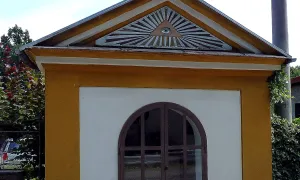
Architecturally, it is a brick object on a rectangular plan with plastered facade and a low saddle roof. The building is directly connected to the wall of the cemetery near the Church of the Ascension of the Holy Cross and forms part of the premises of the Frystát castle. There is an entrance in the shield facade with a stone portal and two-wing doors. There are rectangular windows on the sides of the entrance above which a small circular opening is broken. The shield is lined with a profiled stucco attached to the ledge and its centre is decorated with a plastic circle with a Greek isosceles cross.
Today, this tomb is an important example of the clash of the noble family with the Fryštět estate and an architectural element of the historical park. Visitors to Božena Nemcová Park can see the building in close proximity to the Church of the Holy Cross and the castle Fryštát. The sightseeing tour offers the opportunity to look at the history of a significant family and appreciate the classical form of the monetary architecture in the region.
Historical milestones
- 1820
- The death of John de Matha Josef Antonín Count Larisch-Mönnich.
- 1821
- Construction of the tomb by Henry Count von Larisch-Mönnich.
- 1829
- The deaths of Anna Countess von Larisch-Mönnich.
- 2006
- Declaration of the tomb a cultural monument.
Architectural development
The tomb was built as a classicist brick object with plastered facade. The facade is decorated with profiled stucco and plastic circle with Greek isosceles cross. The building is directly connected to the wall of the adjacent cemetery.
Historical events
1820: The death of John de Matha Josef Antonín Count Larisch-Mönnich in Opava. 1821: Construction of the tomb by Henry Count von Larisch-Mönnich. 1829: The death of Anna Countess von Larisch-Mönnich in Raduni. 2006: Declaration of the tomb by cultural monument.
Owners
Rod Larisch-Mönnichi
Points of interest
- The tomb is a classical building located in the northwest part of Božena Nemcová Park in Fryštát. - The object was built in 1821 by Count Henry von Larisch-Mönnich as a final resting place for his parents. - Since 2006, this building has been protected as a cultural monument. - The bodies of John de Matha Josef Antonín Count Larisch-Mönnich and his wife Anna, who was originally stored in the tomb, were later exhumed. - In the shield of the building there is a plastic circle with a Greek isosceles cross.
Guide
Show guide text
This text was created by artificial intelligence and has not been editorially reviewed. It may contain inaccuracies.
Welcome to the unique monument that you discover today in Fryštát. You are standing in front of the castle's family tomb Larisch-Mönnich, a classic architectural gem located in the northwest part of Božena Nemcová Park. This brick building on a rectangular plan is attached to the wall of the cemetery near the Church of the Elevation of the Holy Cross, which makes it a significant part of the local history and monument area.
Let's dive into her history. In 1821 Jindřich hrabě von Larisch-Mönnich built this tomb as a final resting place for his parents. His father, Jan de Matha Josef Antonín hrabě Larisch-Mönnich, died in 1820 and his mother Anna left us already in 1829. With this act Henry expressed his respect and love for parents, leaving behind a monument full of family spirit and historical value.
Take a look up on the saddle roof and shield facade with stone ornaments. This classical style is characterized by symmetry, simplicity and harmonious relationship between parts of the construction. Although not known architects, their work has been preserved for many years as evidence of artistic taste at that time.
Now let's focus on the key personalities associated with this monument. Jan de Matha Josef Antonín hrabě Larisch-Mönnich, Henry's father, was an important figure in his time, whose death led to the creation of this tomb. Anna hraběnka von Larisch-Mönnich, Henry's mother, also lies here and together with her husband form the core of the family effort to preserve the memory.
The interesting thing is that since 2006 the tomb has been protected as a cultural monument. This protection ensures that future generations can enjoy and appreciate this historical monument, which reminds us of the importance of family heritage and cultural identity.
By inviting you to further explore Fryštát I leave you here to enjoy the beauty of Božena Nemcová Park and discover other historical gems of this area. I hope your visit to Larisch Mönnich's tomb has been interesting and full of discoveries. Thank you for your attention and wish you a comfortable journey!
Tips for visitors
To visit the tomb, it is ideal to choose the morning hours during the working week when there is peace in Božena's park and light penetrating between trees creates a dignified atmosphere for a tour of classical architecture.
You can easily reach the memory by car, and parking can be used near the castle Fryštát. If you choose public transport, use the local connection to the city centre and walk the rest of the way through the park.
We recommend to bring comfortable shoes for walking in the park and the camera. The best images of the tomb are taken from the front view, where its walled classical design stands out, ideally with soft afternoon sun.
In the immediate vicinity you can visit the castle Fryštát, the Church of the Holy Cross Elevation or walk through the large park of Božena Nemcová, which are ideal goals for a day trip.
For families with children the location is suitable thanks to the combination of history and nature; The park offers plenty of space for movement and the Larisch-Mönnich tomb serves as an interesting educational element when walking through the castle area.
Businesses nearby
Do you run a restaurant, accommodation, shop, museum, rental, wellness or other visitor service near this monument? Show yourself directly to the people heading to it — this is how they will see you in the app and on the web:
Nearby
Zámek Fryštát, park Boženy Němcové, kostel Povýšení svatého Kříže.
Accommodation nearby
Themed route
Thematic cruise route from Fryštát
1. Castle Fryštát
Type: Historical castle
Why is worth a visit: The castle is one of the oldest and most famous monuments in the area, offering a view of the history of the region. It's a place full of beauty and historical stories that bears traces of generations.
2. Božena Germans Park
Type: Historical park
Why is worth a visit: The park is named after the famous Czech writer and offers a beautiful natural landscape for relaxation. It is an ideal place to walk that allows you to relax and appreciate nature.
3. Church of the Elevation of the Holy Cross
Type: Historical church
Why is worth a visit: This church is an important architectural monument with a rich history. Its interior and artistic features attract visitors who are interested in the spiritual and cultural aspects of the region.
4.Zámecká rodová hrobka Larisch-Mönnichů
Type: Grave
Why is worth a visit: This tomb is the main destination of the route and offers a view of the history of a significant family. It's a place where you can learn more about the history of the region and its influential personalities.
Visiting order:
You will start your journey at the Fryštát Castle, where you will see historical buildings. Then you move towards the park of Božena Germans, which is the ideal place to relax and walk after visiting the castle. You can also enjoy the Church of the Holy Cross, where you can enjoy its architecture and spiritual atmosphere. And in the end, you end up at Larisch-Mönnich, the main destination of your route.
Visualizations and artistic views

The visualisations are generated by artificial intelligence and serve as inspiration.
Photos from the area
Real photos taken near the monument


Zdroj a licence jsou uvedeny u každého snímku.
Tips from visitors
No tips yet. Be the first!
Log in and add your tip.
Sources and literature
Photos: Pudelek / CC BY-SA 4.0 — Wikimedia Commons. The author and licence also appear when you hover over the image.
Faktickým podkladem tohoto textu byl článek na Wikipedii, jehož autory jsou přispěvatelé Wikipedie. Článek je dostupný pod licencí CC BY-SA 4.0.
Location on the map
Příběhy a pověsti
Legendy, pověsti a příběhy spjaté s touto památkou
Fotografie návštěvníků
Zatím žádné fotografie. Buďte první, kdo přidá fotografii z návštěvy!
Log in a přidejte svou fotografii nebo hodnoťte.
Za ověřenou návštěvu v aplikaci získáte víc bodů — poznáme podle GPS, že jste na místě.
Reviews and comments