






Parkhotel Praha Hotel building
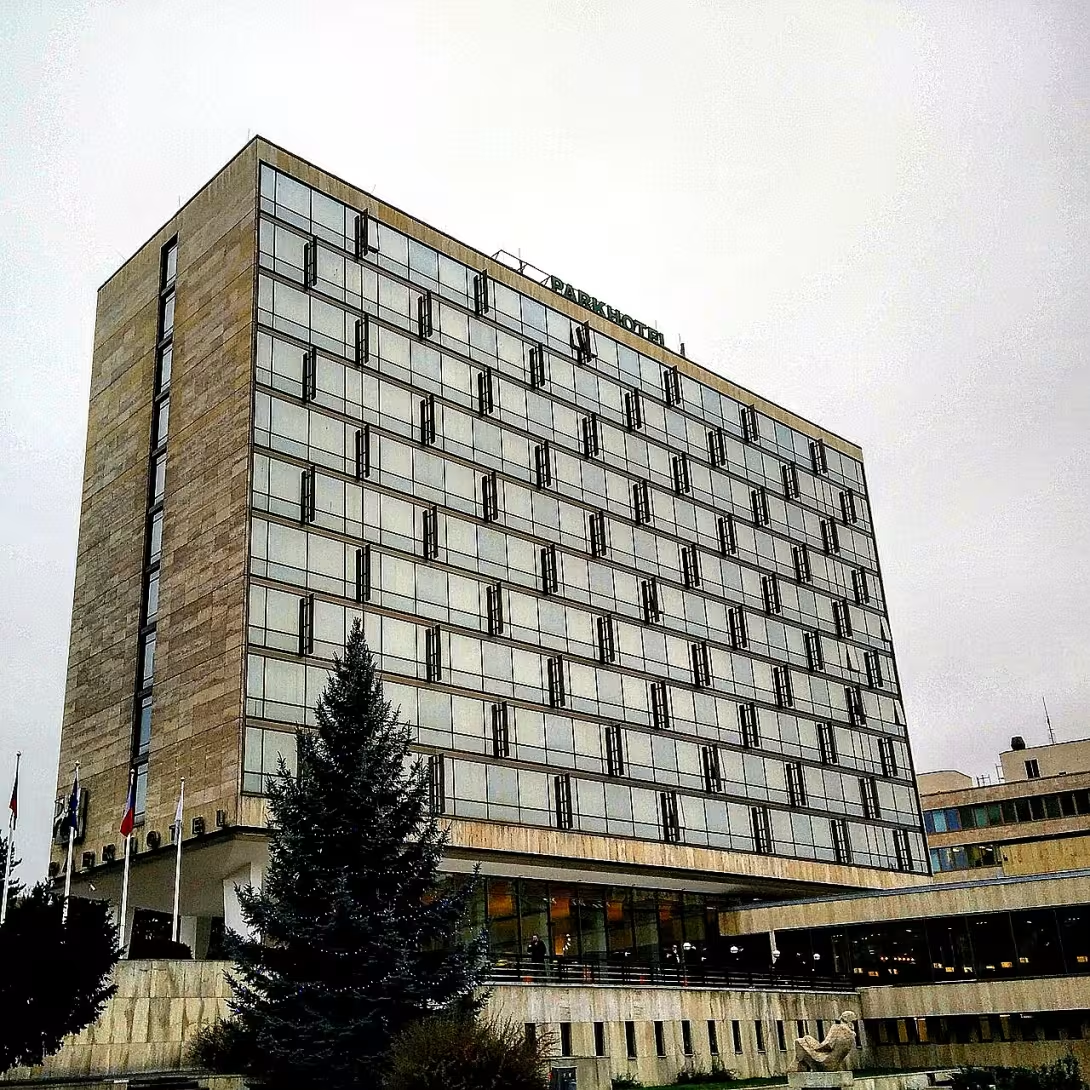
Parkhotel Praha is located in Holešovice at the crossroads of the streets of Dukel Heroes and the Fair. It is the first in a series of large Prague hotels, which were planned to spread around the city in the 1960s to 1980s.
The construction was created within the urban plan, which used the attractiveness of the Vltava shores. The original concept before 1938, however, provided for a different purpose for this place - a symmetrical building complementary to Prague sample fairs. The Parkhotel project was developed in 1964-1967 by architects Zdeněk Edel and Jiří Lavička from the State Project Institute of Trade, with assistance of Jaroslav Tomáš. The interiors were designed by Alena Šrámková. The building was completed and ceremonially opened on July 7, 1967.
The architecture stands on a monolithic reinforced concrete structure with columns. The building combines a horizontal block preplanted towards the lower location of Dukel Heroes street and a ten-floor vertical prism designed for accommodation. This vertical element is slightly filmed against the tray. A characteristic feature is a pair of oblique concrete pillars at the main entrance, which carry a higher part of the construction. The embedded rows of pillars form a smooth connection between the exterior and the interior. The entrance area includes garden treatment and staircase leading to the terrace at ground floor height.
After 1989, ownership ratios changed. In 2006 the hotel was purchased by SGR International.
Parkhotel Praha shows the use of modern materials and period access to urban planning. It represents a suitable goal for people interested in the architecture of the twentieth century and the history of development in Prague Holešovice.
Then and now
Drag the slider to compare how the landmark may have looked when it was built with the view today.
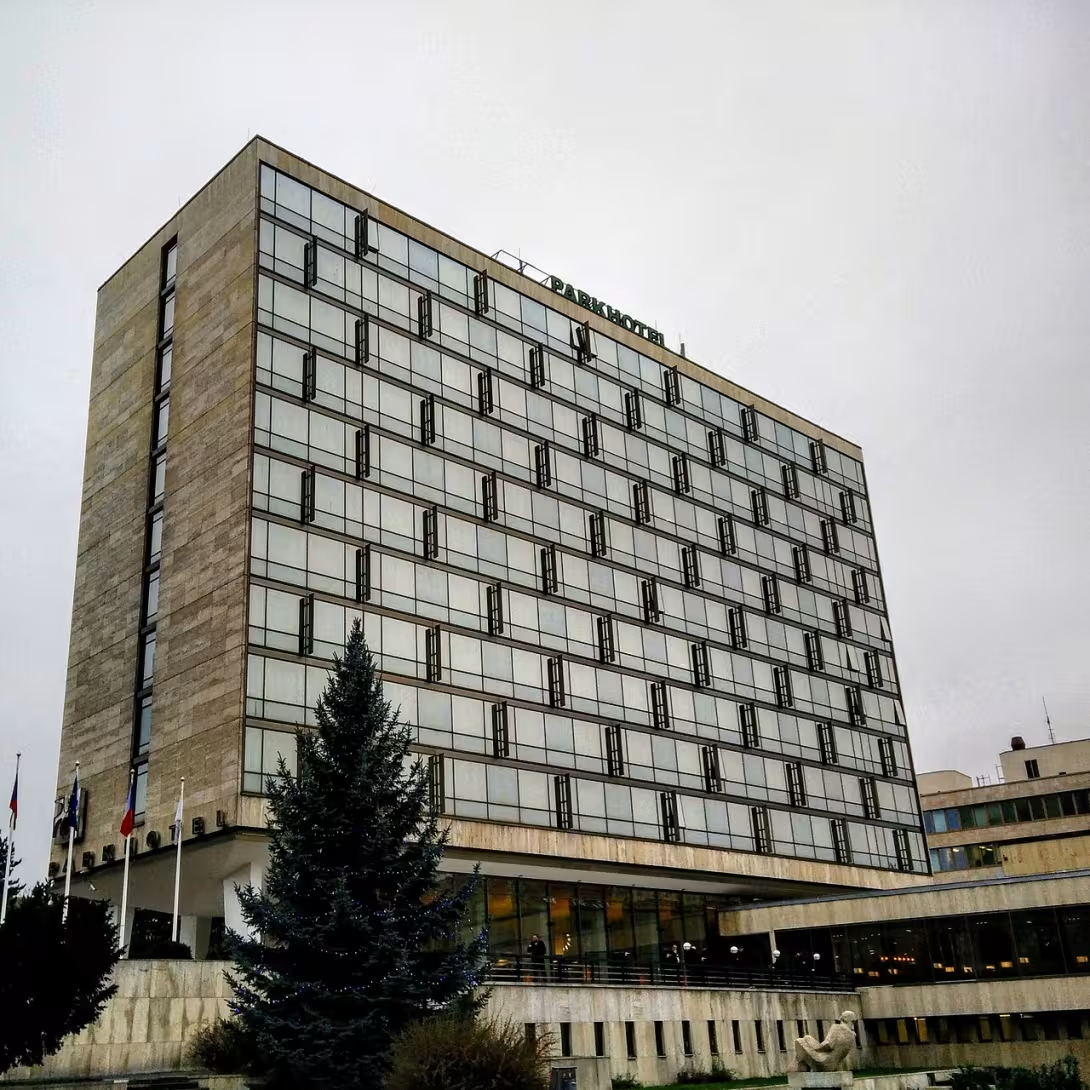
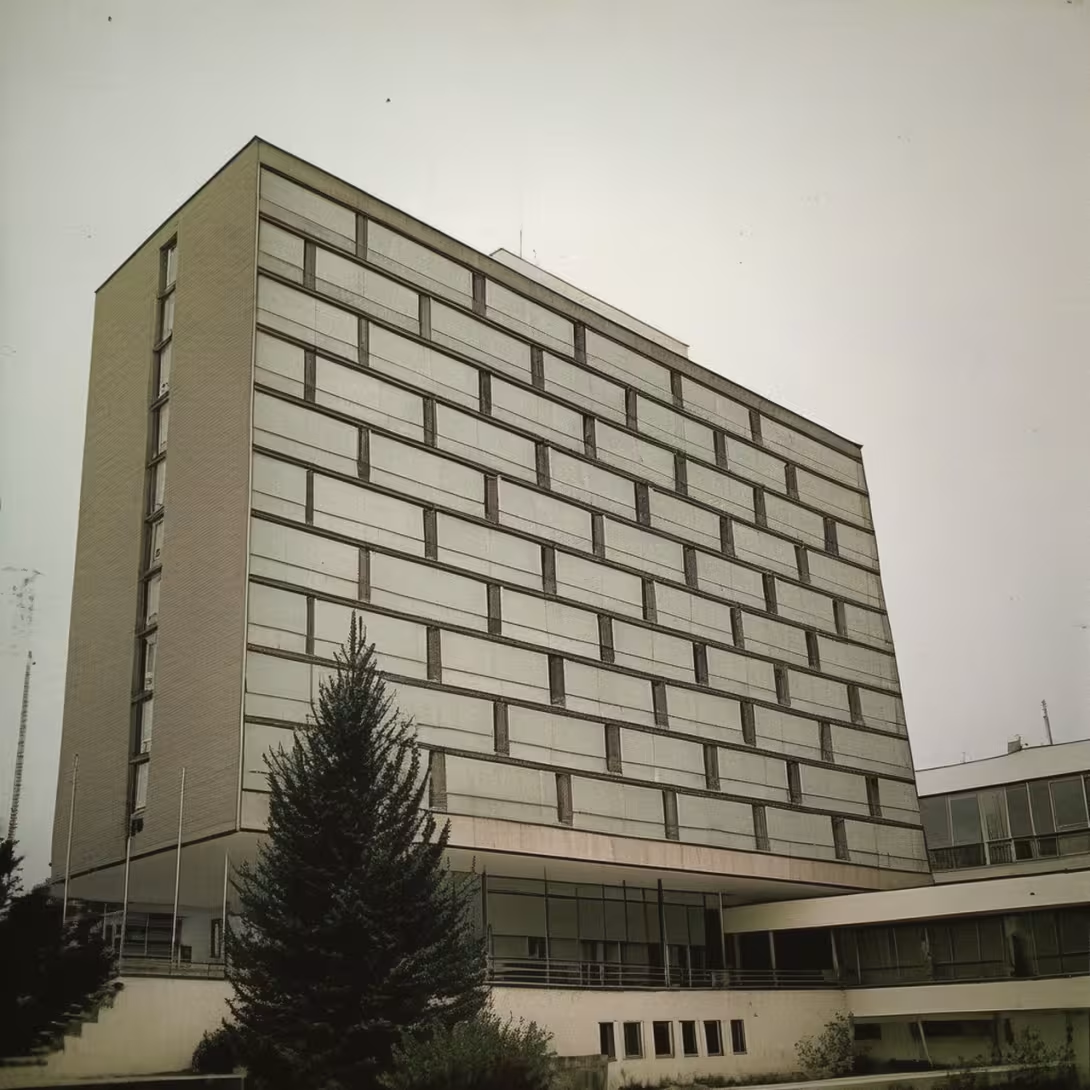
The historical appearance on the left is an AI-generated visualisation and serves as inspiration only.
Historical milestones
- 1964
- The beginning of the project of architects Zdeněk Edl and Jiří Lavíčka.
- 1967
- Completion of construction and festive opening on July 7th.
- 2006
- Buying a hotel by SGR International.
Architectural development
The construction is monolithic, reinforced concrete with columns. The building is made up of a horizontal block set up on Dukel Heroes Street and a slightly filmed 10-floor accommodation prism. The characteristic feature is the oblique concrete pillars at the main entrance.
Historical events
july 7, 1967: opening ceremony.
Owners
Since 2006, SGR International.
Points of interest
- It is the first in a series of large Prague hotels planned in the 1960s to 1980s. - Before 1938, a symmetrical building was foreseen for this place to be complementary to Prague sample fairs. - The building was opened on July 7, 1967. - The building contains a 10-floor vertical prism designed for accommodation, which is slightly filmed. - A characteristic feature is a pair of oblique concrete pillars at the main entrance.
Guide
Show guide text
This text was created by artificial intelligence and has not been editorially reviewed. It may contain inaccuracies.
Welcome to Holešovice, one of the most fascinating parts of Prague, where industrial history meets modern urban planning. Stop for a moment, take a deep breath and look in front of you. You are standing right in front of the Parkhotel Prague, a construction that is much more than just a place for passengers. It is essentially a stone and concrete inscription of one particular time, a testimony of ambition and architectural thinking of the second half of the twentieth century. Feel the atmosphere of this intersection point where the streets of Dukel Heroes and the Fair meet. It is here, on this corner, that the complex is spread out, which at the time of its inception was a new beginning for Prague's hotel industry.
Let's go back in time together to understand why this building was created and what it was meant to mean at the time. Imagine Prague of the 1960s. It was a period of searching for new paths, modernization and desire for a large scale. In this context, the Parkhotel Prague project was created. In the year one thousand nine hundred sixty-four architects Zdeněk Edel and Jiří Lavička went to work, to which Jaroslav Tomáš and Alena Šrámková later joined. Their job was not just to build a hotel, but to create something that would define a new era. The Parkhotel was the very first of many large Prague hotels, which were planned and subsequently built in the range of the 1960s to 1980s. So he was a pioneer, the first stone, based on the modern housing system of the capital.
Now that you're standing outside the building, pay attention to its overall shape. See how the structure is laid out in space. The architects worked here with very clear and strict geometry. Note that the building is not a monotonous block. It consists of a combination of two basic elements. The first is an extended horizontal block which forms the hotel's basic body and spreads out in space as a stable base. And then look up. See that distinctive, ten-story vertical prism? It is this vertical tower that dominates the whole and gives the construction dynamic. This combination of water equality and vertex was a very modern approach at the time. It's a game with space to create a sense of stability, but also an increase. Look at the facade and see how these two parts fit together. It is an architecture that does not seek unnecessary ornaments, but bets on purity of lines and clarity of shape.
The construction progressed for several years and its peak was a festivities you can imagine. On July 7th, a thousand nine hundred sixty-seven, the building was officially completed and ceremonially opened. Imagine the celebrations, expectations and pride with which this modern complex was presented to the public. At that time, it was a symbol of the city's progress and openness. The hotel served as a gateway for visitors who came to Holešovice, an area which was and is closely linked to trade and trade fairs.
When we talk about the people involved in this place, we need to mention the architects again. Zdeněk Edel, Jiří Lavička, Jaroslav Tomáš and Alena Šrámková together created a work to influence the future construction of similar buildings in Prague. Although today we may not know the specific personalities that were in the hotel rooms, the very existence of the building tells the story of collective work and visionary work. The hotel has undergone various changes over the years, one of which was the purchase of SGR International in two thousand and six. This brought a new era of governance and a new view of the use of this space in the modern world.
Now I want to take you to something you can't see at first sight, but what is crucial to understanding this place. It's basically a little architectural mystery or rather a story about what might have been and what eventually was. Try to forget about the vertical prism and the horizontal block you see before you. Imagine the year is one thousand nine hundred thirty-seven. At that time, this place was considered completely different. The plans from that time assumed that there would be a symmetrical building. It should be a mirror supplement to the Prague sample fairs. At that time symmetry was a symbol of order, elegance and classical beauty. If this plan had won, Holešovice would have looked completely different today. Instead of the bold geometric contrast you see now, there would be a harmonious, balanced structure. It's fascinating to see how over the course of 30 years the taste and the needs of society have completely changed. Since symmetry before World War II, we have moved on to the functionality and bravery of the 1960s. Parkhotel Praha is therefore living proof of how our ideas of what is modern and beautiful change.
Now, if you look at the building again, consider it a bridge between two worlds. On the one hand, there is the history of trade and trade fairs, on the other hand, the ambition of a modern city that wanted to be at the heart of the event. The ten-story prism that rises to the sky is like a scream of the time that believed in technology and linear development. The horizontal block then recalls that even the greatest ambition must have solid ground.
Imagine how many thousands of people have walked through this hotel's door since a thousand nine hundred sixty-seven until today. How many business meetings took place here, how many travelers rested here after a long trip and how many people first saw Prague from the windows of this hotel. Each of them saw this architecture a little differently, but for all, this building was a dominant Holešovice.
Now that you know the story of origin, architectural details, and even what was never done in the plains, I suggest you go around the building again. Notice how the view of the vertical prism changes when you move from the corner of the street deeper into space. Watch how the building responds to light and how its geometric shapes divide the space around it. Parkhotel Praha is not just a building, it is a chapter from the history of Prague's urbanism, which you have just searched with me.
Thank you for accompanying me on this short journey to history and architecture. I hope you are interested in this view of Parkhotel Praha and that you will perceive the surrounding buildings in Holešovice with new curiosity. You are now fully entrusted with the space. Explore the surroundings, feel the rhythm of the city and enjoy your next destination in our beautiful city. Goodbye and have a good trip.
Tips for visitors
The best time to observe the architecture of this hotel is in the morning or late afternoon when sunlight best highlights the shapes of the building. There's also a less busy neighborhood in these classes.
Transport to the site is possible by public means of transport and by car. The current timetables and connections are best checked in the internet search engine. If you arrive by car, look for parking options according to local transport signs.
When visiting, we recommend to carry a card and payment money. For photography is the most suitable position on the corner of the streets of Dukel Heroes and Trade Fair, from where you can capture the entire width of the building.
In the vicinity there are Prague sample fairs which represent an interesting destination for a visit within a short walk. This part of the city is suitable for families with children due to the wide area nearby.
Businesses nearby
Do you run a restaurant, accommodation, shop, museum, rental, wellness or other visitor service near this monument? Show yourself directly to the people heading to it — this is how they will see you in the app and on the web:
Events nearby

Zdroj akcí: otevřená data měst a obcí ČR (Národní katalog otevřených dat) a kalendář akcí Národního památkového ústavu.
Nearby
Pražské vzorkové veletrhy.
Accommodation nearby
Trips and activities nearby
Guided tours, tickets and activities nearby from GetYourGuide
Affiliate link: if you buy from the partner, we may receive a commission. The price for you does not change.
Search tours and activities →Themed route
1. Prague sample fairs - Fair area. A place with unique architecture and interesting spaces. Parkhotel Praha - Hotel. The main destination of the trip, which offers accommodation and rest. 3. Parkhotel Praha (Area) - Park. Space for a quiet walk in the immediate vicinity of the hotel.
Seasonal recommendations
Spring: In spring, the surrounding area of Parkhotel Praha in Holešovice wakes up and the gardens begin to bloom. The light is delicate and pleasant in this period, which gives the building a fresh look. I recommend you take several layers of clothing because the wounds are still cold and the afternoon can be warm. The best thing is to come around noon, when nature is the most alive and people don't pile up yet.
Summer: Summer months bring intense sun to Prague and very long days of life. The atmosphere in this part of town is very lively and full of energy in the main summer season. Due to high temperatures and more visitors, it is better to arrive first thing in the morning to avoid the greatest heat and crowds. Dress lightly and don't forget to protect yourself from the sun.
Autumn: Autumn visit offers beautiful leaf colours and a much calmer mood. The morning mist gives the place mystery and the light is golden and soft in the afternoon. It is advisable to carry a windbreaker or coat, because the air is usually wet and colder. This time is ideal for those who seek peace and want to avoid the greatest gathering of people.
Winter: In winter, the days are short and the air is usually freezing, which creates a cozy but cold atmosphere. If you come at this time, prepare for less light and perhaps even snow. The necessity is very warm clothes and solid shoes. I recommend planning a visit during bright days because evenings come very soon and light quickly disappears.
Visualizations and artistic views


The visualisations are generated by artificial intelligence and serve as inspiration.
Photos from the area
Real photos taken near the monument


Zdroj a licence jsou uvedeny u každého snímku.
Tips from visitors
No tips yet. Be the first!
Log in and add your tip.
Sources and literature
Photos: Johan Jönsson (Julle) / CC BY-SA 4.0 — Wikimedia Commons. The author and licence also appear when you hover over the image.
Faktickým podkladem tohoto textu byl článek na Wikipedii, jehož autory jsou přispěvatelé Wikipedie. Článek je dostupný pod licencí CC BY-SA 4.0.
Location on the map


Příběhy a pověsti
Legendy, pověsti a příběhy spjaté s touto památkou
Fotografie návštěvníků
Zatím žádné fotografie. Buďte první, kdo přidá fotografii z návštěvy!
Log in a přidejte svou fotografii nebo hodnoťte.
Za ověřenou návštěvu v aplikaci získáte víc bodů — poznáme podle GPS, že jste na místě.
Reviews and comments