



Podzemní vodárna Waterworks
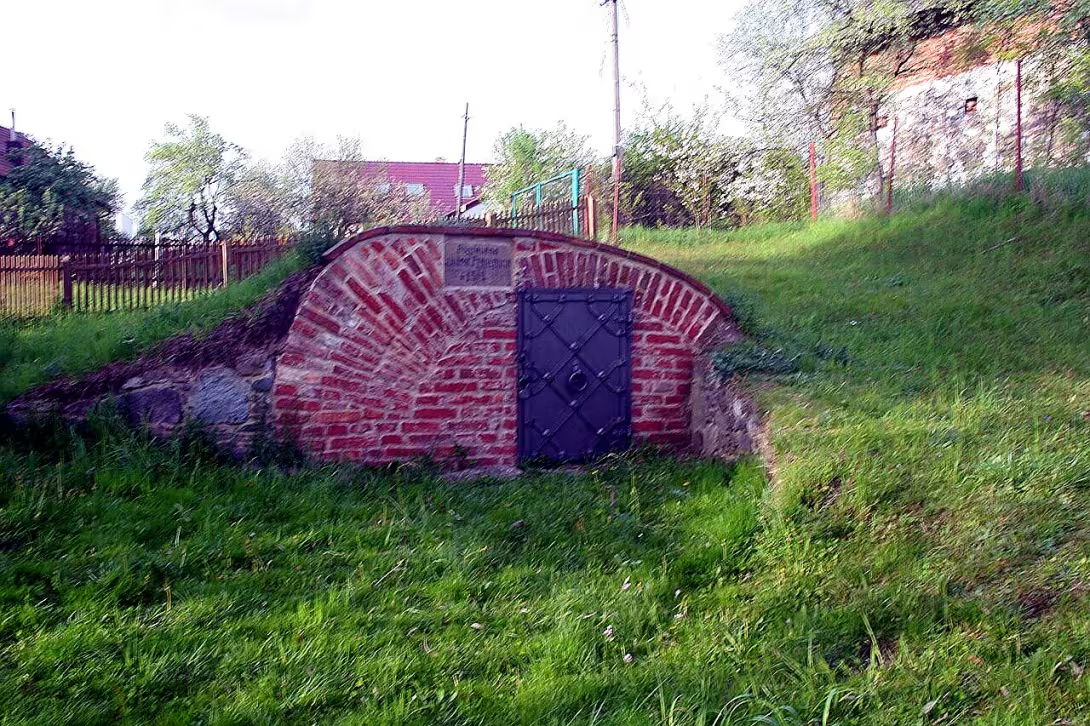
The underground Pernštejn water plant in the location U Vodárny on the western edge of the village of Srch in the district of Pardubice is a significant Renaissance water work from 1515. It served as a reservoir of water to power the fountain in Pardubice Square and in the castle. Since 7 June 2001 it has been a protected cultural monument registered in the Central List of Cultural Monuments of the Czech Republic under registration number 51001 / 6-6193.
This monument represents a historical water work whose main purpose was to store water for the mentioned fountains in Pardubice Square and in the castle.
The creation of this building dates back to 1515 and is linked to the reign of Wilhelm of Pernštejn. At this time, the Pardubice estate experienced a significant economic boom, including the construction of advanced water systems.
It is built into the slope of a deep brick tank, which is encapsulated by a coiled brick vault. The rear part of the tank embedded under the terrain and the frame on the facade are lined with stone. Only the facade of a brick wall with modern metal doors ascends above the grassy surface. At the top of this facade is a stone sandstone plate with historical inscription built behind Wilhelm of Pernštejna in 1515. The object also includes taras on the facade.
From the point of view of administration and history, the documented data is limited to 1515, when the construction took place behind Wilhelm of Pernštejn, and 7 June 2001, when the building became a cultural monument of the Czech Republic.
The interesting feature of this construction is its inconspicuous appearance in the landscape, where it appears to be only a mild field wave with a brick front.
Today this monument is located on the western edge of the village of Srch in the location U Vodárny. For its historical value and as an example of advanced water management from the Renaissance period, it is certainly worth a visit to explore the technical monuments of the Pardubice region.
Historical milestones
- 1515
- Built underground watershed behind the Villa of Pernstejna
- 2001
- The object became a protected cultural memory
Architectural development
The water plant represents a deep wall tank with a corrugated brick vault into the slope. The rear face of the tank and the taras on the facade are lined with stone. In the upper part of the brick facade there is a stone sandstone plate with historical inscription.
Points of interest
- The construction has a subtle appearance in the landscape, where it appears to be only a mild field wave with a brick front.
Guide
Show guide text
This text was created by artificial intelligence and has not been editorially reviewed. It may contain inaccuracies.
Welcome to the village of Srch, in the quiet corner of the Pardubice region, where history lies right under your feet. You're standing right in front of a place that may not look like a magnificent palace or a high tower, but its value and significance are just as rare. Look around you at the landscape. Note that there is no monumental structure in front of you that rises to the sky, but rather an inconspicuous terrain wave. It is this slight ripple of the earth that you see now that is basically the roof cover of something far more fascinating. What appears to be the natural shape of a hill is actually a mask for an underground Pernstein waterworks. The only clear sign that there is a human hand is a brick facade that stands out of the field and serves as a gateway to this forgotten world of water and stone.
Let us now move back more than 500 years in time. We're in 1515. At that time, this area was under the influence of one of the most powerful noble families in Czech countries, the Pernštejn family. It was Vilém z Pernštejna, a man of great vision and strategic thought, who had this water work built. At the time, it was not just a simple construction project, but a key element of infrastructure that was intended to serve the whole city of Pardubice. Imagine how important it was in the 16th century to ensure a reliable supply of clean water. This waterworks was not built for joy, but for a specific and very important purpose. It served as a huge reservoir, a storage tank, which was intended to power the fountain on the Pardubice Square while providing the needs of the Pardubice Castle. The water that has been hoarded here has travelled from this place to the heart of the city to serve the inhabitants and nobles. It is fascinating to think that the water that once flowed from this place was the basis of life and sanitation in that city.
Now pay attention to the architecture of this work itself, although most of it is hidden from your eyes. What you see on the surface is just a small fraction of the whole. The main part of the water plant is made up of a walled tank, which was carefully dug directly into the slope. This position was not random, using natural terrain to allow water to flow and be stored in cold and without direct sunlight. If you could see inside, you would see a brick vault over your head. This vault is a typical element of the time and was used to carry the enormous weight of the superstructure, while maintaining the stability of the whole structure. Notice the material from which the building is removed. While the vault is made of bricks, the rear part of the tank, which is deeply embedded under the terrain, and also the frame on the facade, are lined with stone. The use of stone at these critical points has ensured that the construction can withstand centuries of water and moisture pressure without collapsing. It is proof of the championships of the then builders who remained anonymous, but their work survived for centuries.
When we think about this place, we can't ignore the personality of William of Pernstein. He wasn't just a waterworks builder, he was a man who changed the face of the entire region. His ambitions and ability to organise large projects are clearly visible in this water factory. To him, water was not only a basic need, but a symbol of power, reason and care for its subjects. To build a system that can transfer water from the edge of the village to the center of the city, it required a deep knowledge of engineering at the time. William knew that without water there was neither life nor the flowering of the city, so he invested in such a lasting and good work. So this water plant is a silent witness to his ambitions and influence that the Pernstejns left behind in this country.
And now we get to what's most interesting about this place of perhaps. Notice how subtle this structure is in the landscape. Nowadays we are used to the fact that the monuments are distinctive, have tall columns or decorated facades. However, Pernstejn Water is the opposite case. It's an architecture of stealth. If you walked past her and didn't know what to look for here, you'd probably miss her like an ordinary hill with several bricks. It is in this contrast that her secret lies. It's a hidden treasure that doesn't show its value at first sight, but reveals it to those who stop and start thinking. It is a reminder that some of the most important things in our life and history are often those that are not visible on the surface, but form a solid basis for everything else.
This inconspicuous building was not recognised as a protected cultural monument until 2001. This shows us that after five hundred years, we can still appreciate the genius of a simple and functional solution. What was modern technology in 1515 became a valuable historical document today. It's a bridge between the time of the Renaissance and our present, which reminds us of how people used to deal with nature and how they could use its resources to their advantage.
Now that you know what lies beneath that mild wave of terrain and what role this water plant has played in Pardubice history, I suggest you stop for a while in silence. Try to imagine the sound of the running water that was building up here, and imagine the people who, centuries ago, with stones and bricks in their hands in Hill of Shrich made this work. Feel the atmosphere of this place, where nature and human labor are so intertwined that it almost swallowed each other up.
Thank you for escorting me to this brief interpretation of the underground Pernstejn waterworks. I hope you are interested in this stealth piece of history and that you now see more in this landscape than just plain terrain. Now invited to further explore the surroundings and discover the other hidden details that this area carries. I wish you a pleasant continuation of your journey and many new, fascinating experiences. Goodbye.
Tips for visitors
Preferably visit the underground water plant Srch during spring or autumn, when the weather is pleasant and fewer visitors. These periods also offer a beautiful opportunity to see the surrounding green landscape in full life.
The location is easily accessible by car and public transport. For accurate information about the current connection, we recommend using online search engines.
When visiting, bring sun protection, drinking water and perhaps even comfortable shoes. Although the journey is neither long nor too difficult, the terrain may be irregular.
The best place for photography is at the entrance to the water factory, especially in the early morning or in the evening when the light is softer. This allows you to capture historical architecture in atmospheric conditions.
The surrounding area offers a beautiful view of the area and is an ideal place for relaxation. For families with children it is a suitable place for a short walk or picnic.
Frequently asked questions
Can the monument be visited?
The building is in use (offices, a school, shops and the like). The interior is generally accessible only during operating hours and tours are not usually offered; we have not verified the details. You can see the exterior from the street.
Where is the monument?
Location: Pardubický kraj. The map on this page shows the exact spot.
Why is the monument protected?
It is listed in the Central List of Cultural Monuments of the Czech Republic as a cultural monument (register no. 1000442275).
Businesses nearby
Do you run a restaurant, accommodation, shop, museum, rental, wellness or other visitor service near this monument? Show yourself directly to the people heading to it — this is how they will see you in the app and on the web:
Nearby
Lokalita U Vodárny na západním okraji obce Srch.
Accommodation nearby
Themed route
Thematic cruise route around the Underground Waterworks
1.Podzemní vodárna - Type: Water work - Why is it worth a visit: This historic underground waterworks is a technical monument, built in the early 20th century and used to supply water for local areas. It is a fascinating example of the engineering art of the time, which can be visited after a short survey of its underground corridors and technical facilities.
2. Location U Water plant - Type: Historical site - Why it is worth a visit: This place is an ideal place to relax and explore the surrounding landscapes where the water room is located. It is a place with beautiful green platforms and quiet atmosphere that allow you to enjoy the natural environment on the western edge of the village of Srch.
3. Garden U Water plant - Type: Green area - Why is it worth a visit: This garden offers a beautiful area for a picnic or just for a moment of rest. It is a place where you can enjoy a quiet moment and look at the different kinds of plants and birds that reside here.
4. Port U Vodárny - Type: Space for rest - Why is it worth a visit: This place is ideal for those who want to stop and enjoy a quiet moment on the water. Here you can look at the fish or just sit down with the book and look forward to a peaceful moment.
5. Camping place at the Waterworks - Type: Location - Why is it worth visiting: If you are planning a longer stay in the area, it is the perfect place for camping. It offers basic equipment and the opportunity to enjoy the natural environment in peace and quiet.
This route offers a combination of technical history, nature and relaxation, making it ideal for a diverse group of visitors.
Seasonal recommendations
In spring you will be welcomed by the waking nature around the entrance and fresh air. The contrast between flowering gardens and the cold calm of underground corridors creates a pleasant feeling. We recommend visiting a place in the morning when there are fewer people. Don't forget to wear a light jacket, because it remains wet and cold in the waterworks.
The summer season is ideal for escaping the hot sun. In the underground, there is a refreshing cold and a humid atmosphere that provides a relief from heat. Expect bigger crowds because of the season, so come right in. Even though it's hot outside, we recommend you bring a sweater so you don't freeze in cold areas.
Autumn brings a mysterious mood with fog and golden leaves around the monument. The atmosphere is quieter and less noisy than in previous months. It is advisable to choose the afternoon walk before it becomes dark. Practical tips are waterproof shoes to protect you from moisture of roads and underground spaces.
In winter, the most striking contrast is between freezing outdoor air and stable temperature inside the water plant. The whole space is silent and stopped, which underlines the historical character of the work. Due to the shorter opening time, plan to visit in the morning. Dress very warm, especially when moving from the inner space back to the frost.
Visualizations and artistic views


The visualisations are generated by artificial intelligence and serve as inspiration.
Photos from the area
Real photos taken near the monument


Zdroj a licence jsou uvedeny u každého snímku.
Tips from visitors
No tips yet. Be the first!
Log in and add your tip.
Sources and literature
Photos: Petr1888 / CC BY-SA 3.0 — Wikimedia Commons. The author and licence also appear when you hover over the image.
Faktickým podkladem tohoto textu byl článek na Wikipedii, jehož autory jsou přispěvatelé Wikipedie. Článek je dostupný pod licencí CC BY-SA 4.0.
Location on the map
More monuments – Pardubický kraj
Show all in the region

Příběhy a pověsti
Legendy, pověsti a příběhy spjaté s touto památkou

Fotografie návštěvníků
Zatím žádné fotografie. Buďte první, kdo přidá fotografii z návštěvy!
Log in a přidejte svou fotografii nebo hodnoťte.
Za ověřenou návštěvu v aplikaci získáte víc bodů — poznáme podle GPS, že jste na místě.
Reviews and comments