



Psychiatrická nemocnice Bohnice Hospital building
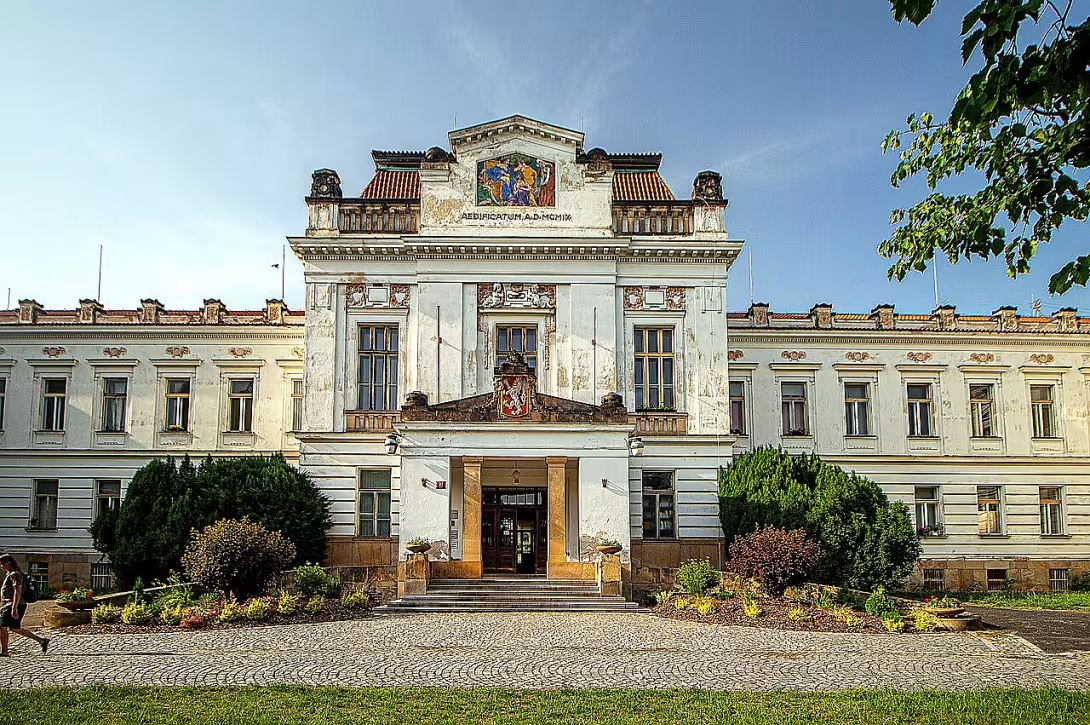
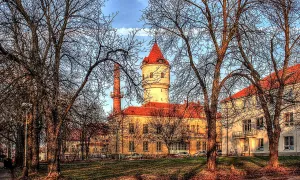
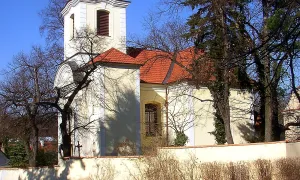
Psychiatrická nemocnice Bohnice is a generously conceived Art Nouveau area of 64 hectares. He grew up in the years 1903 to 1916 on a green meadow in Prague - Božnice according to the design of architect Václav Roštápil. The dominance of this historical complex is the church of St. Wenceslas and the main administrative building, which resembles a Baroque castle. The facilities were designed as the most modern and largest of their kind in Austria-Hungary. Today it is used to treat psychiatric diseases and its large park is fully open to the public.
In the early 20th century, the development of industrialization took place in Czech countries. This brought a deterioration of the social conditions of the population and a growing need for beds, especially in Prague. The Regional Committee of the Kingdom of the Czech Republic therefore decided by order of 12 November 1903 to build a new institution for the insane. For this purpose he bought a large estate with fields and adjacent Chimikých grove in Božnice near Prague. The establishment started as a branch of the Prague Institute in Charles. In 1904, the first patients who performed auxiliary work arrived here. On 28 April 1909 a separate Royal Czech Regional Institute for the insane in Bohemia was established.
Construction of the whole complex took place between 1906 and 1912. A total of 28 treatment pavilions and a number of operating objects grew back then. The architectural design of the administrative building, church and villas in the southern part was prepared by Václav Roštlapil. The Pavilion system allowed exceptional differentiation of patients for their period according to the nature of their difficulties. It included quiet patients, bedpans, infectious operations, and criminal offenders. The components of the complex consisted of a power plant, water jams, service stations of utility water from Vltava and economic facilities. Thanks to this, the Institute was designed as a self-sufficient town.
The object was owned by the Regional Committee of the Kingdom of Bohemia. The first director became MUDr. Jan Hraše, after which the management was taken over by MUDr. Bohuslav Hellich. During the First World War, some pavilions served as a military Lazaret, for example for evacuated mentally ill Italian Trident. The number of patients increased temporarily to 2 186 at the time. Between the two world wars, capacity expanded further and in 1938 the institution reached a historical maximum of 2,567 patients. During the Nazi occupation between 1939 and 1945, the care slowed down and the area received people from the damaged hospital in Dobrány and from the abolished institution in German Brod.
The key element of functioning was the initial involvement of patients in the work process. They worked in agriculture, horticulture, park maintenance, kitchen or workshop, which was of great therapeutic importance. There was also a music choir and later a theatre. The village Bohnice itself became part of Prague in 1922. In folk language the word Bohnice began to be used as a symbolic term for a mental institution or psychiatric institution.
At present, the complex offers comprehensive care for the mental health of adults, children and seniors as well as treatment of addiction. The theatre Behind the fence, the V. column club and the sociotherapy farm are located in the premises of the original farm, which provides working therapy and hipotherapy. The architecturally valuable pavilions are planted in a grown park. It is freely accessible to the public and provides a quiet environment for walks.
A visit to this historic area reveals a unique combination of a generous urban plan of the early 20th century, a quality Art Nouveau architecture and a still functioning therapeutic environment. Walking through the park offers a unique opportunity to know the place that has been serving its original purpose for generations, while forming an integral part of the cultural landscape of Prague.
Historical milestones
- 1903
- The Regional Committee of the Kingdom of the Czech Republic decided to build a new asylum for the insane in Bohunice.
- 1904
- The first patients from the Prague Institute came to the future institution as an aid force.
- 1909
- A separate Royal Czech Earth Institute for the Insane in Bohemia was established.
- 1916
- The main stage of construction of the generously conceived site was completed.
Architectural development
The construction of the complex took place between 1906 and 1912, when a total of 28 treatment pavilions and a number of operating buildings grew up. The architectural design of the administrative building, church and villas in the southern part was prepared by Václav Roštlapil. The Pavilion system allowed exceptional differentiation of patients for their period according to the nature of their illness. The complex included its own power plant, water jams, gas station and economic facilities.
Historical events
On November 12, 1903, the Regional Committee of the Kingdom of Bohemia decided on the construction of a new asylum institution. In 1904, the first patients from the Prague Institute who performed auxiliary work arrived at the premises. On 28 April 1909 a separate Royal Czech Regional Institute for the insane in Bohemia was established. During the First World War, some pavilions were used as a military hospital for evacuated mentally ill.
Owners
Regional Committee of the Kingdom of Bohemia
Points of interest
- It is a generously conceived Art Nouveau complex with an area of sixty-four hectares, which grew between nineteen and three to nineteen hundred and sixteen. - The main administrative building of this historical complex resembles a Baroque castle and the church of St. Wenceslas is also dominated. - The facility was designed as the most modern and largest of its kind in Austria-Hungary and, thanks to its own power plant, water and economic facilities, it worked as a self-sufficient town. - During the First World War, some pavilions served as a military hospital and the number of patients rose to two thousand and eighty-six. - The key element of operation was the involvement of patients in the working process on the farm, horticulture, workshops or in park maintenance, which was of great therapeutic importance.
Guide
Show guide text
This text was created by artificial intelligence and has not been editorially reviewed. It may contain inaccuracies.
Welcome. You are standing in front of the vast area of the Psychiatric Hospital Bohnice and have put on headphones to learn the story of this special place. Look around you. You are in an extensive complex of sixty-four hectares, which was generously built on an earlier green meadow. Do you feel the calm atmosphere? In front of you, there is a complex full of architecturally valuable pavilions that are sensitively planted in a grown park. This park is not just for patients, but is also open to the general public for walking and contemplation.
Let us now return in time and look at how this respectable complex was formed. The year is nineteen hundred and three, and the Regional Committee of the Kingdom of Bohemia decided at that time to build a new asylum for the insane in Bosnian. The total construction of this generously conceived area took place between nineteenth and nineteen hundred and sixteen. The first patients came here in nineteen hundred and four, from the Prague Institute, initially acting as an aid to the construction. A few years later, in nineteen hundred and nine, a separate Royal Czech Earth Institute for the Insane in Bohunice was established and finally in nineteen hundred and sixteen the main stage of the construction of this generous work was completed.
Now pay attention to the architecture itself. The whole complex was built according to the design of a talented architect who was Václav Roštlapil. When you look around, notice how individual buildings are arranged and how harmonically the greenery of the surrounding park blend together. The dominant feature of the whole complex is the beautiful church of St. Wenceslas, which will certainly impress you at first glance with its nobility. You will also draw your attention to the main administrative building of this historical complex. Its appearance is so distinctive that it instantly resembles a castle in Baroque style. Try to stand for a while, observe the lines of buildings, perceive the proportions of the facade and let the whole architectural concept, which was created on the green meadow in the early twentieth century, affect itself.
Let's move on in our narrative and remind ourselves of the people who have linked their lives and fates to this place. The history of the Bohemian Institute is associated with a number of important personalities, such as Antonín Růžička, Jan Hraše or Bohuslav Hellich. These people formed the operation and spirit of this device in its beginnings and left an indelible mark. Each of them has contributed to making the Institute what it is today, an important and generously conceived complex with a deep history.
Let's stop at the attractions surrounding this place. The whole complex is an example of the generous Art Nouveau architecture and urbanism of its time. The area of sixty-four hectares provided plenty of space not only for the healing buildings and facilities themselves, but also for extensive park modifications which were intended to have a positive effect on patient mental status. The combination of nature, architecture and a premeditated arrangement of pavilions makes this place a unique historical entity, which has no many traditions in our countries.
Thank you for listening so far. Now, I invite you to explore this beautiful area again. Follow the roads here, discover further corners of the park, see the link of architect Václav Roštápal and let yourself be carried away by the history that breathes on you from every corner. I wish you a pleasant walk and goodbye.
Tips for visitors
The best time to visit is late spring or autumn, when the colours of the grown park are the most distinctive and the architecture of Roštápila excels in a mild light. The premises can be reached by car and public transport; Check the current connection in the search engine.
When walking we recommend to wear comfortable shoes suitable for long routes because the area of the area is very large. As it is a operated medical facility, we recommend to maintain calm and discretion.
For photo lovers are the most interesting views of historical buildings from outside. The best light for façades is shortly before sunset.
In addition to the buildings themselves, you will definitely visit the large park in the area and adjacent Čimický grove, which offers peace and nature in the immediate vicinity.
For families with children it is ideal to walk in the surrounding park and in the forest, where you can walk safely and observe nature, which is a pleasant contrast to the urban rush.
Frequently asked questions
Can the monument be visited?
The building is in use (offices, a school, shops and the like). The interior is generally accessible only during operating hours and tours are not usually offered; we have not verified the details. You can see the exterior from the street.
Where is the monument?
Location: Bohnice. The map on this page shows the exact spot.
Why is the monument protected?
It is listed in the Central List of Cultural Monuments of the Czech Republic as a cultural monument (register no. 1000152683).
Businesses nearby
Do you run a restaurant, accommodation, shop, museum, rental, wellness or other visitor service near this monument? Show yourself directly to the people heading to it — this is how they will see you in the app and on the web:
Events nearby

Zdroj akcí: otevřená data měst a obcí ČR (Národní katalog otevřených dat) a kalendář akcí Národního památkového ústavu.
Nearby
Součástí areálu je vzrostlý park otevřený veřejnosti a přilehlý Čimický háj.
Accommodation nearby
Trips and activities nearby
Guided tours, tickets and activities nearby from GetYourGuide
Affiliate link: if you buy from the partner, we may receive a commission. The price for you does not change.
Search tours and activities →Themed route
1.Psychiatrická nemocnice Bohnice Type: Medical device. Why: The main destination of your trip in this location.
2. A big park open to the public Type: Park. Why: It offers a pleasant walk in a green environment right near the premises.
3. Chimy grove Type: Forest area. Why: Ideal place for a quiet finish trip in nature.
Seasonal recommendations
Spring brings a growing nature in the area, where huge parks are filled with flowering trees and fresh green grass, creating a strong contrast to historical brick buildings and providing a special, peaceful character under the spring sun. Since the complex works for everyday purposes, we recommend choosing fixed shoes to walk around a large park and a light jacket, because spring weather is usually variable and the morning shadow under the bony trees is still cold.
The summer offers deep shadows beneath the grown alleys that provide welcome relief during hot days, while sharp sunlight penetrating through thick leaves creates interesting visual effects on the old facades and the overall atmosphere is very calm thanks to the snorting nature. In this period you can use air clothes, headgear and plenty of drinking water, with the most appropriate time for outdoor walking around the outdoor pavilions being early morning hours when the air is still pleasantly cold.
Autumn turns the whole park into a colourful palette of shades from yellow to red, with morning fog covering a vast area and falling leaves on old roads creating a melancholy mood ideal for quiet contemplation in nature. For cold autumn days it is necessary to dress warm laminated clothes, waterproof shoes due to wet fallen leaves and set off in the afternoon when the low sun best illuminates architectural details of buildings.
Winter covers the whole enclosed complex into silence, which sometimes only disturb the snow crunch under the feet, while bare trees make the whole complex's generous composition stand out and the gray sky underlines the serious face of this historic place. For a winter walk outside, make up a warm winter shoe with anti-slip soles, gloves and a ball, and because the days are very short, plan your stay outside for around noon when the light is strongest.
Visualizations and artistic views

The visualisations are generated by artificial intelligence and serve as inspiration.
Photos from the area
Real photos taken near the monument

Zdroj a licence jsou uvedeny u každého snímku.
Tips from visitors
No tips yet. Be the first!
Log in and add your tip.
Sources and literature
Photos: VitVit / CC BY-SA 4.0 — Wikimedia Commons. The author and licence also appear when you hover over the image.
Faktickým podkladem tohoto textu byl článek na Wikipedii, jehož autory jsou přispěvatelé Wikipedie. Článek je dostupný pod licencí CC BY-SA 4.0.
Location on the map

Příběhy a pověsti
Legendy, pověsti a příběhy spjaté s touto památkou
Fotografie návštěvníků
Zatím žádné fotografie. Buďte první, kdo přidá fotografii z návštěvy!
Log in a přidejte svou fotografii nebo hodnoťte.
Za ověřenou návštěvu v aplikaci získáte víc bodů — poznáme podle GPS, že jste na místě.
Reviews and comments