






Purkrabský pivovar Brewery building
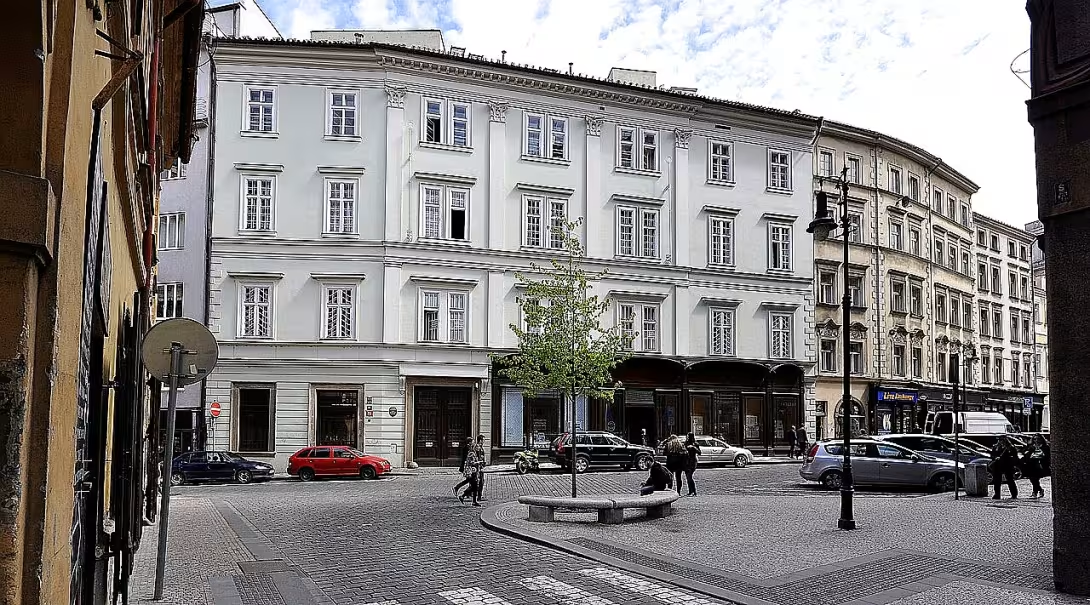
Purkrabský pivovar, located on the street Na Perštín 12 in Prague's Old Town, is a large residential house with a rich history. The building, which was created by the gradual connection of several originally medieval buildings, is protected as a cultural monument of the Czech Republic. Today it serves as the headquarters of the Prague Regional Centre of the National Heritage Institute, where there is also an information centre and a publishing shop.
The history of this place is closely linked to important communications of medieval Prague. A significant position was ensured near the link between Prague Castle, the Old Town Market and Vysehrad. Although archaeological evidence of Romanesque development is missing, there are assumptions about its origin and preserved Gothic cellars. In the 15th and 16th centuries, houses were converted into breweries. In 1641 Jaroslav Bořita z Martinic bought a house for the Purcrabery of Prague Castle, making the object known as Purkrabský pivovar.
The architecture of the object reflects its complex past. The shattering facade is indicative of the gradual structural modifications hidden behind a unified facade. Sober classicist elements make windows with second rococo-style tables, which are modern replicas. The Baroque wing increased around 1730 and in 1848 the building gained its present late classical form with an increase of two floors. After 1900 another floor was built and the interiors were supplemented with Art Nouveau elements, such as glass doors.
The property and administration of the building have undergone several changes. After Jaroslav Boríto of Martinique, it was owned by the Purcraby of Prague Castle until the 19th century. In the 1990s, Jaroslav Pospíslav's publishing house was located in the building, which moved in 1942.
Key events in the history of the building include the purchase of a house for purcrabery in 1641, Baroque modifications around 1730 and classical reconstruction in 1848. The department of the northeast part of the property in 1893 allowed the construction of new tenement houses.
Today Purkrabský pivovar serves not only as a monument but also as a functional administrative space. Historical and architectural values make it an interesting place for visitors to Prague. Thanks to the accessibility of the building, the public can not only explore its history, but also use the services of the National Heritage Institute.
Purkrabský pivovar reminds of the rich history and architecture of Prague. Its transformation from townhouse via brewery and Purkrabi property reflects the social and urban development of the Old Town Core. Visiting this place offers a unique opportunity to know the past and present Prague.
Historical milestones
- 1641
- Purchase of the object Jaroslav Boritou from Martinique for the Purcrabship of Prague Castle.
- 1730
- Complement the baroque wing at the southern border of the parcel.
- 1848
- Rebuilding to late classical form and raising the building by two floors.
- 1893
- Department of the northeast part of the property for building tenement houses.
Architectural development
The building is probably based on Romanesque foundations with preserved Gothic cellars. Around 1730 a Baroque wing was added and in 1848 the building gained a classical appearance with an increase of two floors. After 1900 another floor was built and the interiors were supplemented with Art Nouveau elements.
Historical events
1641 - purchase of a house for the purcrabship of Prague Castle; 1848 - a fundamental reconstruction into a late classical form; 1942 - moving away from the publishing house Jaroslav Pospíšil ml.
Owners
Jaroslav Bořita z Martinic (from 1641), the purgrave of Prague Castle (until the 19th century)
Points of interest
- The building was created by gradually connecting several originally medieval buildings and is protected as a cultural monument. In the 15th and 16th centuries, houses were converted into breweries at this place. - In 1641 Jaroslav Bořita z Martinic bought a house for the purcracy of Prague Castle, making the object known as Purkrabský pivovar. - The Baroque wing was added around 1730. - In 1848 the building acquired its present late classical form with an increase of two floors.
Guide
Show guide text
This text was created by artificial intelligence and has not been editorially reviewed. It may contain inaccuracies.
Welcome to the heart of Prague's Old Town. Right now, when you're standing in front of this building, you're in a place where history isn't just intertwined in textbooks, but in the very stones and walls that surround you now. The Purkrabský pivovar stands before your eyes. At first glance, you may find it a coherent and unified building, but if you look at it more carefully, you start to see a fascinating puzzle of different times, different styles and different lives. It's not just one house, it's a whole that's created by gradually connecting several original medieval houses. Feel the atmosphere of a place that has constantly changed its shape to meet the needs of its time.
Let's go back deep into the past together to understand why this object looks like this. The roots of this place go back to the Middle Ages, where there were individual houses, each with their own history. The turning point came in the 15th and 16th centuries. At that time something fundamental started happening here - these original houses were converted into breweries. Imagine that period of excitement, the smell of malt, and the constant movement of people who made drinks here, which was absolutely necessary for the society at the time. This industrial function has determined the direction of the entire building for several centuries.
Now pay attention to how this building changed over the next century. If you look at its overall structure, you can see traces of different architectural periods. In the year one thousand seven hundred thirty there was an important change when the Baroque wing was added at the southern border of the property. This gave a whole new dimension and changed its appearance. But the biggest transformation you can imagine came much later, in the year one thousand eight hundred forty-eight. That's when the building was converted into a late-classicist form. But it wasn't just a change of appearance, it was a change of height. At that time, the building grew two floors upwards, changing its dominance significantly in this part of the city. In the year of the thousand eight hundred ninety-three, part of the land was separated for construction of other tenement houses, which defined today's scope of this building.
In this context, it is important to mention the figures that are closely related to this place. One of the key moments for the future name and importance of this place was the year of the thousand six hundred forty-one. This year he bought the Jaroslav Bořita z Martinic object. His purchase wasn't random. The building was designed for the needs of the Purcrabsty of Prague Castle. It is because of this connection that the object became known just as Purkrabský pivovar. This link to the castle administration gave the site a whole new status. It was no longer just a simple brewery operation, but a place of high political and administrative importance. There are other names such as Jaroslav Pospíšil Jr. in the history of this place.
Try to look at the building again and perceive its complexity. It's a fascinating example of how architecture adapts to functions. From medieval foundations, to brewery operations, to the headquarters of the Purcraby. Every layer you see is the result of some decision, some needs, or some economic change. Although we do not know the names of the particular architects who designed these reconstructions, their work is clearly evident in how the individual parts of the building connect into one whole.
You might find one interesting thing that connects beer and power. How did it happen that the place where beer was brewed in the 15th century became an important administrative centre for Prague Castle? It's the constant transformation that's typical of this place. Purkrabský pivovar is not only a monument to the old craft, but also to the way the power structures of Prague extend to these urban streets. This building witnessed great political decisions and the everyday life of the people of Old Town.
They don't make beer here anymore, but the object serves a different, very important purpose. It is based here at the Prague Regional Centre of the National Heritage Institute, including the Information Centre. This means that this very place is now a guardian of the memory of the whole of Prague and ensures that its history is preserved for future generations. As a cultural monument of the Czech Republic, this object has a high weight and its protection is a priority.
I hope this short journey over time has helped you better understand what you are seeing in front of you. Purkrabský pivovar is not just walls and roofs, it's a live record of urban transformation. Continue to walk around Old Town now, look around you and try to find traces of history in every other building that surrounds you right now. Thank you for your attention and we will wait you out at the next stop.
Tips for visitors
The best time to visit the Purkrabi brewery is early morning or late afternoon - at these times there are fewer people and the light on the exterior is most favourable.
The location is well accessible by foot and public transport; nearby you will find tram and bus stops. For autists there is paid parking along the National Class, but we recommend using public transport and checking the current connection in advance.
Take comfortable shoes, umbrella or raincoat, water bottle and a mobile phone with camera. If you travel with young children, remember the pram and possibly snack.
Photo in the brewery stands out in front of the main entrance and on the roof, from where is the view of Staré Město. The best light is during the afternoon hours; respect the privacy of the operating premises and do not interfere.
The surrounding area is worth visiting the National Class with historical buildings, Burnt street with cozy cafes, Prague Castle (short walk) and Vyšehrad with large park and playground. For families are suitable interactive exposure in the brewery and the possibility to taste soft drinks on site.
Businesses nearby
Do you run a restaurant, accommodation, shop, museum, rental, wellness or other visitor service near this monument? Show yourself directly to the people heading to it — this is how they will see you in the app and on the web:
Events nearby

Zdroj akcí: otevřená data měst a obcí ČR (Národní katalog otevřených dat) a kalendář akcí Národního památkového ústavu.
Nearby
Národní třída, Spálená ulice, Pražský hrad, Vyšehrad
Accommodation nearby
Trips and activities nearby
Guided tours, tickets and activities nearby from GetYourGuide
Affiliate link: if you buy from the partner, we may receive a commission. The price for you does not change.
Search tours and activities →Themed route
1. Vyšehrad, a historical location: It offers beautiful views and a calm mood. 2. Prague Castle, landmark: It is the most important historical place in the area. 3. National class, street: This artery of the city will guide you through the busy center. 4. Burnt street, street: This road will lead you to the final stop. 5. Purkrabský pivovar, brewery: The main destination of your route where you can enjoy the traditional drink.
Seasonal recommendations
Spring: In the spring period Purkrabský pivovar is revived by the scent of flowering trees and shrubs that bring freshness and durability to the Old Town. Sunny days and mild nights provide ideal conditions for exploring historic places without unnecessary heat. Visit the brewery in the early afternoon to avoid the morning cold and prepare for possible visitors who enjoy this beautiful period. Good clothes should be practical with a combination of warm layers that allow easy adjustment according to the temperature change during the day.
Summer: Summer brings long sunny days and lively atmosphere to Old Town, where Purkrabský pivovar is a popular place for afternoon relaxation. The sun reflects its shiny flash on stone facades and the water in the sewers becomes calm and quiet, which adds instead of magic. Don't forget to visit the brewery early in the afternoon to manage a possible crowd seeking refuge from the hot sun. Good clothes should be light and light, with sun protection such as hats or wide collar.
Autumn: In autumn Staré Město is a veil of fine colours that brings the November blizzard. Purkrabský pivovar offers moon and star views during cold evenings where the atmosphere becomes calm and quiet. Visit him in late afternoon or early evening to enjoy less noisy moments and prepare for mild temperatures with suitable clothes. We recommend wearing layered clothing that allows easy adjustment according to the change in temperature during the day.
Winter: The winter visit to the Purkrabi Brewery offers a unique view of Staré Město covered with snow, where every detail is decorated with a white blanket. Sun rays create magical shadows and the atmosphere becomes quiet and calm. Visit the brewery in the early afternoon to handle a shorter time of day and prepare for cold temperatures with warm clothes. We recommend that you wear several layers, including protective handkerchiefs and a strong shoemaker, to enjoy a winter view of the historic monument with comfort.
Visualizations and artistic views


The visualisations are generated by artificial intelligence and serve as inspiration.
Photos from the area
Real photos taken near the monument


Zdroj a licence jsou uvedeny u každého snímku.
Tips from visitors
No tips yet. Be the first!
Log in and add your tip.
Sources and literature
Photos: Jan Sommer / CC BY-SA 4.0 — Wikimedia Commons. The author and licence also appear when you hover over the image.
Faktickým podkladem tohoto textu byl článek na Wikipedii, jehož autory jsou přispěvatelé Wikipedie. Článek je dostupný pod licencí CC BY-SA 4.0.
Location on the map

Příběhy a pověsti
Legendy, pověsti a příběhy spjaté s touto památkou
Fotografie návštěvníků
Zatím žádné fotografie. Buďte první, kdo přidá fotografii z návštěvy!
Log in a přidejte svou fotografii nebo hodnoťte.
Za ověřenou návštěvu v aplikaci získáte víc bodů — poznáme podle GPS, že jste na místě.
Reviews and comments