






Reinwartův dům Tenement house
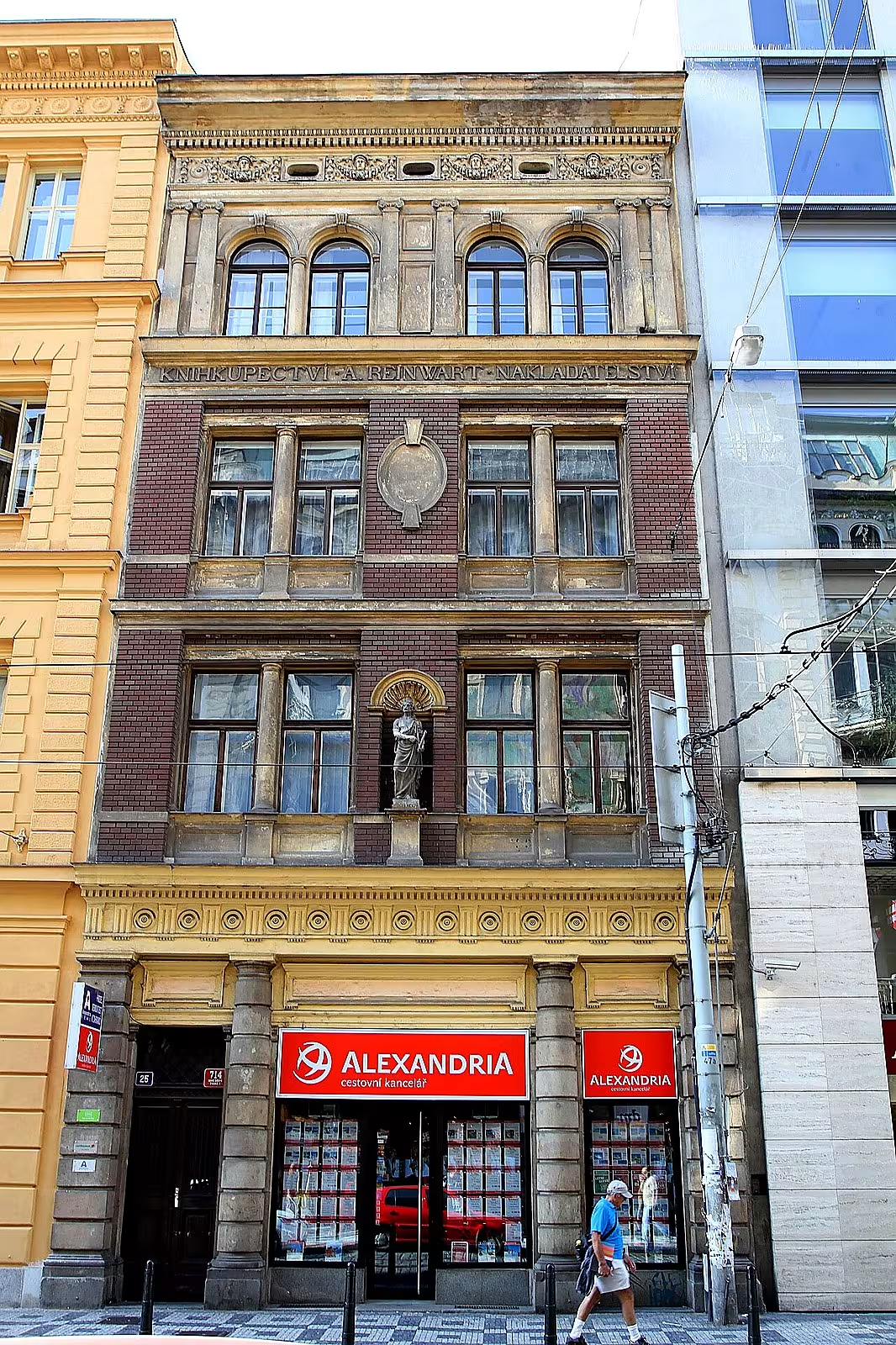
Reinwartův dům is a Neo-Renaissance commercial and multi-purpose house no. 714 / II in Vodickova Street 25 on New Town in Prague. From 1884 to 1886, the publisher and bookseller Antonín Reinwart built it according to the design of architect Achill Wolf. The building captures a narrow medieval park with a rich facade with a plastic decoration including a statue of the mythical singer Lumír and a court wing oriented to the Franciscan garden. Since 2008, this building has been protected as a cultural monument.
The town of the house has more than six hundred years old history. After the founding and fortification of the New Town of Prague, the road from the mountain city gate to the Dobytčí market led in the route of the later streets of Jindříšský and Vodiček. The first registered resident of the house on this parcel was the passenger Peško in 1381. In the following years, also neighbouring houses inhabited mainly by passengers are remembered. The name in the alley is listed in 1434. The corporate roula from the mid-17th century recorded a home tax payment of two and a half gold. In the second half of the 19th century, a turbulent modernization of cities and the development of national trade and culture took place in Czech countries. This corresponds to the construction of a new house for the bookseller Antonín Reinwart from 1884 to 1886 according to the design of architect Achill Wolf. Successful housekeeping took place in 1886.
The house is three-story, understacked and has a saddle roof. Compared to neighbouring objects, it appears small and has a narrow medieval plot. However, it is two-way, with its yard wing wider than the street tract and offers views of the Franciscan garden. The street facade is four-axis with two pairs of combined windows with a middle column. On the ground floor there are stone barefoot pillars, on the first and second floors wall made of brick and on the third floor plaster. Among the windows of the first floor is inserted a niche with a statue of the mythical Slavic singer Lumír. It is shown in a blur of an ancient tunic, with a laurel wreath on its head and a varnish in its hand. The model of this statue was created by Josef Manes and the unknown author derived it from the statue of Antonín Pavel Wagner on the front of the National Theatre. On the facade of the second floor there was an empty oval field between the windows originally painted by Daniel Adam of Veleslavin. Under the cordon ledge there is a well preserved frieze with an antikiating relief in which the heads of boys with fruit festons are replaced. Under the ledge between the second and third floors, the inscription KNIHKUPECTI is inserted instead of the frieze. A.REINWART. COLLECTION.
In 1884 Antonín Reinwart and his second wife Albertina became owners of the house. In the same year they acquired Prague city law, moved into a new house and welcomed the birth of their son Albert. The building housed a bookshop and a small operation of the publishing house, which advertised books from the field and domestic economy. There were also rooms for rental apartments. The architect Jan Vejrych and the painter Mikoláš Aleš are listed among the tenants before 1907. After the cancellation of the bookstore, the store served on the ground floor at the delicatessen and in recent years it is the seat of the travel agency.
The key events and attractions are worth mentioning the year 1381, when the first inhabitants of the plot are documented by the passenger Peško, the start of the construction in 1884, the approval in 1886 and the official registration of the building as a cultural monument in 2008. The house is located in the immediate vicinity of Franciscan Garden, Vodickov and Jindřišská Street or Charles Square.
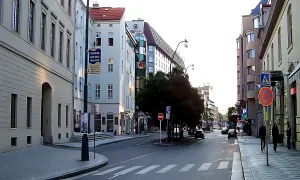
Today, this object serves as a seat of a travel agency and attracts passers through its historic facade with artistic details right in the centre of the metropolis. It is worth stopping at Vodickova Street, looking at the neoRenaissance facade in detail with the character of Lumíra and visiting the following Franciscan garden.
Historical milestones
- 1381
- First written mention of a documented resident of the house, the passengers Peškovi on the given parcel.
- 1884
- The construction of a new house for the bookseller Antonín Reinwart according to architect Achill Wolf.
- 1886
- Successful housewarming of the Neo-Renaissance building.
- 2008
- The building was officially registered as a cultural monument.
Architectural development
The house is three-storey, underlaid and has a saddle roof with a narrow medieval park. The court wing is wider than the street tract and its facade is oriented into the Franciscan garden. The street facade combines stone barefoot pillars on the ground floor, solid masonry on the first and second floors and plaster on the third floor.
Historical events
In 1381, the first inhabitants of the parcel are documented by the passenger Peško. The building of the Neo-Renaissance house was built between 1884 and 1886 according to the design of Achilles Wolf. In 2008, the building was declared a cultural monument.
Owners
Antonín Reinwart and Albertina Reinwartová since 1884
Points of interest
- The building was built between 1884 and 1886 by the publisher and bookseller Antonín Reinwart according to the design of architect Achill Wolf and has been protected as a cultural monument since 2008. - The town of the house has more than six hundred years old history and the first registered resident on this parcel was the passenger Peško in 1381. - Among the windows of the first floor there is a niche with a statue of the mythical Slavic singer Lumír, whose pattern was created by Josef Manes. - Before 1907 the architect Jan Vejrych and the painter Mikoláš Aleš are listed among the tenants of the house. - After the cancellation of the bookstore, the store in the ground floor served the delicatessen shop and in recent years is the seat of the travel agency.
Guide
Show guide text
This text was created by artificial intelligence and has not been editorially reviewed. It may contain inaccuracies.
Welcome to the heart of our great city. You're standing in one of those places where time seems to be thicker and where every brick and every stone has their own voice. In front of your eyes is Reinwartův dům, a building that is not just an ordinary house, but a living witness to the transformation of Prague. Feel the atmosphere surrounding you. You're standing in Vodickov Street, where history meets today's city's heart. The first impression of this building is undoubtedly a sense of grandeur and stability. It is a house that has its weight, its dignity and its clearly expressed personality. When you look at him, you can't understand that he wasn't built just to provide shelter, but to express the success and culture of his time.
Let us now move further into time together and try to understand what has happened in this place. Even though the building you're looking at may seem like a work from the late nineteenth century, its story is much older. The very place on which this house stands has roots dating back to the 14th century. Imagine the fourteenth century when the city of Prague was warm in a completely different form. The first paper trail we can find on this parcel brings us to a man named Peško. He was a pimp, a craftsman who worked with precious metals, which tells us that even then this part of town was an important place for skilled craftsmen and businessmen. This history, over 600 years old, forms an invisible foundation on which everything you see today stands.
Now, however, let us move our attention to a large fraction in the history of this place. We come to the 1980s. In this period Prague was changing, growing to size and looking for its new, modern look. Just then, from the year one thousand eight hundred eighty-four to the year one thousand eight hundred eighty-six, this house was created in the form you know. The main driver of this big project was Antonín Reinwart. He wasn't just an ordinary property owner, he was a man who lived by word. As an important publisher and bookseller, he knew how powerful the books were and how important it was to have a decent place for them. His vision was clear: to create a building that will serve not only for housing, but also for trading and the wider life of the city. To make this vision a reality, he entrusted the work to a competent architect who was Achill Wolf. Wolf was a man who was able to translate his client's ambition into matter and stone, and create a work that would last generations.
Now pay attention to the architecture itself that is surrounding you. If you look at the facade of the building, you're immediately affected by her style. It's a neo-Renaissance. This style was not chosen by chance. At that time, it represented a return to the ideals of harmony, balance and beauty, which were linked to human science and culture. The Neo-Renaissance elements you see here are designed to create a sense of order and nobility. Feel the richness of details that decorate the facade. It's an architecture that doesn't try to be loud, but wants to be dignified. When you look at the face of this house, feel the symmetry and the certainty that the Neo-Renaissance style carries.
And now I'm going to ask you to take a closer look. Pay attention to one of the most beautiful parts of this facade. See that statue over there? He's a figure of a mythical singer named Lumir. This statue gives the building an unexpected, poetic touch. Lumir, the legendary singer, becomes the invisible guardian of this house. His presence here reminds that even in a busy city and in a department store there is a place for art, for myth and for the beauty of human voice. It's a detail that makes you stop, stop rushing and really see what's in front of you. This statue is the link between the world of matter and the world of imagination, between the stone and the song.
But the history of this place is associated with many other names. In addition to the publisher Reinwart and architect Wolf, there were people like Albertina Reinwartová or Jan Vejrych when the city grew. The place was a place where different fates clashed and Prague society formed. Even the famous artist Mikoláš Aleš is an inseparable part of the history of this city, and even though his name does not directly bind to every stone of this house, the spirit of art that ruled in Prague at that time is felt in every detail.
You might find one interesting thing that gives this place even more weight. Although the building may seem relatively young compared to other monuments of Prague, in the year two thousand eight it was officially recognized as a cultural monument. This means that its value has been confirmed by the state and the entire nation. It is a recognition that Reinwartův dům is not only a building but a part of our common heritage that we must protect for future generations. It is proof that what we consider modern and functional at one point can become an immortal symbol of culture in time.
Now that you've gone through the story of this place, from medieval Peshka to the magnificent Neo-Renaissance construction of Antonín Reinwart, you can see this house quite differently. It's not just a building on Vodickov Street anymore. It's a layered story that happens right in front of your eyes. It's a combination of craft, trade, architecture and art.
I hope you are interested in this brief view of Reinwartův dům and that it has helped you better understand the secrets that carry this place. Let yourself be carried away by the beauty of Prague streets and continue to explore all the hidden treasures this city offers at every turn. I wish you a beautiful and inspiring further walk through the history of Prague. Goodbye.
Tips for visitors
For the best experience of visiting Reinwart's house, we recommend to arrive in the morning, when the surrounding area of Vodickov Street is quieter and the facade of the building is beautifully refreshed with natural daylight. Transportation to the place is very easy because the monument lies in the heart of New Town; take advantage of public transport or come on foot from the adjacent Charles Square, and check the current connection in the respective locator. Bring comfortable shoes to explore urban terrain, a charged camera and possibly an umbrella in case of variable weather. For photography lovers, the best angles offer a view directly from the opposite side of Vodičkova Street, where rich Neo-Renaissance details and architectural elements from eighteen hundred and eighty-four to eighteen hundred eighty-six from the author of the Achill Wolf project stand out. Within 30 minutes' walk you can visit a quiet Franciscan garden, historic Charles Square, lively Vodickova Street or nearby Jindřišská Street. Families with children appreciate a short walk along with a rest in the green Franciscan garden, where small visitors can relax from the busy city center.
Businesses nearby
Do you run a restaurant, accommodation, shop, museum, rental, wellness or other visitor service near this monument? Show yourself directly to the people heading to it — this is how they will see you in the app and on the web:
Events nearby

Zdroj akcí: otevřená data měst a obcí ČR (Národní katalog otevřených dat) a kalendář akcí Národního památkového ústavu.
Nearby
Františkánská zahrada, Karlovo náměstí, Vodičkova ulice, Jindřišská ulice
Accommodation nearby
Trips and activities nearby
Guided tours, tickets and activities nearby from GetYourGuide
Affiliate link: if you buy from the partner, we may receive a commission. The price for you does not change.
Search tours and activities →Themed route
This thematic walking route will guide you through the historic heart of New Town in Prague and show you its most important and most beautiful corner.
1. Charles Square Type: Historical Square Why is it worth a visit: It is one of the largest squares in Europe, founded already in the 14th century by King Charles the Fourth. It offers large green areas for relaxation and is surrounded by important historical buildings.
2. Franciscan Garden Type: Public park Why is it worth a visit: This quiet and picturesque green space, hidden in the middle of the busy city centre, serves as an ideal haven for rest. Visitors can admire modified beds of herbs and roses or sit on a bench.
3. Vodičkova Street Type: Historical street Why is it worth a visit: The busy urban artery connects Charles Square with Wenceslas Square and is lined with houses with rich history and shops. It offers a great opportunity to explore traditional urban buildings.
4.Reinwartův dům Type: Historical building and architectural monument Why it is worth a visit: The main purpose of our trip is a valuable historical house that will capture its unique facade and building development. It is an example of old Prague construction.
5. Henry Street Type: Historical street Why is it worth a visit: This street offers a pleasant walk through the historic New Town environment. Its character completes ancient houses and peaceful atmosphere in close proximity to the main destination.
Seasonal recommendations
Spring awakens Nové Město into a new life and Reinwartův dům in good condition attracts discoveries as the surrounding streets smell of awakening greenery and the sun rays pleasantly irradiate the historic facade without sharp summer shadows. The atmosphere is calm and ideal for wandering without rush. It is recommended to set off in the morning when the least people are around the monument. Put on a light coat or sweater and tight shoes for longer walks with spring tiles.
Summer brings the main tourist season to the metropolis, when the historic building acts majestically under the bright blue sky, filled with hot sun, which creates sharp contrasts of light and shadow ideal for shooting details of the exterior. Due to the great crowds of tourists, the best time to visit early in the morning is right after dawn, when there is a quiet and pleasant cool. Choose breathtaking clothes, sunglasses and don't forget the drinking water bottle because the afternoon temperatures in the streets are very high.
Autumn covers Nové Město in warm earthy colors and surrounding trees lose leaves, which gives Reinwart's house a somewhat melancholy and romantic touch, which underlines the dim autumn light and occasional foggy morning. In this period you will meet fewer visitors, so you will enjoy the memory in complete peace. The ideal time for a tour is around noon, when daylight reaches its maximum. Get ready with waterproof jacket, umbrella and warmer layers, because autumn weather can be variable and windy.
Winter changes the size of the whole neighborhood and Reinwartův dům in good condition offers a unique spectacle, especially if ancient roofs and paved pavement dusts the snow that dampens the noise of the city and creates a fabulous atmosphere. The lighting in the streets lights up very early in the afternoon, creating a magical atmosphere approaching the end of the year. Plan your tour for around noon, when it is the hottest and most light out. Winter clothes are absolutely necessary, i.e. a high-quality warm coat, hat, gloves and firm non-slip shoes.
Visualizations and artistic views

The visualisations are generated by artificial intelligence and serve as inspiration.
Photos from the area
Real photos taken near the monument


Zdroj a licence jsou uvedeny u každého snímku.
Tips from visitors
No tips yet. Be the first!
Log in and add your tip.
Sources and literature
Photos: Ondřej Kořínek / CC BY-SA 3.0 — Wikimedia Commons. The author and licence also appear when you hover over the image.
Faktickým podkladem tohoto textu byl článek na Wikipedii, jehož autory jsou přispěvatelé Wikipedie. Článek je dostupný pod licencí CC BY-SA 4.0.
Location on the map
More monuments – Nové Město
Show all in the municipality


Příběhy a pověsti
Legendy, pověsti a příběhy spjaté s touto památkou
Fotografie návštěvníků
Zatím žádné fotografie. Buďte první, kdo přidá fotografii z návštěvy!
Log in a přidejte svou fotografii nebo hodnoťte.
Za ověřenou návštěvu v aplikaci získáte víc bodů — poznáme podle GPS, že jste na místě.
Reviews and comments