



silniční most v Čimelicích Road bridge
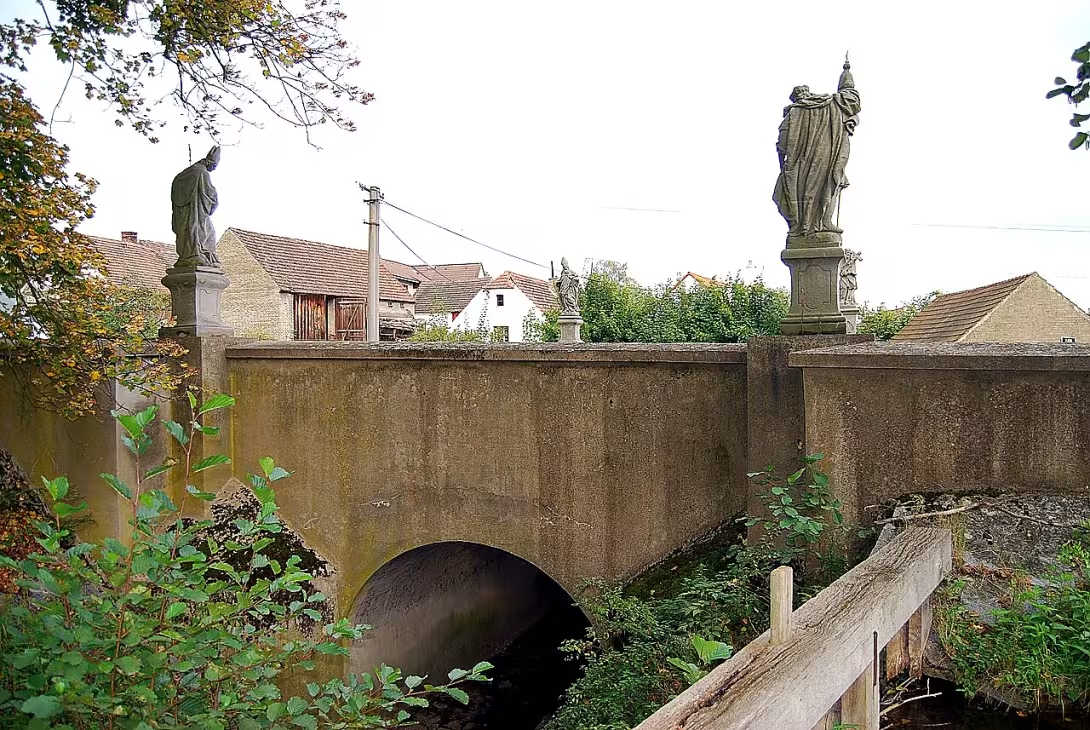
The road bridge in Čimelice is a baroque stone building from the first half of the 18th century, which bridges the Čimelický potok near the Church pond. The monument is important thanks mainly to four statues of saints and is protected as a real cultural monument of the Czech Republic in the landscape monument zone Čimelicko-Rakovicko.
Construction was created in the first half of the 18th century. Baroque statues decorating this object come from the beginning of the same century and are attributed dílně Jana Karla Hammera. The clients of the statues were probably Karl Bohumil z Bissingenu, or even earlier his mother Barbora z Tanfeldu.
It is a single-arc bridge of quarry stone with a length of 11,8 metres, a width of 12,6 metres and a height of 5,1 metres. The semi-circular arch has a radius of 2.5 meters. The support pillars are rounded in the cheek and equipped with a sharp head, while the wings are bent from the arch heel. Bridge faces reach a height of approximately one metre; on the east side they are equipped with a lime cement plaster, while on the west concrete spatula. The coryto of the drain is lined with a quarry stone and covered with stone blocks. The surface of the bridge is lively and leads through I / 4.
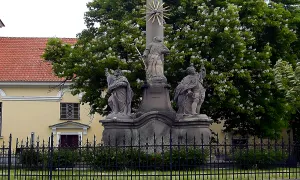
On the parapet walls of the pillars there are four stone weddings in sublife size (160 to 165 cm), located on meters of high pedestal. The joining element of all sculptures is plastically modeled drapery. On the southeast side is Saint Jan Nepomucký in Canovnik's garment with biret, crucifiks and palm branch. His plinth is decorated with B.B.F.V.B.G.V.T and the coat of arms of Tanfeld. Next to him stands the Holy Vojtěch in a bishop's robe with a mitra, a book and a paddle. Its base bears the inscription S. ADALBERTVS OBIVIT XXIII. AP: A: 1001.
The northwest side of the bridge is decorated with a statue of St. Wenceslas, depicted in a slight bow with a flag and a shield with an eagle. The plinth is marked S: WENCESLAVS OBIVIT A: 929 DIE 28: SEP. The fourth wedding is St. Norbert in a bishop's robe with a mitra, a chalice with a feast and a crutch, placed on a bundle of books. His plinth bears the inscription S. NORBERTUS OBIVIT, 6.
The statues went through several stages of renewal in 1938-1941, 1967-1968 and after 1980. For protection reasons, sandstone originals were transferred to the municipal deposit in 1985 and were replaced on the spot by copies of them in the form of an aneurysm.
This Baroque bridge represents a valuable example of period sacral sculpture and stone building. It is advisable to visit it as part of the historical zone in Chimelice.
Historical milestones
- 18th century
- Building a bridge and placing Baroque statues.
- 1938-1941
- A statue restaurant.
- 1967- 1968
- A statue restaurant.
- 1985
- Location of original sandstone statues in the village deposit.
Architectural development
A single-arc bridge made of quarry stone with an arc span of 2.5 m and a living surface. The bridge faces are plastered with a calcium cement plaster and a concrete spatula. The statues went through several stages of restaurants in 1938-1941, 1967-1968 and after 1980.
Historical events
In 1985, sandstone originals of statues were transferred to the village deposit and copies were placed on the bridge.
Owners
Probably ordered by Karl Bohumil from Bissingen or Barbora from Tanfeld.
Points of interest
It's a Baroque stone bridge from the first half of the 18th century. - The memory is decorated by four statues of saints attributed to dílně Jana Karla Hammera. The statues are sublife-size, namely 160 to 165 centimeters. - The original sandstone originals were transferred to the municipal deposit in 1985 and replaced by a copy. - It's a one-arch bridge made of quarry stone.
Guide
Show guide text
This text was created by artificial intelligence and has not been editorially reviewed. It may contain inaccuracies.
Welcome to Chimelice. Stop for a moment, take a breath and feel the atmosphere of this place. Right now, you're standing in front of a building that's been connecting two banks for hundreds of years and serving as a reliable way for people. In front of you there is a stone road bridge, which, with its quiet dignity, brightens the Chimelický brook near the Church Pond. It is a place where the practical purpose of transportation meets the high art baroque times. Look at its overall form. You will see one massive stone arch that carries the whole structure and allows the waters of the stream to flow freely under the road. This bridge is not just an ordinary building work, but is protected as a real-estate cultural monument of the Czech Republic, which shows its extraordinary value for our history and architecture.
Let's go back in time together now. To understand why this bridge looks like this, we have to move to the first half of the eighteenth century. At that time, Baroque architecture was at the height of its glory. Everything was designed with regard to grandeur, dynamics and spiritual dimension. It was during this period that the bridge was built. Imagine what this landscape looked like at the time, how carriages passed through here and what an important point this transition was for people from around here. The bridge was created at a time when ambitious plans and development were promoted in the region. The whole building is located in the landscape monument zone Čimelicka-Rakovicko, which means that the surrounding nature and space around the bridge are perceived as one whole to be preserved for future generations.
Now pay attention to details that you can see right in front of you. The most important decorative element is the four Baroque statues of saints that decorate the bridge. Look at them carefully. These figures aren't random here. In Baroque times, the statues on the bridges often had a protective significance, to guard pilgrims and passengers from the danger of travel. These particular sculptures are attributed to the workshop-recognized artist Jan Karl Hammer. Notice their expressions and gestures that are typical of the Baroque style where they tried to capture movement and emotion. Even though there is a busy first-class road across the bridge today, these statues still stand there and remind us of a time when the pace of life was much slower.
When we think about the history of this place, we can't ignore the personalities associated with it. Names such as Karl Bohumil z Bissingenu and Barbora z Tanfeldu appear in connection with the region and the bridge creation period. They were people who at that time influenced the landscape and the development of local monuments. Their influence and social position helped to create not only functional but also aesthetically valuable structures. It is thanks to such personalities and their support that a bridge that we admire today could have been created. It's fascinating to think that these people once walked on the same rock that modern cars drive today.
Now I want to impress you with one interesting thing that you can't see at first sight, but which is crucial to understanding the state of the monument. If you look at the statues of the saints, you might notice that they look very well preserved. And that's true, but there's an interesting story behind it. The original sculptures were made from sandstone, which is a beautiful but very fragile material, which in time suffers from weather and air pollution. In order not to destroy these unique works of the workshop Jan Karl Hammer, nine hundred and eighty-five were decided to save them. The original sandstone sculptures were carefully transferred to the municipal depository, i.e. to a safe storage site where they are protected from the influence of the surrounding area. What you see today on the bridge are very precise copies that are designed to preserve the visual form of the bridge while the originals remain safe.
One more interesting thing concerns the size of these characters. If you put them next to each other, you'd find that they're substandard. Specifically, each of them measures from 100 to 60 centimeters. This slightly smaller size combined with the location on the bridge creates a harmonious ratio with the overall construction of the arch and road.
If we look at the chronology of taking care of this bridge, we'll find that it's been taken care of for decades. The statues passed through several waves of restaurants, for example, in the years of a thousand nine hundred thirty-eight to a thousand nine hundred forty-one and again in the years of a thousand nine hundred sixty-seven to a thousand nine hundred sixty-eight. This shows us how much people in Chimelice appreciated this piece of art and how much they cared about keeping the baroque beauty in good condition even in times of modernization.
Today, this bridge is a fascinating contrast. On the one hand, we have a historic stone arch and baroque saint, on the other hand, a modern first-class road on which it flows to the right. It's a symbol of the connection between the past and the present. The bridge is no longer just a path across the stream, but it is a living witness to the history that survived wars, regime changes, and technological progress.
Before we say good-bye and you move on, I suggest you go around the bridge again from different angles. Try to look at how the stone arch mirrors itself in the waters of the chimelic creek and how the statues are drawn against the sky. Feel the silence that in some moments beats the noise of the road, and imagine what stories these stones would tell you if they could talk.
Thank you for stopping by this beautiful baroque bridge in Chimelice. I hope this short trip to history has helped you more notice the details that make this place something special. Now I invite you to explore the surroundings and discover other hidden treasures of this beautiful landscape zone. I wish you a pleasant journey and many new experiences. Goodbye.
Tips for visitors
For the best visual experience we recommend a visit in spring or autumn when the surrounding nature is the most colorful. For photography is the best time early morning or late afternoon when light is soft and creates interesting shadows on the stone arch.
The location is available by car and by public transport; Please check the current connection in the traffic controller.
Bring comfortable outdoor walking shoes and drinking water. For families with children, a walk in this location is pleasant, but it is necessary to take extra care near the water.
As part of a short walk you can also see the nearby Church Pond in Čimelice, which is located in close proximity.
Frequently asked questions
Can the monument be visited?
This is a structure in a public space that can usually be seen from outside free of charge. We have not verified that this particular one is freely accessible.
Where is the monument?
Location: Čimelice, Jihočeský kraj. The map on this page shows the exact spot.
Why is the monument protected?
It is listed in the Central List of Cultural Monuments of the Czech Republic as a cultural monument (register no. 1000144802).
Businesses nearby
Do you run a restaurant, accommodation, shop, museum, rental, wellness or other visitor service near this monument? Show yourself directly to the people heading to it — this is how they will see you in the app and on the web:
Events nearby
Zdroj akcí: otevřená data měst a obcí ČR (Národní katalog otevřených dat) a kalendář akcí Národního památkového ústavu.
Nearby
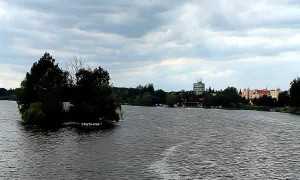
Kostelní rybník v Čimelicích.
Accommodation nearby
Themed route
Thematic trip route from Chimelice
1. Road bridge in Chimelice (bridge)
Type: architecture, technical monument
Why is it worth a visit: This historic bridge is not only an important transport link but also a witness to local engineering. Its architecture and construction are interesting for lovers of technology and history.
2. Church pond in Chimelice
Type: natural monument, holiday place
Why it is worth a visit: This pond is an ideal place for relaxation and knowledge of the local ecosystem. Its peaceful waters are the beauty of the village, providing an opportunity to look at wild flora and fauna.
3. The surrounding forests around the Church Pond
Type: natural environment
Why is it worth a visit: Walking through these forests offer a beautiful view of local vegetation and provide an opportunity to relieve everyday life. They are an ideal place for a picnic or just for a moment of peace in nature.
4. The sidewalk around the Church pond
Type: recreational route
Why is worth a visit: This beautiful pavement is an ideal place to ride a bike, walk or run. It offers views of the pond and surrounding nature, making it a popular place for locals and visitors.
5. Local traditional cafe near the pond
Type: gastronomy
Why is worth a visit: The cafe offers local specialities and an opportunity to relax after a walk. It is an ideal place to meet the locals and learn more about the cultural life in Chimelice.
This route offers a combination of technical heritage, natural beauty and local culture, making a visit to Chimelic an unforgettable experience.
Seasonal recommendations
In the spring, the bridge is surrounded by awakening nature and fresh greenery. The morning sun gently illuminates the stone details, creating an optimistic atmosphere. We recommend moisture resistant shoes and a light jacket. It is best to visit the place in the early hours when traffic on the road is quieter.
The summer season brings radiant warmth and dense leaves of trees that provide shade. The atmosphere is full of energy and bright light. Due to the summer crowd of visitors it is advisable to come first thing in the morning. Don't forget light summer clothes and sun protection.
In autumn, the surroundings of the bridge are painted in golden and red tones. Often in the morning there is a fog that gives the monument a mysterious touch. The ideal time for a visit is late afternoon in soft light. Get ready with layered clothes and solid shoes.
In the winter, the bridge works, but the freezing cleanliness of the air and the possible layer of snow highlight its architecture. There's peace and quiet. It is necessary to have warm winter clothes, gloves and a hat. We recommend planning the morning trip because the days are short.
Visualizations and artistic views


The visualisations are generated by artificial intelligence and serve as inspiration.
Photos from the area
Real photos taken near the monument


Zdroj a licence jsou uvedeny u každého snímku.
Tips from visitors
No tips yet. Be the first!
Log in and add your tip.
Sources and literature
Photos: Richenza / CC BY-SA 3.0 — Wikimedia Commons. The author and licence also appear when you hover over the image.
Faktickým podkladem tohoto textu byl článek na Wikipedii, jehož autory jsou přispěvatelé Wikipedie. Článek je dostupný pod licencí CC BY-SA 4.0.
Location on the map


Příběhy a pověsti
Legendy, pověsti a příběhy spjaté s touto památkou

Fotografie návštěvníků
Zatím žádné fotografie. Buďte první, kdo přidá fotografii z návštěvy!
Log in a přidejte svou fotografii nebo hodnoťte.
Za ověřenou návštěvu v aplikaci získáte víc bodů — poznáme podle GPS, že jste na místě.
Reviews and comments