



Škochův dům House
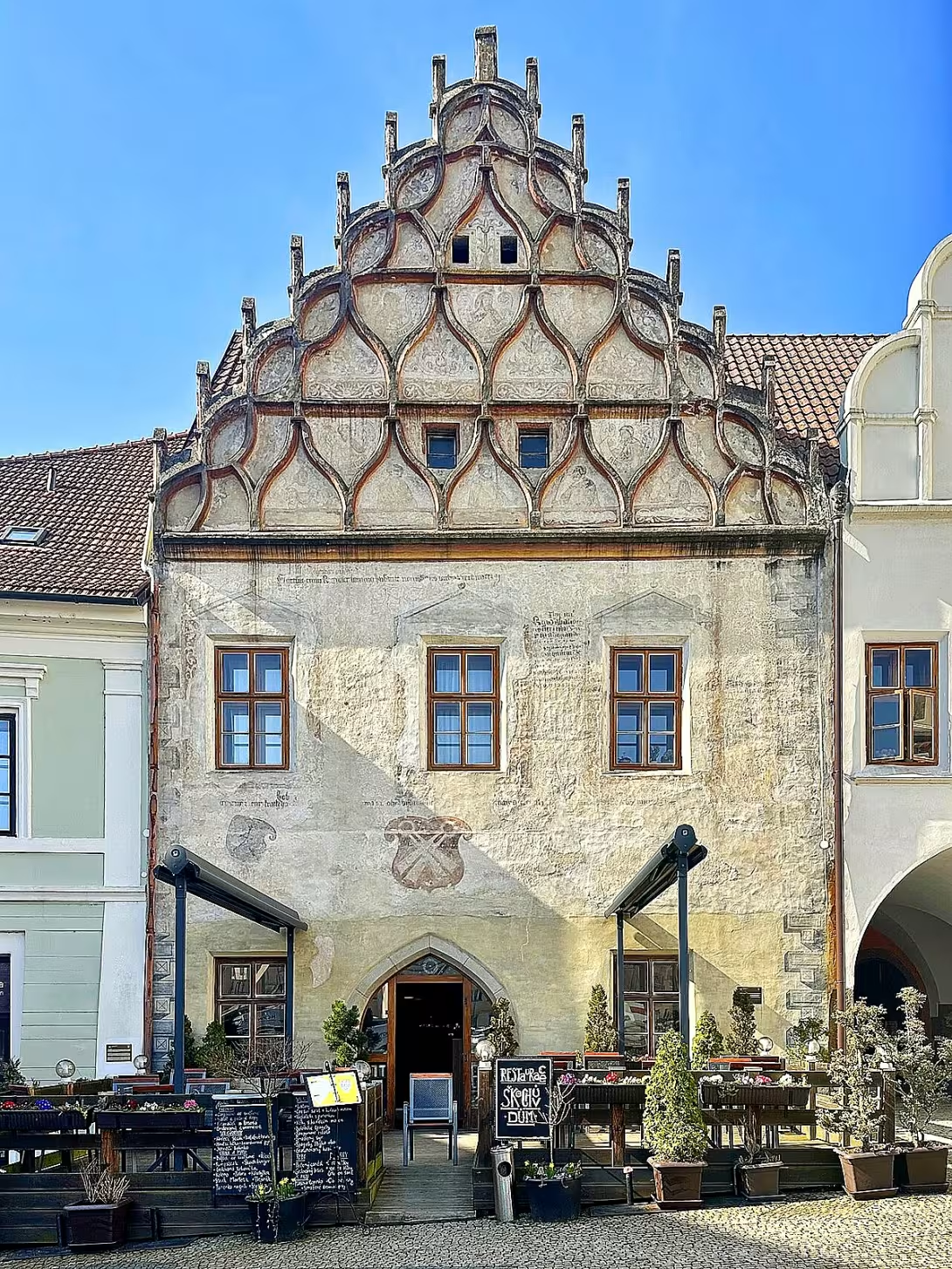
Škochův dům is an important Renaissance urban object in Tábor. Located in the southwest corner of Zizkov Square near the old Town Hall and Town Hall Tower. The historian Karel Thir described it as the house with the longest history of all the camps. Since 1963, it has been listed in the state list of cultural monuments.
There is little information about the oldest history and the exact date of construction. The first mention dates back to July 1532, when the Tábor was hit by a devastating fire. While City Hall and approximately 61 houses escaped the flames, all that was left of the school's house was a burn ground. The original masonry from earlier today was preserved only in the basement.
In 1536, the owner then sold his house to Martin Helm of Vorlov. Helm became rich thanks to the craft of the trimmer and weaver and marriage to the daughter of Jan Pštros. From the remains, he built the current brick form. The main building was created with a Gothic shield and part of the passage with a smaller shield. Before 1557, a ground-floor extension, known as a kvelb or shop, was added, which Helm acquired in exchange for a meat shop with a town.
In 1596 the house was sold to Adam Hradsky, who paid off his debts after Benjamin Helm. The rear part of the pass was probably built in the second half of the 16th century. Later, the house was taken over by Jan Chvátal, which became a camp primate. In 1612 he added a two-storey rear part to Martin Húsky Street. This part was led by two gutters, one of which was headed for the house No. 21 and the other on Jan Hratal's stripe.
The building is two storey with irregular ground plan. The main facade from Žižkov Square is decorated with a late gothic trietaz camp shield with the motif of donkey loins, bellows and a system of small philes. The shield was originally polychrome. The first floor of the facade has three window openings with neo-gothic elements, such as bevelled edges and saddle ledge. In the northern part there is a valené arched chimney pass leading to Martin Húsky Street. The roof is saddled with a ceramic bag of the type of a fake.
In 1901 the house was bought by Václav Škoch. Here he and his son Karl ran a material store with drugstores, paints, varnishes and mineral waters. According to the memoirs, liqueurs were produced here, while Brother Jan used to run a paint shop. In 1932, the Renaissance arch part of the shield at the pass was repaired. After nationalization in 1960, the house served as an office, scout clubhouse or art craft establishment.
After the restitution in 1991, extensive repairs took place. Between 1997 and 1998, the roof was repaired and the facade was subsequently reconstructed. In these works, frescoes were discovered and restored on the facade. The original extension was sold in 1802 because of the emergency situation and later the bookstore was located there. In 1994, it was reconstructed by the city, and today it is under descriptive number 23.
The restaurant Škochův dům is currently located in the building. The building presents a unique example of the building development of the town hall from the 16th century to the present. The visit to this building offers the possibility to see authentic elements of the Gothic and Renaissance periods in the heart of the city monument reservation.
Historical milestones
- 1532
- Damage to the house during one of the three devastating fires in Tábor.
- 1536
- The sale of a house by Nicholas Dasek Martin Helm.
- 1596
- The sale of the house of Adam Hradsky by decision of Emperor Rudolf II.
- 1612
- The rear two-storey part of the house facing Martin Húsky Street was added.
- 1901
- Purchase of the object Václav Schochem.
Architectural development
After the 1532 fire, Martin Helm built a walled shape with a Gothic shield and passage. In the second half of the 16th century the rear part of the pass was completed and in 1612 a two-storey wing was added towards Martin Húsky Street. The Renaissance arch shield was repaired in 1932.
Historical events
1532 - the house was almost completely destroyed by the devastating fire in Tábor; 1963 - entry into the state list of cultural monuments.
Owners
Nicholas Dashek (until 1536), Martin Helm (from 1536), Adam Hradský (from 1596), Jan Chvátal, Václav Škoch (from 1901)
Points of interest
- historian Karel Thir described it as a construction with the longest history of all the houses in Tábor. - After the fire in 1532, there was only a burn site left of the building and only a basement left of the original wall. - The main facade is decorated with a late gothic shield with donkey back motif, which was originally colored. - Václav Škoch here in 1901 with his son operated a drug trade, paints, varnishes and mineral waters. - During the reconstruction of the facade between 1997 and 1998, paintings were discovered and repaired on the facade.
Guide
Show guide text
This text was created by artificial intelligence and has not been editorially reviewed. It may contain inaccuracies.
Welcome to the heart of Tábor. Right now, you're standing in the southwest corner of Zizkov Square, and there's a building in front of you that carries the memory of centuries. Look at Škochův dům. At first glance, it may seem like one of the many beautiful townspeople houses that form the frame of this historic space, but believe me, this object is exceptional. It's a place where the everyday life of the present meets the deep layers of the past. Today you can smell the smell of a restaurant that resides in the building, but if you close your eyes, you can move much further back in time.
Let's look together at how this house became who it is today. The history of this place is fascinating and very long. It is such a long journey that the famous historian Karel Thir called him the house with the longest history of all the houses in all Tábor. It means that when you look at it, you look at one of the oldest tissues in the city. However, the journey was not easy. Imagine a year of five hundred thirty-two. At that time, the Tábor hit three devastating fires that almost wiped the city off the map. It was just one of them who made this house a burning ground. At that moment, the original masonry remained basically a basement, in which perhaps the secrets of the beginning of the city are still asleep.
Now pay attention to what you see right in front of you. Look up at the main facade. Notice the beautiful shield. It is a late Gothic element with the motif of the so-called donkey loins. These wavy lines are typical of their time and provide a house of elegant, easy-to-play appearance. It is interesting to realize that this shield has not always been as you see it today. Originally, it was colorful, which in the Middle Ages and Renaissance gave the city streets a completely different dynamic and saturation. Even though the colors were gone, the shape remained and told us about the ambitions of the people who lived here.
When the building started to grow up again after the fire, it went through a lot of changes. In the year five hundred thirty-six, the house was sold from Nicholas Dasek to Martin Helm. A few decades later, in the year five hundred ninety-six, the owner changed again. According to the decision of the Emperor Rudolf the second became home owner of Adam Hradský. It is fascinating to think that the fate of this house was at some point linked to the supreme imperial power of that time.
Now let's think about how the house was expanding. If you look towards Martin Húsky Street, you'll see the back of the building. This two-storey extension was added in the year of tyre six hundred twelve. It is in this detail that you can see how the house grew along with the needs of its inhabitants and how it adapted to the city's space. The whole building thus bears traces of several construction stages, which start in the 16th century and continue until the modern age. It's actually a stone book where each layer of masonry represents a different chapter in the history of the camp.
The key character for the house to carry its name today was Václav Škoch. It was in the year of a thousand devytes that he bought one of the objects and printed his trail. Together with him, names like Jan Chvátal are associated with this place. These people were not just owners of the property, they were citizens who formed the face of Tábor at a time when the city was modernized, but they were also trying to preserve their unique identity.
Now I want to invite you to a little thought. Imagine the contrast. On the one hand, we have the absolute destruction of the year five hundred thirty-two, with only piles of ash and a hot cellar left of the house. On the other hand, we have seen today's form, written in the list of cultural monuments since the year nine hundred and sixty-three. It's a symbol of endurance. This house has survived fires, regime changes, imperial orders, and the rotation of generations. It's fascinating that even though there's a restaurant in the building today, where people indulge in food and drink, the walls around them still whisper stories of Gothic and Renaissance times.
Notice how the house fits into the overall atmosphere of the urban conservation. You're standing in a place where history can't be overlooked. Škochův dům is not just a building, it's a witness. A witness to Tábor turning radical city into a quieter urban center.
I suggest you stand for a while and observe the details of the facade. Try to imagine the colors that once decorated the donkey's grave on the shield. Try to feel the energy of a place that was at one moment erased from the ground and then rebuilt again and again. It is a reminder that nothing is forever, but that, with care and respect, what seemed irreparably lost can be preserved.
Now, when you continue your journey along Žizkov Square, let yourself follow the sounds of the city and look at the surrounding houses. Škochův dům showed you that even behind a simple facade can hide the longest history in the whole city. I hope you enjoyed this brief dive into the past and that this house, with its donkey back and imperial stories, impressed you.
I wish you a pleasant further walk by Tábor. Discover, perceive and be surprised by other gems waiting for you in this beautiful city. Goodbye.
Tips for visitors
The best time to visit is morning or late afternoon time when the sun hits the façade of the house at a pleasant angle and highlights the details of the oldest building in the square.
Since it is a residential building that can only be admired from the outside, you do not need to prepare any special equipment. We recommend comfortable shoes for walking around the historical heart of the city. When shooting, focus on detailed views from the southwest corner of Žizkov Square, where the house is best seen.
During a short walk in the area, which will not take more than half an hour, you will definitely visit the old Town Hall and Town Hall Tower, which are located in the immediate vicinity. Families with children can use a visit to find the oldest elements in the architecture of the house and compare with other buildings in the square.
Frequently asked questions
Can the monument be visited?
This is a residential or farm building, not a museum with opening hours. Please view it from public space and respect the owners' privacy. We have no information about access to the interior.
Where is the monument?
Location: Tábor. The map on this page shows the exact spot.
Why is the monument protected?
It is listed in the Central List of Cultural Monuments of the Czech Republic as a cultural monument (register no. 1000128079).
Businesses nearby
Do you run a restaurant, accommodation, shop, museum, rental, wellness or other visitor service near this monument? Show yourself directly to the people heading to it — this is how they will see you in the app and on the web:
Nearby
Žižkovo náměstí, stará radnice, radniční věž
Accommodation nearby
Themed route
Here is the design of the cruise route:
1. Žižkov Square (central area) - The starting point of the journey where you can feel the atmosphere of the historic city core. 2. Old Town Hall (Administrative Building) - Architectural Jewel, which represents the rich history of the local administration. 3. Town Hall Tower (sightseeing building) - A place from which you can admire panoramic view of the whole area. 4. Škochův dům (Memorial House) - The main destination of the journey where you can learn more about the life and work of an important person.
Seasonal recommendations
In spring, the surroundings of the house are awakened into colours and the fresh sun gently illuminates the facade. It's an ideal time for walks where the streets are clean and the air is fresh. We recommend shoes suitable for wet terrain and visit in the morning when the light is the cleanest for observing the details of the construction.
Summer brings hot air and bright, sharp light that highlights the shapes of the building. The main season is the streets of the most people, therefore it is best to start early in the morning or at sunset to avoid the crowds of visitors. Practical is light cotton and a hat against the hot sun.
The atmosphere becomes melancholic in autumn and the surrounding trees gain a golden touch. Soft underevening light creates a pleasant mood for silent observation of the house from the outside. Due to the variable weather, it is advisable to choose layered clothes and waterproof shoes.
Zimą works in quiet and often accompanied by freezing air. If snow hits the building, the whole scene will get a dream look, especially in advent time. It is necessary to wear warm winter clothes, gloves and hat, while the best time to visit is a short daily interval between sunrise and sunset.
Visualizations and artistic views

The visualisations are generated by artificial intelligence and serve as inspiration.
Photos from the area
Real photos taken near the monument


Zdroj a licence jsou uvedeny u každého snímku.
Tips from visitors
No tips yet. Be the first!
Log in and add your tip.
Sources and literature
Photos: Merxbnik / CC BY-SA 4.0 — Wikimedia Commons. The author and licence also appear when you hover over the image.
Faktickým podkladem tohoto textu byl článek na Wikipedii, jehož autory jsou přispěvatelé Wikipedie. Článek je dostupný pod licencí CC BY-SA 4.0.
Location on the map



Příběhy a pověsti
Legendy, pověsti a příběhy spjaté s touto památkou
Fotografie návštěvníků
Zatím žádné fotografie. Buďte první, kdo přidá fotografii z návštěvy!
Log in a přidejte svou fotografii nebo hodnoťte.
Za ověřenou návštěvu v aplikaci získáte víc bodů — poznáme podle GPS, že jste na místě.
Reviews and comments