



Škvořetice Chateau
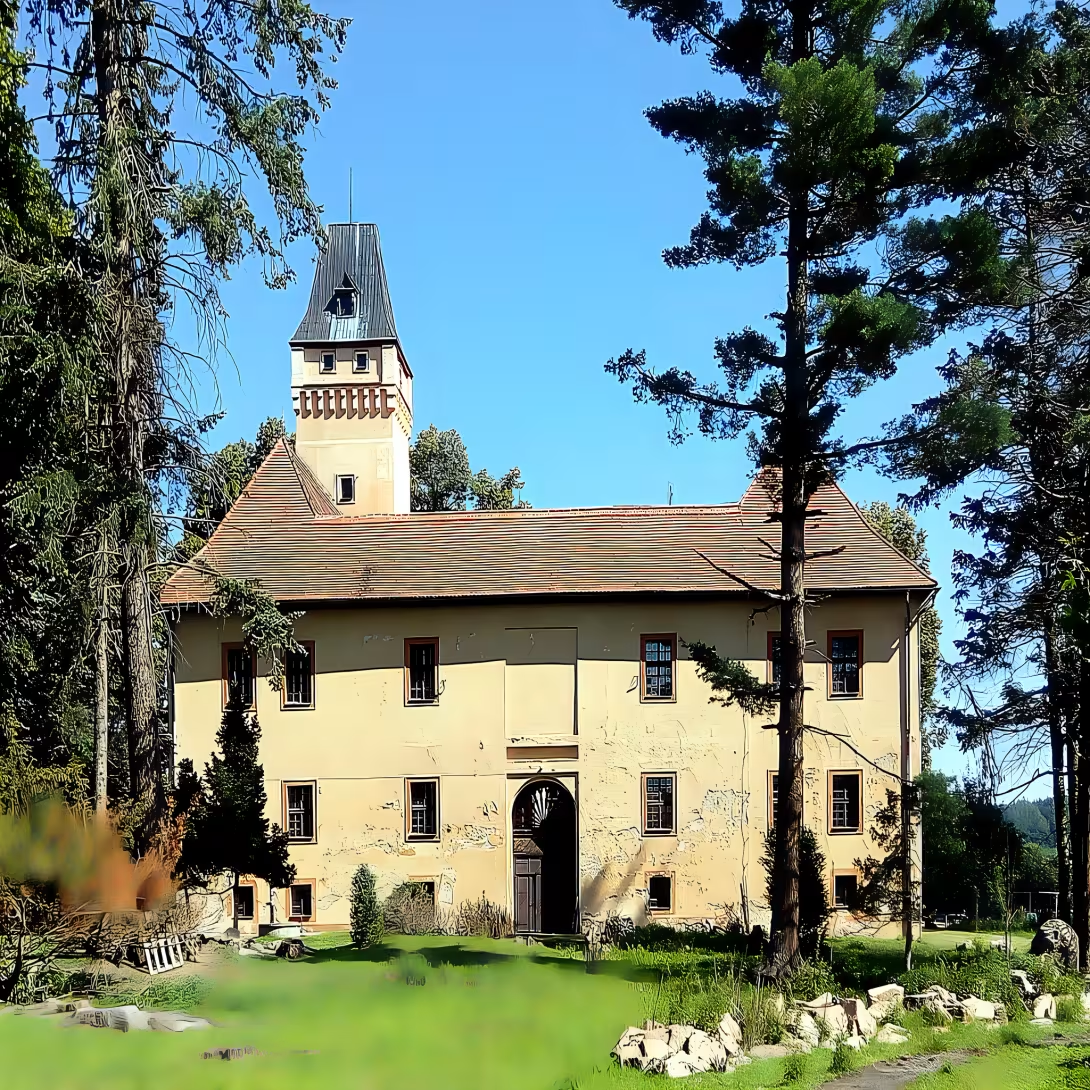
Damage Greek chateau, Renaissance monument in the village Škvořetice in the district of Strakonice in South Bohemia, has a rich history. Originally, it was in the place of a fortress whose beginnings date back to the 14th century. Jan Jr. from Kalenic probably rebuilt the older structure into a Renaissance chateau in the 16th century. Today's resemblance is the result of a pseudorenesance modification from 1921-1922, designed by Vojtěch Volf. The chateau consists of four wings around the courtyard and is surrounded by a park; The whole area is protected as a cultural monument.
The oldest mansion in Škhorověřice was a fortress which the Mirovic flags held. Their coat of arms was a horse. The first known representative of this family was Jan Mirovec of the Škhorvoøetky, mentioned in 1380. He later appeared as a witness on the papers between 1397 and 1412. The other holders of the fort were his brothers Hurt and Ondrej, who died before 1454.
The fort was sold to Zdeněka Konopistský from Sternberk. According to Karl Truska, sales could have been made in 1444, while other figures refer to the period before 1454. The second part of the village was owned by Beneš of Kalenic, who bought the part with a fortress around 1462. The Kalenics held Škvořetice until 1673.
Beneš's son Oldřich obtained a bachelor's degree at Prague University in 1465. The last mention of him as the owner of Zhravořítice is from the year 1493, when he also had a farm near Klení. He held the property in common with the brothers Zikmund, Bohuslav and Beneš, mentioned since 1498. Since 1517, only Beneš has been listed as owner.
In the first half of the 16th century Škvořetice belonged to the brothers Jiří, John and Zikmund. Jiří has separated himself from the property because of the failure of the promised money from the brothers. By 1540, he already owned his own part. Jan and Zikmund had Škvořetice registered with the court, fortress and village Leskovice in 1543. Jan later survived Zikmund and became the sole owner.
The reconstruction of the older fortress to the Renaissance chateau took place between 1543 and 1586, probably behind Jan younger from Kalenic. The specific reason for the reconstruction and its completion are unknown. Jan died in 1568 and the guardian of his daughters became Bohuslav Šlejbor of Tis, who in 1572 was the master of the Damages.
The property then went to John's sons Beneshi, Zdeněk and Adam. Beneš died in winter 1595. His son John had Uncle Zdeněk as his guardian, but the management was entrusted to the widow Anna, born of Jilmanic, on condition that she did not bother the subjects.
When John reached adulthood, he began to manage the farm and extended it to the Koží. Shortly before his death in 1629 he wrote a will, in which he bequeathed to the daughter of Johanc and the rest of the greasy estate to John Wilhelm's son.
Jan Wilhelm sold Škvořetice in 1668 to Jiří František Doudlebski from Doudleb, but bought them back from him. In 1673, he resold the farm to Ferdinand Antonín Malovka of Chýnov. The property at the time included Škvořetice, a fortress, two courts, a brewery and the village of Mážetice, Anniversary, Pacelice, Peace, Mílk and Lom.
In 1682 the estate was acquired by Marie Františka Malovcova, born Villanova. After her death, he was offered in a public auction for orphans after Countess Ernestina Barbora Serenyi and became part of the estate of Blatná.
The estate was later won by Baron František Hildprandt, whose descendants owned the complex until 1945. Karel Hildprandt had the chateau building modified in a neo-Renaissance style according to the design of Vojtěch Volf, which took place in 1921-1922.
Today's chateau consists of four wings around the courtyard and is surrounded by a park. The pseudorenesance adjustment significantly affected the preserved form of the building. In the second half of the twentieth century the chateau had irregular use, for example as a school of the Czechoslovak state railway. In 2008 it was offered for sale for an amount of CZK 40 million and in 2018 again together with approximately 71 hectares of land, including the Stark pond of 2.05 hectares.
Damage Greek chateau is an interesting visit thanks to the combination of various historical layers. From the original fortress to the Renaissance residence to the current pseudorenesance form, each period contributes to its rich history. Before visiting, it is advisable to check the actual availability of the site.
Then and now
Drag the slider to compare how the landmark may have looked when it was built with the view today.
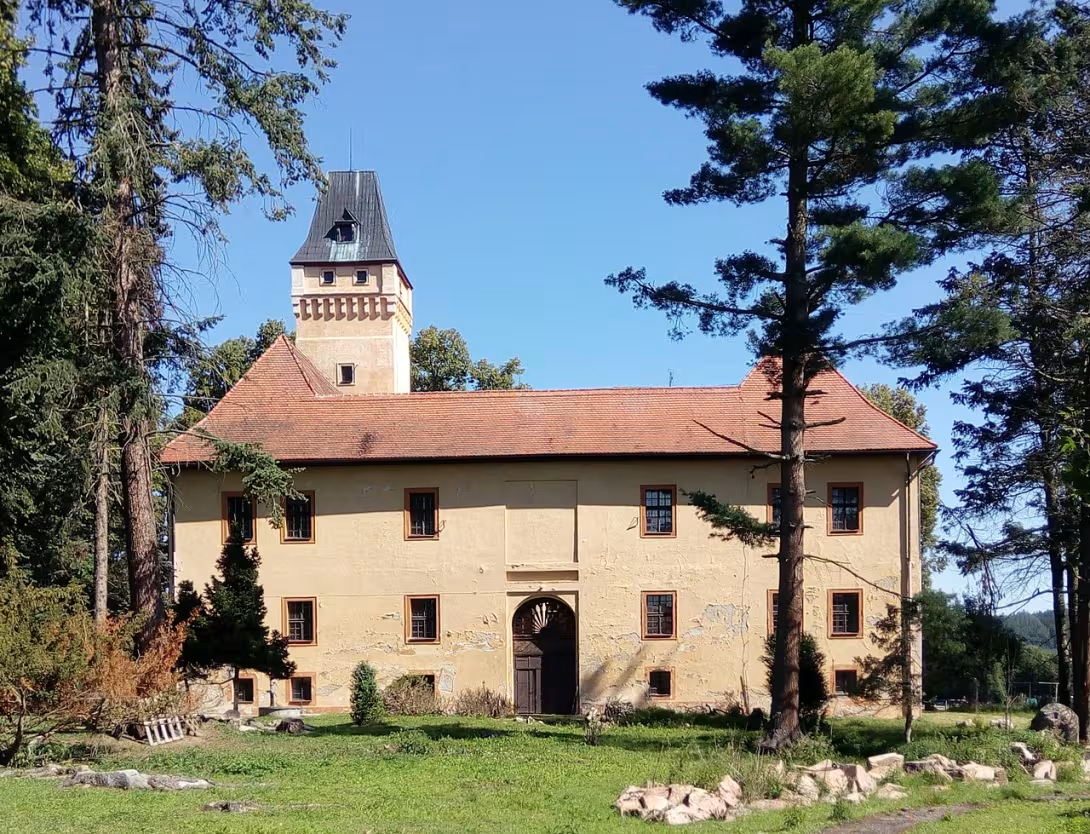
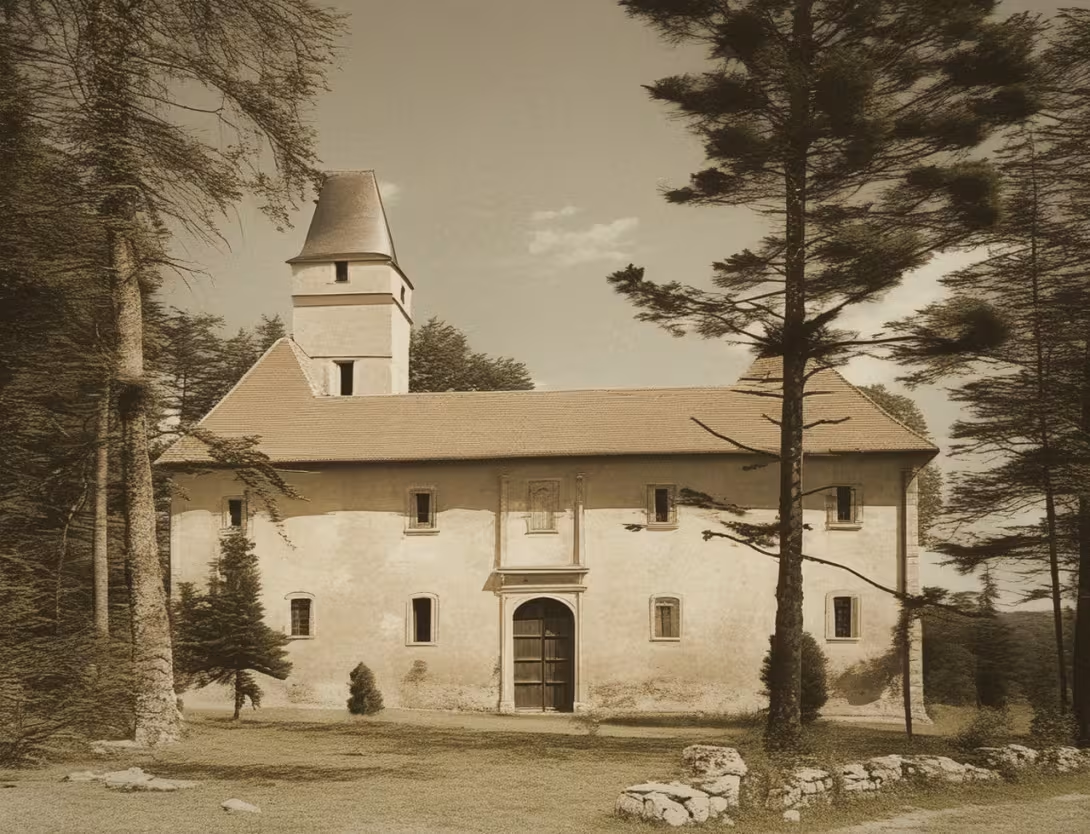
The historical appearance on the left is an AI-generated visualisation and serves as inspiration only.
Historical milestones
- 1380
- Jan Mirovec of Zhravorec is the first known member of the family whose members were based on hardships.
- 1462
- Beneš of Kalenice bought part of the fort.
- 1543-1586
- The fort was probably rebuilt by Jan Jr. from Kalenic to Renaissance chateau.
- 1673
- Ferdinand Antonín Malovec of Chýnov purchased a farm including a fortress and other parts.
- 1921-1922
- The chateau was built under Karl Hildpradt's pseudorenesantic design according to Vojtěch Volf's plans.
Architectural development
The Gothic stronghold was unclear, so its precise plan and appearance are not substantiated. During the sixteenth century, the older fortress was transformed into a Renaissance chateau; The preserved description mentions four corner towers covered with bans. In 1921-1922, Karel Hildprandt had a pseudorenesance reconstruction carried out according to the design of Vojtěv Volfe. The four-wing chateau is in the middle of the courtyard and is surrounded by a park.
Historical events
For the first time in 1380, Jan Mirovec from Zhravoretic, the first known family member based on hardness, is documented in writing. Before 1454 Jan Šteker from Mirovic to Zdeněk Konopistský from Šternberk crossed the fort and was bought by Beneš from Kalenice around 1462. Between 1543-1586, the older fortress was probably rebuilt by Jan the younger of Kalenic to a Renaissance chateau. In 1921-1922, the chateau for Karl Hildpradt was pseudorenesanted according to the plans of Vojtěv Volf.
Owners
Since the 14th century, the fountains of Mirovic held the fort; Jan Mirovec of Škrovořice is documented in 1380. Before 1454 Jan Šteker of Mirovic Zdeněk Konopistský of Šternberk sold it and around 1462 it was obtained by Beneš of Kalenice. The Kalenics owned Škvořetice with a short exception until 1673. In 1673 Ferdinand Antonín Malovec from Chýnov bought the farm and in 1682 it was acquired by Marie Františka Malovcova.
Points of interest
- The Damage Greek chateau has a rich history and was originally in the place of a fortress whose beginnings date back to the 14th century.
- Jan Jr. from Kalenic probably rebuilt the older structure into a Renaissance chateau in the 16th century.
- The oldest mansion in Škhorověřice was a fortress which the Mirovic flags held; Their coat of arms was a horse.
- The first known representative of the House of Mirovec was Jan Mirovec of Zhravoretic, mentioned in 1380.
- The fort was sold to Zdeněk Konopistský from Sternberk, possibly in 1444.
Guide
This guide is narrated by a synthetic voice generated by artificial intelligence.
Show guide text
This text was created by artificial intelligence and has not been editorially reviewed. It may contain inaccuracies.
Welcome to Damages, where one of the most beautiful Renaissance locks in the whole Republic is located. You're standing in front of him right now, and you have a beautiful facade with towers covered in jars. Notice the architecture details that will bring you closer to the history of this place.
The Damage Greek chateau has a rich history, which dates back to the 16th century, when Jan Jr. of Kalenic had the original chateau rebuilt. This change was due to the need for modernisation and adaptation of premises for increasingly large noble families.
Let's move on to architectural details. The Damage Greek chateau is typical of Renaissance elements, such as towers covered with bans, which are the only known architectural interest of this place. Also note the beautiful wooden windows and doors that make the building a cozy and comfortable environment.
The Damage Greek Chateau is full of historical personalities that took place here. Among them are Jan Mirovec of Zhravoretic, Oldřich Kalenice, Zikmund Kalenice, Beneš of Kalenic, Jan of Kalenic, Ferdinand Antonín Malovková of Chýnov and František Wilhelm Salm of Reifferscheid.
And now it's time for some surprising facts. The Renaissance chateau was covered in bans in all four corners of the tower, which is the only known architectural interest concerning this chateau. The chateau was also offered for sale for 40 million CZK in 2008 and again in 2018.
Notice the atmosphere that exists here. The Damage Greek lock is full of history and mysticism that will come close to you if you listen to his story.
Now I invite you to explore this beautiful place again. I hope you enjoyed what you saw and that you will come back so you can see more details and atmosphere of the Damaged Greek. I will say goodbye to you in this place, which is full of history and beauty.
Tips for visitors
The best time to visit the Damage Greek Chateau is in the spring or autumn period, when vegetation is in its full bloom and the sun rays illuminate architecture. The park around the chateau offers quiet walks and beautiful views of the surrounding countryside.
Current information about routes and times can be found in the online search engine.
When visiting the chateau, it is advisable to bring sun protection, shoes suitable for walking on the lawn and possibly a guide or application on the phone that provides historical context and information about the monument.
The best place for photography is the west part of the chateau, where the sun sets behind the roof of the buildings. This moment offers ideal lighting conditions to capture historical details in stylized lighting.
In the vicinity of the chateau there is the Starka pond, which is the perfect place to relax and observe nature. For families with children, the park around the chateau is an ideal environment for playing outside and exploring natural beauties.
Frequently asked questions
Can the monument be visited?
Some buildings of this kind are open for guided tours, others serve another purpose or are privately owned. We have not verified whether and when this monument is open – please ask the operator.
What are the opening hours and admission?
We have not verified the opening hours or admission. Current information is published by the operator.
Where is the monument?
Location: č.p. 1, Škvořetice, Jihočeský kraj. The map on this page shows the exact spot.
Why is the monument protected?
It is listed in the Central List of Cultural Monuments of the Czech Republic as a cultural monument (register no. 20404/3-4394).
For kids
Damaged Greek Secrets
All right, young gentlemen and lady! Do you want to know about the most beautiful chateau in the entire South Bohemia region? So join me for an adventure walk Škvořeticemi!
Imagine you're in 1520. Jan Jr. from Kalenic wanted to build a new mansion and thus the original chateau was created. But what happened to him? The chateau became a fortress and later, in 1921-1922, it was converted into a Renaissance chateau.
Businesses nearby
Do you run a restaurant, accommodation, shop, museum, rental, wellness or other visitor service near this monument? Show yourself directly to the people heading to it — this is how they will see you in the app and on the web:
Nearby
The chateau area is surrounded by a park. On the grounds there is a Starka pond, the area of which is given at 2.05 hectares.
Accommodation nearby
Themed route
Thematic cruise route chateau Škvořetice
1. Chateau Škvořetice - historical monument, castle Castle Škvořetice is one of the most important Renaissance buildings in South Bohemia. Its beautiful courtyard and architecture attract historians and tourists who are interested in the period architecture and history of the region.
2. Park at chateau Škvořetice - park The park around the chateau offers quiet walks between beautiful trees and cozy pavements. It is an ideal place for relaxing and enjoying the natural environment, which complements the historical atmosphere of the chateau.
3. Pond Stark - Pond On the grounds of the chateau there is a small but charming Stark pond with an area of 2.05 hectares. It is a place for quiet moments by the water and ideal for nature lovers who enjoy the beauty of a small fishing unit.
This route offers a combination of historical and natural experiences in one district. The chateau and its park provide insight into the past, while the Stark pond provides a calm atmosphere for relaxation.
Seasonal recommendations
In the spring, the chateau will be surrounded by awakening nature and fresh green gardens. Soft spring light highlights the facade details and the overall atmosphere is full of optimism. We recommend to dress in layered clothes because the weather in South Bohemia is very variable in this period. It is best to visit the memory in the morning when the air is the cleanest.
The summer season brings rich colors and full bloom of the surrounding park. The bright sun hits the historic walls and creates sharp contrasts with a deep shadow of old trees. Due to the high season expect a larger number of visitors, it is therefore advisable to come right after opening. Choose light, breathable clothes and don't forget the sun protection.
Autumn in Škhorověřice is a period of golden leaves and morning fog, which give the place a mysterious and melancholy touch. The atmosphere is quieter and nostalgic, which is ideal for long walks. Hot clothes and solid shoes are suitable for the wet lawn. We recommend a visit in the afternoon when the low sun illuminates the landscape most beautifully.
In winter, the monument is pristine and quiet, especially if a layer of snow covers it. The contrasts between the white landscape and darker tones of buildings are very significant and seem majestic. It is necessary to wear warm thermal layers and waterproof shoes. Before travelling, check carefully the shortened opening times typical of this season.
Visualizations and artistic views


The visualisations are generated by artificial intelligence and serve as inspiration.
Photos from the area
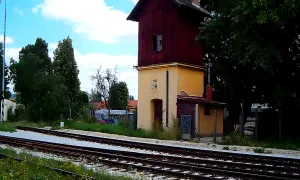
Real photos taken near the monument


Zdroj a licence jsou uvedeny u každého snímku.
Tips from visitors
No tips yet. Be the first!
Log in and add your tip.
Sources and literature
Photos: Czeva / CC BY-SA 4.0, rozlišení zvýšeno umělou inteligencí — Wikimedia Commons. The author and licence also appear when you hover over the image.
Faktickým podkladem tohoto textu byl článek na Wikipedii, jehož autory jsou přispěvatelé Wikipedie. Článek je dostupný pod licencí CC BY-SA 4.0.
Location on the map




Příběhy a pověsti
Legendy, pověsti a příběhy spjaté s touto památkou
Fotografie návštěvníků
Zatím žádné fotografie. Buďte první, kdo přidá fotografii z návštěvy!
Log in a přidejte svou fotografii nebo hodnoťte.
Za ověřenou návštěvu v aplikaci získáte víc bodů — poznáme podle GPS, že jste na místě.
Reviews and comments