



Sloup se sochou Panny Marie (Nebřeziny) Marian column
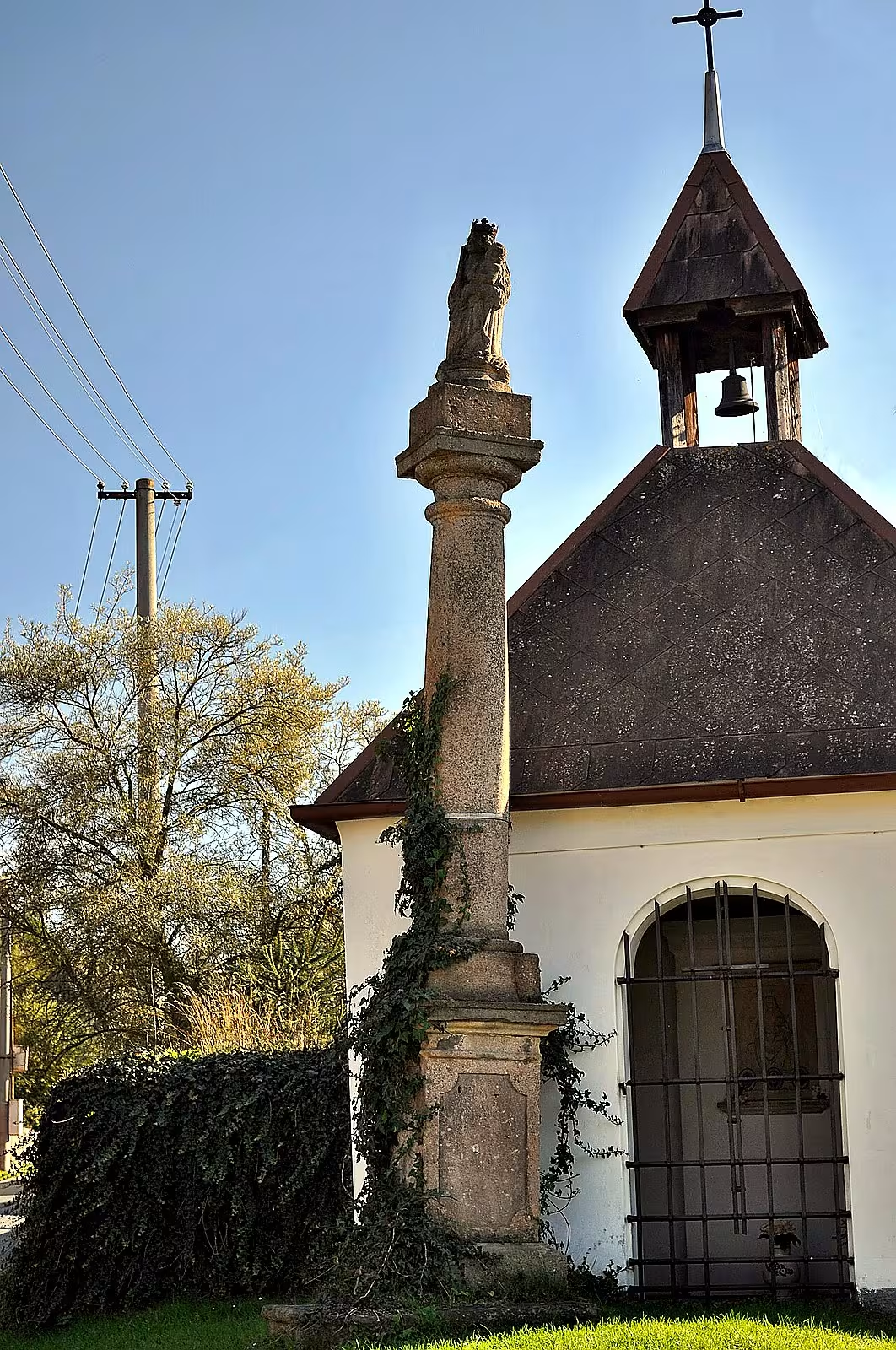
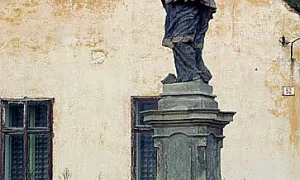
The column with the statue of the Virgin Mary in the village of Nebrázina (cadastre Plasy, district of Plzeň-North) is a Baroque Marian column which occupies a remarkable place between cultural monuments of the Czech Republic. It was erected in 1738 and since 1996 it has been protected as a cultural monument. Its history combines diverse parts that originally did not form one whole. The column came from the monastery of Plash and the statue of the Virgin Mary was formerly part of the tank in the courtyard of the old convention. This combination gives the object a unique character.
The history of the monument is rooted in the Baroque period, which brought rich decoration and emotional expression to Central Europe. In 1738, separate parts were originally connected in Nebráziny, indicating an adaptive use of historical elements in the new context. The column was originally part of the support of the capitular hall, which was rebuilt by Abbot Kryštof Tengler. The plinth is marked with an abbey crutches and the year 1668. The statue of the Virgin Mary comes from a monastery tank, which underlines its importance beyond the religious context.
The architecture of the column and sculpture is an example of baroque artistic expression. The column forms an arch with a four-sided prism and a pre-set plinth on which the Tuscan warhead rests. There is a statue of the Virgin Mary with a scepter in her right hand and a sleeping Jesus with a saint in her left. The Madonna crown was gilded during the 2016 landmark renewal, highlighting the aesthetic quality of the work. There were traces of polychromia found on the plastics, indicating the original colour.
The column with the statue of Our Lady has undergone some significant changes. In 2016, a total renewal took place, as the building was damaged by a landslide and attacked by a lichen. The edges and profiles have been repaired. The sculpture of Jesus was returned to the halo which was gilded along with the crown of Madonna. The consecration of the sculpture was followed on 8 December of the same year.
Today the column in Nebráziny is not only a cultural monument, but also an attractive place for visitors. Its historical value and artistic processing make it an important part of the local heritage. Visiting the object allows you to explore baroque traditions that are evident in every detail. It is a place of harmonious meeting of history and present, which should not be left out by anyone interested in cultural monuments of the Czech Republic.
Historical milestones
- 1738
- A connection between the column and the statue in Nebraska.
- 1996
- Registration as a cultural monument.
- 2016
- Memorial restoration of the work.
Architectural development
The column and the statue have different origins. The column comes from the monastery space, the statue was part of the tank. In 2016, the column was restored, which was disrupted by a landslide.
Historical events
- 1738
- The column and the statue were connected in the Nebraska.
- 2016
- A monument reconstruction of the column with the statue of the Virgin Mary took place.
Points of interest
- The column with the statue of Our Lady is a Baroque Marian column from 1738 and since 1996 it has been protected as a cultural monument. - The column comes from the monastery of Plách, where the statue was originally part of the tank in the courtyard of the old convention. - There is a sign of Abbot Christopher Tengler on the plinth of the column with a 1668, showing his original connection to the capitular hall. - In 2016, a total recovery of the column took place during which the damaged parts were repaired and the Madonna crown was gilded. - The column is an important place for visitors who want to explore baroque traditions and historical value of the building.
Guide
Show guide text
This text was created by artificial intelligence and has not been editorially reviewed. It may contain inaccuracies.
Welcome to Nebula. You are at the very place where history touches the present, and before your eyes, this majestic Marian pillar stands. You're standing right in front of a baroque work that carries incredible strength and peace at the same time. Feel the atmosphere around you. If you look at this column, you might be immediately consumed by the strange weight of history and artistic expression that was so typical of this time. It is a work that encourages you to stop, to breathe deeply and to enjoy a moment in the presence of this stone witness of the past. Feel how light is reflected from its surface and how this object dominates its surroundings, even if it is just one of the many historical elements in this landscape.
Now let's move further into the past together and understand how this column actually came into being. This may not seem to you at first sight, but this work is not the result of one single moment of creation. It is actually a fascinating combination of two previously independent elements that have been brought together with great intent. Their roots extend deep into the space of the plasma monastery. Originally, this column was not meant as a whole in this form. Its parts had a completely different purpose and another place in the life of monks. The statue of the Virgin Mary, which you now see at the top, was once part of something much more practical and everyday. It was located in the courtyard of the old convention and served as part of a tank, i.e. a tank for water capture and storage. Imagine the monastic life where water was necessary for survival and where the religious symbol watched over the most important source of life. It was only in 1738 that there was a crucial moment when these two parts, namely the building column and the spiritual statue, were connected here in Nebriziny into one harmonious whole that you are now observing.
Now pay attention to the very form of this work and to what you can see right in front of you. Although history has not given us the names of the particular architects who designed this column, the Baroque style is evident in every detail of its overall composition. The Baroque was not only seeking simplicity, but seeking movement, emotion and grandeur. Look at the essential part of the work, the solid base, which is called the plinth. It is this volcano that gives stability and dignity to the whole pillar. If you approach it, you may notice very important details that have been carved into the stone. There is a sign on this plinth that tells us the story of who was behind this reconstruction and the connection of parts. It's a symbol that allows us to read from stone about the people who shaped this environment in the eighteenth century. Feel the work with the material, how the column lines go up and how the whole structure is trying to connect the earth to the heavens.
And it is here that we come to a character that is absolutely crucial to this place and to the creation of this column. He's a man named Kryštof Tengler. He was the abbot who ruled at the time and who was in charge of the administration and development of monasteries. His name is firmly linked to this place. Now, when you look at the engraved sign on the plinth, look at it as the signature of a man who decided in 1738 that these two parts - the practical part of the monastery courtyard and the new column - would form one complete and beautiful whole. Tengler wasn't just the administrator, he was a man with a vision who understood the need to create beauty and dignified places to express faith. His decision to combine these elements in the Nebraska created a monument that resisted time and which now allows us to understand the way of thinking and perception of beauty.
You may now be interested in one particular thing that gives this place even greater importance. We often imagine religious statues only as objects for prayer or as purely artistic elements in temples. But this column shows us a much more human and practical aspect of history. The fact that the statue of the Virgin Mary originally served in the tanker, that is to say by the water, gives the whole place extraordinary mysticism. Water and faith are closely linked in the history of mankind. The statue that once watched over the water supply for the monastery brothers has now become the center of this pillar. It's a reminder of how sacred it was intertwined with the most basic human need. So this column is the link between the spiritual world and everyday life. It is also proof of how things can change and yet retain their essence. Since 1996, this work has been officially protected as a cultural monument, which confirms to us that this combination of two old parts is of great value to us today. In 2016, there was an important monument renewal that ensured that this column would look as dignified for future generations as it was at the time of its creation.
I hope that this brief moment at this Marian pillar has brought you new views of history and how things change and connect over time. This column in Nebraska is just one of the many tracks that the past has left for us to explore. Before you go on your journey, stop for a moment, perceive the silence and beauty of this baroque work and be inspired by its history. We wish you a pleasant continuation in discovering other secrets and the beauty of this place. Goodbye.
Tips for visitors
The best time to visit the column with the statue of the Virgin Mary in Nebráziny is autumn or spring, when nature is around full of colors and light is ideal for photography. The column is located in a public garden, making it a comfortable destination even for colder days.
We recommend using online search engines or mobile travel planning applications for accurate route information.
What to take with you: Do not forget the quality camera if you intend to capture details of the column and statue. It is also advisable to carry protective clothing or umbrella in case of unforeseen weather changes.
Photography: The best light for photos is usually morning or evening when the sun is not directly above your head. For detailed images of the statue we recommend to stand at some place with a slightly higher perspective.
What to visit in the area: Near the monument there is no other specific place to visit, but the Plasy area offers many historical and cultural attractions. For families with children, it is advisable to consider visiting natural parks or water areas that are available nearby.
Frequently asked questions
Can the monument be visited?
This is a structure in a public space that can usually be seen from outside free of charge. We have not verified that this particular one is freely accessible.
Where is the monument?
Location: Plasy. The map on this page shows the exact spot.
Why is the monument protected?
It is listed in the Central List of Cultural Monuments of the Czech Republic as a cultural monument (register no. 1000120085).
Businesses nearby
Do you run a restaurant, accommodation, shop, museum, rental, wellness or other visitor service near this monument? Show yourself directly to the people heading to it — this is how they will see you in the app and on the web:
Nearby
🏰 Historic sites (75)
- Kolo na Střele 1.4 km
- U Gandalfa 2.0 km
- Pomník obětem 2. světové války 2.4 km
- Oto Zeman 2.5 km
- sv. Bernard 2.6 km
- Muzeum centrum stavitelského dědictví 2.6 km Pivovarská 5 web
- Centrum stavitelského dědictví Plasy 2.6 km
- sv. Jan Nepomucký 3.2 km
- Památník č. p. 26 3.3 km
- Památník obětem 1.světové války 3.4 km
- Památník obětem první světové války 3.5 km
- Občané I. a II. odboje 3.6 km
- Památník obětem druhé světové války 3.6 km
- Památník obětem druhé světové války 3.6 km
- základní kámen Na Krkavci 5.1 km
- Gryspekův hraniční kámen 5.2 km
- pomník založení obce 5.5 km
- Šebíkov 5.8 km
- Tvrziště Šebíkov 5.8 km
- Muzeum těžby borové smoly 5.9 km +420731587426 web
🍽️ Restaurants and dining (63)
- Club čp. 0.5 km
- Zámecká Fořtovna 1.6 km +420777612333 web
- Hostinec U Suku 2.3 km
- Pivovarský dvůr Plasy 2.4 km Plzeňská 37 +420 724 105 952 web
- Zámecká 2.5 km
- Rud's Pizza 2.5 km web
- Knížecí pivovar Plasy 2.6 km +420 727 875 115 web
- Střela 2.6 km
- Hospůdka "Domeček" 2.8 km
- Hospoda u Pašků 3.0 km
- Obecní šenk Obora 3.3 km
- U Foksů 3.6 km +420 725 889 195 web
- Stop Cafe 3.6 km
- Modrý Hrozen 3.6 km
- Brother's Pizza Pub 3.6 km
- Na Barandově 3.7 km
- Jeskyně 3.7 km Náměstí 38 +420 604 382 115
- HT Bistro 3.7 km Náměstí 38 +420 604 382 115
- Pendl Café 4.0 km
- Na Růžku 4.3 km
🏨 Accommodation (22)
- Zámecká Fořtovna 1.6 km +420777612333 web
- Pivovarský dvůr Plasy 2.4 km Plzeňská 37 +420 724 105 953 web
- kemp Vobořice 2.9 km
- Rekreační středisko Máj 3.8 km
- Jubilant 4.0 km Úzká 481
- Sport-kemp 8.2 km Manětínská 911
- Penzion Na Výsluní 8.4 km Na Výsluní 940 +420 723 846 225 web
- Kobylka 8.5 km web
- Kateřina 8.6 km
- Hotel Berounka 9.4 km
- Planá 10.3 km
- Stenly 10.6 km +420776312259 web
- Na Rybárně 11.8 km
- Stellplatz Němčovice 11.9 km web
- Levande Ranč 12.0 km
- Skautský tábor 12.7 km
- Hotel Sport Zruč 12.8 km web
- U Přívozu 13.5 km
- Camp Tišina 13.9 km web
- U Dolanského mostu 14.1 km
🚲 Rentals and sport (13)
- Sokol Obora 3.2 km
- Oranžové hřiště 3.3 km
- TK Kaznějov 3.4 km web
- FK Bohemia Kaznějov 3.5 km
- Cemos 4.0 km web
- Koupaliště 8.1 km
- Dětský bazén 8.1 km
- Koupaliště Kralovice 8.1 km
- Motokros Třemošná 8.9 km
- Prodej a servis jízdních kol Jiří Bretšnajdr 9.4 km
- SPOKE s.r.o. 10.8 km web
- Motokros Horní Bříza 11.2 km
- Sportovně rekreační centrum 12.9 km web
🥾 Hiking and nature (137)
- Lazy 0.6 km
- Špitál 1.3 km
- Křístalův vrch 2.0 km
- koně 2.3 km
- Na Můstkách 2.4 km
- Klášterní sýpka 2.5 km
- rajský dvůr 2.5 km
- Klášterní sýpka 2.5 km
- Pytel 2.5 km
- klášterní zahrada 2.5 km
- Na Hrbech 2.5 km
- Klášter Plasy 2.6 km +420 373 322 174 web
- koně 2.9 km
- Bílý vrch 3.0 km
- Zadní Puchýř 3.0 km
- Střední vrch 3.3 km
- Škála 3.3 km
- Na Krásnici 3.5 km
- Spálená hora 3.5 km
- Ve Zkratce 3.5 km
Accommodation nearby
Trips and activities nearby
Guided tours, tickets and activities nearby from GetYourGuide
Affiliate link: if you buy from the partner, we may receive a commission. The price for you does not change.
Search tours and activities →Themed route
1. Column base - architectural element. Here you can see details of the lower part and possible inscriptions. 2. Statue of the Virgin Mary - a work of art. The main peak of the monument, which forms its aesthetic and spiritual core. 3. Monument area - public space. A place for peaceful contextion and a view of the whole building from different sides.
Seasonal recommendations
Spring: In the spring season, the Pláp with the statue of the Virgin Mary in Nebráziny is surrounded by flowers and new leaves of trees, adding colour and life to the environment. The sun's rays illuminate the statue finer than in the summer months, highlighting its details. It is advisable to visit a monument in spring in interstellar hours to avoid weather and possible rain. A good idea is to wear clothes with top ingredients because the morning can be cold, while the temperature may increase on Wednesday.
Summer: In summer, the Column with the statue of Our Lady is surrounded by dense vegetation and full flowering, creating an attractive green environment. Intense sunlight may dazzle, but it also highlights the colors of the statue and surrounding nature. The best time for a tour is in the morning or evening when the temperature is not so high and the sun is less intense. We recommend to wear light clothes and a sun protective necklace.
Autumn: During the autumn, the Column with the statue of the Virgin Mary is surrounded by colorful leaves falling from trees, creating a beautiful and melancholy atmosphere. The sunlight is less intense than in the summer, which allows a calmer tour without dazzling. Visiting a monument in autumn days is suitable with warm clothes and perhaps an umbrella is brought, because it can be wet or rainy.
Winter: In winter, the Column with the statue of Our Lady is surrounded by snow, giving it a magical and peaceful look. Less sunlight and shorter days bring a different way of viewing with a quiet atmosphere. The best time to visit is during the daily hours when there is more sunlight, and it is recommended to wear warm clothes, including a fur coat or blanket, to protect yourself from cold.
Visualizations and artistic views

The visualisations are generated by artificial intelligence and serve as inspiration.
Tips from visitors
No tips yet. Be the first!
Log in and add your tip.
Sources and literature
Photos: Zdeňka Bušková / CC BY-SA 3.0 — Wikimedia Commons. The author and licence also appear when you hover over the image.
Faktickým podkladem tohoto textu byl článek na Wikipedii, jehož autory jsou přispěvatelé Wikipedie. Článek je dostupný pod licencí CC BY-SA 4.0.
Location on the map

Příběhy a pověsti
Legendy, pověsti a příběhy spjaté s touto památkou
Fotografie návštěvníků
Zatím žádné fotografie. Buďte první, kdo přidá fotografii z návštěvy!
Log in a přidejte svou fotografii nebo hodnoťte.
Za ověřenou návštěvu v aplikaci získáte víc bodů — poznáme podle GPS, že jste na místě.
Reviews and comments