



Socha svatého Jana Nepomuckého (Nový Bydžov, park) Statue column
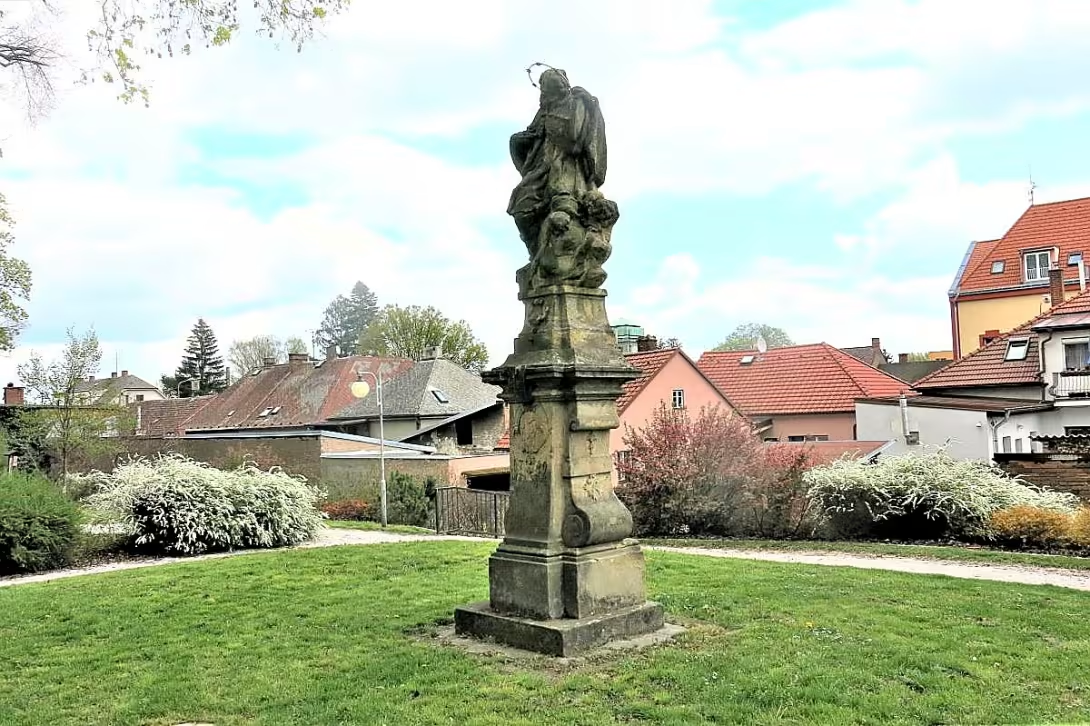
The statue of St. John Nepomuk in Nový Bydžov in Hradec Králové is a Baroque sandstone work from 1749. Currently located in the park near the Church of the Holy Trinity and is protected as a cultural monument of the Czech Republic.
The creation of the statue is confirmed by a inscription on a pedestal of 15. JULY 1749. The author of the work is not known. The building comes from the period of the high late Baroque. At that time, a rich sacral sculpture dominated Czech lands and the cult of St. John Nepomucký expanded.
The statue is made of sandstone. The saint is depicted in Canovnik robes with his head exposed and a halo with five stars. He's holding an oval palace in his left hand, his right hand on his chest. The figure stands on the clouds where the heads of putti are placed.
The whole object lies on a three-piece base. It ends with a profiled ledge and decorated with volutes with plant curtains. The base stands on one stone base. On the front wall of the pillar is placed embossed cartouche with curved edges in which there is damaged relief of kneeling figures. The own plinth is approximately 70 centimetres high and the front is decorated with a shell.
Originally, the statue was located on Klicper Street. In 1911, she was transferred to the park. In the register of the National Heritage Institute, the object is listed under the register number SAR 101774.
Thanks to its historical value and baroque design, the statue represents an important element of local sacral architecture. It is available for visitors in the park near the Holy Trinity Church.
Then and now
Drag the slider to compare how the landmark may have looked when it was built with the view today.
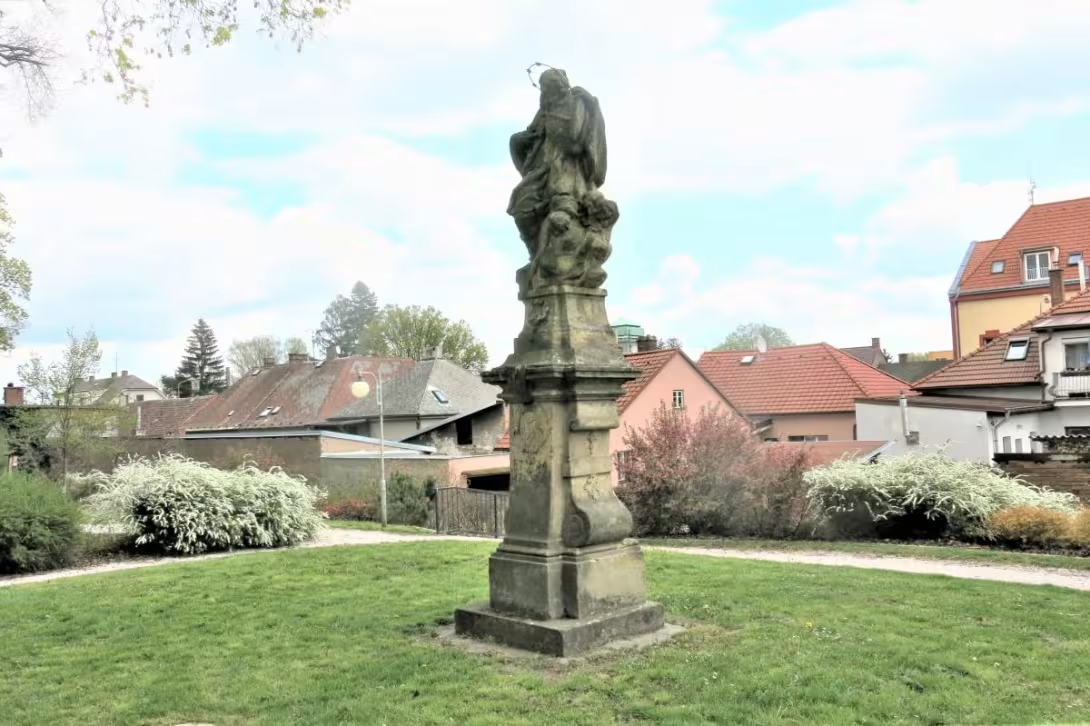
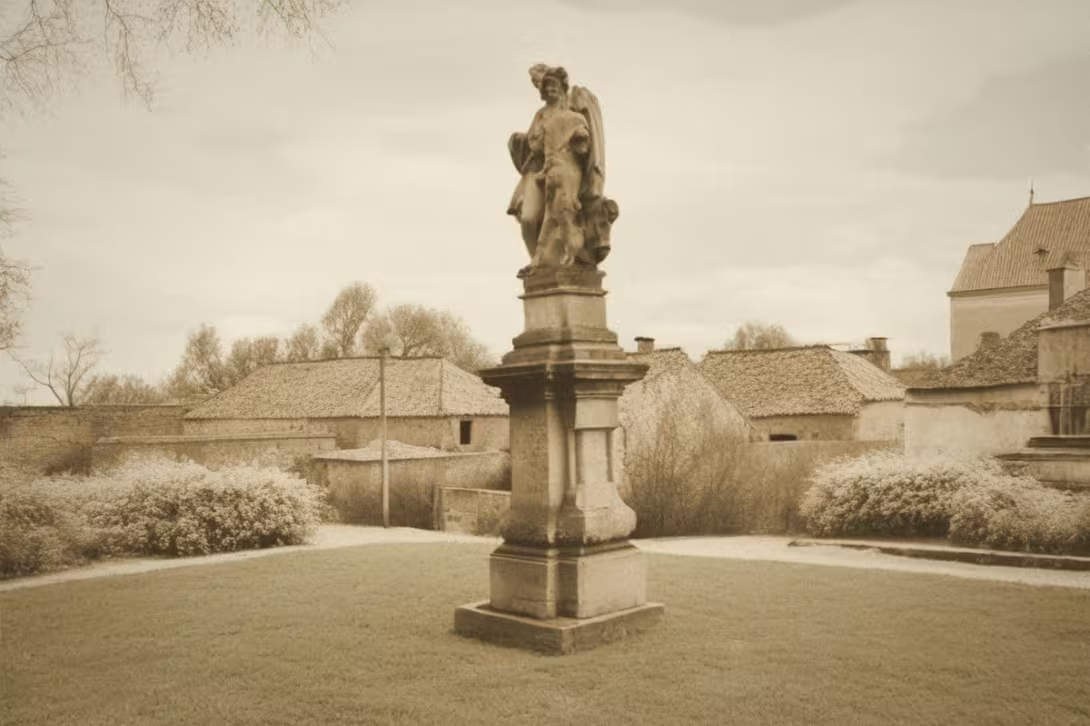
The historical appearance on the left is an AI-generated visualisation and serves as inspiration only.
Historical milestones
- 1749
- The creation of the sandstone statue of St. John Nepomuk
- 1911
- Moving the statue from Klicper Street to the park by the church
Architectural development
The statue is made of sandstone in Baroque style. The base is decorated with volutes, plant curtains and embossed cartouche with engraved date. The statue is approximately 70 cm tall and decorated with a shell at the head.
Points of interest
- The statue of St. John Nepomuk in New Bydžov is a Baroque sandstone work from 1749. - It is located in the park near the Holy Trinity Church and is protected as a cultural monument of the Czech Republic. - On the pedestal is the inscription 15. JULY 1749, the author of the work is not known. - It was originally on Klicper Street, but in 1911 it was moved to a contemporary park. - The register of the National Monument Institute is registered under the number SZP 101774.
Guide
Show guide text
This text was created by artificial intelligence and has not been editorially reviewed. It may contain inaccuracies.
Welcome to New Byjo. Right now you're standing in the silence of the park, where one of the beautiful examples of ancient art welcomes you. The statue of St. John Nepomuk stands before you, which, with its presence, gives this place depth and peace. It's a life-size figure carved out of sandstone that carries the spirit of a time when faith and art intertwined in every detail. Stop for a moment, take a breath and let your eyes pass through the contours of this character who has long been guarding his space here.
When we look at the time when this work was created, we are going to go deep into the past, namely the year seven hundred forty-nine. At that time, the Baroque era ruled, which loved dynamics, emotions and rich decorating. It is from this period that this statue comes from. Although today we do not know who was the specific author, who held the chisel in his hand and who of the hard stone eviscerated these fine shapes, the work speaks for itself with its quality. It's evidence of craftsmanship, which was very high in the 18th century.
Now I ask you to pay full attention to the details you see right in front of you. Look at the holy garment. It is depicted in Canovnik's garment, which attaches to his character with typical baroque correctness. Notice his face and expression radiating inner peace. Above the holy head you will see a hallow in which the five stars shine. These stars are not only an ornament, but they carry a deep symbolic meaning associated with the legend of this holy. In his hand is the palace, a priesthood symbol, which complements his image as a man of faith and devotion.
When your attention drops lower, notice what the Holy One stands for. The figure doesn't count on the ground, but it seems to be floating on the clouds. Among these clouds you can see the little heads of putti, which are the little angels who often accompany celestial figures in Baroque art and give the scene lightness and otherworldly character. The whole set then rests on a decorated three-piece base. If you approach it and take a close look, you'll see the inscription on July 15th, seven hundred forty-nine. It's the exact moment that tells us when this statue was completed and handed over to the world.
It's fascinating to think that this place in the park is not home to the statue from the beginning. History teaches us that monuments often move along with the changing face of the city. Originally, this statue stood in Klicper Street, where it probably served as a spiritual beacon for people passing through the city centre. However, in the year one thousand and nine hundred eleven it was decided that Saint John Nepomuk would be brought here, to this park at the Church of the Holy Trinity. This change of location gave him an environment more consistent with his confession of peace and contemplation.
Here we come to one interesting thing that may not be visible at first sight, but it is very important. This statue is not just an ordinary stone painting, but is officially protected as a cultural monument of the Czech Republic. This means that the state recognises its extraordinary value for our history and culture. It's a piece of history that has survived centuries, changes in regimes, and adverse weather effects, so it can stand before you today. But the mystery remains the identity of the creator. It is fascinating that such an important work that calls us today remains anonymous. Who was that? Was he a local master, or perhaps one of the great cities that was invited to New Bydjevo just for this project? The answer remains hidden in the archives of time.
Feel the atmosphere of this place now. The park around you, the proximity of the church and this sandstone figure form a whole that encourages us to stop. In today's rush world, such a moment of silence and observation of detail is rare. Look again at the five stars and the fine petals of the clouds under the feet of the saint. It was all carved out of one piece of stone, which in the year seven hundred forty-nine looked quite different than today, but its essence remained the same.
I hope you're interested in this short trip to history with the character of St. John Nepomuk. This statue is just one of the many pieces that compose the Mosaic of New Bydžov. It's a place where every rock can tell a story if we're just paying attention to its silent voice. Now you can quietly continue to explore the surroundings, perceive the beauty of the park and perhaps seek further clues of the past that await you in this city.
Thank you for your time together at this beautiful monument. I wish you a pleasant continuation of your journey and many other discoveries in our city. Goodbye.
Tips for visitors
The best time to visit is morning or late afternoon time, when the sun hits the sandstone surface at an angle, which better excites the details of baroque clothing and halo. The location is available by car and by public transport; Check the current connection in the search engine.
We recommend taking shoes suitable for walking through the park. Since it is a life-size statue, we recommend that you approach it to observe the details of the palace and the five star halo.
For the best photos we recommend looking for angles that include the surrounding greenery of the park, or try the image from below to make the statue appear lofty against the sky. Use soft light behind the clouds to balance the colour of sandstone.
During walks in the surroundings, remember to visit the Church of the Holy Trinity, located near the statue. For families with children, the park is an ideal place for a short rest and observing the details of stony art in the natural environment.
Frequently asked questions
Can the monument be visited?
This is a structure in a public space that can usually be seen from outside free of charge. We have not verified that this particular one is freely accessible.
Where is the monument?
Location: Nový Bydžov. The map on this page shows the exact spot.
Why is the monument protected?
It is listed in the Central List of Cultural Monuments of the Czech Republic as a cultural monument (register no. 1338123212).
Businesses nearby
Do you run a restaurant, accommodation, shop, museum, rental, wellness or other visitor service near this monument? Show yourself directly to the people heading to it — this is how they will see you in the app and on the web:
Nearby
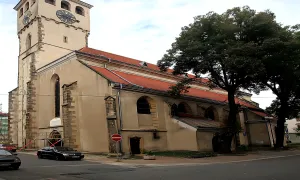
Kostel Nejsvětější Trojice
Accommodation nearby
Themed route
Here is the design of the thematic route:
1. Church of the Holy Trinity (church) - Dominanta of the place, which captures its architecture and spiritual atmosphere. 2. Statue of St. John Nepomuk (statue) - A work of art in a park that serves as the main destination of the journey and a place to think.
Seasonal recommendations
In spring the park awakens to life and the statue is surrounded by fresh greenery and blooming trees. The soft spring light gently highlights the details of the stone. We recommend shoes suitable for wet grass and visit in the morning when the air is the cleanest.
In the summer months the thick crown of trees provides a pleasant shadow that creates a game of light and shadows on the surface of the monument. The atmosphere is playful and full of vitality. It is advisable to choose light summer clothes and visit a place in late afternoon when the sun no longer burns.
Autumn brings golden and red leaves to the park, which form a strong contrast with the colour of the statue. The environment is melancholy and calm. For a comfortable tour it is advisable to take a lighter jacket or coat and leave shortly before sunset.
In winter, the statue is very lonely and monumental in the desolate landscape, especially if it is covered by a layer of snow. The lighting is cold and clean. It is necessary to wear warm winter clothes and waterproof shoes, while the best are clear freezing days.
Visualizations and artistic views


The visualisations are generated by artificial intelligence and serve as inspiration.
Photos from the area
Real photos taken near the monument


Zdroj a licence jsou uvedeny u každého snímku.
Tips from visitors
No tips yet. Be the first!
Log in and add your tip.
Sources and literature
Photos: Barocco / CC0 — Wikimedia Commons. The author and licence also appear when you hover over the image.
Faktickým podkladem tohoto textu byl článek na Wikipedii, jehož autory jsou přispěvatelé Wikipedie. Článek je dostupný pod licencí CC BY-SA 4.0.
Location on the map
Příběhy a pověsti
Legendy, pověsti a příběhy spjaté s touto památkou
Fotografie návštěvníků
Zatím žádné fotografie. Buďte první, kdo přidá fotografii z návštěvy!
Log in a přidejte svou fotografii nebo hodnoťte.
Za ověřenou návštěvu v aplikaci získáte víc bodů — poznáme podle GPS, že jste na místě.
Reviews and comments