



sokolovna v Českých Budějovicích Sokol gymnasium
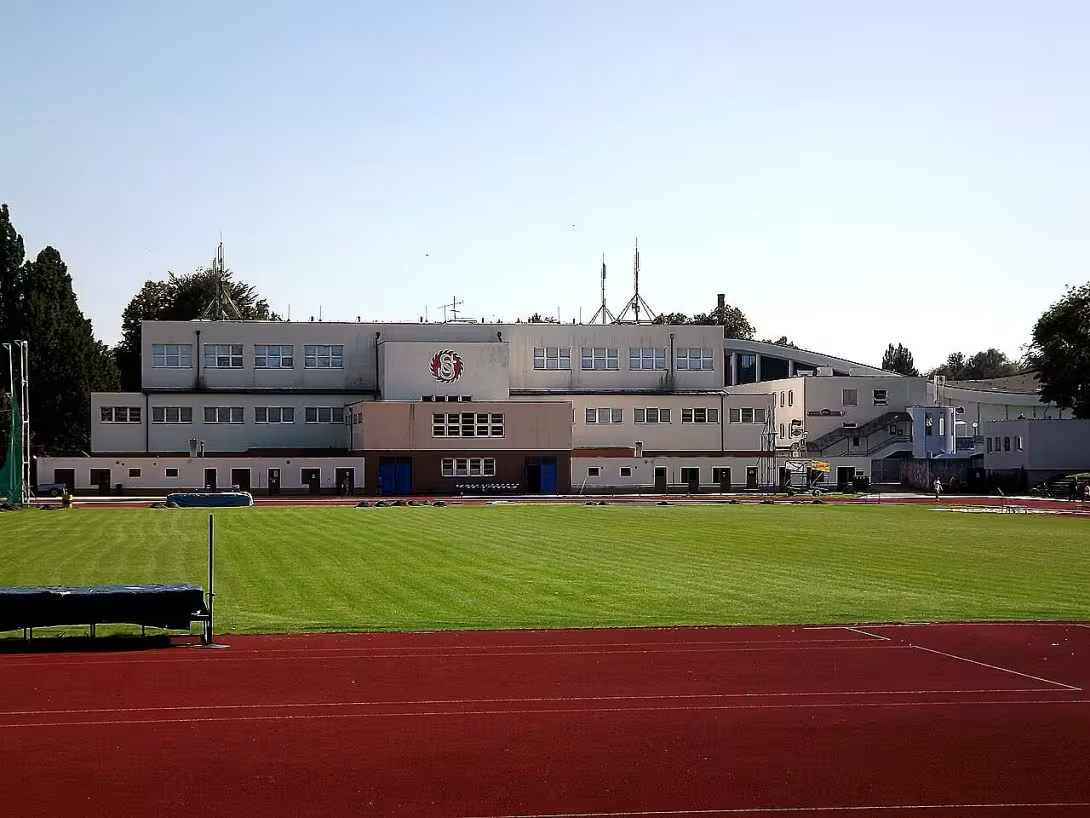
A monumental monument to functionalism on Sokol Island. A place where sports tradition meets bold interwar architecture.
Historical milestones
- 1923
- Getting Schnarcher Island, which was renamed Sokol Island.
- 1947
- The opening ceremony of the falcon on 14 June.
- 2004
- The Sokolovna and the main stadium stands are protected by a monument.
Architectural development
The building was designed in the spirit of functionalism. The construction took place in several stages with interruptions due to lack of finance and war events. In the 1990s, a reconstruction took place in which the colour of the facade was changed and one of the entrances was sealed.
Historical events
1941 prevents occupation administration building material and savings, 1947 festive opening of the building, 2004 announcement of monument protection.
Owners
Falcon in České Budějovice
Points of interest
The building is an important monument to interwar functionalism. - At the time of its opening, it was the second largest falcon in the entire Czechoslovak Republic. - The stadium was completed very quickly, within three months, and when it was opened, President T. G. Masaryk was present. - The construction of the falconry itself began in 1930, although the foundation stones were laid four years earlier. - The building was ceremoniously opened on 14 June 1947 after several breaks in the buildings.
Guide
Show guide text
This text was created by artificial intelligence and has not been editorially reviewed. It may contain inaccuracies.
Welcome to the heart of Budejovice. You're standing in front of a building that's a lot more than just an ordinary house for sports activities. In front of you, there is a falcon tower, a massive building that dominates the entire island of Sokol with its presence. If you look at her, you'll see a reflection of a time when people were trying to combine common sense with a healthy body and build a new society. Feel the atmosphere of this place where history meets motion and energy.
Let us now stop at how this building was built and why it is so important for this city. It all began in the year one thousand and ninety-three, when an island was acquired that was named Schnarcher. Soon, however, he was given a new label that suits him today and became Sokol Island. It was here that space was created to build the Falcon movement, which at that time represented much more than just body exercises. It was a symbol of national pride, unity and desire for modernization. The construction of the falcon plant itself was built between a thousand and ninety-eight years and a thousand ninety-seven. It is a long period that reflects the stormy ripples of the time, but also the persistence of the people who wanted to complete this project. The ceremonial opening followed on the fourteenth day of June in the year a thousand and ninety-seven.
Now pay attention to the very form of the building. If you look at its shapes, you will notice that there are no unnecessary ornaments or complex ornaments. It is because the building is an important monument to interwar functionalism. This direction in architecture, designed by architects Josef Šlégla and Jaroslav Stránský, placed particular emphasis on practical use of space and purity of lines. Everything here has a purpose. Look at the facade and see how the building looks balanced and stable. Funktionalism at that time meant progress and modernity, and it is this sokolovna that is one of the most prominent representatives of this style in our region. Together with the adjacent stadion, this complex forms a monument protected whole, which means that the building has preserved its original face despite decades of use.
When we talk about this place, we can't forget the personalities that were connected to it. The Sokolov movement was closely linked to the construction of the first independent state. A very important moment was the visit of the first President of the Republic, Thomas Garrigue Masaryk. The president was present at the opening of the stadium, which accompanies the falcon itself. Imagine the atmosphere where thousands of people gathered here to welcome the head of state and celebrate the emergence of a new center of physical life. Masaryk himself was a supporter of the rational development of society, and it was a building such as this falcon that embodied his vision of a modern and healthy nation.
And now I'm going to transfer you to some interesting things that may not be visible at first sight, but that give this place a special charm. Did you know that at the time of its opening this building was the second largest falcon in the entire Czechoslovak Republic? This gives you an idea of how important it was for the whole region and how much capacity it should have taken. It's a real colossus between the gym buildings. Still fascinating is the pace at which the stadium was formed. While the falcon itself required long years of work, the stadium was completed incredibly quickly in just three months. It is a fascinating contrast between the patient building of the main building and the lightning formation of the sports complex.
Notice how this building in the year two thousand and four became officially monument protected, not only the building itself, but also the stadium's main stand. This is proof that the architecture of the interwar period has its unmistakable value, which must be protected for future generations. This building is not just concrete and stone, it is a monument to human effort and belief that sport and health are the foundation of a strong society.
Let's end this journey slowly. You stand before a symbol that has survived changes in regimes, war, and oblivion to serve the people today. I hope you've realized by looking at this functionalist pearl how deep the physical movement in our city has its roots. Now I invite you to look around in peace, go through the surroundings of Sokolsky Island, and perhaps imagine how the first falcons trained here decades ago under the accompaniment of music and in the rhythm of moving together.
Thank you for walking through the history of Budejovice. Enjoy the rest of your day and continue to be inspired by the beauty of our city. Goodbye.
Tips for visitors
The best time to visit is late afternoon when the sun hits the building facade and highlights its clean line of functionalist style. Transportation to the city centre is possible by car and public connections; verify the specific possibilities in the maps.
To visit we recommend taking comfortable shoes because you are located in the island area where it is pleasant to walk around the water. The building serves as an office and school, so we recommend a quiet movement in its vicinity.
The best places for photo lovers are views from the banks of rivers that capture the building in context with surrounding nature. Ideal light for pictures of architecture is shortly before sunset.
During a short walk around you can visit Sokol Stadium or walk to the confluence of the Vltava and Malš rivers. For families with children it is ideal to walk along rivers, which offers space to move and discover nature in the heart of the city.
Frequently asked questions
Can the monument be visited?
The building is in use (offices, a school, shops and the like). The interior is generally accessible only during operating hours and tours are not usually offered; we have not verified the details. You can see the exterior from the street.
Where is the monument?
Location: České Budějovice 1. The map on this page shows the exact spot.
Why is the monument protected?
It is listed in the Central List of Cultural Monuments of the Czech Republic as a cultural monument (register no. 1660034239).
Businesses nearby
Do you run a restaurant, accommodation, shop, museum, rental, wellness or other visitor service near this monument? Show yourself directly to the people heading to it — this is how they will see you in the app and on the web:
Events nearby

Zdroj akcí: otevřená data měst a obcí ČR (Národní katalog otevřených dat) a kalendář akcí Národního památkového ústavu.
Nearby
Sokolský stadion, soutok řek Vltavy a Malše.
Accommodation nearby
Trips and activities nearby
Guided tours, tickets and activities nearby from GetYourGuide
Affiliate link: if you buy from the partner, we may receive a commission. The price for you does not change.
Search tours and activities →Themed route
Here is the design of the thematic route:
1. Sokolovna in České Budějovice (building) - The main destination of the trip, where one can admire the architecture and history of this place. 2. Sokol Stadium (sports grounds) - Located nearby and represents the center of physical education and sports meetings. 3. The confluence of the rivers Vltava and Malš (natural place) - Ideal place for a peaceful walk by the water and observation of two flows.
Seasonal recommendations
In spring, the surrounding area of the building is awakened into colours and the sun is gently illuminated by the facade. It is advisable to start in the morning when the air is fresh and nature begins to bloom around. We recommend light spring clothes and comfortable shoes to walk through the city.
In the summer months it dominates bright light and hot air. It is best to visit the place in the early hours of the morning or at dusk to avoid the hot heat.
Autumn brings golden colours of leaves and a specific melancholy atmosphere. The light is softer and golden, which creates interesting shadows from SLC leaves and walls. Practical is a layer of clothing and waterproof shoes due to frequent collisions.
Zimą works in a cool, sharp light and often accompanied by frost. In advent time the area is lit up and it looks cozy. It is necessary to wear warm winter clothes, gloves and hat to make the outside visit pleasant.
Visualizations and artistic views

The visualisations are generated by artificial intelligence and serve as inspiration.
Photos from the area
Real photos taken near the monument


Zdroj a licence jsou uvedeny u každého snímku.
Tips from visitors
No tips yet. Be the first!
Log in and add your tip.
Sources and literature
Photos: JAn Dudík / CC BY-SA 3.0 — Wikimedia Commons. The author and licence also appear when you hover over the image.
Faktickým podkladem tohoto textu byl článek na Wikipedii, jehož autory jsou přispěvatelé Wikipedie. Článek je dostupný pod licencí CC BY-SA 4.0.
Location on the map
More monuments – České Budějovice 1
Show all in the municipality
Příběhy a pověsti
Legendy, pověsti a příběhy spjaté s touto památkou
Fotografie návštěvníků
Zatím žádné fotografie. Buďte první, kdo přidá fotografii z návštěvy!
Log in a přidejte svou fotografii nebo hodnoťte.
Za ověřenou návštěvu v aplikaci získáte víc bodů — poznáme podle GPS, že jste na místě.
Reviews and comments