






Sokolovna v Karlíně Sokol gymnasium
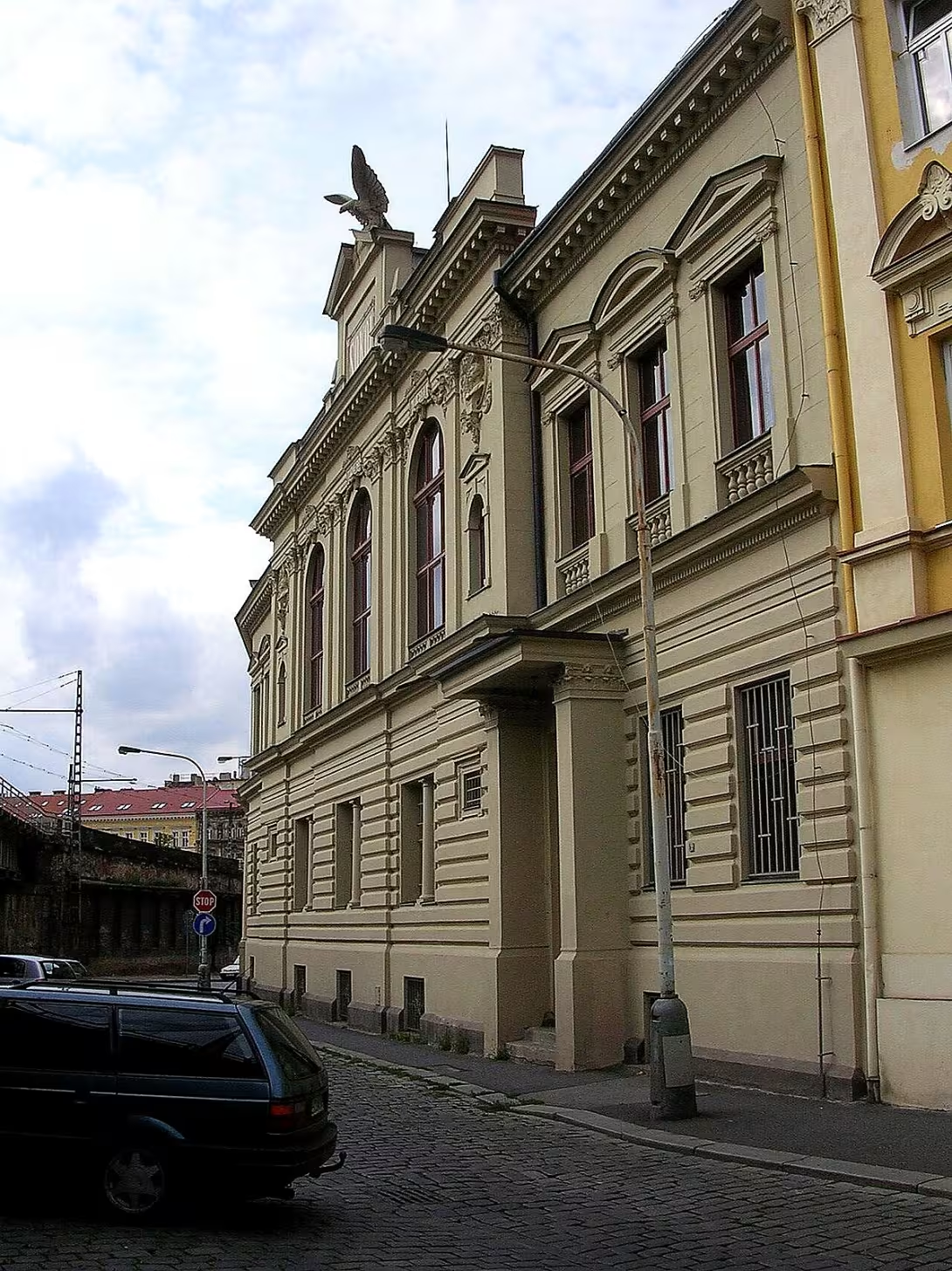
Sokolovna v Karlíně is a historic building built in 1886-1887 according to the design of builder Josef Blech older. The building is located in the street of Malé in Praze- Karlín, near the Negrelli viaduct and Karlín barracks. It is protected as a real cultural monument of the Czech Republic.
The formation of the falcon falls into the 1980s, when the Czech society went through a period of national renewal and emancipation. The then expansion of associations and the dynamic development of Prague led to Karlín becoming an important industrial and residential district. The need for social and sport activities has therefore increased. The construction itself took place in 1886-1887, in the 1920s the building was expanded with a modern extension on the east side.
The architecture combines the original Neo-Renaissance core with a later annex. The building has an irregular ground plan that determines the shape of the building plot. The main entrance is lined by Corinthians' half columns and the doors are sealed with a semi-circular profile archive. The upper leg is decorated with the Sokol motto "NI ZISK NI SLAVU." On the presented risality there are oval niche with busts of founders Sokol, Miroslav Tyrš and Henry Fügner. The belt of the cordon ledge complements the atics with a central attachment bearing SOKOL.
The interior has preserved the original available as well as a number of artistic and craft details such as carpentry work or tiles. The entrance vestibule has an unconventional circular plan and leads from it a staircase to the floor. The historic hall is finished with a semi-circular niche and is carried on the gallery floor with decorative consoles. The modern extension from the 1920s contrasts with the historical core and is carried out in simple geometric forms.
The building represents an important proof of Federal life and architectural development of Karlína at the turn of the 19th and 20th centuries. Thanks to the preservation of the original material solution and authentic elements, it remains a valuable monument that reminds us of the idea of the Sokol movement. Visiting this place offers the opportunity to explore historical architecture in the immediate vicinity of important Karlín buildings such as Negrelli's viaduct.
Historical milestones
- 1886
- The construction of the falcon building according to the design of Josef Blech the elder.
- 1887
- Completion of the falcon building.
- 1920
- Implementation of modern extension on the east side of the building.
Architectural development
The original Neo-Renaissance building was built on an irregular plan corresponding to the building plot. In the 1920s, it was extended to include a modern extension that contrasts with the historic core. The object retained its original material solution and a number of authentic elements such as carpentry work or tiles.
Historical events
1886-1887: Construction of the building according to the design of Josef Blech older. 20th years of the 20th century: Implementation of a modern extension on the east side of the building.
Points of interest
- The building was built between 1886 and 1887 according to the design of builder Josef Blech older. - Above the main entrance is placed Sokol's motto that the goal is neither profit nor fame. - On the front of the building there are oval niche with busts of founders of Sokol, Miroslav Tyrš and Henry Fügner. - The entrance hall has an unusual circular plan from which the staircase leads to the upper floor. - In the 1920s, a modern part with simple geometric shapes was added to the original Neo-Renaissance core.
Guide
Show guide text
This text was created by artificial intelligence and has not been editorially reviewed. It may contain inaccuracies.
Welcome to Karlín, one of the most characteristic parts of our city. Please stop for a moment and concentrate fully on the building that is now facing you. You stand in the street of Little and observe a building that is not just an ordinary house, but a real witness to the history, ambitions and efforts of our ancestors. In front of you you can see the Karlín Sokol, an object that affects the atmosphere with its strength and dignity. Feel its presence and imagine how many generations of people have been lost, how much physical fitness has been established here and how much friendship has been created in the spirit of national belonging. This building is protected as a real cultural monument of the Czech Republic and its facade tells us a story about how the role of sport and social life was perceived in the late nineteenth century.
Let us now look together at how this building was created and in what context it was perceived at that time. The end of the nineteenth century was a period of great optimism and bloom. It was in this atmosphere, in 1886, that the construction of this falcon house began. The whole project was entrusted to a builder named Josef Blecha starší, who wanted to create a space which would be proud, representative and also functional for the needs of the Sokol Association. The construction progressed quickly and already in 1887 the falcon was completed and opened to the public. At that time, the falcon was not only a place for exercise, but it served as a centre of social activity, a place of meeting of intellectuals, craftsmen and workers who joined together in a common vision. It was a time when, through physical education, the path to inner strength and self-confidence of the entire nation was sought.
Now pay attention to the architecture of the building itself. If you look at the general appearance, you'll notice that this is a historic building. This means that builder Josef Blecha starší drew inspiration from earlier epoch to build a sense of stability and tradition. In particular, here we see neo-Renaissance elements which are very typical of buildings of this type from that time. Take a look at the rhythm of the windows and the overall layout of the facade, which is harmonious and balanced. But there is also something in the building that deviates from the original 19th century plan. If you look at the east side of the building, you'll see a modern extension. It was realized much later, namely in 1920. This element shows us how the needs of the association changed over time and how the building had to grow in order to accommodate more and more members and new activities. It is fascinating to see this contrast between the original Neo-Renaissance style and a later modern approach from the 1920s. It's like reading a book where every chapter rewrote or completed the previous chapter.
Now when you raise your eyes above the facade, notice the details that are placed here with clear intent. In the upper part of the facade there are oval nuggets. If you look at them carefully, you'll see two men's bust. They are the founders of the Sokol, Miroslav Tyrš and Jindřich Fügner. It was these two men who defined the philosophy of the Falcon in the middle of the nineteenth century. Miroslav Tyrš, who was educated in physical education, believed that a healthy spirit required a healthy body. Jindřich Fügner assisted him in this project and provided the necessary support. Their faces thus look at visitors and members of the society, reminding them of the fundamental values on which the movement was built. It is a very personal touch of architecture that gives a human dimension to the building and reminds us that behind every stone and every plan there are specific people with a specific dream.
And now look right above the main entrance where the inscription is placed, which is perhaps the most important element of the entire facade. You read here the words Ni profit or glory. Stop over this password for a moment. Today, when everything is often measured by money, success or visibility, these words seem almost incredible. This motto expresses the very essence of the Sokol movement. The goal was not personal gain, it was not a pursuit of recognition or wealth. The goal was to serve the community, improve yourself and help others. This idea was carved into stone so that everyone who entered knew that it was coming to a space where rules apply other than in the business world. It is a call for selflessness and humility that persists today in Karlín.
If you're standing in front of this building, you might wonder why this building in Karlín was so significant. Karlín was a dynamically developing industrial district at the time of its creation. Between factories and workshops, the falcon was an island of culture and health. Imagine the contrast between the noise of the machines in the area and the silence or rhythm of the exercise inside these walls. This building was a symbol of hope and development for people at the time. Although the surroundings have changed dramatically over the years, the falcon has remained a fixed point that connects the past with the present. It is a place where architecture, sport and national identity have interconnected into one whole.
Now that you've looked at the main elements of the facade, you've seen its historical development from 1886 to 1920 to today, and you've thought about the words of the founders, I suggest you go around the building, and from different angles, you see its size and ratio to the surrounding building in Little Street. Note how the original part naturally passes to a later extension and how the building is entered into the character Karlína. Let the atmosphere of this place engulf you for a moment and imagine what stories have happened here over the past 100% of the years.
Thank you for stopping by this beautiful monument. I hope this short trip to history has helped you see more than just walls and windows in this building, but the real symbol of values that can inspire us today. Now invited to further explore Karlín and his hidden treasures. I wish you a pleasant continued journey and many new experiences in discovering our common monuments. Goodbye.
Tips for visitors
To visit, choose the morning hours of the working week when the surroundings are quieter and the building stands out in natural daylight. The building is located in a dense urban building, so we recommend using public transport; You can find the current connection in the travel app, parking in the streets is limited. Take only basic equipment with you, the building serves primarily sports purposes, so respect the privacy of the trainers. For photography is the best angle from Malý Street, where the historic facade stands out, ideally with side lighting that highlights architectural details. In the immediate vicinity you can admire the technical monument of Negrelli viaduct or visit the Karlín barracks, which is also suitable for families with children who appreciate the open space around these buildings.
Businesses nearby
Do you run a restaurant, accommodation, shop, museum, rental, wellness or other visitor service near this monument? Show yourself directly to the people heading to it — this is how they will see you in the app and on the web:
Events nearby

Zdroj akcí: otevřená data měst a obcí ČR (Národní katalog otevřených dat) a kalendář akcí Národního památkového ústavu.
Nearby
V bezprostřední blízkosti se nachází Negrelliho viadukt a Karlínská kasárna.
Accommodation nearby
Trips and activities nearby
Guided tours, tickets and activities nearby from GetYourGuide
Affiliate link: if you buy from the partner, we may receive a commission. The price for you does not change.
Search tours and activities →Themed route
1. Negrelli viaduct, technical construction. This historic stone construction offers an interesting view of urban architecture. 2. Karlín barracks, military premises. These buildings represent an important part of local history. 3. Sokolovna v Karlíně, cultural building. The main destination of a trip that serves as a meeting place.
Seasonal recommendations
Spring Sokolovna v Karlíně offers a unique combination of light and air in spring months. The sun penetrates the glass surfaces of the hall, creates moving shadows and illuminates historical details that often remain in the semi-shade in winter. The outer area is surrounded by the beginning of green trees, which are not yet dense, but bring a delicate, fresh aroma. The atmosphere is lively but not overloaded - ideal for a peaceful walk. I recommend visiting Sokolovna in April when it is pleasant out, but not yet so hot. Avoid Tuesday when there are more people around for schools. Light clothes with long sleeves are suitable because morning and evening temperatures can be cold while the sun can overheat at noon. Don't miss the neighborhood - in the park behind the building the primrose starts to bloom and undercut.
Summer In the summer months Sokolovna v Karlíně attracts visitors with its air look and pleasant shade. The large glass hall part serves as a sun protection, while the outdoor terraces offer a view of the green spaces. The atmosphere is lively, but not chaotic - ideal for relaxation between urban bustle. The best time to visit is early morning or after 6:00 in the afternoon, when there are fewer crowds and temperatures are more tolerable. In July and August the crowds are the largest, so you better book an entry or visit Sokolovna in the main summer season on Monday when there are fewer tourists. Dress up in light, airy clothes, but do not forget the hat or sunglasses - the sun on concrete surfaces strongly reflects. It's cold in the interior, so you'll bring a light jacket.
Autumn Autumn visit Sokolovna is magical thanks to the changing colour of leaves and soft, sunny light. The trees in the surrounding area are beginning to colour in gold and red shades, while the glass areas of the hall capture the glare of autumn sky. The atmosphere is calm and reflexive, ideal for reflection or photography. It's nice out in September and October, but it's getting colder days. The best time to visit is Friday afternoon when the light is out, but it's not as cold as in winter. Avoid rainy days, because moisture can make the well-being worse when staying out longer. Dress in warmer but still light layers - sweatpants or sweaters will be suitable while wear comfortable shoes on your feet. The interior is dry, so you don't need an umbrella, but you still bring it to the outdoor terrace.
Winter In winter Sokolovna v Karlíně offers contrast between historical interior and snow landscape outside. The glass surfaces of the hall capture sun reflections that reflect from the snow and create a frosty but beautiful atmosphere. The outdoor area is covered with white coating, which gives the place peace and quiet. The best time to visit is in December when it is beautiful outside, but not yet as cold as in January. Avoid Monday when the crowds get bigger because of family visits. Opening hours are shorter, so plan your visit by noon. Dress in warm clothes - wear a jacket with a hood on the top layer, gloves on your hands and tight shoes with anti-slip soles on your feet. It's warmer in the interior, but it can get cold on the outside terraces, so you can bring the thermofoils. In advent time it can be beautifully lit outside, but don't forget the warmth - the freezing wind can be unpleasant.
Visualizations and artistic views

The visualisations are generated by artificial intelligence and serve as inspiration.
Photos from the area
Real photos taken near the monument

Zdroj a licence jsou uvedeny u každého snímku.
Tips from visitors
No tips yet. Be the first!
Log in and add your tip.
Sources and literature
Photos: ŠJů (cs:ŠJů) / CC BY-SA 3.0 — Wikimedia Commons. The author and licence also appear when you hover over the image.
Faktickým podkladem tohoto textu byl článek na Wikipedii, jehož autory jsou přispěvatelé Wikipedie. Článek je dostupný pod licencí CC BY-SA 4.0.
Location on the map


Příběhy a pověsti
Legendy, pověsti a příběhy spjaté s touto památkou
Fotografie návštěvníků
Zatím žádné fotografie. Buďte první, kdo přidá fotografii z návštěvy!
Log in a přidejte svou fotografii nebo hodnoťte.
Za ověřenou návštěvu v aplikaci získáte víc bodů — poznáme podle GPS, že jste na místě.
Reviews and comments