



Sousoší Kalvárie / svatého Vavřince a Donáta Sculptural group
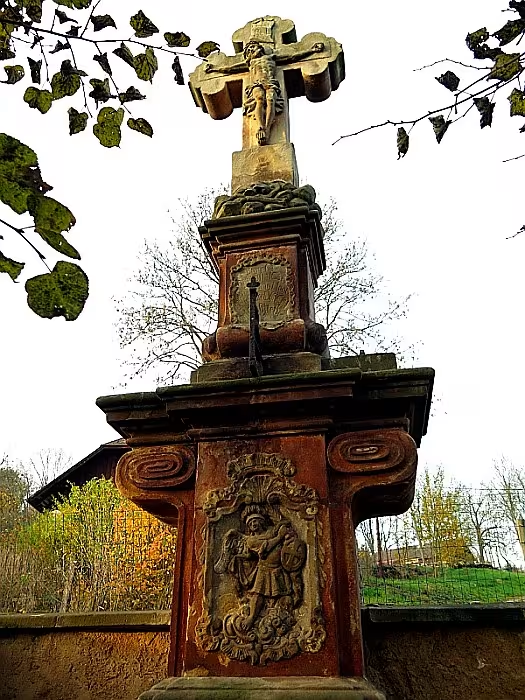
The sandstone sculpture of Calvary and Saint Donát and Vavríce from 1765 is situated in the village of Sedliště in the district of Jicin near the road from the Old Hrad to Bystřice. This baroque work of Turnov sculptor František Fiala combines religious symbolism with typical elements of his time.
The monument was created in 1765 during the Baroque period. This style was common in architecture and sculpture with rich and dramatic forms in Bohemia. The author's name is shown in the inscription on the back of the stand.
The whole object is made of sandstone and placed in a pen on six degrees. The base consists of a two-stage prism plinth with a base. His front side adorns a polychrome relief angel with sword and shield. The upper part of the base with the ledge ends with volutes. On the ledge stands a smaller volcano with a lantern handle and another stand with inscriptions. The top of the statue is a profiled ledge with a clover cross and crucified Jesus Christ. Christ is dressed in a loin cloth, his head drops to his right shoulder. The cross stands on a rock with a skull and legs.
The original appearance of the sculptures included statues of St. Donat and St. Vavríce, which used to stand on the side edges of the ledge. They are no longer in the original place, but they are stored in the castle in the Old Castle.
A monument in the village of Sedliště is an accessible testimony of baroque art in the landscape. For visitors, an interesting example of František Fiala's work and an example of the 18th century religious sculpture.
The sculpture is a valuable fragment of local history and baroque spirituality. We recommend visiting it on the road between the Old Castles and Bystřice.
Then and now
Drag the slider to compare how the landmark may have looked when it was built with the view today.
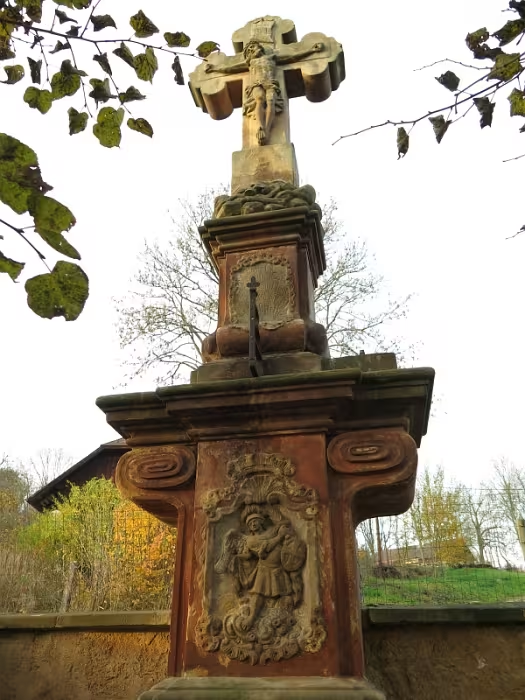
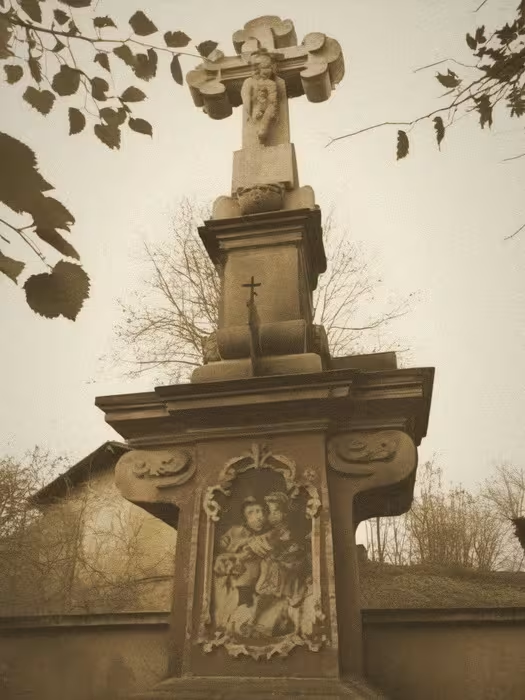
The historical appearance on the left is an AI-generated visualisation and serves as inspiration only.
Historical milestones
- 1765
- The creation of sandstone sculpture in the village of Sedliště
- 1765
- Formation of the Turnov sculptor František Fialy
- after 1765
- Transferring the statues of Saint Donat and Vavrnice to the castle of Old Castle
- around 1760
- The flowering of Baroque art in the region of Jicin and Turnov
Architectural development
The statue was created by the sculptor František Violet of Turnov. Its design includes sandstone elements with polychrome details and is characteristic of Baroque style.
Points of interest
- The sandstone sculpture of Calvary and Saint Donat and Vavríce was created in 1765. - This work is attributed to Turnov sculptor František Purple, his name is on the back of the pedestal. - The sculpture was originally supplemented by statues of St. Donat and St. Vavřinec, which are not in the original place today, but are stored in the castle in the Old Hrady. - The entire object is placed in a fence at six degrees and decorated with polychrome relief angel with sword and shield. - The top of the statue is the crucified Jesus Christ, dressed in a loincloth, standing on a rock with skull and legs.
Guide
Show guide text
This text was created by artificial intelligence and has not been editorially reviewed. It may contain inaccuracies.
Welcome to the village of Sedliště. Stop for a moment, take a breath and feel the calm of this place. Right now you are standing in front of the sandstone sculpture of Calvary, which is a silent witness to history decorating the landscape along the road from the Old Castles to Bystřice. If you look at him for the first time, you might be interested in his strange form and the feeling that something is missing in this space. It's a sandstone building that rises above the surrounding terrain and ignites the spirit of the time when art was an inseparable part of every journey and every village.
Let's look together at what you see right in front of you. The whole area of the sculpture is set into the boundary space, which is built on six sandstone stages. These degrees create a natural rise to prepare the visitor to meet the sacred image. The sandstone from which the whole building is carved is a material typical of our regions, in which sculptors managed to capture both softness and monumentality. Notice how this stone, with gradual aging, was changing and how it carved its traces of ten years of wind and rain into it.
Now pay attention to the lower part of the building. Take a look at the two-stage plinth that carries the entire base. Right here is one of the most valuable details you could miss if you just walked by. There is a polychrome relief, a cut in the stone, which was originally decorated in colour. It shows an angel holding a sword and shield in his hands. Imagine how these colors shone at the time of origin and how they attracted the attention of pilgrims and locals. An angel with a sword and shield is not just a decoration, but a symbol of protection and spiritual vigil.
To understand why this work is even standing here, we have to go back more than two centuries in time. The year is seven hundred and sixty-five. At that time, the surroundings of Jičín and Turnov experienced the true bloom of baroque art. The Baroque was a style full of emotions, dynamics and desires for greatness. It was during this period that this sculpture was created in Sedlista. His author was Turnov sculptor František Fiala. He was the master of his craft, who could bring about a sense of movement and life in a hard stone. If you had the opportunity to bypass the base and look at its back, you would find a confirmation of its authorship, because František Fiala left its name here.
Now try to close your eyes for a moment and imagine what this place looked like in the year seven hundred and sixty-five. The pedestal wasn't empty. On it stood two noble statues of saints, Donat and Vavríce. They were important saints who, in people's wisdom, represented protection against storms and trials of faith. The whole area acted as a comprehensive religious image, which was meant to be a reminder of suffering and hope. Saint Donat and Saint Vavřinec, together with the angel on the plinth, formed a harmonious whole, which acted as a beacon of faith and beauty in the plains of the village of Sedliště.
Here, however, we encounter one of the greatest mysteries and sad stories of this place. As you may have noticed, the statues of St. Donat and St. Vavríce are not here today. Where did they go? History tells us that at some point after a year, seven hundred and sixty-five of these two figures were moved. But they did not disappear into oblivion, but found a new refuge in the castle in the Old Castle. It is fascinating to think that one part of the work remained here, in an open space, exposed to all elements, while the other part moved to the protected spaces of the castle where it became part of the noble collection.
This distribution of sculptures creates a special atmosphere. The emptiness over the polychrome relief of the angel makes us think about fleeting and how the perception of art changed over the centuries. What was originally one of the total intended for the public fell into pieces. However, it is this incompleteness that may be interesting for us visitors. It forces us to engage in fantasy and seek the connection between this sandstone base in Sedlista and the statues that are now resting in the castle.
If you look again at those six sandstone degrees, remember that each one represents a way up. The baroque concept was often about the symbolism of ascension to deity or higher truth. František Fiala did not only create a religious monument with its work, but put a piece of Turnov art in the landscape that has lasted centuries. It is admirable that despite the loss of the main sculptures, this foundation and the tiny, colored angel with the sword, still guarding the way from the Castles to Bystrica.
The view of this sculpture reminds us of how closely faith, art and landscape were interconnected in the eighteenth century. The sculptor was not just a craftsman, he was a storyteller in stone. And even though this story is divided into two locations today, we still feel the strength of the Baroque period and the Franz Fiala Championship.
Now, before we say good-bye, I suggest you rebuild the entire space once again. Feel the texture of sandstone under your fingers, if the surroundings permit, and look again at the details of the shield and sword in the angel's hands. Try to imagine what a meeting with those two saints would look like if they were still standing here. Perhaps this idea will inspire you to visit the castle in the Old Castle on the next occasion and find the missing parts of this sandstone puzzle.
Thank you for spending time with us at this silent memorial. We hope that you have felt a connection to the history of the region of Jicin and Turnov and that you were fascinated by the work of the Turnov master. We now invite you to further explore the surroundings and continue your journey. Let yourself be guided by the countryside and look for other hidden clues of the past that await you in this beautiful area. Have a safe trip, and I say good-bye to history.
Tips for visitors
The best time to visit the sculptures of Calvary and Saint Donata and Vavríce is in spring or autumn, when the weather is pleasant and the place is not crowded. This time of year also offers the most beautiful colours of trees in the area.
For those travelling by public transport, it is appropriate to verify the current connection with a search engine or local route plan.
When visiting, wear a suitable suit because the place is outdoor and in winter it can be cold. We also recommend comfortable shoes for walking on the ground and protective sunglasses.
For photography it is recommended to come to the sculpture at noon, when the light is brightest. The best places for photo are the west side and top of the boundary area where you can capture the overall view of the surroundings.
In the area you can visit Bystíci pod Hostín, which is located about 30 minutes walk from the place. This historic village offers interesting sights and beautiful green spaces suitable for relaxation.
Frequently asked questions
Can the monument be visited?
This is a structure in a public space that can usually be seen from outside free of charge. We have not verified that this particular one is freely accessible.
Where is the monument?
Location: Královéhradecký kraj. The map on this page shows the exact spot.
Why is the monument protected?
It is listed in the Central List of Cultural Monuments of the Czech Republic as a cultural monument (register no. 1000124462).
Businesses nearby
Do you run a restaurant, accommodation, shop, museum, rental, wellness or other visitor service near this monument? Show yourself directly to the people heading to it — this is how they will see you in the app and on the web:
Nearby
🏰 Historic sites (117)
- zámek Staré Hrady 1.0 km
- 1914-1918 1.1 km
- sv. Václav 2.1 km
- Ecce Homo 2.1 km
- Mistr Jan Hus 2.2 km
- Karel Havlíček Borovský 2.2 km
- Základní kámen 3.4 km
- pomník padlých I. sv. války 3.7 km
- Kalvárie 4.0 km
- 1914-1918 4.2 km
- 1914-1918 4.3 km
- zámek Dětěnice 4.4 km
- Pomník obětem světových válek 4.5 km
- 1914-1918 5.1 km
- zámek Vlčí Pole 6.2 km
- sv. Jan Nepomucký 6.7 km
- Hrad Veliš 7.2 km
- Mariánský sloup 7.3 km
- Památník obětem 1. světové války 7.3 km
- sv. Anthelm 7.4 km
🍽️ Restaurants and dining (118)
- Radnice 2.2 km
- Na Knížecí 2.2 km
- Cukrárna Karolína 2.2 km
- Hospoda U Havlů 3.0 km
- U Markvarta 4.4 km
- Šenk u dvou čarodějnic 4.4 km
- Středověká krčma 4.5 km +420 493 599 142 web
- Cukrárna, kavárna 4.6 km
- U Bači 4.7 km
- Pivnice U Bači 4.7 km
- Kulinářská restaurace Kovárna 5.8 km +420 776 766 628 web
- Mlíkárna 6.1 km Křešice 19 web
- Restaurace Anna Kráva 6.7 km +420 777 270 783 web
- Restaurace Na Samšině 7.1 km
- Holiday Cafe 8.1 km TGM 270 +420 733 666 194 web
- Staročeská restaurace 8.2 km web
- MOL 8.4 km web
- Občerstvení Labužníkův ráj 8.7 km
- Bistro Radnice 8.7 km
- Maso-uzeniny Hanušovi 8.7 km
🏨 Accommodation (50)
- Řáholec 2.4 km
- Středověký hotel Dětenice 4.4 km +420 493 599 161 web
- Rustikal 4.6 km +420 493 599 161 web
- Homole 6.4 km
- Ubytování Drštěkryje 7.7 km web
- Hotel Pošta 8.7 km +420 732 445 151 web
- Chata Svinčice 8.8 km +420602173073
- Hotel Pod Šikmou věží 9.2 km Horní Lochov 32 +420 739 747 374 web
- Farma Košík 9.3 km +420325514850 web
- Koupaliště Kemp Sobotka 9.6 km +420776133341 web
- Kemp Rumcajs 10.1 km
- Buškovský mlýn 10.1 km
- Hotel TAMMEL **** 10.3 km
- Hotel U Krále *** 10.4 km Nerudova 45
- Hotel Bohemia 10.5 km
- Ort 10.5 km web
- Věž Jičín - Romantika pro 2 10.5 km
- Penzion u České Koruny 10.6 km +420493531241
- Hotel Paříž 10.7 km
- Hotel U Valdické Brány 10.7 km
🚲 Rentals and sport (7)
- Sportovní hala 7.7 km
- Horolezecká stěna Sobotka 9.0 km
- SK Tenis 9.6 km web
- Cyklocentrum Souček 10.5 km Kollárova 43 +420493534061
- Sportisimo 10.7 km Riegrova 1263 +420724484985
- Koupaliště Kníže 10.7 km
- Aqua centrum 11.4 km
🥾 Hiking and nature (249)
- Libáň 1.7 km
- Cikán 2.2 km
- Rybník Mordýř 3.6 km
- Hrádek 3.7 km
- Na Vysoké 4.8 km
- Kamenný vrch 4.8 km
- Holý vrch 4.8 km
- Čakan 4.8 km
- Pramen Mrliny 5.2 km
- Loreta 6.3 km
- Rybník Jíkavec 6.3 km
- Dubolka 6.5 km
- Špičák 6.7 km
- Na vrchu 7.2 km
- Veliš 7.2 km
- Houser 7.2 km
- Mílova hůra 7.2 km
- Čmelík 8.4 km
- 221 8.8 km
- Velká Svinčice 8.9 km
Accommodation nearby
Themed route
Route around Sousoší Kalvárie / svatého Vavřince a Donáta
1. Neighbors of Calvary / Saint Vincent and Donat (sculpture) This work of art is the center of our route. It is a unique example of baroque sculpture that depicts scenes from the life of Christ and his martyrs. Visit him for details and historical value.
2. Church of St. Lawrence and Donata (church) Around the same area there is a church, which is part of the complex together with our selected sculpture piece. The church offers a view of rich history and architectural elements from the time of its creation.
3. Chapel by the church (chapel) Near the church there is a chapel, which served as a place of prayer and refuge for the locals. It is a place of peace and reflection of the historical traditions of the region.
4. Space around the church (space) Walk through the courtyard or surrounding area offers a view of the overall composition and location of the monument in the space. It is an ideal place to enjoy a quiet moment and appreciate architectural details.
5. Church interior (interior) Visit the interior of the church to see the interior decoration, frescoes and other works of art. This space offers a deep insight into the history and culture of the area.
This route will guide you through the key sites associated with the monument of the Soussoš Calvary / Saint Vincent and Donat, which will allow a deeper understanding of its history and cultural importance.
Seasonal recommendations
Spring: During the spring season, the first flowers appear at the Crescent of Calvary that discolour the surroundings and bring their characteristic odour. The sunny days offer ideal conditions for walking between statues when the lighting is finer and nature begins to bloom again. At this time the visit may be slightly challenging due to the morning cold, so it is advisable to dress in layered clothes. The best time for a tour is in the morning when the temperature is more pleasant and the crowds are not so intense.
Summer: The summer is known for its heat and long sunny days at Calvary. Full green trees provide natural sun protection, which creates a calm atmosphere for relaxing and observing the sights. This season it is recommended to visit in the morning or in the evening to avoid the heat and crowds that are common at noon. Don't forget your sunglasses, UV cream and plenty of drinking water.
Autumn: In autumn, the surroundings of Calvary are transformed into colored mosaics of pink, yellow and orange shades. Solar lighting is finer, which creates ideal conditions for shooting a monument with its unique atmospheric effect. At this time the temperature may still be pleasant, but at the end of the day it can quickly cool down, so it is advisable to dress in layered clothes. The best time to visit is morning or evening.
Winter: Winter visit The Calvary Statue offers a different view of the memory where snowy hills and trees create a romantic atmosphere. Sun days are limited, so it is advisable to visit during maximum lighting. Temperature can be very low, which requires warm clothes and wind protection.
Visualizations and artistic views


The visualisations are generated by artificial intelligence and serve as inspiration.
Photos from the area
Real photos taken near the monument


Zdroj a licence jsou uvedeny u každého snímku.
Tips from visitors
No tips yet. Be the first!
Log in and add your tip.
Sources and literature
Photos: Sovicka169 / CC BY-SA 4.0 — Wikimedia Commons. The author and licence also appear when you hover over the image.
Faktickým podkladem tohoto textu byl článek na Wikipedii, jehož autory jsou přispěvatelé Wikipedie. Článek je dostupný pod licencí CC BY-SA 4.0.
Location on the map
Příběhy a pověsti
Legendy, pověsti a příběhy spjaté s touto památkou
Fotografie návštěvníků
Zatím žádné fotografie. Buďte první, kdo přidá fotografii z návštěvy!
Log in a přidejte svou fotografii nebo hodnoťte.
Za ověřenou návštěvu v aplikaci získáte víc bodů — poznáme podle GPS, že jste na místě.
Reviews and comments