



Staroměstská mostecká věž Tower
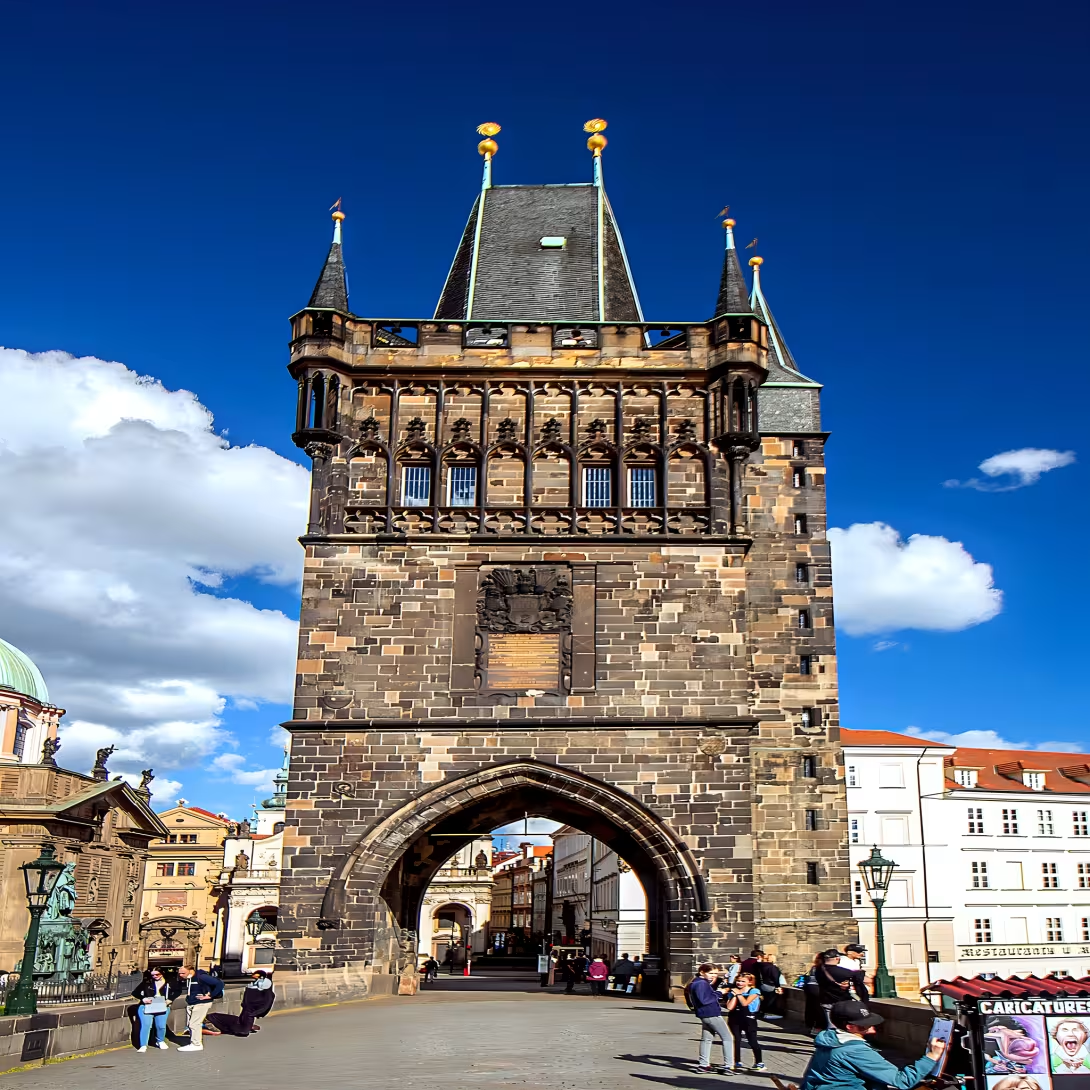
Staroměstská mostecká věž is located on the Old Town of Prague on Crožovnický Square at the right-hand entrance to Charles Bridge. It is not just a fortress structure, but a representative victory arch, which was supposed to convey a power message to the victorious traveler. When a man crossed the threshold, a view of Prague Castle was spread in front of him, where the golden mosaic of the Last Court shone at the Saint's Gate. The tower thus served as a gateway to the most extravagant part of Prague, and it was the Emperor Karel IV. who stated that the coronation parades of his followers would lead this very place.
The building of the tower was started shortly after laying the base stone of the bridge in 1357. The first builder was Master Otto, who determined the form of the future work. After that Michael Savojský joined and led the construction to the top of the first floor. Then the building was taken over by the imperial parlerian smelter, and the work continued between the seventies and eighties of the fourteenth century, when the tower was completed. The ideal creator of the magnificent plastic decoration of the facade was Karel IV. himself, his successor Václav IV. then added partial elements. All the sculptures came from the workshop of Peter Parléra.
Petr Parléř was in its field of versatile talent - builder, stonemason, sculptor and carver, today ranked among the greatest artists of European top goth. He started his dazzling Prague engagement in 1356, when as a 24-year-old he took over at the request of Charles IV the building of the St. Subsequently, he was entrusted with the construction of the Charles Bridge and the Old Town Tower, which became an emblem of Gothic fortification gates in Czech countries.
The tower was once a symbol of the greatest glory of the Czech kingdom, but in the seventeenth century it turned into a symbol of Habsburg power. In 1621, after the failed uprising of the Czech Protestant states, Ferdinand II had the heads of twelve executed Czech masters displayed in iron baskets. One head was taken at the request of the widow after a year, the other eleven heads remained hanging for ten years before they were taken out in 1631. But their later fate remains unknown.
The tower suffered the worst during the 30-year war. In 1648, the Swedes tried to get to Staré Město by attacking Charles Bridge. The Prague people defended themselves from the Old Town Tower, which was barricaded by logs, and were supported by students and professors from near Clementine. However, the Swedish artillery fire completely destroyed the Gothic decoration of the west side of the tower - its shape was not preserved. A stone plate with a Latin text resembling the heroic struggle of the Pražani was attached to the site of the destroyed statues in the mid-seventeenth century by Carlo Lurago and Giovanni Spinetti.
The tower was further damaged during the revolutionary storms of 1848. A thorough reconstruction was carried out between 1874 and 1878 under the guidance of architect Josef Mocker, co-author of the project of the modern construction of the St. Matthew Cathedral. In the twentieth century, further partial repairs were followed, but the construction and decoration were rather insensitive. In 1972, six large sandstone statues of kings and saints were taken from the tower, along with sign shields.
Today we cannot see the tower in its original Gothic beauty. Many damage and repairs turned her into a double witness - both the glory of the medieval kingdom and the storms that destroyed her. Yet it remains one of Europe's most important gothic works and an essential part of the experience of walking through Charles Bridge.
Then and now
Drag the slider to compare how the landmark may have looked when it was built with the view today.
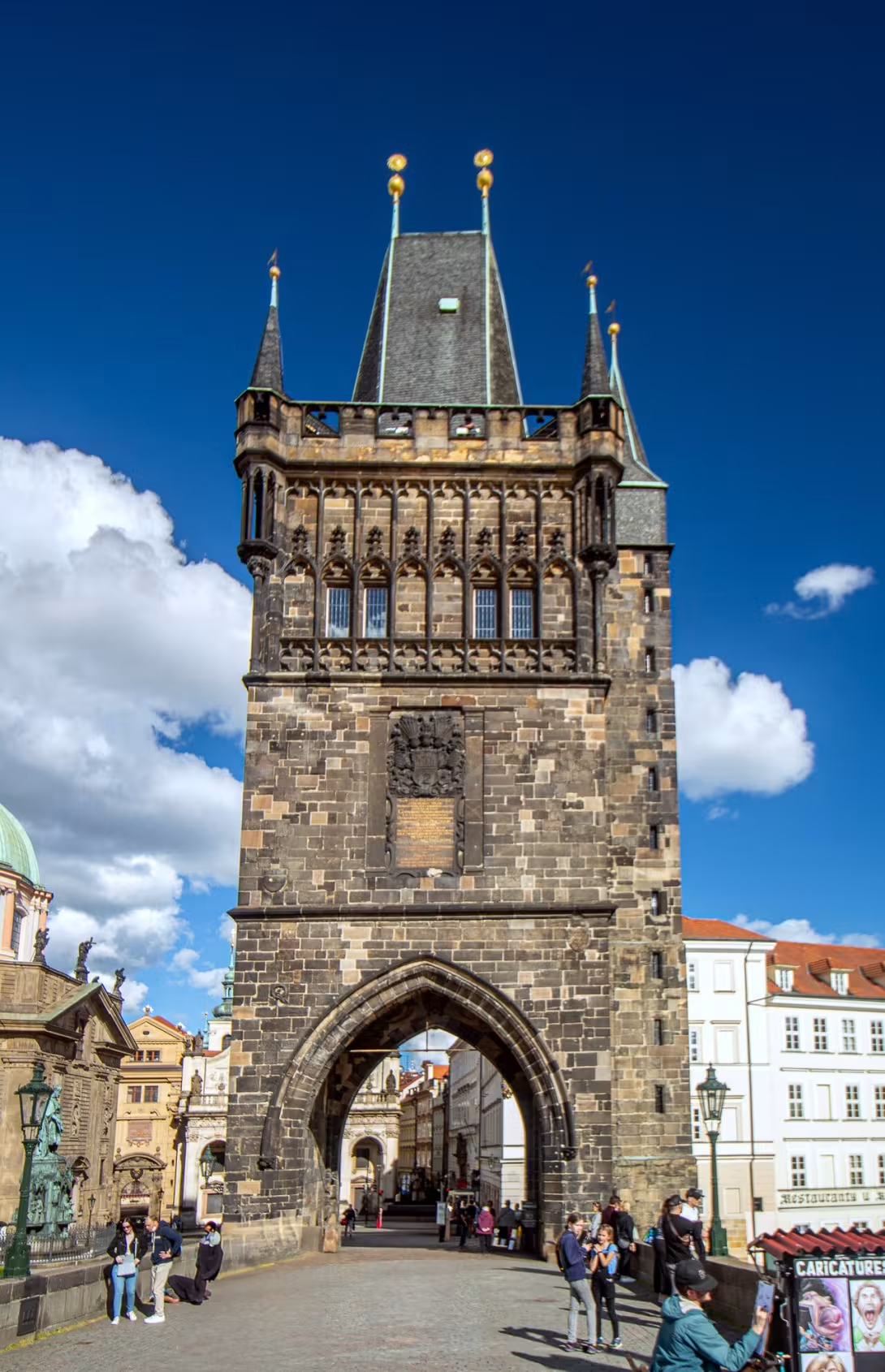

The historical appearance on the left is an AI-generated visualisation and serves as inspiration only.
Historical milestones
- 1357
- Opening of tower construction
- 1621
- Prague execution of 27 Czech masters
- 1648
- The invasion of Swedish troops in Prague
- 1874-1878
- A thorough reconstruction of the tower
Architectural development
The building of the tower was started shortly after laying the base stone of the bridge in 1357. The first builder of the tower was Master Otto, who designed her form, followed by Michael Savojský, who led her to the level of the 1st floor. Then the imperial plant of Peter Parléra took over the building. The construction was completed between the 1970s and 1980s.
Historical events
Prague execution of 27 Czech masters in 1621
The invasion of the Swedish troops in Prague at the end of the Thirty Years' War in 1648
A thorough reconstruction of the Old Town Bridge Tower took place in 1874- 1878 under the guidance of architect Josef Mocker
Points of interest
- Staroměstská mostecká věž stands at the Old Town of Prague on the Crožovnický Square at the right-hand entrance to the Charles Bridge. - It's not just a fortress structure, it's a representative victory arch that was supposed to convey a power message to the victorious traveler. - The tower thus served as a gateway to the most glorious part of Prague, and it was the Emperor Karel IV. who determined that the coronation parades of his followers would lead this very place. - Petr Parléř was in its field of versatile talent - builder, stonemason, sculptor and carver, today ranked among the greatest artists of European top goth. - The tower was once a symbol of the greatest glory of the Czech Kingdom, but in the seventeenth century it turned into a symbol of Habsburg power.
Guide
This guide is narrated by a synthetic voice generated by artificial intelligence.
Show guide text
This text was created by artificial intelligence and has not been editorially reviewed. It may contain inaccuracies.
The Old Town Bridge Tower stands in the Old Town of Prague, on Křižovnická Square, at the right bank entrance to Charles Bridge. It lies on the royal route, along which, according to the will of Charles IV, coronation processions of his successors were led.
The Gothic tower was built together with the bridge. It was not merely a fortification. It was intended as a triumphal arch that celebrated the rule of Charles IV and his son Wenceslaus IV. At the same time, it formed a symbolic passage into the most prestigious part of Prague. Behind it, a view opened onto Prague Castle with the golden mosaic of the Last Judgment on the St. Vitus Gate. A visitor was thus meant to understand that the emperor himself resided here.
Construction began shortly after the laying of the bridge's foundation stone in 1357 and proceeded under the direct supervision of Charles IV. The appearance of the tower was designed by Master Otto. After him, Michael Savojský took over the work and brought it up to the height of the first floor. Then the imperial workshop of Petr Parléř took over and the tower was completed between the seventeen seventies and eighteen eighties of the fourteenth century. The ideological creator of the facade decoration was apparently the emperor himself, and Wenceslaus IV later added to it. All the sculptures come from Parléř's workshop. Petr Parléř was a builder, stoneman, sculptor and carver, and ranks among the greatest artists of European High Gothic. The tower became a model for Gothic fortress gates in the Czech lands.
In the seventeenth century, it served as a backdrop for Habsburg power. After the execution of twenty-seven Czech lords in 1621, Ferdinand II had the heads of twelve of the executed placed in iron baskets on the tower's balcony. One skull was removed after a year at the widow's request. The remaining eleven heads stayed there for ten years and were taken down in 1631. Where they were stored is not known.
The tower was most seriously damaged in 1648 when the Swedes attempted to conquer the Old Town across the bridge. The people of Prague, aided by students and professors from the Clementinum, defended themselves behind a barricade of logs. Artillery fire destroyed the Gothic decoration on the western side. During the repair carried out by Carlo Lurago and Giovanni Spinetti, the destroyed sculptures were replaced with a stone plaque with a Latin text about the struggle of the people of Prague. Further damage came in 1848. A thorough reconstruction was led by architect Josef Mocker from 1874 to 1878. Later partial repairs in the twentieth century affected the structure and decoration insensitively.
Tips for visitors
The best time to visit is in the morning or in the evening when the light is ideal for photography.
Parking is possible in nearby parking lots or in nearby parking lots.
It is advisable to bring your own water and breakfast because there are not many shops nearby.
You can take photos from different angles, but it is best to take pictures from sunrise when light is soft and without shadows.
In the area you will also find the Old Town Hall and Crožovnická Square, where there are several interesting sights and restaurants.
Frequently asked questions
Can the monument be visited?
Yes. We verified the opening hours or admission on the official website (30. 9. 2026); you will find them in the visitor information on this page. Please double-check with the operator before you travel.
What are the opening hours and admission?
Details verified on the official website (30. 9. 2026) are listed in the visitor information on this page. Official website: https://www.prague.eu/staromestskamosteckavez
Where is the monument?
Location: Staré Město, Praha, Hlavní město Praha. The map on this page shows the exact spot.
Why is the monument protected?
It is listed in the Central List of Cultural Monuments of the Czech Republic as a national cultural monument (register no. 108). It is protected as part of a larger listed ensemble.
For kids
Hi! You hear that? This is the story of the Old Town Bridge Tower, which is a real adventure building full of secrets and strange events. It stands there in Old Town of Prague, as a guardian waiting to introduce you into the world of the past.
Businesses nearby
Do you run a restaurant, accommodation, shop, museum, rental, wellness or other visitor service near this monument? Show yourself directly to the people heading to it — this is how they will see you in the app and on the web:
Z magazínu
Events nearby


Zdroj akcí: otevřená data měst a obcí ČR (Národní katalog otevřených dat) a kalendář akcí Národního památkového ústavu.
Nearby
Prague Castle
St. John's Cathedral
Clementine
Accommodation nearby
Trips and activities nearby
Guided tours, tickets and activities nearby from GetYourGuide
Affiliate link: if you buy from the partner, we may receive a commission. The price for you does not change.
Search tours and activities →Themed route
Thematic cruise route Staroměstská mostecká věž
1. Old Town Square - Type: Square - Why it is worth a visit: This historic heart of Prague is famous for its architectural beauty and peaceful environment. Here you can explore ancient houses, shops and restaurants and start your way to the tower.
2. Old Town Hall - Type: Historical object - Why is it worth a visit: Old Town Hall is one of the most famous monuments of Prague, famous for its Gothic architecture and important historical events. We need to examine her courtyard and interiors.
3.Staroměstská mostecká věž - Type: Tower - Why is it worth visiting: This iconic tower is the most famous symbol of Old Town and provides a unique view of Prague. It's an ideal place to understand the history of the Bridge Bridge.
4. Bridge Station - Type: Station area - Why is it worth a visit: This place is important for understanding the transport history of Old Town. Here you can explore the architectural style and use of the premises.
5. Bridge Square - Type: Square - Why is it worth visiting: This place is known for its peaceful atmosphere and historic buildings that reflect the rich past of Old Town. It is ideal local for relaxing after visiting the tower.
This route offers passengers a view of the key historical and cultural aspects of the Old Town, beginning from its centre to the Bridge region.
Seasonal recommendations
In spring the tower surrounds the fresh air and the waking greenery along the waterfront. The morning light gently hits the stone details, which creates a calm mood. We recommend to wear more layers of clothing because of variable weather and schedule a visit in the morning before most people gather around.
The summer season brings an intense sun and a noisy, energetic atmosphere full of visitors from around the world. The bright noon highlights the colours of facades and the details of architecture. Because of the big crowds in the season, it's best to come first thing in the morning. Choose light, breathable materials and don't forget enough fluids.
Autumn is characterized by golden lighting and fog coming from the river, which gives the monument a mysterious touch. The colours of the surrounding leaves contradict the dark sandstone. Ideal is a visit in the afternoon to capture the best colors. Don't forget your waterproof jacket and comfortable shoes.
In winter, the tower operates monumentally, especially if it is covered by a layer of snow. The atmosphere in advent time may be seductive, but in the very object, it is cold. It is necessary to wear warm clothes, gloves and a hat. Pay attention to the shorter opening time and take advantage of the evening lighting, which in dark hours works magically.
Visualizations and artistic views


The visualisations are generated by artificial intelligence and serve as inspiration.
Photos from the area
Real photos taken near the monument


Zdroj a licence jsou uvedeny u každého snímku.
Tips from visitors
No tips yet. Be the first!
Log in and add your tip.
Sources and literature
Photos: VitVit / CC BY-SA 4.0, rozlišení zvýšeno umělou inteligencí — Wikimedia Commons. The author and licence also appear when you hover over the image.
Faktickým podkladem tohoto textu byl článek na Wikipedii, jehož autory jsou přispěvatelé Wikipedie. Článek je dostupný pod licencí CC BY-SA 4.0.
Location on the map
More monuments – Staré Město
Show all in the municipality

Příběhy a pověsti
Legendy, pověsti a příběhy spjaté s touto památkou

Fotografie návštěvníků
Zatím žádné fotografie. Buďte první, kdo přidá fotografii z návštěvy!
Log in a přidejte svou fotografii nebo hodnoťte.
Za ověřenou návštěvu v aplikaci získáte víc bodů — poznáme podle GPS, že jste na místě.
Reviews and comments