






Šternberský palác na Malé Straně Palace
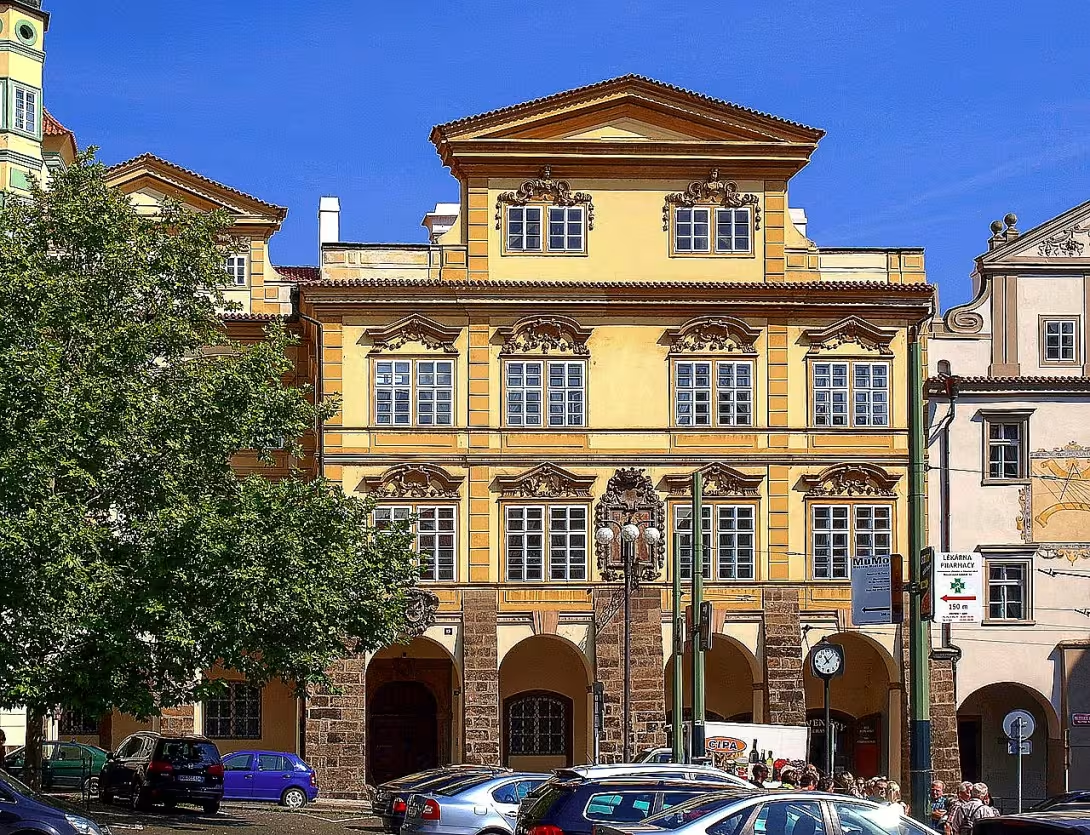
The medieval foundations of the palace are deeply embedded in time. There were two Renaissance houses at the site of today's construction, which were built again on Gothic perimeter walls. During the construction of the cellars, they discovered the foundations of the buildings from the 13th to 14th century, the testimony of the ancient site.
But the history of the palace is largely tied to a fatal fire. On 2 June 1541 a devastating fireworks erupted in a house called "The Bastion," which stood on the site of today's facade. The fire destroyed two-thirds of the Little Party's houses, hit the northern part of Prague Castle and damaged the temple of St. Vitus. Land under the ruins of the house At the bastion it became unsellable for a long time. The second of the buildings originally belonged to Empress Lieutenant Antonio Vittali, who posted a picture of the Virgin Mary on the house - this motive has been preserved here in various forms until now.
It was only in 1664 that the imperial chamber Oldřich Adolf Vratislav of Šternberk (1627-1703) was acquired. About 20 years later, his successor bought the next Vittali house. The two buildings were connected in a single architecture between 1703- 1719 for the ownership of František Damian from Šternberk (1667- 1723). It is assumed that the construction was led by its project Giovanni Battista Alliprandi. The interior decoration of the palace was then performed by the searched stuckers Giuseppe Donato Frisoni and Giovanni Bartolomeo Cometa as well as the painters Jan Rudolf Bys and brothers Abraham a Isaac Godynové. The facade still retains a baroque picture of the Coronation of the Virgin Mary surrounded by the holy spots of the orderer. The sternberg family coat of arms decorated by the Order of the Golden Fleece with a crown resembles its owner.
However, the Palace is not only important in its architecture, but in the history of Czech culture and science. In the 18th and 19th centuries he became a popular centre of intellectual life. For the reign of art collector Franz Joseph Count of Šternberk-Manderscheid (1763- 1830) was founded in the palace in 1770 a Private Society of Science, which was renamed the Royal Czech Society of Science after twenty years. This was where the first gallery was based, which became the National Gallery. In 1796 the Society of Patriot Friends of Art was also established.
The next member of the family, the naturalist Kaspar Mario of Šternberk, met with the leaders of the national revival - František Palacký, Josef Dobrovský, František Martin Pelcl and Viktor Barvitius. In this circle was developed the idea of the establishment of the National Museum in 1818 and the Society of Patriotic Museum in Bohemia in 1820. The palace of Sternberg thus meant a decisive step in the efforts to map and preserve the Czech cultural identity.
Today, the building is a natural part of the historical center of the Small Party and currently the premises of the Chamber of Deputies.
Then and now
Drag the slider to compare how the landmark may have looked when it was built with the view today.
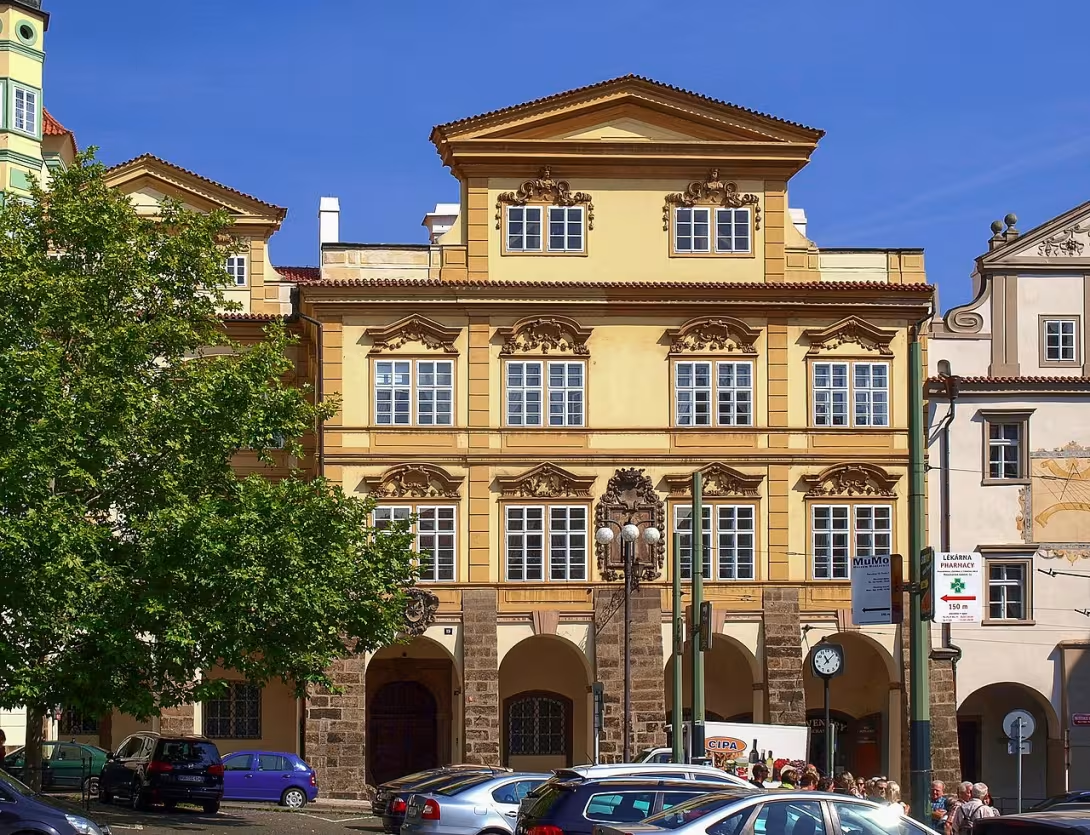

The historical appearance on the left is an AI-generated visualisation and serves as inspiration only.
Historical milestones
- 1541
- The devastating fire that struck the northern part of the Little Party and Prague Castle; The bastion house is completely burned.
- 1664
- Oldřich Adolf Vratislav from Šternberk got a house To a bastion that had long been considered cursed.
- 1703
- Connecting two neighboring houses to the Baroque Palace according to the Giovanni Battista Alliprándi project.
- 1770
- The establishment of the Private Society by František Josef from Šternberk-Manderscheid.
Architectural development
The palace was formed by combining two Renaissance houses from the 16th century, which were based on Gothic buildings from the 13th to 14th century. The facade retains the receding part of the original house on the bastion. The Baroque reconstruction from 1703- 1719 included the connection of both buildings, stuccaturas and paintings from important artists. The interiors are richly decorated, with elements of the early Baroque style. Materials include stone, wood and stucco decorations.
Historical events
{'1541': 'The devastating fire that hit the northern part of the Little Party and Prague Castle; the House of the Bastion completely burned down.', '1703-1719': 'Baroque reconstruction and connection of two houses to the palace according to the Giovanni Battista Alliprandi project.', '1770': 'The establishment of the Private Society of Science (later Royal Czech Society of Science) by František Josef of Sternberg-Manderscheid.', '1818': 'Representatives of the national revival, where the idea of the National Museum arose.'}
Owners
{'13th-14th century': 'unknown owners (Gothic and Renaissance houses)', '16th century': 'house On the Bastion - unknown owners, house Vittali - Antoniu Vittali', '1664': 'Oldřich Adolf Vratislav from Šternberk', '1684': 'František Damián ze Šternberka' (after the purchase of the second house) ',' 18th century ':' František Josef hrabě ze Šternberka-Manderscheidu (1763- 1830) ',' 19th century ':' Kašpar Maria ze Šternberka ',' 20th century ':' State (since 1918, part of Parliament of the Czech Republic) '}}
Points of interest
- The foundation of buildings from the 13th to 14th century was found under the palace during the construction of the cellars.
- In 1541, the fire from the fateful fireworks destroyed two-thirds of the houses on the Mala Strana and damaged part of Prague Castle and St. Vitus Temple.
- In the place of today's front, there was a house called "The Bastion," whose ruins had not been sold for a long time because they thought the place was cursed.
Guide
This guide is narrated by a synthetic voice generated by artificial intelligence.
Show guide text
This text was created by artificial intelligence and has not been editorially reviewed. It may contain inaccuracies.
Welcome, dear visitors! You are standing in front of one of the most interesting monuments in Mala Strana - Sternberg Palace, which will charm you with its beautiful and rich history. In front of you you can see a baroque building with an elegant front that reminds you of an ancient adventure and work of art. The palace stands in the place where the house "On the Bastion" was used, whose ruins were found during construction works under the cellars. His facade will show you today how the Baroque style has merged with the original Gothic foundations.
Let's move on to the past. This palace was created by joining two Renaissance houses in 1703 according to the plan of Italian architect Giovanni Battista Alliprándi. His work brought a new form that became a symbol of wealth and cultural development. In 1541 there was a devastating fire that destroyed two-thirds of the houses on the Malá Strana and damaged part of Prague Castle. This tragic event has become fatal for many houses, including the original "On the Bastion," whose remains were later found.
Now pay attention to the details the palace offers you. Look at his facade, which is richly decorated and expresses the baroque style. Note how different architectural elements are alternated - from decorated window frames to elegant stucco decorations. These details are the work of prominent 18th century artists who contributed to his representative appearance. The Palace is not only a beautiful building, but also an example of how old traditions have merged with new artistic tendencies.
The palace also has a rich history associated with significant personalities. Oldřich Adolf Vratislav of Šternberk, who bought the house in 1664, was known as a man who had long been considered cursed. In 1770, his family, Sternberk, founded a private study society which was an important part of the Czech national renewal. František Damián ze Šternberka and František Josef hrabě ze Šternberka-Manderscheidu were important representatives who supported scientific and artistic activities here.
The interesting thing is that under the palace, the foundations of buildings from the 13th to 14th century were found during the reconstruction. This shows how long the history of this place is and how different epochs take turns. In 1541, the fire on the Little Party was so devastating, it destroyed nearly half the houses. This tragic event also occurred at the site of today's palace, where the remains of the original house were preserved.
Now that you've looked at the history and details the palace offers, I invite you to further explore. Take a walk around the neighborhood, look around the streets and see how history and culture meet here. The palace will remain in your memory as a place where art, science and rich history meet. Thank you for your attention and we wish you pleasant tours on the Lesser Side.
Tips for visitors
{'paragraph': 'The best time to visit the Sternberg Palace is in the morning when there are fewer visitors and you can see its rich interior decoration in peace. The Baroque architecture and artistic details then seem even more impressive when it is not busy around. If you prefer a pleasant light, come here in the late afternoon, when the sunlight lights up the facade and creates picturesque shadows.'}
{'paragraph': 'Transport to the palace is not problematic. The place is available by car, but in the centre of Prague parking is often challenging. It is recommended to use public transport - the stops are nearby and the connection is dense. The current connection and parking options can be found in the traffic search engine. If you arrive by car, find a parking lot outside the historical centre to avoid unnecessary complications.'}
{'paragraph': 'When visiting, wear comfortable shoes because the palace and its surroundings offer plenty of beautiful but often stony or staircase paths. It is often cold in the interior, so bring a light sweater or sweater. If you plan to take pictures, don't forget the mobile charger - rich decoration and facade require frequent footage. It is also appropriate to take a small notebook or notebook to take notes or sketches from the interior.'}
{'paragraph': 'Photography in the palace is permitted, but with regard to the protection of the monument. The best places for shots are the facade of the palace and its inner spaces, especially the hall with fresco and representative staircase. For quality images use natural light - morning or afternoon, when light is not too hard. In the interior avoid flashing of lightning to avoid damaging sensitive paintings.'}
{'paragraph': 'In the vicinity of the palace are worth visiting several interesting places that are within 30 minutes' walk. For the first stop, choose the Malotranská Most Tower, a Gothic building from the 14th century, which is part of the historical bridge complex. Another option is the Church of St. Nicholas, a Baroque sacral building from the 18th century, which is an important dominant of the Little Party. It is ideal for lovers of history and architecture to visit other sights in the surroundings to complete your tour. '}
{'paragraph': 'If you visit the palace with children, prepare for them some activity to help them better understand the history of the place. For example, you can tell stories about the noble families that lived here, or you can draw together some of the artistic details that you see in the interior. In the vicinity of the palace it is also possible to play on the stairs or to see the surrounding streets, which offer many interesting details and picturesque views. Children will also love the nearby Church of St. Nicholas, where they can admire its rich decoration and listen to the stories associated with this place.'}
Frequently asked questions
Is Šternberský palác na Malé Straně open to the public?
Yes, the palace is open to the public. The tour is possible on Tuesday to Friday from 9: 00 to 3: 00, on the weekend from 10: 00 to 4: 00.
How do I get to the place by car / public transport?
The palace is available by bus No. 12 or 19 from the centre of Prague. The nearest metro station is Malostranská, from where the palace is 5 minutes walk away.
How much is the entrance fee and is it paid on the spot?
Payment is made directly at the entrance to the palace.
Is the tour suitable for children and seniors?
Yes, the tour is suitable for all ages. The Palace offers accessible premises and special tours for families with children.
How long does the tour take?
The tour takes approximately 1 hour and 15 minutes.
What are the opening times and booking is required?
The palace is open Tuesday to Friday from 9: 00 to 3: 00, weekend from 10: 00 to 16: 00. Reservation is not necessary, but it is recommended for groups over 10 people.
What's interesting in the immediate vicinity?
In the immediate vicinity there is Malostranská Square with many historical buildings and cultural institutions. There is also Charles Square nearby with his famous church of St. Ignatius.
For kids
Imagine going back 323 years until Šternberský palác na Malé Straně was still young and full of life. At that time there was a rich man named František Šternberk who was an official of Emperor Leopold I.
It was like a game where a hero enters a new world. Thus entered the palace, which was then a small house with narrow streets and grey walls. František Šternberk lived here with his wife and children who had fun in a garden full of flowers and trees.
Businesses nearby
Events nearby

Zdroj akcí: otevřená data měst a obcí ČR (Národní katalog otevřených dat) a kalendář akcí Národního památkového ústavu.
Nearby
{'monuments': [{\ 'name': 'Malostran Bridge Tower', 'distance': '500 meters', 'description': 'Gothic Tower of the 14th century, part of the Bridge Complex.'}, {'name': 'Church of St. Nicholas', 'distance': '300 meters', 'description': 'Baroque Church of the 18th century, significant sacral structure on the Small Town'.}, 'natural elements': [{'name': 'Vltava', 'distance': '1,2 km', 'description': 'Baroque Complex with a library': 'The River' Proflowering ', one of the most important scientific libraries in Europe'}], 'natural elements': [{'Name': 'Vlutava', '300 meters', 'description'
Accommodation nearby
Trips and activities nearby
Guided tours, tickets and activities nearby from GetYourGuide
Affiliate link: if you buy from the partner, we may receive a commission. The price for you does not change.
Search tours and activities →Themed route
Thematic cruise route to Malá Strana with visit to the Sternberg Palace
1. September Palace * Baroque mansion from the 18th century * - A unique example of Prague's noble castle with richly decorated interiors and historic fresco. The Palace offers a view of the Old Town Square and is an ideal entrance into the atmosphere of the Little Party.
2. Malostran Bridge Tower * Gothic tower about 500 meters from the palace * - The symbolic entrance gate of the Charles Bridge, built in the 14th century. Here you can see the Gothic architecture and historical statues that decorate the bridge.
3. Church of St. Nicholas * Baroque church about 300 meters from the tower * - richly decorated church with impressive interior and historical organ. It's a significant sacral monument with a rich history associated with the Little Party.
4. Clementine * Baroque complex about 1.2 km from the church * - One of the most important libraries in the Czech Republic, with a rich collection of old books and historical exhibitions. The visit is ideal for lovers of history and culture.
The route is designed to be logical and allow a visit to all named monuments in natural order.
Seasonal recommendations
Spring brings the palace freshness and fine, bright light, which beautifully highlights the colors of historical details. In the vicinity of the Little Party nature begins to bloom, creating an encouraging and optimistic atmosphere. For the best experience I recommend visiting the morning hours when the air is the cleanest. Clothes should be laminated so that you can easily adjust your thermal well-being according to the changing temperature between morning cold and afternoon sun.
The summer season is characterized by intense sunlight and long days, which make the tour very pleasant activity. In the main summer season, however, there is the largest movement of people around the palace, so it is best to arrive immediately after opening to avoid the biggest crowds. Dress lightly and comfortably, while not forgetting enough water, so that the summer heat doesn't bother you too much while walking on Prague streets.
Autumn offers unique melancholic beauty and golden shades, which together with soft light create a magical atmosphere. The morning fog in the surrounding streets gives the place mystery and peace, which is ideal for lovers of history. The number of tourists naturally decreases during this period, so you can enjoy the tour in greater privacy. Prepare a waterproof jacket and shoes suitable for wet surfaces.
Winter makes the atmosphere more peaceful and relaxed, while the palace serves as an ideal refuge from the cold. In advent time, there is a strange excitement in the surroundings, even though the days are very short. Due to limited time of day and lower temperatures, I recommend planning a visit around noon. To move outside it is necessary to have very warm clothes and quality accessories that will protect you from freezing while moving between monuments.
Visualizations and artistic views


The visualisations are generated by artificial intelligence and serve as inspiration.
Photos from the area
Real photos taken near the monument


Zdroj a licence jsou uvedeny u každého snímku.
Atmosphere of the place
This atmospheric visualisation of the place and period was generated by artificial intelligence. It is not real footage of the location.
Tips from visitors
No tips yet. Be the first!
Log in and add your tip.
Sources and literature
Fotografie: VitVit / CC BY-SA 4.0 — Wikimedia Commons. The author and licence also appear when you hover over the image.
Faktickým podkladem tohoto textu byl článek na Wikipedii, jehož autory jsou přispěvatelé Wikipedie. Článek je dostupný pod licencí CC BY-SA 4.0.
Location on the map

Příběhy a pověsti
Legendy, pověsti a příběhy spjaté s touto památkou
Fotografie návštěvníků
Zatím žádné fotografie. Buďte první, kdo přidá fotografii z návštěvy!
Přihlaste se a přidejte svou fotografii nebo hodnoťte.
Za ověřenou návštěvu v aplikaci získáte víc bodů — poznáme podle GPS, že jste na místě.
Reviews and comments