






Strojírny Breitfeld-Daněk Factory
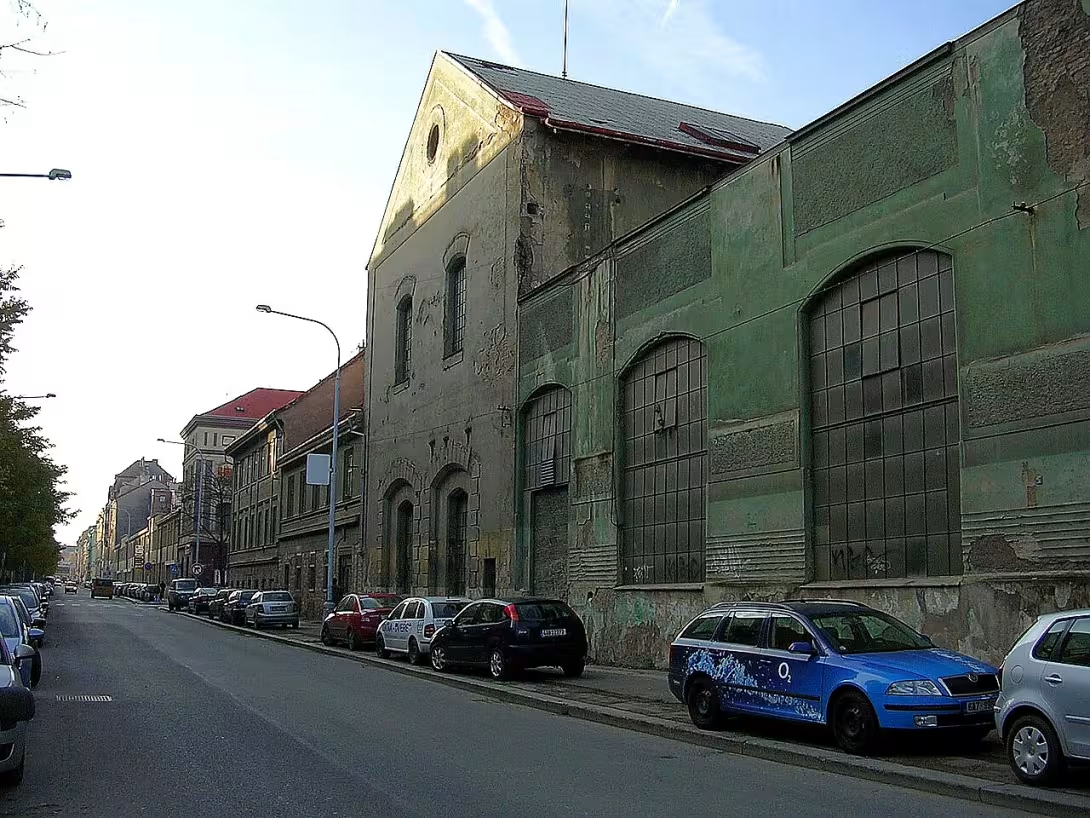
The former industrial complex of the machines Breitfeld-Daněk in Prague Karlín on the corner of the streets of Pernerova and Thamova represents an important cultural monument of the Czech Republic. The complex includes a preserved hall Kotlarna and two adjacent residential houses. The original engineering production took place here from the second half of the nineteenth century to the 1990s. Today, some of the older halls have undergone a sensitive conversion and serve a new administrative and cultural use.
The historical context of the creation of the monument dates back to the middle of the nineteenth century, when intense industrialization took place in Czech countries. This was accompanied by the development of engineering and the creation of large factory complexes during the period of economic growth associated with the development of railways and factory production. In 1854, Čeněk Daněk, a former employee of the machine shop Breitfeld and Evans, and Josef Götzl, a later Karlín mayor, the original machinery plant Götzl and Danek were founded in building No. 9, which had already disappeared. Three years later, in 1857, a new site grew up across from this original building. It included a boiler room, machinery room, hall of the boiler room and five halls of workshops, along with a warehouse set up in the older house No. 136 on the corner of Perner and Thama Street.
The architectural development of the complex is characterised by gradual construction and reconstruction. Between 1889 and 1891, the objects underwent modifications for the Joint Engineering Company, formerly Breitfeld and Daněk. Before 1926 another significant reconstruction took place. With Perner Street, a new two-boat steel 80-metre hall was built into the older walls. Later, after 1953, there was an even 90-metre-long hall called Sleeping Hall. She turned to the street through a distinctive facade with the letters of ČKD Dukla, but this part was demolished in September 2011.
The property structure and operational fates of the building are linked to important personalities and industrial entities. The owners and founders include Čeněk Daněk and Josef Götzl, later a joint stock company and more recently the publishing house Economia. Industrial operations in the halls were definitively completed in the 1990s.
Among the key events and attractions are the fact that after industrial operation, empty spaces for various cultural events served. The year 2013 became an important milestone in modern use, when the conversion of the older hall to the large-space office of the newspaper editorial office of Economia publishing house took place. The area is located in Prague's Karlín district in the immediate vicinity of Pernerova and Thamov streets in the surrounding area with a number of other historic industrial and residential houses.
This historic site shows the transformation of the former industrial production centre into a modern administrative and cultural space. Visiting this place in KarlínA offers a unique view of the development of Czech industrial architecture and its successful conversion for current use.
Historical milestones
- 1854
- Establishment of machinery plant Götzl and Daněk Čeněk Daněk and Josef Götzl.
- 1857
- Position of the new complex with boiler room, machinery room, boiler room hall and workshops.
- 1891
- Finishing the modifications of the objects for the Joint Engineering Company, formerly Breitfeld and Danek.
- 2013
- Conversion of an older hall to a large-scale newspaper office.
Architectural development
The area was created by gradual construction since 1857, when a boiler room, machinery room, boiler room hall and five workshops were built. From 1889 to 1891, objects underwent modifications. Before 1926, a new two-boat steel 80-metre hall was built into the older walls and after 1953 there was an even 90-metre hall called Sheephouse.
Historical events
In 1854 Čeněk Daněk and Josef Götzl founded the original machinery plant in building No. 9. In 1857 he grew up opposite the new complex with boiler room, machinery and workshops. Between 1889 and 1891, adjustments were made for the company. In the 1990s, the hall was definitively shut down.
Owners
Machinery plant Götzl & Daněk, later Joint Company of Engineering, work Breitfeld and Daněk, in the later days of the publishing house Economia.
Points of interest
- Part of the preserved complex is Kotlarna Hall and two adjacent residential houses. - The original machinery plant was founded in 1854 by Čeněk Daněk and Josef Götzl. - In 2011, a section called the Sleeping Room was demolished, which turned to the street with letters. - After industrial operation, empty spaces for cultural events served. - In 2013 there was conversion of the older hall to the large-space office of the editorial newspaper.
Guide
Show guide text
This text was created by artificial intelligence and has not been editorially reviewed. It may contain inaccuracies.
Welcome to the heart of Prague's Karlín. You're standing in an interesting place where the history of industrial expansion meets the modern life of today's city. If you look around you now, you'll see at the corner of the streets of Perner and Thama's building, carrying the incredible power of the past. In front of your eyes is the former industrial site of the machines Breitfeld-Danek. Even though the surroundings may seem quieter today, these walls still have a sense of the imprinting of the enormous power and constant movement that has existed here for decades. Please feel this atmosphere, this space that once formed the artery of the entire region, and which today serves as proof of how our society and our city are changing.
Let's go back to the past together now to understand how everything started. To understand the importance of this place, we must return to the middle of the nineteenth century. It's 1854. In this period Prague was transformed into a modern metropolis and required new technologies, new machines and new production options. It was at that time, thanks to the courage and vision of two men, that a chapter that should last over a century began to be written. These men were Čeněk Daněk and Josef Götzl. They were the ones who laid the first stones under this ambitious project. They set up a machine shop that became an important player in the market over time.
But it's not just the story of two men, it's the story of constant growth. Just three years after the foundation, in 1857, the site began to expand rapidly. A new boiler room, machinery room and large workshops were created. This entire space was designed to meet the demands of the time and to allow the material and people to move constantly. As production developed, the structure of the entire business changed. In 1891 there was an important change when the objects were modified for the needs of a newly created joint stock company of engineering companies, which was previously known just by the names of its founders. This process of transformation and growth lasted until the 1990s, when the industrial era slowly began to close in this particular place.
Now pay attention to what you see right in front of you. Although the world around us has changed, these buildings are preserved as a real-estate cultural monument of the Czech Republic. This means that their appearance and nature are protected for future generations. Note above all the preserved parts that are so important to us today. One of the most important is the hall known as the boiler room. It is a space that we must perceive as the heart of all engineering operations. Next to it are two adjacent residential houses, which probably served the people associated with this place. Please check out these buildings. Although their function has changed today, their architecture is still telling the story of how in the past the place of work was connected to the place of residence.
It's fascinating to see how these historic spaces can adapt to new times. Look at how the old industrial heritage becomes part of modern work. For example, there was a significant step in 2013 when one of the older halls was converted into a large space space for offices. In particular, there are news editors here today. It is a beautiful example that history may not just be something that is being viewed, but it may be a living environment for today's creative activity.
Speaking of this place, we can't forget the key characters that left their mark. Čeněk Daněk and Josef Götzl were not just owners, they were visionaries of their time. Imagine their decision to join forces and create something to survive their own lives. Their legacy is not only in buildings, but in the whole industrial spirit that still resonates in this part of Karlína. Without their workmanship and ability to see opportunities at a time of great change, this place would look completely different today.
And now, before you go on another journey, let me share with you one interesting thing that carries a sense of loss, but also a lesson about the passing of things. Perhaps looking at the current state of the complex you will not notice that its original range was even wider. This complex was also part of a building called the Sleeping Room. This part was very specific because its facade was decorated with letters. It was a building that was part of this whole living organism, but in 2011 it was unfortunately demolished. Even if you don't see it today, its existence is an important part of the history of this place and reminds us of how the urban landscape is constantly changing and how some parts of the past must give way to a new one.
This complex is a living witness to the industrial revolution, blossom and modern transformation. You are standing in front of a place that has survived decades of production, changes in political systems and technological leaps. Whether you're looking at the Kotlarna Hall or residential buildings, always remember that every wall here has a story.
Thank you for stopping by and paying attention to this historic monument. We hope that this view of the past has helped you better understand the character of today's Karlín. Please continue your walk and look forward to other interesting places in this city. To a reunion.
Tips for visitors
A tour of the former machines Breitfeld-Danek in Karlín is planned for the morning hours, when sunlight will best highlight the historical architecture of brick buildings. We recommend quieter weekdays when you enjoy the area on the corner of Perner and Thamov streets without crowds.
Use public transport to transport, check the current connection in the search engine or come by car, and check parking in the surrounding streets in advance. The place is close to Perner and Thamov.
Take your comfortable fixed shoes to walk on the urban terrain, a loaded phone or camera and drinking water. The resort does not offer complete tourist facilities inside, so it is good to have everything necessary together.
For the best photos, capture the industrial details of the old facades and window frames in the streets of Perner and Thamov, where the sun hits the historic wall at noon. Close-up images underline the industrial character of the monument.
In the wider area within 30 minutes walk you can admire other historical industrial sites and old tenement houses in Prague's Karlín district. Walking these streets offers a unique view of the development of the region.
Businesses nearby
Do you run a restaurant, accommodation, shop, museum, rental, wellness or other visitor service near this monument? Show yourself directly to the people heading to it — this is how they will see you in the app and on the web:
Events nearby

Zdroj akcí: otevřená data měst a obcí ČR (Národní katalog otevřených dat) a kalendář akcí Národního památkového ústavu.
Nearby
Areál se nachází v pražské čtvrti Karlín v bezprostřední blízkosti ulic Pernerova a Thámova, v okolí s řadou dalších historických průmyslových a činžovních domů.
Accommodation nearby
Trips and activities nearby
Guided tours, tickets and activities nearby from GetYourGuide
Affiliate link: if you buy from the partner, we may receive a commission. The price for you does not change.
Search tours and activities →Themed route
Strojírny Breitfeld-Daněk Type: Industrial historical area Why is it worth a visit: This important business carries a rich history of Czech engineering. Today, the heart is made up of the whole discovery of the historic buildings of Carolina.
Perner Street Type: Historical street Why is worth a visit: Located in the immediate vicinity of the main destination and offers a view of a number of other historic houses. Walk through this street breathes the atmosphere of the old industrial suburb.
Thama Street Type: City street Why is it worth a visit: Links to the immediate surroundings of the engineering plants and shows the unique architecture of local tenement houses. It perfectly complements the idea of how people used to live and work here.
Seasonal recommendations
Spring in Karlín awakens old industrial sites into a new life, when brick walls of former engineering plants meet fresh greenery coming out of neglected corners. The sun rises higher and creates an interesting shadow game through broken industrial windows and rusty structures. The tour in this period requires fixed shoes because the melting snow and spring rain can leave mud in the courtyard. I recommend we leave in the morning when the air is clear and the crowds of tourists are still minimal. Put on your layered clothes because inside buildings it is colder than in the spring sun outside.
Summer brings hot rays to the former factory that lean on metal roofs and heat brick walls into golden shades. The atmosphere is alive due to the excitement from the surrounding newly repaired streets, but in the very shadow of the massive columns I find pleasant cool. In the high summer season it is best to come first thing in the morning to avoid the afternoon heat and the biggest strain of curiosity. Take with you enough drinking water, sunglasses and light breathable clothes, because in enclosed spaces without air conditioning, it is keeping warm.
Autumn turns the Karlín surroundings into a painting canvas full of yellow and red colors that contradict industrial grey monuments. The lighting is very soft thanks to the low sun and creates long shadows ideal for lovers of photography of old times. In this period you will appreciate a warm windbreaker and waterproof shoes because autumn showers and wet leaves make the surface slippery. The best time to visit is in the afternoon when autumn herpes gives the place a mysterious and melancholy mood.
Winter covers the engineering area in silence and occasional snow duster, which softens the rough features of industrial architecture. The light is very short, the shadow comes early in the afternoon and the white snow cover is interesting to reflect the light from the street lamps. For a winter walk, choose really warm winter clothes, hat and gloves, because in historic unheated buildings you quickly cool down. The best time to visit is around noon, when the thermometer shows the highest values of the day and daylight allows safe movement on uneven terrain.
Visualizations and artistic views

The visualisations are generated by artificial intelligence and serve as inspiration.
Photos from the area
Real photos taken near the monument


Zdroj a licence jsou uvedeny u každého snímku.
Tips from visitors
No tips yet. Be the first!
Log in and add your tip.
Sources and literature
Photos: cs:ŠJů / CC BY-SA 3.0 — Wikimedia Commons. The author and licence also appear when you hover over the image.
Faktickým podkladem tohoto textu byl článek na Wikipedii, jehož autory jsou přispěvatelé Wikipedie. Článek je dostupný pod licencí CC BY-SA 4.0.
Location on the map


Příběhy a pověsti
Legendy, pověsti a příběhy spjaté s touto památkou

Fotografie návštěvníků
Zatím žádné fotografie. Buďte první, kdo přidá fotografii z návštěvy!
Log in a přidejte svou fotografii nebo hodnoťte.
Za ověřenou návštěvu v aplikaci získáte víc bodů — poznáme podle GPS, že jste na místě.
Reviews and comments